

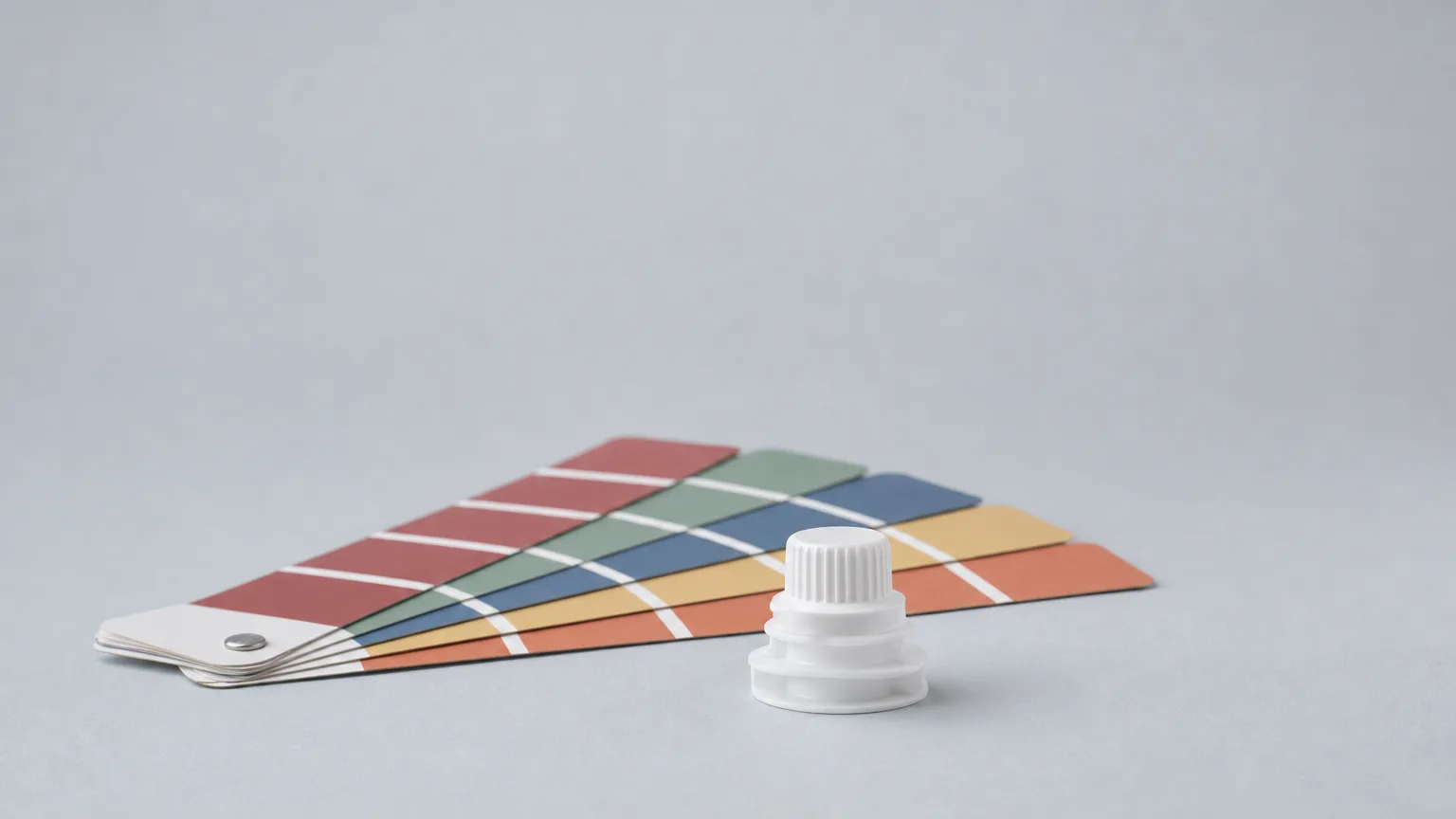
If you have ever sent a supplier a Pantone number and expected the caps to come back that color, this is the correction. A Pantone reference is not a color. It is a reference — a physical color standard read under controlled light — and what you are buying is a molded plastic component whose color is dispersed through the resin itself. Between them sits a process with several places to go wrong, and the color you ship is the color of the sample you approved, not the number you sent.
That gap has a cost. Take a routine case: a brand approves a red for a 100,000-piece order, the caps arrive close but not right, and by then the pallet is packed. This guide covers custom spout cap color matching the way a buyer needs it: what determines a cap's color, what to put in the brief, how the reference becomes a signed sample, why color drifts afterwards, and what custom color does to your order size.
A Pantone number is not a color — and a cap is not printed film
The first correction is that a cap and a pouch are colored by two different methods. Your pouch is printed: ink is laid on a film, and the ink's appearance depends on the film's surface and the print process. Your cap is molded: pigment is compounded into plastic pellets, the pellets are melted, and the color is the material itself. Same word — "color" — two unrelated mechanisms.
Pantone systems exist so that a designer and a printer can agree on a target without standing next to each other. The convention grew up around ink on paper, and a molded part stretches it in three ways: it is opaque where printed film may be translucent; it has its own surface finish, and a matte molded surface scatters light differently from a gloss laminate; and it has thickness, so light passes through the material before it comes back to your eye.
What follows is practical rather than philosophical. A supplier can work toward your reference and often get very close — "very close" is the honest word. What matters is not whether the number can be hit exactly, but whether you and your supplier agree on which physical sample defines the color and what happens if a later batch differs from it.
That agreement is the whole point of this article, and it is worth separating from the other things customization can change — shape, closure, diameter, anti-choking geometry. Those usually need a new tool; color usually does not. The custom tooling hub covers the projects where the geometry itself has to change, so you can tell which conversation you are in.
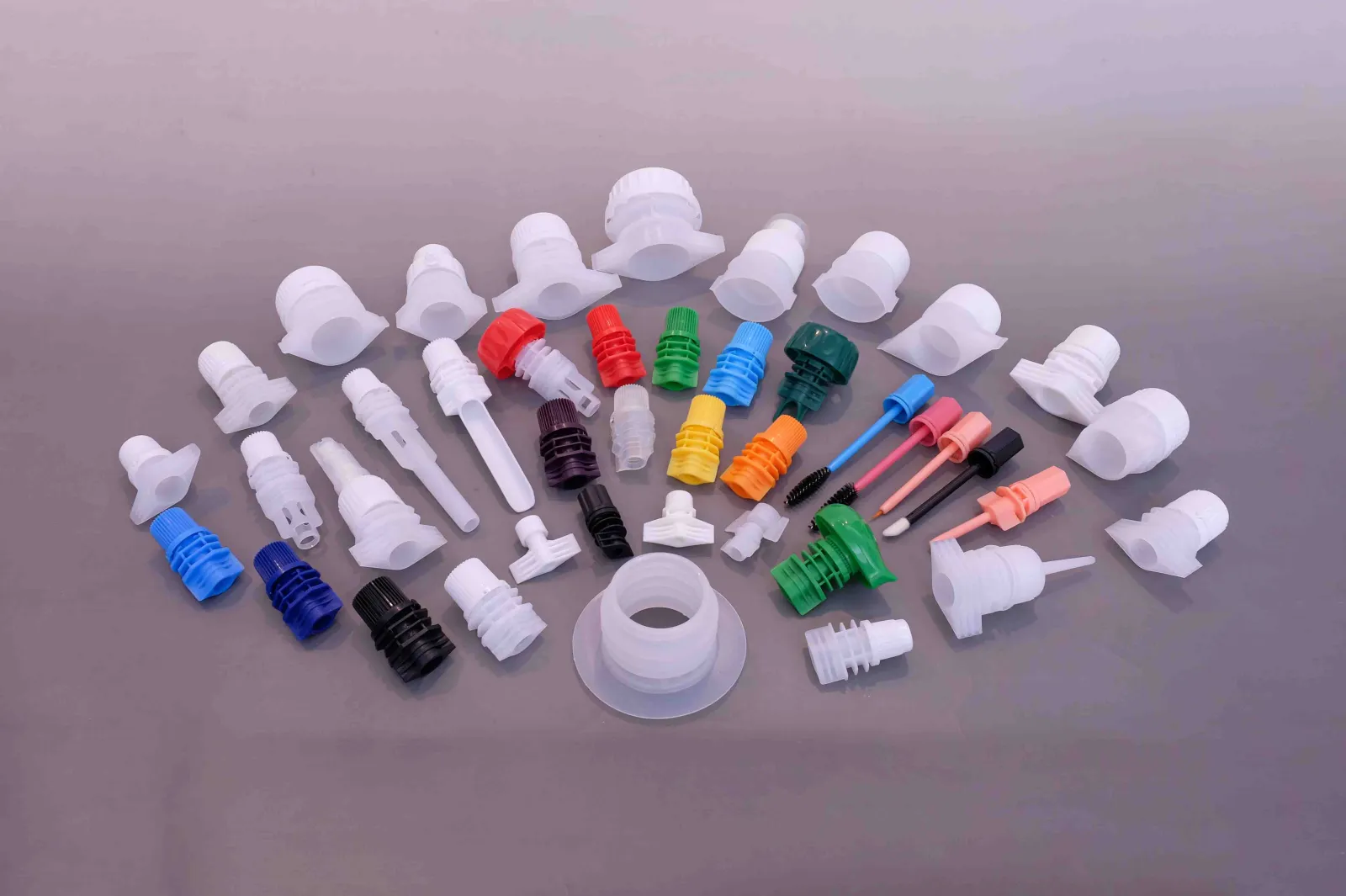
How a spout cap gets its color: resin, masterbatch and the limits of matching
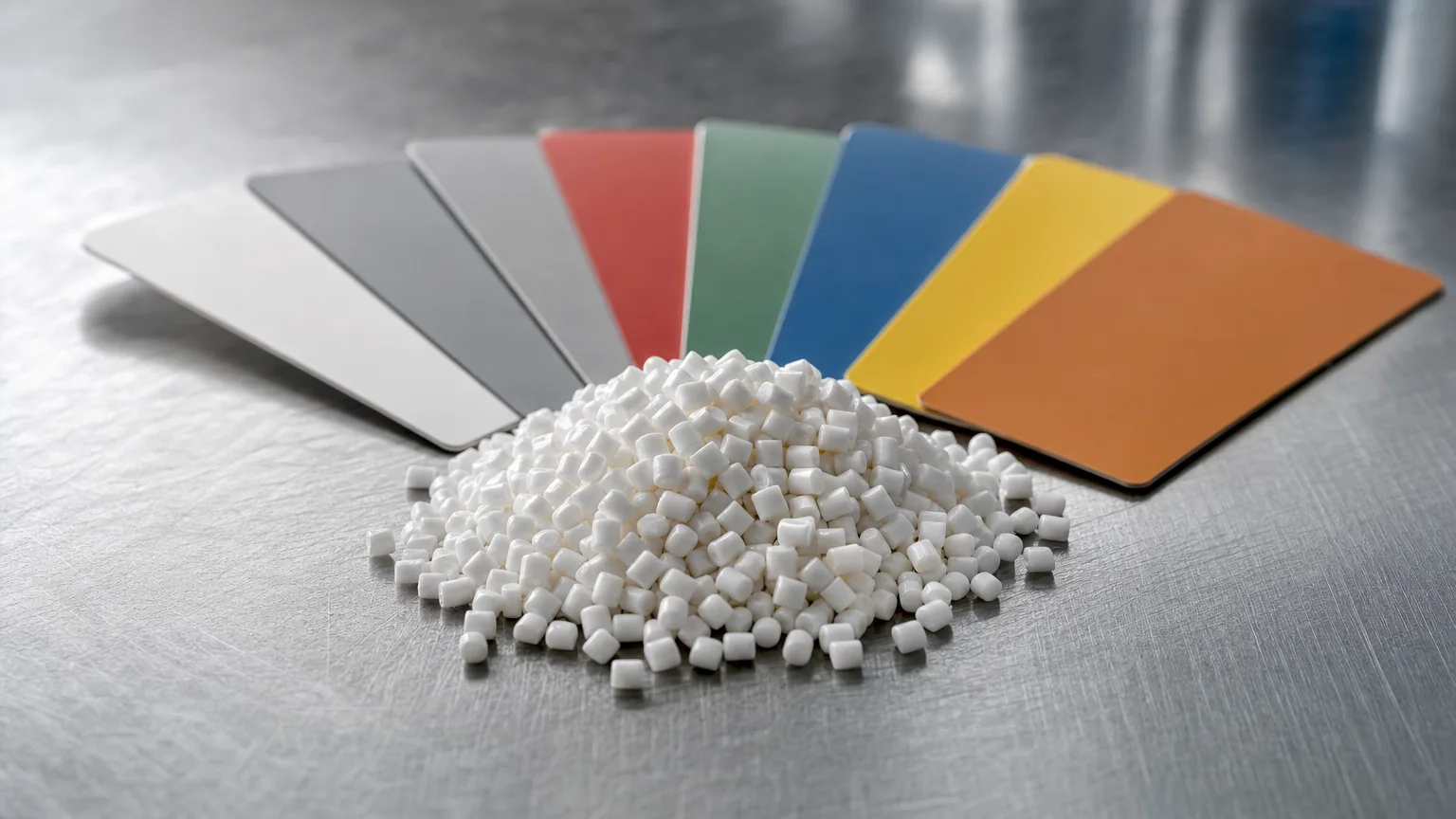
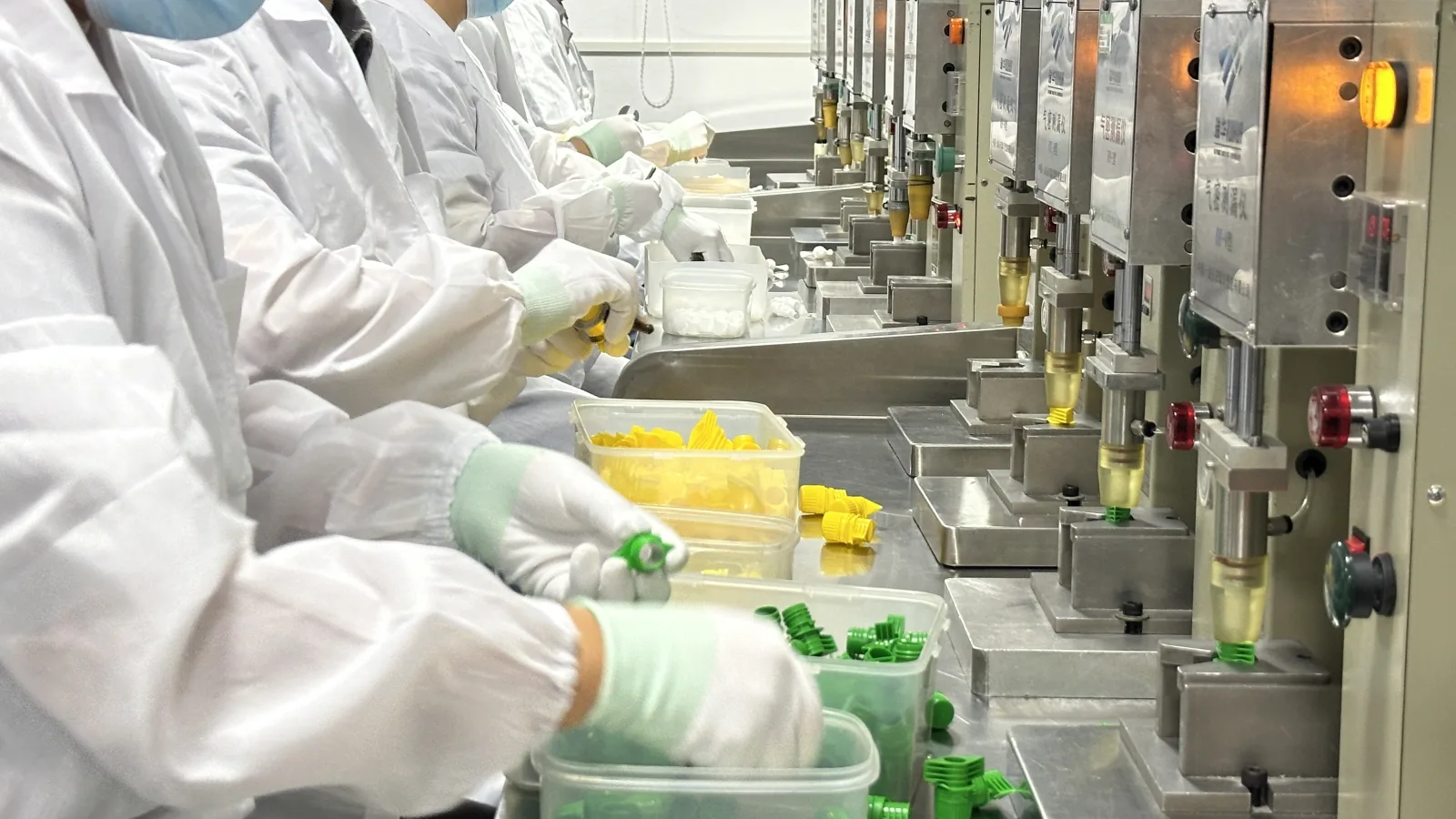
Injection-molded parts are colored with a masterbatch — a concentrated blend of pigment or dye carried in resin, supplied as pellets and blended into the base polymer before molding. The molder does not "paint" your cap. The color arrives as an ingredient.
Three consequences follow, and each one is something buyers discover late:
The base resin sets the ceiling. Most spout caps are molded in white or natural (unpigmented) food-grade PP or PE. Starting from a light base makes light and mid tones straightforward and saturated dark tones harder, because you are adding pigment to an already-opaque white rather than to a clear base. This is why a supplier asks "light or dark?" before they ask for your number.
The polymer changes the result. The same masterbatch in PP and in PE will not read identically, because the two resins have different transparency, shrinkage and surface behavior. If your cap is PP and your pouch film is PE, an exact visual match between the two is the wrong thing to specify. Specify each against its own reference.
Additives have to earn their place. A food-contact spout cap carries colorant into a package that touches food. The colorant must be suitable for the application, which is why switching color is not a matter of picking a chip from a fan — it goes through the same material review as any other component that ends up against the contents (EU food-contact rules for plastics are the general frame here).
This is the layer where Ruihua works directly: the caps are molded in food-grade PP and PE, and a custom color is a change to what goes into the machine rather than a step added afterwards. If the shape also has to change, that is a separate project with its own economics — the breakdown of what custom tooling costs is worth reading before you ask for both at once. For what already exists without a new tool, the spout cap product family runs from 1.2 mm to 40 mm inner diameter.
The color brief: what your supplier needs before matching can start
Most color problems are set up before anyone opens a mold, in a two-line email that says "match Pantone 485C, 100k pcs". A supplier can start from that, but they will make assumptions, and the assumptions become your production part. Send a brief instead.
Item | What to state | Why it changes the outcome |
|---|---|---|
Reference | The exact system and code, plus a physical reference if you have one | Screens and printouts shift; a physical chip removes one variable |
Target part | Which component is being matched — cap, spout body, or both | They can be molded in different materials and will not read alike |
The neighbours | What the color will sit next to: the pouch, the shelf, other SKUs, a competitor's product | A color that "matches" in isolation can clash in the real fixture |
Surface and finish | Gloss, matte, textured, or spot finishes | Finish changes perceived color more than most buyers expect |
Viewing conditions | Where the product will be judged — daylight, retail lighting, online photos | The same part reads differently under each; agree the reference light |
Application and contents | Food, cosmetic, detergent, pharmaceutical; hot-fill or ambient | Constrains which colorants and resins are acceptable |
Order structure | Total volume, how it is split across batches, how often you reorder | Volume per batch is what a supplier's process has to hold constant |
Compliance and markets | Target markets and any food-contact requirements | Rules out colorants early instead of at the sample stage |
The two lines buyers leave blank are the last two, and they are the two that decide whether the color holds. A single 100,000-piece run and the same 100,000 pieces split across five reorders are the same total quantity and completely different color problems, because each run is a fresh blend and a fresh machine setup — and a split structure like that is one of the special cases a supplier has to agree to individually. Lead time sits outside the color decision, so it is not covered here.
From reference to signed sample: the four approval steps
Color is confirmed the same way a shape is: by approving something physical. The steps below are the ones that matter, and you can hold a supplier to each of them.
1. Agree the target. The supplier translates your reference into a workable target in their material — a colorant formulation and a resin base. Ask what base they are starting from, and whether the target will be shown to you as a molded plaque or as an actual cap. A cap is better: the wall thickness, the surface texture and the closure geometry all affect how the color reads.
2. Ask for a molded color sample. Not a printed mock-up, not a digital render, not a paint chip. A part made from the resin you will be buying. If the shape is already tooled and sampling, the color sample and the shape sample can be the same part; if not, a plaque in the correct material is the next best thing.
3. Evaluate it against the reference under agreed light. This is where color difference measurement comes in — instruments express the gap between your reference and the sample as a number, which is far more useful than "a bit darker". Ask two questions: what does the supplier measure with, and what gap will they commit to in writing. Get the answer as a stated criterion, not a reassurance.
4. Sign the sample and retain it. The approved sample becomes the master reference for production. Ask how many copies are kept, who holds them, and how long they are retained. A signed sample nobody can produce later is a signed sample that will not settle a disagreement.
Keep the paperwork in the same place as the sample. When you organize the round — reference, comparison, sign-off, retained copies — a structured checklist does the job better than a spreadsheet of photos; the sample and validation planner is built for exactly this stage, and the broader sequence from drawing to production is covered in sketch to mass production.
Where color drifts after sign-off — and how to lock it down
A signed sample is a snapshot. Production is a series of separate events, and each one can move the color a little:
- A new masterbatch lot. Colorants are blended, not synthesized to infinite precision; the next lot is nominally the same and not literally the same.
- A different base resin lot. The white or natural resin underneath can change supplier or specification between lots, and the base moves every color built on top of it.
- Regrind and machine conditions. Reused scrap, barrel temperature, residence time and shot weight all shift how pigment disperses. A change in any of them is a change in color.
- A new mold or a surface change. A different cavity, a different polish, a switch from textured to smooth — all read as a color change even when the formulation is identical.
- A different viewing condition. The same caps under retail LEDs and under a north-facing window are not the same caps to your eye.
Three habits contain these. First, record the approved formulation, the resin base and the machine conditions alongside the sample, so a reorder starts from a specification rather than a memory. Second, retain sample caps from the approved production lot, not only the lab sample. Third, re-approve the color whenever the material or the tool changes — treat it as a new project, because that is what it is.
The honest limit is worth stating plainly: the tolerance we can hold, and how long we retain a reference sample, are things we fix together with each customer for that project rather than publish as one number for everyone. If a supplier gives you a single number for all parts and all colors without asking what you are making, that number is not a commitment.
What custom color costs in order size — and where the cost hides
Custom color is often the first place a buyer meets a minimum order quantity, and the way it is usually explained gets it wrong. It is not a volume ladder where more is always cheaper. Here is the structure:
Situation | Order size |
|---|---|
Standard white caps, stock models | Held in stock — any quantity |
Custom color | Typically from 100,000 pieces; special cases negotiable |
After a dedicated mold has been opened for your part | No minimum — supplied to your requirement |
That last row surprises people, because it breaks the pattern most buyers expect. The reason is mechanical. A color change means purging and cleaning the machine and changing the masterbatch, and the setup has to be spread across the run; a short run cannot carry it. A tooling project is different — the mold ties the order to the customer anyway, so the volume question largely disappears. If you are weighing both, the article on how MOQ behaves after tooling works through the comparison.
The costs that hide are the changeover itself, the color development work before any sample exists, and the scrap produced while the machine settles. When a custom-colored cap quote looks higher than the white version, that is what you are paying for — and compare the total for your actual batch sizes, not a unit price at a volume you will not run.
What to get in writing before you approve a color
Before you sign a color sample, put these in the purchase record. Each line takes a minute and each one has cost somebody a pallet of unusable caps:
- The master reference — system, code, and the retained physical sample, identified by date and lot.
- The material specification — base polymer, colorant, and any food-contact conformity that applies.
- The acceptance criterion the supplier will be measured against, stated as the supplier's own method and threshold.
- The evaluation light and viewing condition the criterion was set under.
- What triggers a re-approval: new masterbatch lot, new resin supplier, mold change, or a gap in production.
- How many reference samples are retained, where, and for how long.
- Which of the above your supplier confirms case by case rather than as a blanket policy.
That final line is not filler. On tolerance, retained samples and the sign-off form itself, a project-specific written agreement is worth more than a general claim — and a supplier who is willing to put each item next to your product name is a supplier whose process you can audit.
Next step
If your color is still a number in an email, the fix is one message: send the reference, the target part, what it will sit beside, the finish, the volume and the markets, and ask for a molded sample in the correct material. Once you have a signed sample and a written criterion, color stops being a hope and becomes a specification.
Send us your reference and we will come back with a color sample matched to your part, along with the order structure that actually applies to your volume — request color samples or a quote and put the color decision on the record.