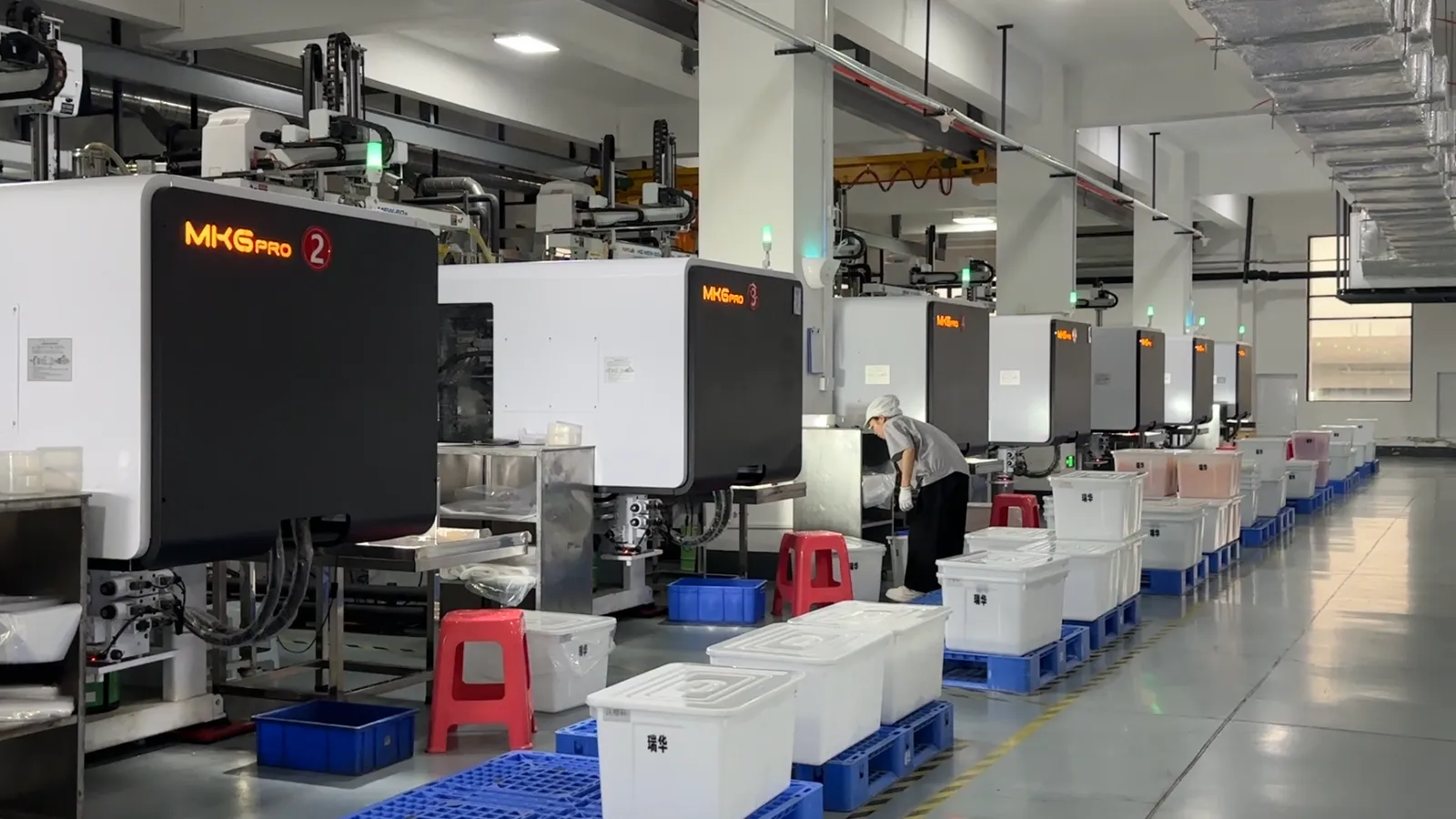
The PDF is complete. That is not the same as current
Logo, certificate number, a scope sentence, a signature, an expiry date two years out — everything a buyer was told to check is on the page. It can still be an expired certificate reprinted from a folder, one covering a different plant in the same group, or one from an issuer nobody accredited.
None of that is visible by reading the PDF harder. It is visible only in three questions: the issuer's accreditation for this standard, the certificate's entry in the register, and the site that entry names.
Verification is three questions, not one
A certification body issues the certificate, an accreditation body assessed it, and both facts live in registers the issuer does not control. What buyers call "a supplier certification" is one site's system, certified by one body and accredited by another.
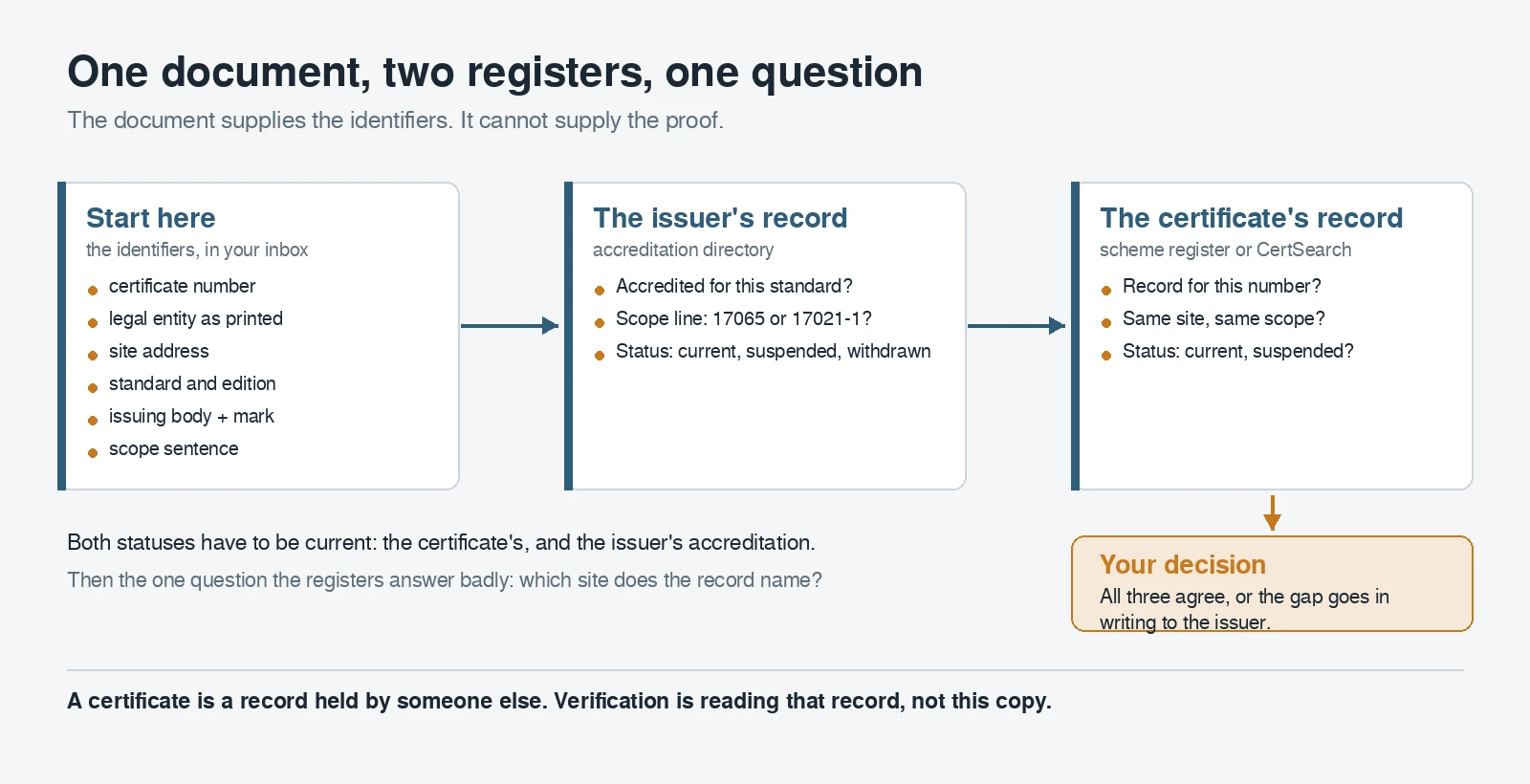
Three questions: was this issuer accredited for this standard; is the certificate in the register with this scope and site; does the record name the plant that will mould your caps?
Step 1 — Take the identifiers off the page
You are not judging yet, only extracting search strings: the certificate number, the legal entity name exactly as printed, and the site address. The standard, the edition, the issuing body and the scope sentence are on the same page — take them off it too, and read what the scope says about moulding of closures and fitments rather than packaging.
Reread that scope line after every lookup: a live certificate for the wrong activity is the most expensive "pass" in supplier approval. Modern forgeries get every field right; nothing here counts as verification.
Step 2 — Prove the issuer is accredited for that scope
Accreditation is granted per standard, not per company: a body competent to audit food manufacturers is not thereby competent to audit packaging manufacture.
On the list kept by the Global Accreditation Cooperation Incorporated (Global ACI), filter by sub-scope rather than scrolling — the scheme names sit in the filter (Global ACI recognised ABs). Then open the national directory named by the mark (UKAS, CNAS, ANAB) and read the issuer's accreditation schedule, not its certificate: it lists the standards and scheme parts it may certify against, and carries its accreditation status, suspensions and withdrawals included. The line differs by scheme: BRCGS Packaging Materials sits under ISO/IEC 17065, FSSC 22000 and ISO 9001 under ISO/IEC 17021-1 — on a BRCGS certificate, look for the 17065 line. An issuer in neither place is not accredited, whatever the PDF says.
One currency check: the International Accreditation Forum ceased operations on 1 January 2026; its role and ILAC's are now handled by Global ACI, and the IAF's own site is an archival notice (iaf.nu). A guide still calling the IAF current has not been updated in a year.
Step 3 — Find the record itself
For management-system certificates the fastest lookup is IAF CertSearch, which consolidates data from 81 accreditation bodies and roughly 2,600 certification bodies (IAF CertSearch). Search the number, then compare four fields: organisation name, site, scope wording, status — the register carries status, the PDF the date.
For GFSI-recognised food-safety schemes, also go to the scheme owner. BRCGS and FSSC require every certified site to be listed, so absence there is strong evidence rather than proof — registration is the certification body's job and can lag. Sites are searchable in the BRCGS Directory, and the FSSC Public Register lists every organisation currently certified under FSSC 22000 or 24000, with its status. CertSearch — still branded IAF, though the IAF itself has gone — is fed by participating bodies, so a gap there proves little; a gap in the scheme owner's register needs an explanation. CertSearch and BRCGS want a free account; FSSC's register does not.
Which scheme to require is a separate decision — see BRCGS vs FSSC 22000: scope before the logo.
Step 4 — Read status, not just the expiry date
"Not expired" is a date comparison. "Valid" is a register status, and the two diverge: certification runs on a cycle with surveillance audits, so a certificate can be suspended mid-cycle for an unresolved non-conformity while the printed expiry still reads next year.
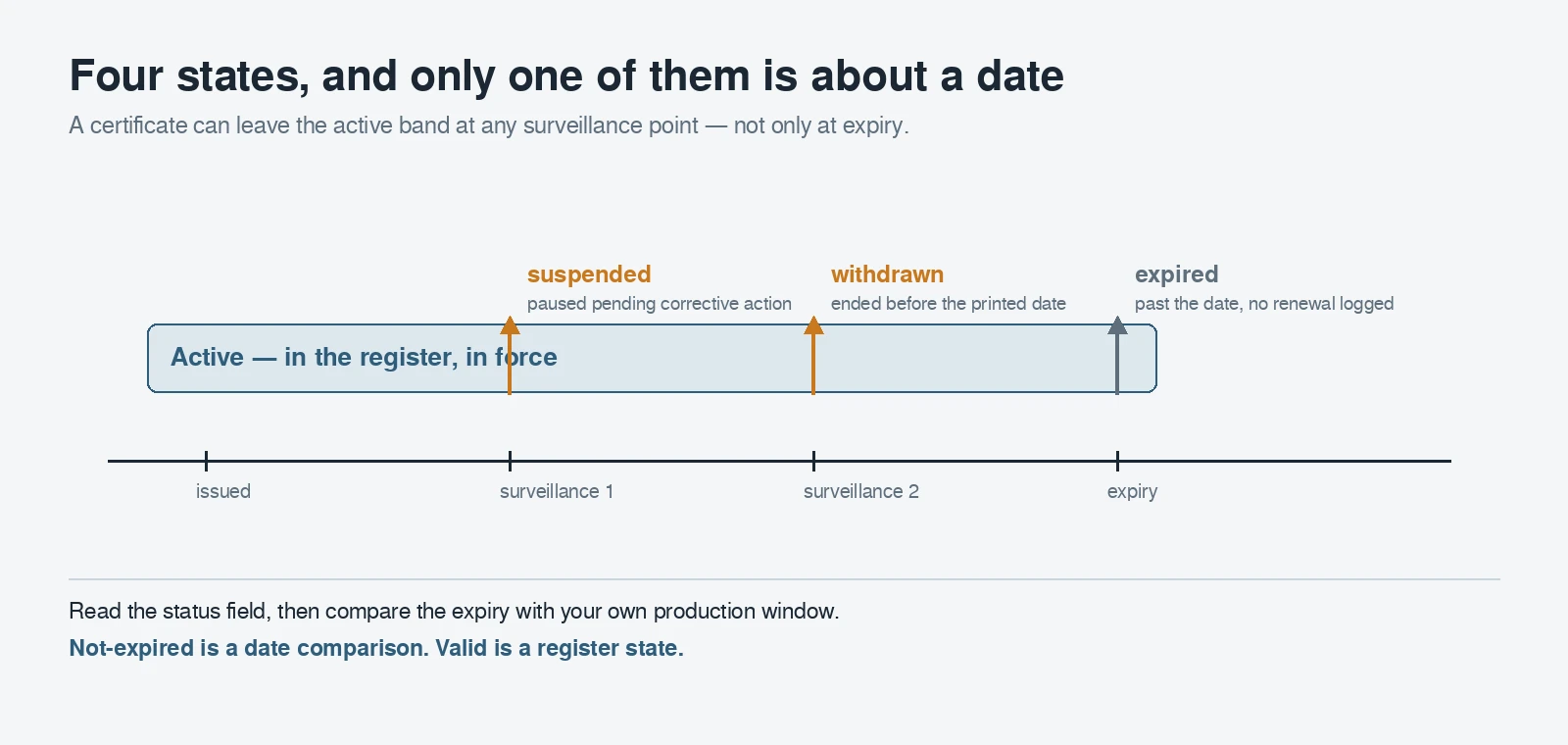
Active: in force. Suspended: paused, usually pending corrective action — treat as not certified until it lifts. Withdrawn: ended before the printed expiry, often after a missed audit or a scope reduction. Expired: past the date, no renewal recorded. This is the certificate's record; the issuer's accreditation has its own status, and an approval is current only when both are.
Step 5 — Check the site line in the record
The record names a site; the PDF may have come from a different one. Read the site field in the register, not the address block on the certificate, and check it against the address that will appear on the packing list.
Where a group holds one certificate across several plants, check that the row names your plant; if it names only a head office, the record has not told you where your caps will be moulded.
When the register returns nothing
Absence is a finding, not a verdict. Get the issuer's contact details from the accreditation body's directory, never from the certificate — a forged document can carry a forged number — then put the question in writing.
What you see | Most likely cause | What to do |
|---|---|---|
No record; name differs | Trading name vs legal entity, or a rename | Search the legal entity and site address |
No record at CertSearch, issuer accredited | New certificate, or that body does not publish there | Confirm in the scheme register, then ask in writing |
No record at the scheme register | Not certified under that scheme | Treat as unregistered until the body confirms registration is not pending |
Record exists, site differs | Group certificate, or the wrong site's PDF | Request the site annex; "same company" is not an answer |
Scope or dates differ from the record | Revised scope, or an edited PDF | Ask for the certificate as issued |
Suspended or withdrawn | Failed surveillance, open non-conformity | Ask what the corrective action was and when it closed |
Register unreachable | Access problem, not a supplier problem | Log the attempt, get written confirmation, re-check |
What a verified certificate still does not cover
A system or operation certificate — ISO 9001, FSSC 22000, BRCGS Packaging Materials alike — says the site's processes are controlled and audited. None of them certifies the part: nothing about the resin in this batch or whether the finished cap passes migration testing for the food you fill.
That evidence is a separate pack — declaration of compliance, migration reports, the liner declared separately — itemised in food-grade spout caps certification.
What to ask for next, in one email
Five items, in this order: the current certificate PDF plus any site annex; written confirmation of status from the certification body, not the sales contact; the scope sentence as the issuer registered it; product-level documents for your material; and a named contact for suspension or withdrawal notices. Then diarise the re-check: expiry minus 90 days, any change of certification body, any move of production.
Our own position is plain. The documents Ruihua holds are listed on our certificate page — ISO 9001:2015 and HACCP issued by CQC, EU 1935/2004 food-contact compliance through TÜV SÜD, US FDA food-grade compliance, a national industrial production licence, and two SGS reports on PPWR heavy metals and total fluorine for the tested sample. We do not hold BRCGS Packaging Materials or FSSC 22000, and will not let a logo imply otherwise; if your programme requires either, say so before samples.
If the certificate pack is the last open item, the parts are the next question: spout caps for stand-up pouches and doypacks, and samples or a quote. The rest of this series sits in the Sourcing & Supply hub.
Sources checked 12 Nov 2026.