

What "food-grade" actually means for a pouch spout cap
Ask ten suppliers what makes a spout cap food-grade and you will get ten different answers: an FDA letter, a migration test, a piece of virgin resin. None of them is wrong. All of them are incomplete, and the gap between "we have a certificate" and "your product is actually compliant in your market" is where recalls, customs rejections and brand damage happen.
For a spout cap on a stand-up pouch — the kind used for juice, sauce, dairy and other liquid foods — food-grade means three separate things that must all be true at once:
- The material is permitted for food contact in the market where the filled pouch will be sold. For polypropylene and polyethylene, that is a defined, checkable list of rules, not a marketing phrase.
- The finished component passes migration testing under realistic conditions — because the molded cap, not the raw pellet, is what touches your product.
- The factory that makes it operates under a food-safety quality system, so the compliance you tested for is the compliance you get in every batch, not just on the sample you approved.
If you only verify one of these, you have not verified food safety. You have verified a document.
This guide walks through all three layers for juice, sauce and dairy pouch applications, then gives you a document checklist you can send to any supplier — including us — and get a straight answer.
The certification stack: three layers to verify
Think of food-grade certification for spout caps as a three-layer stack. Each layer answers a different question, and none of them can substitute for another.
Layer 1 — Material compliance: is the polymer allowed?
The resin itself must be on an approved list or meet a defined standard. In the US, polypropylene and polyethylene resins used for food contact are covered by FDA 21 CFR 177.1520 (olefin polymers). In the EU, the framework is Regulation (EC) No 1935/2004, with Commission Regulation (EU) No 10/2011 defining the specific rules for plastic materials and articles.
This layer is where suppliers usually show you a certificate. It is also the layer that is most often misunderstood: a letter covering the base resin does not cover the color masterbatch, the sealing gasket or the release agents used in molding.
Layer 2 — Migration testing: does the finished cap stay safe?
A cap passes through an injection molding process, gets colored, and may include a gasket or a silicone valve. Each step can introduce substances that migrate into food. Migration testing measures what actually transfers from the finished component into food simulants under accelerated conditions — time and temperature representing the worst realistic contact.
The common tests are overall migration (total transferred substances), specific migration limits (SMLs) for individual substances, heavy-metal checks, and sensory evaluation (the cap must not taint taste or odor). We cover these in detail in the migration section below.
Layer 3 — System certification: is the process repeatable?
Standards like ISO 9001 (quality management) and HACCP (hazard analysis and critical control points) certify the factory's process, not a single batch. They are the reason a buyer can assume batch 47 is like batch 12. Some markets and retailers also recognize BRC or SQF food-safety schemes.
One way to remember the stack: material compliance says the polymer may be used, migration testing proves this component is safe in practice, and system certification explains why the next batch will be too.
For our own production, that means food-grade virgin PP/PE resins, certification to ISO 9001, HACCP, US FDA and EU 1935/2004 (TÜV SÜD), and product-level references to GB 4806.7 and EU LFGB. It is the same three layers, documented and auditable.
FDA vs EU: which standard applies to your market
The most common question we hear from pouch brands is "is FDA enough?" The honest answer: it depends on where the filled pouch will be sold.
Market | Key rule | What you should request from the supplier |
|---|---|---|
United States | FDA 21 CFR 177.1520 for olefin polymers; food-contact compliance of the finished article | FDA compliance letter/declaration naming the resin, plus migration/extractives data for the finished cap |
European Union | Regulation (EC) 1935/2004 framework + EU 10/2011 for plastics | EU Declaration of Compliance (DoC) per Article 16 of 1935/2004, plus migration test reports against EU 10/2011 limits |
Germany (stricter national rules) | LFGB §30/31, often tested against BfR recommendations | LFGB test report from an accredited lab |
China | GB 4806.7 (food-contact plastic materials and articles) | GB 4806.7 compliance report |
Global retail / food-service | BRC, SQF or IFS schemes where buyers require them | Current certificate from the scheme's listed body |
Note that EU rules are generally the stricter yardstick of the two for migration: EU 10/2011 sets overall migration limits and specific migration limits across a wide list of authorized substances, and it explicitly requires a Declaration of Compliance to travel down the supply chain. If a cap satisfies EU 10/2011, it will usually sail through FDA-oriented checks — the reverse is not always true. For the wider picture across films, closures and recycling claims, see our regulations and recyclability hub.
A phrase you will see on datasheets is "FDA + EU food-grade certified." That combination is what we hold, and it is what you want to see from any supplier selling into both markets. Always ask which specific regulations the claim refers to — a bare "food-grade" with no rule number is not a claim you can audit.
What migration testing covers (and why a certificate alone is not proof)
A material certificate proves the polymer family is permitted. It does not prove your cap is safe. Here is why: the moment resin is compounded with colorants, processed on a hot screw, and molded with release agents, the finished article has its own migration profile. That profile is what regulators care about, and it is measured, not assumed.
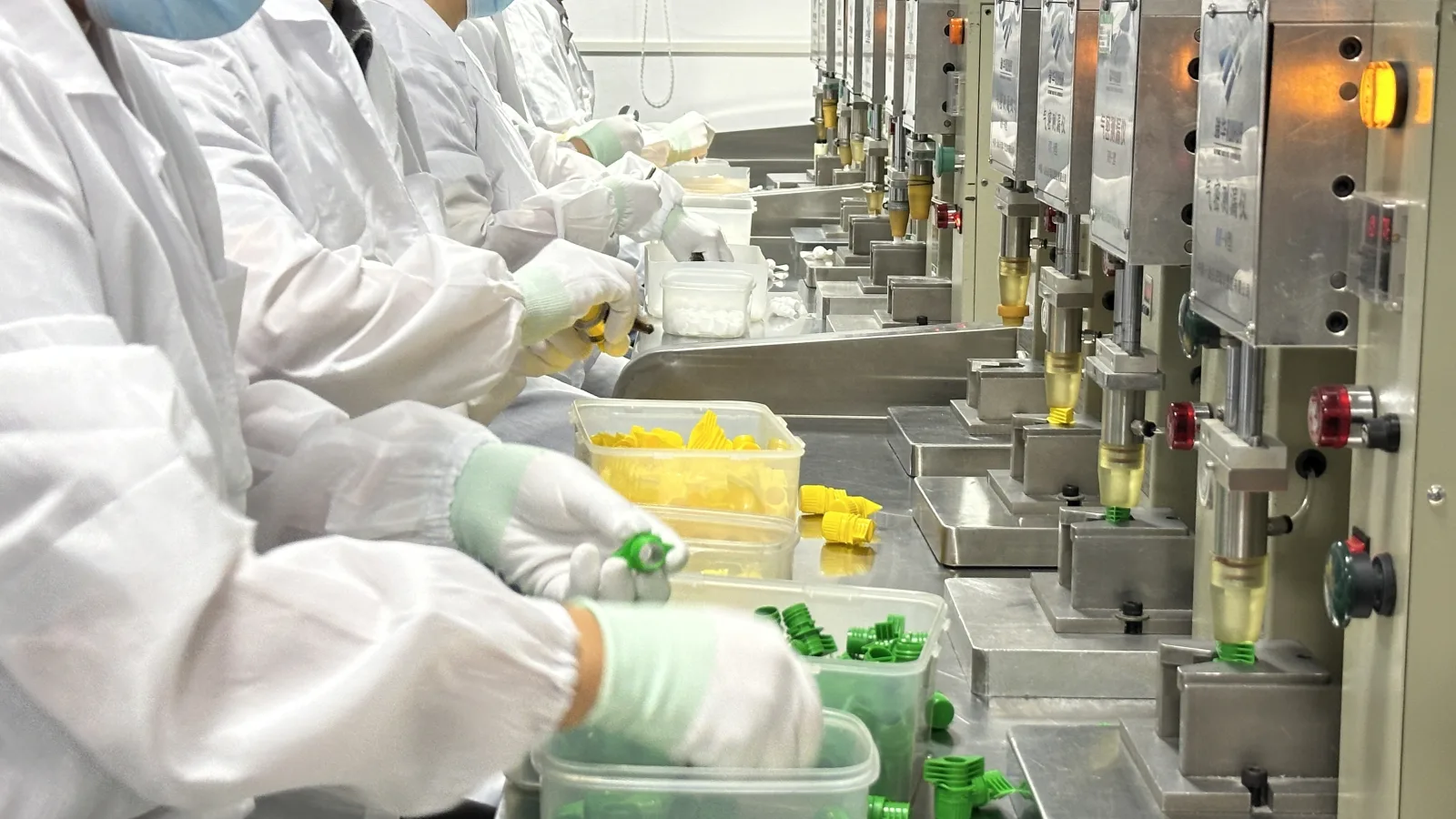
The tests you should expect in a migration report for a food-contact spout cap:
- Overall migration (OML): total mass of substances transferring into food simulants, measured against the limit in the applicable regulation (10 mg/dm² under EU 10/2011). Simulants are chosen by the food type — aqueous, acidic, alcoholic or fatty.
- Specific migration limits (SMLs): individual substances with assigned limits — heavy metals like lead and cadmium, and monomers/additives. This is where a color masterbatch can fail even when the base resin is clean.
- Sensory / organoleptic testing: the cap must not transfer taste or odor to the food. For dairy and juice, where consumers detect off-flavors immediately, this test is commercially as important as the chemical limits.
- Extractives (FDA route): under FDA's approach for polyolefins, tests include solvent extractives in n-hexane and xylene at defined temperatures.
Conditions matter as much as the test list. A cap tested at 40 °C for 10 days (the EU standard condition for long-term ambient storage) is not validated for a hot-fill sauce line at 85 °C or a retort cycle at 121 °C. When you approve a spout cap for hot-fill or retorted products, ask for migration data at the temperature and duration that match your process — this is exactly the kind of gap that shows up at customs or, worse, in a consumer complaint.
The EU Rapid Alert System for Food and Feed (RASFF) publishes real rejection cases for food-contact materials. Migration limit exceedances — frequently in fatty-food simulants — are a recurring theme. It is the clearest public evidence that "the material is food-grade" and "the finished article passes" are different statements.
Component-level compliance: cap, gasket and colorant
A pouch spout assembly is rarely one part. It is a spout body, a screw cap, sometimes a gasket or sealing liner, and always a colorant. Compliance must hold for the assembly as a whole.
- Spout body and cap: molded from PP or PE. Each resin grade — including recycled or regrind content, if any — changes the migration profile. Virgin food-grade resin is the baseline to specify.
- Color masterbatch: the most common hidden failure point. A pigment itself may be permitted, but its carrier resin, dispersants and stabilizers are part of the finished article too. The cap you see as "white" or "blue" is not the same material as the uncolored pellet on the certificate.
- Gaskets, liners and silicone valves: used on induction-seal caps and non-drip valves. Silicone grades, curing agents and any additives must themselves be food-contact approved — a platinum-cured food-grade silicone is not interchangeable with an industrial-grade one.
- Printing and coatings: any ink or lacquer on the cap surface that could contact food (or be handled and then touch food) should be food-safe.
This is also where we would point out something specific to our own process: the material formulas are developed in-house, including grades for demanding contents, and our food-contact materials are free of optical brighteners and fluorescent agents — a declaration you should request in writing from any supplier, because brighteners are a classic cause of failed sensory and migration checks.
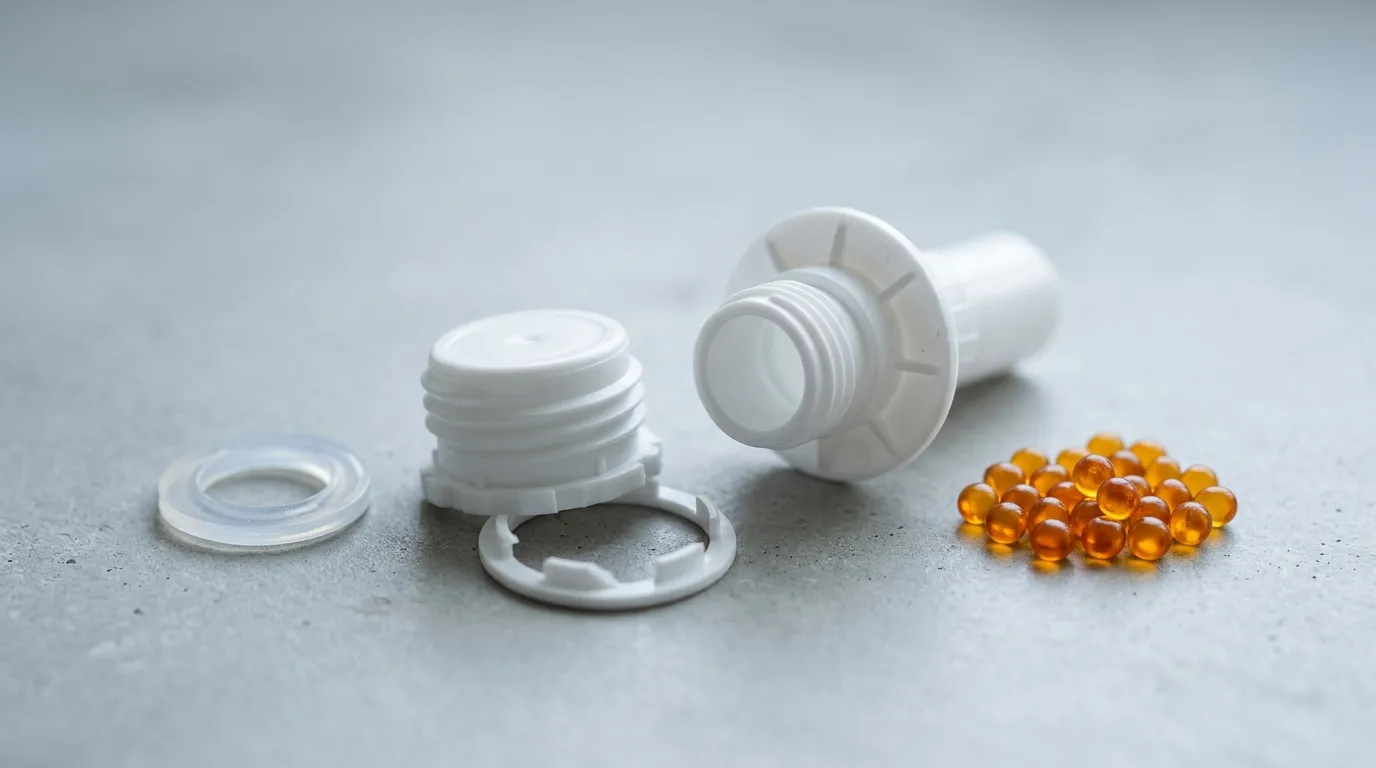
Every component that touches the product — body, cap, gasket, colorant — needs its own compliance evidence.
Juice, sauce and dairy: what each application adds
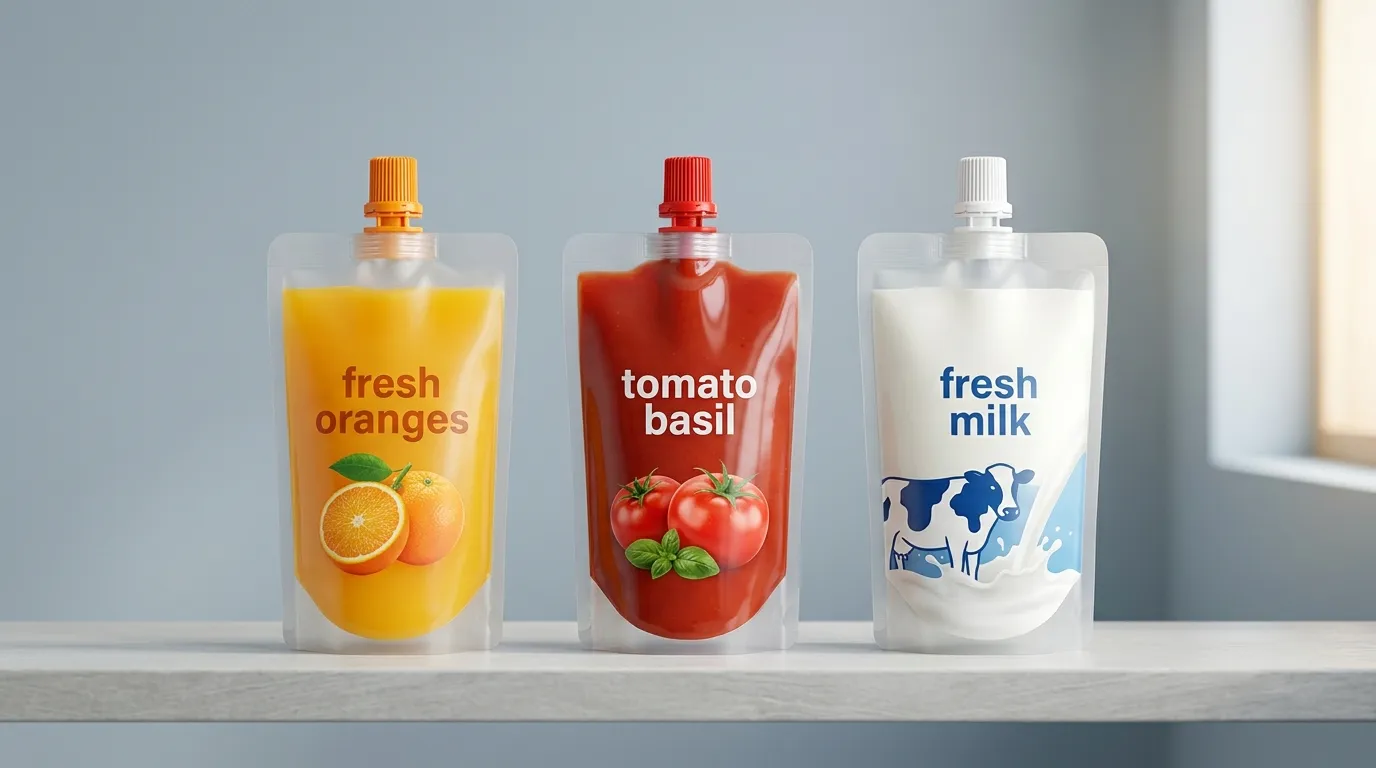
Certification is market-dependent, but the practical demands also differ by what is inside the pouch. Here is how the three headline applications shift the requirements.
Juice and beverages (acidic, ambient or cold-fill)
Acidic products are well covered by standard aqueous/acidic simulants, and ambient storage means the default 10-day, 40 °C migration condition is realistic. The commercial-critical checks are sensory (juice consumers notice off-notes instantly) and cap sealing integrity — a leak at the spout ruins shelf life regardless of certificates. Tamper-evident rings are expected by retailers and consumers.
Sauce and condiments (hot-fill, viscous, sometimes retorted)
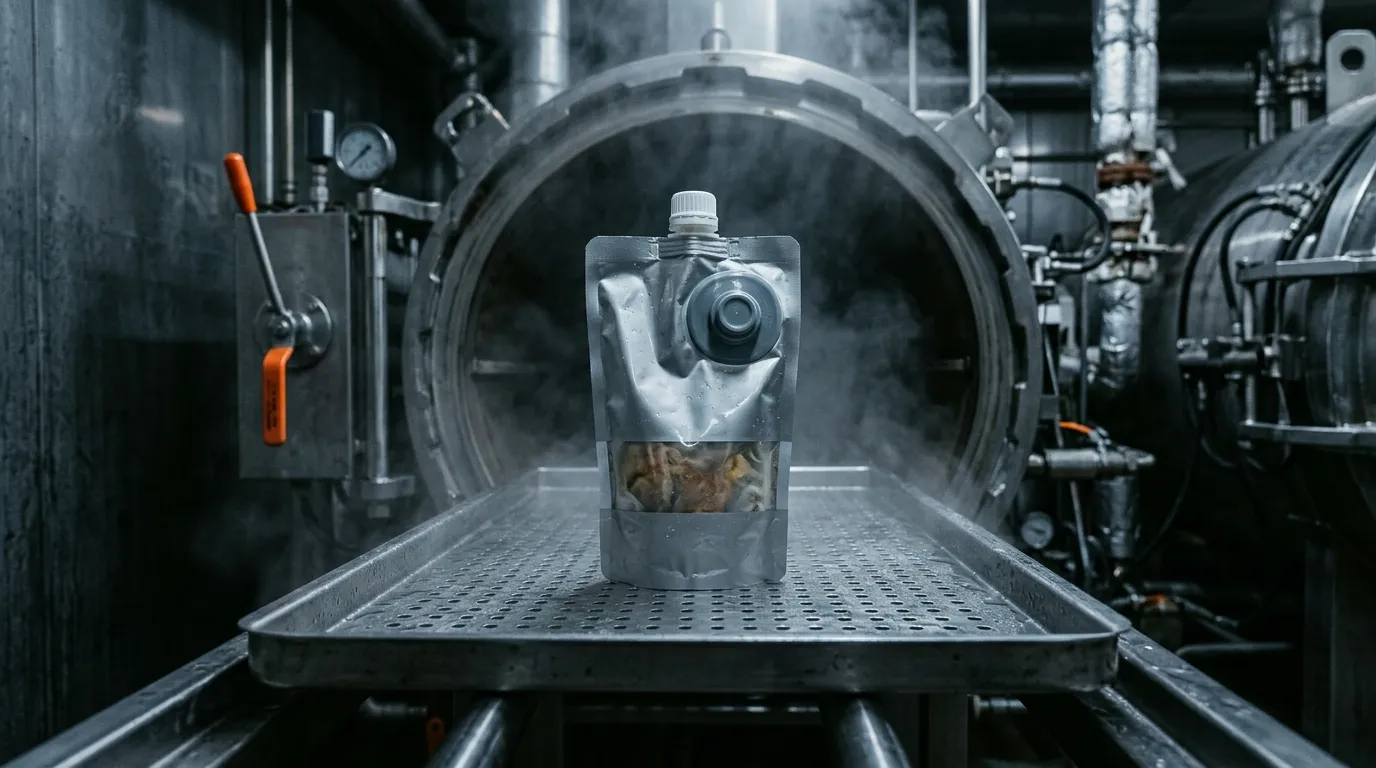
Sauces are filled hot — frequently 80–95 °C — and may be pasteurized or retorted. Two consequences: the cap must hold its seal and torque after heat exposure, and the migration test must be run at the fill temperature, not the ambient default. For retorted products (121 °C), the spout needs a PP formulation that keeps its shape and seal performance through the cycle. This is the application where "certified at ambient" silently fails. Some of our retort-rated spout caps are specified exactly for this; when a sauce brand asks us for a retort-capable assembly, the migration data is produced at process temperature, not at 40 °C.
Dairy (fatty, refrigerated or aseptic)
Fatty foods use fatty simulants, which are the harshest migration conditions — and the ones most often skipped in a supplier's test folder. If your dairy product is shelf-stable or aseptic, ask explicitly whether the migration report includes a fat simulant at the relevant time/temperature. Refrigerated dairy is a lighter burden, but the sensory test still matters: a plastic off-flavor in milk or yogurt is a fast route to a product recall.
One cross-cutting trend: recyclable PE pouches
More brands are switching to mono-material recyclable PE film. Recyclable PE pouches need a spout that welds at lower temperatures (110–130 °C) so the film's sealant layer is not damaged — standard spouts designed for higher welding temperatures can scorch the film or weld inconsistently. When you move to recyclable packaging, re-qualify the spout's sealing temperature and confirm its materials still meet your food-contact rules. A food-grade spout is not automatically a recyclable-pouch spout.
The 10-point document checklist to send your supplier
You do not need to become a compliance engineer. You need the right documents, and you need them in writing. Send this list to any spout cap supplier — including us — and the quality of the answers will tell you a lot about the quality of the factory.
- Material compliance declaration — state which regulations apply (FDA 21 CFR 177.1520, EU 10/2011, GB 4806.7, LFGB) and which resin grades are covered.
- FDA compliance letter (if selling into the US) — naming the resin and, ideally, the finished article.
- EU Declaration of Compliance (if selling into the EU) — per Article 16 of Regulation (EC) 1935/2004, from the manufacturer.
- Overall migration test report — finished component, relevant simulants, conditions matching your fill/process.
- Specific migration / heavy-metal test report — especially if the cap is colored or contains a gasket.
- Sensory evaluation report — taste and odor neutrality.
- Extractives report (US route) if the supplier claims FDA compliance.
- System certificates — ISO 9001, HACCP and any BRC/SQF/IFS certificates, with certificate numbers and issuing bodies.
- Brightener/fluorescer declaration — a written statement that materials are free of optical brighteners and fluorescent agents.
- Batch traceability statement — how the factory guarantees that production material matches the tested material (virgin resin, no unapproved regrind).
If a supplier cannot produce items 4–7, they do not have finished-article evidence — they have resin evidence. That distinction decides whether your pouch passes inspection in your target market.
Red flags: shortcuts that pass a casual review
A few patterns recur in supplier audits and import inspections. Recognize them and you will avoid most of the damage:
- One certificate for everything. A single FDA letter covering "food contact" with no regulation number, no resin grade and no finished article is a marketing document, not compliance evidence.
- Test reports without conditions. "Passed migration" with no temperature, no duration and no simulant list is meaningless. Conditions are the content.
- Ambient-only data for hot-fill or retort products. The most common silent gap in this category.
- Expired or near-expired system certificates. ISO 9001 and HACCP certificates have validity periods; check the issue date and the issuing body.
- No traceability. If the factory cannot say which resin grades and masterbatches are in the approved BOM, the tested sample and the production batch are different products.
When you see these, it does not automatically mean the supplier is bad — it often means nobody asked the right questions before. Asking is cheap. Discovering the gap after a customs hold or a recall is not.
How to spec food-grade spout caps from a manufacturer
You now know the questions. Here is how to turn them into a specification.
First, fix your market and your process before you talk to suppliers: which countries will the filled pouch be sold in, what is your fill temperature, is the product retorted, does it contain fat, and are you moving to recyclable mono-material PE? Write those down — they determine which documents you need.
Second, ask for the checklist above. Compare answers across suppliers, not just certificate names. A supplier who sends a full folder with conditions and test parameters is telling you their compliance is an operating system, not a slideshow.
Third, order samples and test them in your own line. A cap that passes paperwork but fails your sealing temperature window is not food-grade for your product — it is food-grade in a laboratory. Seal a few pouches, run them through your fill process, and check torque, leak resistance and any tamper-evident ring behavior.
This is the approach we take with our own customers: start from their market and process, then match spout diameter (our range spans 1.8 mm to 33 mm), sealing characteristics and materials to the application, and support each order with the documentation above. You can see the full product range on our spout caps page and our certification page, or read more about sourcing food-grade components.
Frequently asked questions
Does a spout cap need FDA certification to be sold in the US? Resin and finished article must comply with FDA food-contact regulations — for PP/PE that means 21 CFR 177.1520 — and the manufacturer should provide written compliance evidence. There is no "FDA certificate" issued by the agency itself; what you receive is a compliance letter backed by test data.
Is a material letter enough, or do I need migration test reports? A material letter is Layer 1 only. Migration test reports (overall and specific migration, sensory) are the evidence that the finished cap — with its colorants and gaskets — is safe in practice. For food-contact components, request both.
What is the difference between EU 1935/2004 and EU 10/2011? 1935/2004 is the framework regulation for all food-contact materials; 10/2011 is the specific implementing regulation for plastics. Both apply, and together they define the EU compliance regime that includes the mandatory Declaration of Compliance.
Can a food-grade spout cap be used on recyclable PE pouches? Only if the spout is engineered for low-temperature welding (roughly 110–130 °C) so it seals reliably to mono-material PE film without damaging the sealant layer. Re-qualify sealing and migration whenever you switch film structure.
Does hot-fill or retort change the certification requirements? It changes the evidence required: migration testing must be run at the actual process temperature and duration, not at ambient defaults. A cap certified for cold-fill is not automatically certified for a 121 °C retort cycle.
For more on choosing and running pouch spout caps — diameters, sealing windows and machine compatibility — start with our guide to spout cap diameters and guide to spout sealing temperatures, both part of our caps-by-content hub.