
Two green certificates, one of them wrong
A brand owner qualifying a spout cap moulder for a new stand-up pouch line asks two suppliers for their certificate pack. Two PDFs come back. One says BRCGS Packaging Materials. One says FSSC 22000. Both are recognised by the Global Food Safety Initiative. Both carry a logo, a certificate number, an expiry date and a signature.
Procurement marks both as "certified" and moves on to price.
The logo is the least informative thing in either document. Neither scheme stamps "this covers the 8.6 mm spout cap you are buying" on the front page. The fields that do the work are the scope statement, the site address, the standard version and — for FSSC 22000 — the category letter. Buyers read those fields last, if at all, which is why supplier approvals regularly pass on a certificate that covers a different plant, a different activity, or a version of the standard that has already been superseded.
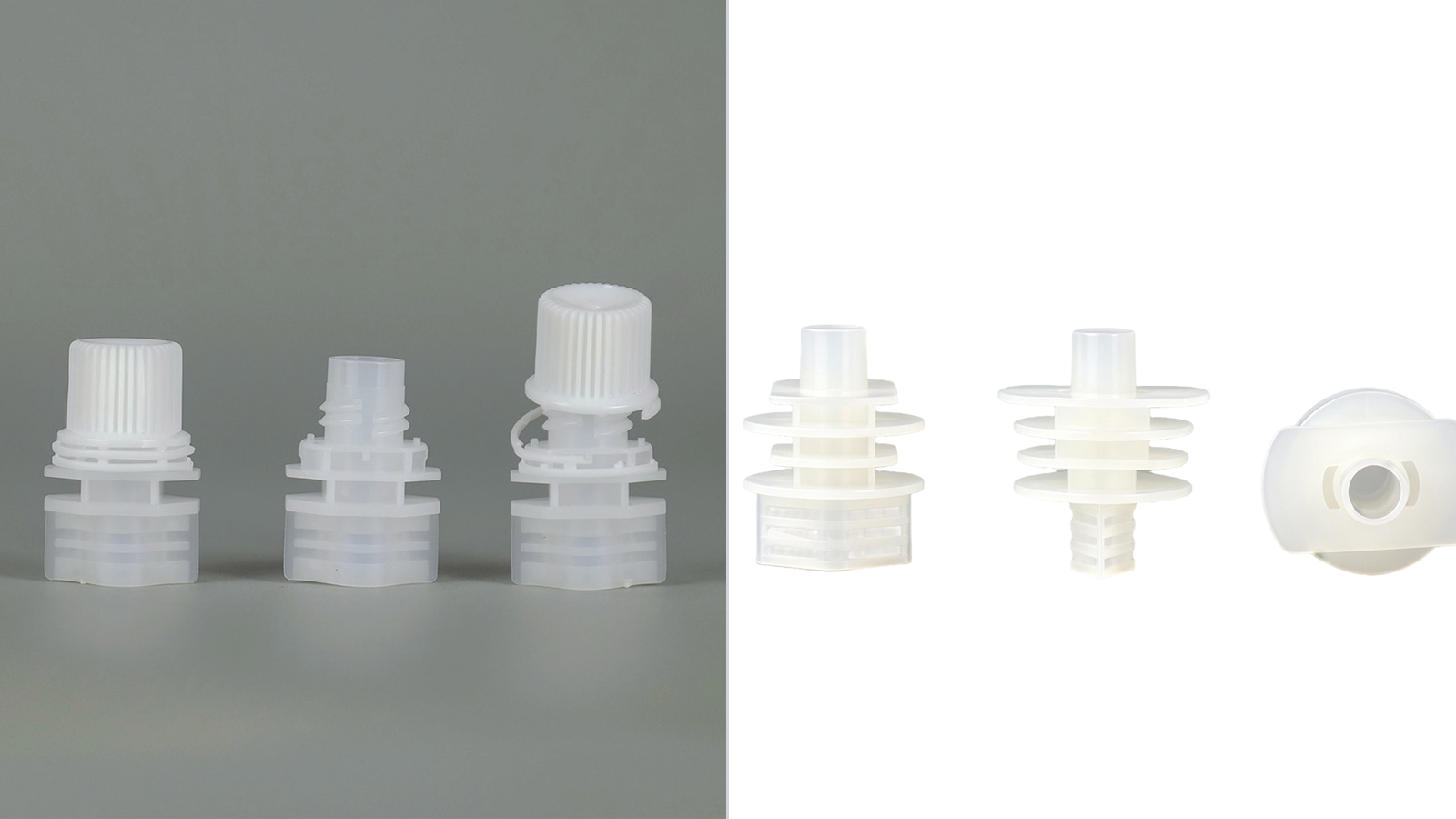
This is written for the components end of that chain: injection-moulded spout caps, fitments and closures welded into spout pouches and doypacks, and the certificate pack you are handed when you approve the moulder, the converter, or the trading house in between. It is a reading guide, not certification advice; the schemes' published documents decide what a certificate means.
The two schemes are not two flavours of one thing
The names get used interchangeably in procurement emails. Architecturally they are not.
BRCGS Packaging Materials is a standard written for packaging. BRCGS describes it as the first packaging standard recognised by GFSI, aimed at manufacturers, producers and suppliers of packaging materials, and audited as a certification of a manufacturing operation against packaging-specific requirements (BRCGS Packaging Materials). The current issue is Issue 7, published in October 2024, with audits against it running from April 2025; BRCGS reports more than 7,100 sites certified across 94 countries (BRCGS, 25 years of Packaging Materials). BRCGS also publishes neighbouring standards for activities that are not manufacturing — Agents and Brokers, for example, is written for businesses that "buy, sell or facilitate the trade of food, packaging and consumer products" (BRCGS Agents and Brokers).
FSSC 22000 is a certification scheme for food safety management systems, aligned with the ISO management-system approach and built on ISO 22000 plus the sector-specific prerequisite programmes in the ISO 22002-x series (What is FSSC 22000). On top of those standards the scheme adds its own requirements — food defense, food fraud mitigation, allergen management, environmental monitoring, equipment management, hazard control for cross-contamination, food safety and quality culture (FSSC 22000 V7 Additional Requirements). Packaging manufacture enters through a scope category, not through the standard's title.
The practical consequence: one certificate describes a packaging manufacturing standard audited at your supplier, the other describes a management system audited at your supplier, with packaging as one category among many food-chain activities. Neither is better in the abstract. One of them may be the wrong instrument for your approved-supplier list, and only the scope wording tells you which.
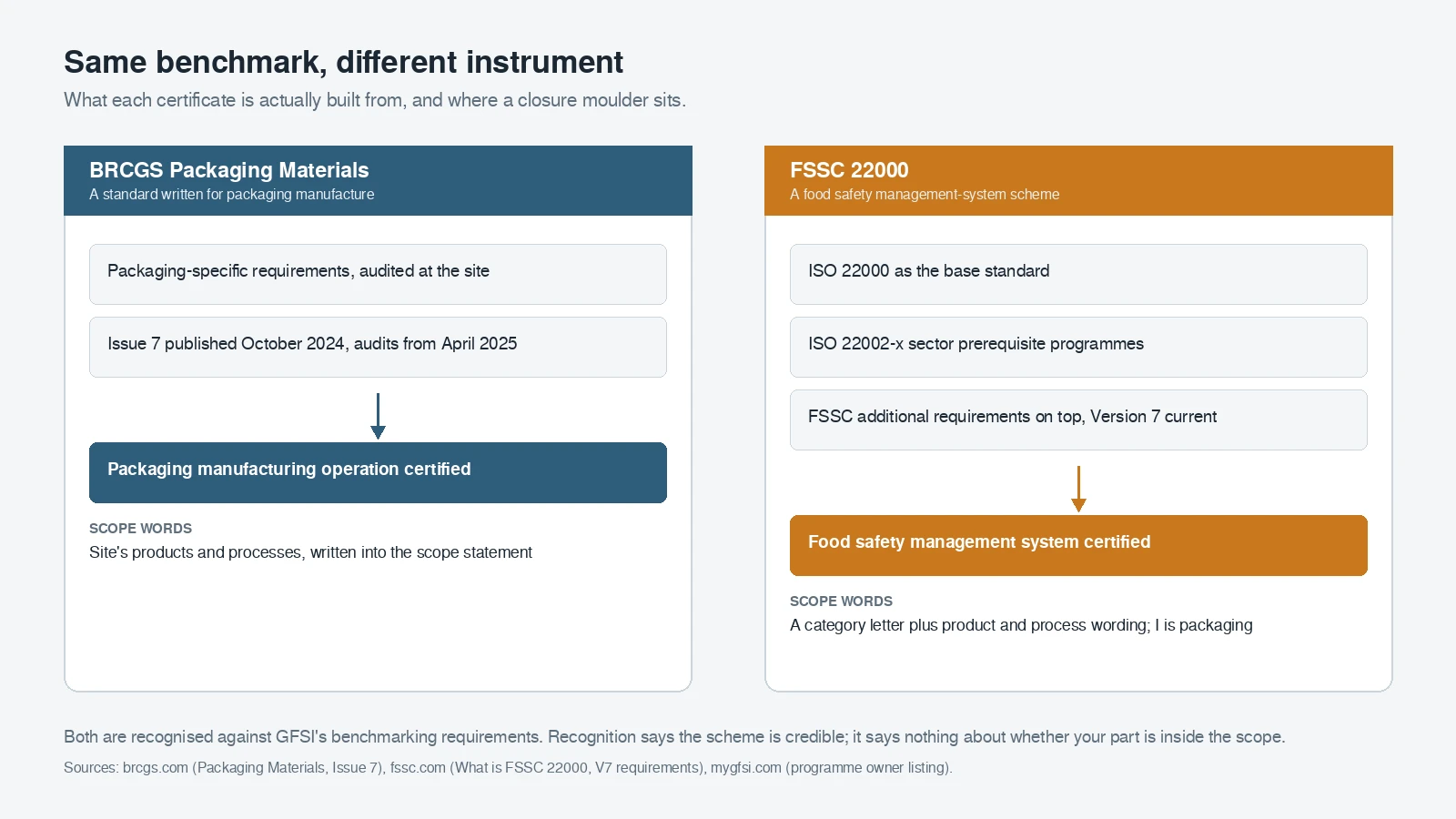
The logo tells you which scheme audited the site. The scope statement tells you whether that audit had anything to do with your part.
Dimension | BRCGS Packaging Materials | FSSC 22000 |
|---|---|---|
What is certified | A packaging manufacturing operation, against a packaging-specific standard | A food safety management system, against ISO 22000 + ISO 22002-x PRPs + FSSC additional requirements |
Who it was written for | Manufacturers, producers and suppliers of packaging materials | Any organisation in the food chain, sorted into scope categories |
How scope is expressed | Free-text scope statement naming products and processes | A category letter (C, D, G, I, K…) plus product and process wording |
Where a closure moulder sits | The standard itself, if the scope names moulding | Category I — Production of Food Packaging |
Where to verify the certificate | BRCGS Directory | FSSC Public Register |
Version status at the time of writing | Issue 7, auditable since April 2025 | Version 7 published May 2026 and recognised November 2026; audits move to it from May 2027, with V6 audits permitted until 30 April 2027 |
Six fields decide whether the paper covers your part
Whether the certificate says BRCGS or FSSC 22000, the same six fields carry the meaning. Read them in this order.
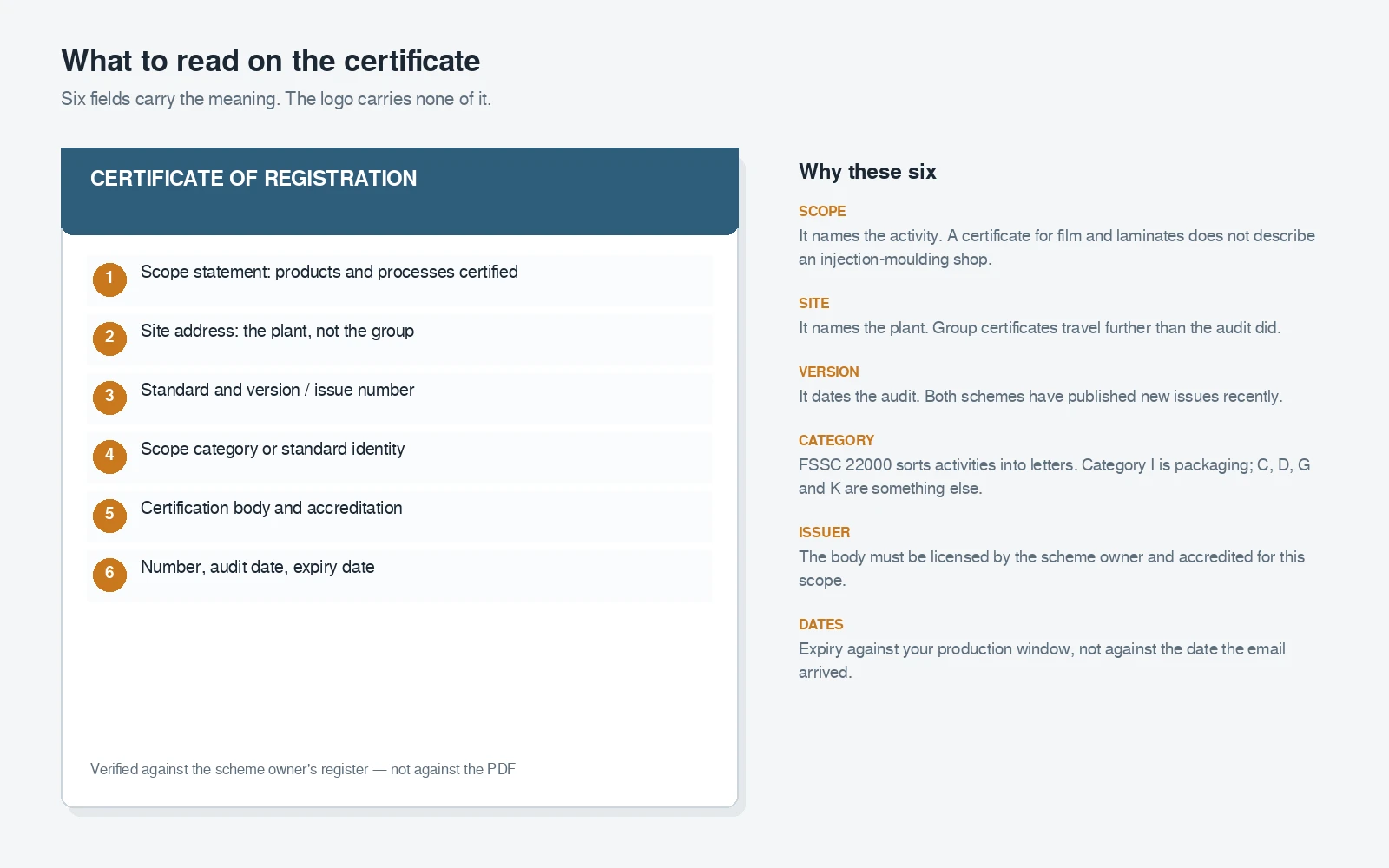
- Scope statement — the sentence naming what the site is certified to make or do.
- Site address — the plant, not the group, not the sales office.
- Standard and version — "Packaging Materials Issue 7", "FSSC 22000 Version 7", and the ISO 22000 edition underneath it.
- Scope category (FSSC 22000) or standard identity (BRCGS) — category I for packaging, or the difference between Packaging Materials and Agents and Brokers.
- Certification body and accreditation — who issued it, and whether that body is licensed by the scheme owner and accredited for the scope.
- Certificate number, audit date and expiry — the fields you look up in the register rather than trust in the PDF.
Two minutes with those six fields answers a question the logo cannot: is the activity that makes my caps inside this certificate, at the address that will mould them, under a version that is still current?
Field 1: the scope statement is the whole argument
The scope statement is where the schemes differ most visibly: FSSC 22000 works from a fixed category list, while a BRCGS certificate carries the site's own products and processes as free text — proposed by the site, verified by the auditor, issued by the certification body.
GFSI's own listing of recognised programme owners publishes the FSSC 22000 scope categories, and reading that list is the fastest way to see how easily a certificate can be right and irrelevant at the same time (GFSI-recognised programme owners). The same page lists, side by side, "I – Production of Food Packaging", "CII – Processing of Perishable Plant Products", "G – Provision of Storage and Distribution Services" and "K – Production of (Bio) Chemicals".
Words on the certificate | What it actually covers | What to ask before you approve |
|---|---|---|
I – Production of Food Packaging | Manufacture of food packaging; closures belong here where they are supplied as packaging components | Does the product wording include injection-moulded caps and fitments, or only film and laminates? |
CII – Processing of Perishable Plant Products | A food processing plant | Which site moulds my caps, and is that site on the certificate? |
G – Storage and Distribution | Warehousing and logistics | Who manufactured the parts, and to what standard? |
Agents and Brokers (BRCGS) | Buying, selling and facilitating trade | The manufacturing site's certificate is a separate document — request it |
The site's own free text, e.g. "manufacture of injection-moulded plastic closures" | The part you are buying | Nothing, if site, version and date all line up |
A trading house holding Agents and Brokers certification is doing exactly what that standard is for. It is not evidence that anybody moulded your cap under a food-safety standard. It is a reminder that a supply chain can hold four certificates and none of them cover the plant you care about.
Field 2: the site on the certificate against the site on the invoice
Group certificates cause more approval errors than expired ones. A moulder with three plants in two provinces holds a certificate for the plant that was audited; the commercial team sends that PDF for every enquiry.
Cross-check three strings before you sign: the address on the certificate, the plant named on the shipping documents, and the address on the quality or supplier-approval form. If the caps will be moulded at a plant that is not named, you have approved a company, not a supplier. Ask for the site list annex if the certificate covers multiple sites.
The same check catches the reseller pattern: a certificate for a sales office above a certificate for a plant, stapled together in one PDF, with no indication of which address produces the part.
Field 3: the version on the paper is a date stamp
Both schemes have moved recently, and the movement is exactly what you want to read off the certificate.
BRCGS replaced Issue 6 with Issue 7 — published October 2024, audits from April 2025. A certificate still citing Issue 6 tells you when the last audit happened and that the next one will be against Issue 7; it is a scheduling fact, not necessarily a defect, but it should prompt the question.
FSSC 22000 has published Version 7 — released on 1 May 2026 — and Foundation FSSC announced its recognition against GFSI's 2024 benchmarking requirements in November 2026 (FSSC 22000 Version 7 achieves GFSI recognition). Publication is not auditability: FSSC's own FAQ states that audits against Version 6 are permitted until 30 April 2027, with upgrade audits against Version 7 running from 1 May 2027 to 30 April 2028 (Version 7 FAQ). The FSSC certificate in front of you is therefore most likely a Version 6 certificate, and it is current until that window closes. Version 7 adds a product design and development requirement tied to sustainable packaging material, and folds the SAVE Food packaging design principles into the scheme for organisations that design primary packaging — a clause that lands on a fitment supplier who co-designs a closure with a brand, not only on the converter (V7 additional requirements).
Here is the part most buyers miss. At the time of writing, GFSI's public listing of recognised programme owners names Packaging Materials Issue 6 and FSSC 22000 Version 6. Those two entries mean different things, and the difference is the lesson. For BRCGS the listing trails a standard that has been auditable since April 2025 — genuine lag. For FSSC it is simply accurate, because Version 6 is still what audits are delivered against until 30 April 2027. Either way, "GFSI-recognised" is a property of a programme at a version on a date, never a property of a logo on a supplier's website.
Read the version field, then read the scheme owner's current document. Do not take a blog table — including this one — as the authority on which version is live today.
Field 4: category letters, and the standard that is not the one you meant
Three substitutions happen often enough to check by name.
The first is ISO 22000 presented as FSSC 22000. ISO 22000 is the standard; FSSC 22000 is a scheme that uses it, adds sector prerequisite programmes and its own additional requirements, and certifies through licensed bodies. A certificate that says "ISO 22000" is a management-system certificate. A certificate that says "FSSC 22000" is a scheme certificate. They are not the same document, and if your specification names one, the other does not satisfy it.
The second is BRCGS Food Safety presented for a packaging supplier. BRCGS runs several standards; the one written for packaging manufacture is Packaging Materials. A PDF headed "Global Standard Food Safety" is a food manufacturer's certificate, and it will not describe a moulding shop's process controls.
The third substitution is quieter: a HACCP certificate presented as a GFSI scheme. HACCP certification is evidence that a hazard-analysis and critical-control-point system has been assessed. It is not a GFSI-benchmarked certification scheme. If your approved-supplier list asks for a GFSI-benchmarked certificate, HACCP does not answer it — but it is not nothing either, and the honest move is to say which document you hold rather than let the logo do the talking.
Field 5 and 6: the register, the body, the dates
A PDF can be edited; a register cannot.
Both scheme owners publish a lookup. FSSC's register of certified organisations is stated to be updated daily (FSSC Public Register); BRCGS maintains a directory for validating certificates (BRCGS Directory). Look up the certificate number and compare four things: the organisation name, the site address, the scope wording, and the expiry date.
Then look at the issuer. The certification body should be licensed by the scheme owner and accredited for the scope — a body accredited for food manufacturing is not automatically accredited for packaging, and a certificate from an unlicensed body is not a scheme certificate at all. If the body's name does not appear on the scheme owner's list, that is the point to stop and ask, politely and in writing.
Finally, the dates. Compare the expiry date against the date you will place the order, not the date the PDF was emailed. A certificate that expires during your production window is a scheduling problem you can solve in advance, and an approval problem you cannot fix afterwards.
What the certificate does not cover, and what to request instead
Neither scheme approves your part. They certify a system or a manufacturing operation; they do not certify that the resin in this batch, the gasket in this cap, or the masterbatch in this colour is suitable for food contact.
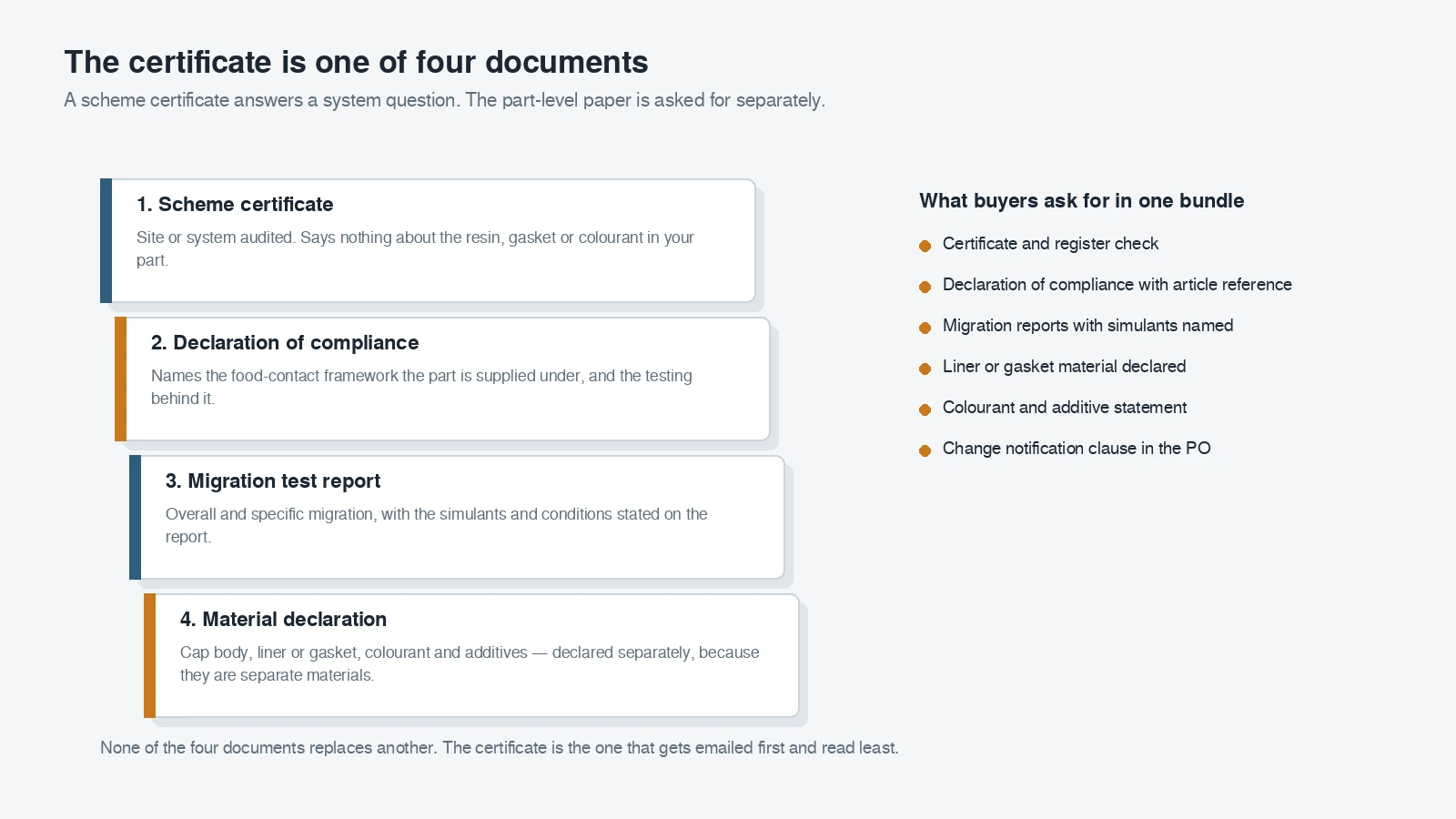
The product-level paper is a separate request, and for a spout cap it usually means:
- a declaration of compliance naming the food-contact framework the part is supplied under, and the migration testing behind it;
- test reports for overall and specific migration, with the simulants and conditions stated;
- the gasket or liner material declared separately from the cap body — a PP cap with an EVA or silicone liner is two materials, not one;
- colourant and additive declarations, since a masterbatch change is a formulation change;
- recyclability and packaging documentation if your market asks for it, which for European programmes now runs through the PPWR paperwork rather than the food-safety certificate.
For how the three big food-contact frameworks differ, see FDA vs EU 1935/2004 vs GB 4806.7 on pouch closure certificates. For the document set a closure supplier should be able to hand over on request, see food-grade spout caps certification.
A ten-minute check before the sample order
Run this against the PDF in front of you — every line is answerable from the certificate plus one lookup.
- Read the scope statement aloud. Does it name the product or process you are buying, in words a stranger would understand?
- Match the site address to the plant that will mould your caps — not the group, not the sales office.
- Note the standard and version. Look up what the scheme owner currently publishes.
- For FSSC 22000, note the category letter. Category I is packaging; C, D, G and K are other activities.
- For BRCGS, confirm it is Packaging Materials and not Food Safety or Agents and Brokers.
- Look the certificate number up in the scheme owner's register or directory. Compare name, site, scope, expiry.
- Check the certification body is licensed and accredited for this scope.
- Compare the expiry date with your production window, then diarise the renewal so it does not lapse mid-programme.
- Ask what happened at the last audit — grade or outcome, and whether non-conformities were closed.
- Ask who tells you if the certificate is suspended, withdrawn or re-scoped. Get a name, not a promise.
If the answers hold, you have approved a supplier on evidence. If they do not, you have found the gap before it reaches a line trial — which is the cheapest possible moment to find it. The wider version of this exercise, covering the plant rather than the paperwork, is in the spout cap factory audit checklist.
Red flags worth escalating rather than noting
- A certificate whose scope statement is a product list that does not include closures, offered for a closure order.
- A group certificate with no site annex, where the plant on the shipping documents is not the plant on the certificate.
- A version that is two issues behind what the scheme owner publishes, with no explanation of the audit schedule.
- A register entry that exists but whose scope wording differs from the PDF in your hand.
- A "certificate in progress" or "audit booked" email presented as coverage. An audit booking is a plan; a certificate is a result.
- A logo on a homepage with no certificate number anywhere on the site.
None of these proves a bad supplier. Each is a question the supplier should answer in a day, and the answer tells you more about their behaviour during a non-conformity than the certificate will.
A certificate is a snapshot of one site on one date. Approval is a decision that the snapshot still describes what you are buying.
What to write into the purchase order or quality agreement
Certificate checks expire; clauses do not. Buyers who manage this well tend to put five things in the agreement, and the wording is theirs, not ours:
- currency — a valid certificate for the named scope must be held for the life of the agreement, with the certificate number recorded;
- site lock — production at the named site, with movement to another plant requiring written re-approval;
- notification — the supplier tells you within a stated period if the certificate is suspended, withdrawn, or its scope reduced;
- change trigger — a change of resin, liner material, colourant or moulding site triggers a document refresh before the next shipment;
- product-level documents per lot or per change — declarations and test reports tied to the material actually shipped.

When several sites or several buyers are involved, the failure mode is rarely a missing certificate; it is six versions of the same specification living in six folders. That problem has its own playbook: multi-site closure specification control. And when the question is who inside your own organisation is allowed to accept the evidence, the answer is usually written down already: who signs off a spouted pouch project.
If your programme requires a scheme your moulder does not hold
Some approved-supplier lists require a GFSI-benchmarked certificate from the packaging supplier itself. Others accept ISO 9001 plus HACCP plus product-level compliance for lower-risk dry-food closures. Both positions are defensible; what is not defensible is discovering the requirement at the audit rather than at the RFQ.
So put it in the RFQ, in one line: which scheme, which version, which scope, held by which site. A supplier who cannot answer that quickly has told you something useful.
Our own position is deliberately plain. The documents we hold are listed on our certificate page — ISO 9001:2015, HACCP, and EU 1935/2004 food-contact compliance, and the SGS test reports on packaging-regulation heavy metals and total fluorine for the tested sample. We label each for what it is. A HACCP certificate is evidence of a hazard-control system, not a GFSI-benchmarked scheme, and we will not present it as one. If your programme requires a specific scheme held by the moulder, say so before samples and we will answer directly rather than let a logo answer for us.
Questions buyers actually ask
Is FSSC 22000 stricter than BRCGS? The comparison is not answerable in the abstract: the two documents do different jobs, and both are recognised against GFSI's benchmarking requirements. What is answerable is whether the scope on the certificate you were sent covers the part you are buying, at the site that will make it.
Can one site hold both? Yes. Sites do, particularly where different customers specify different schemes. If you see two certificates, check that both scope statements name the same products — a second certificate is not automatically broader.
Is ISO 22000 the same as FSSC 22000? No. ISO 22000 is the standard; FSSC 22000 is a certification scheme that uses it together with sector prerequisite programmes and additional requirements, and certifies through licensed certification bodies.
Our supplier is certified but the certificate is in the group's name. Is that a problem? Only if the plant making your caps is not the plant named. Ask for the site annex and the address on the shipping documents, and put the plant in the purchase order.
Does a BRCGS Packaging Materials certificate cover the printed film as well as the cap? Only if the scope statement names both activities at that site. Printing and lamination are separate processes with separate controls, and a converter's certificate does not travel to a moulder.
If the certificate pack is the last open item on a spout cap programme, the caps themselves are the next question: spout caps for stand-up pouches and doypacks covers the range we mould, and the Sourcing & Supply hub collects the rest of this series — MOQ behaviour, tooling ownership, pricing drivers and the audit sequence that follows supplier approval.