

The most misread document in PPWR compliance is a test report with the word "Pass" on it. Two substance obligations for food-contact packaging began applying on 12 August 2026 — a PFAS concentration limit under Article 5(5) of Regulation (EU) 2025/40 and a heavy-metal content limit under Article 5(4) — and most buyers in that chain now hold at least one laboratory report in a supplier folder. What it settles is narrower than it looks, and the distance between "we have a Pass" and "we can defend this file" is where a market-surveillance request lands.
So this guide does one thing: it takes the two tests a plastic spout cap usually gets — a total-fluorine screen and a heavy-metal content test — and separates what each of them proves from what it does not. Read it as the evidence map for the PPWR PFAS packaging limits rather than as another summary of the regulation. Every article number, threshold and date below was checked against the regulation text on EUR-Lex and against the Commission's own guidance on 13 September 2026, and the worked examples are the two reports we hold for a sampled spout cap, quoted as they read. If you are working through this cluster for the first time, the Regulations & Recyclability hub puts the whole set of EU packaging duties in order.
What PPWR PFAS packaging limits require of a spout cap
Start with the two paragraphs your report will be compared against, because they answer different questions.
Article 5(4) is a content limit on four metals. In the regulation's words, "the sum of the concentrations of lead, cadmium, mercury and hexavalent chromium resulting from substances present in packaging or packaging components shall not exceed 100 mg/kg." Note two things a summary often drops: it is a sum, and it applies to packaging components — not only to the pouch film. The paragraph opens by stating it applies "without prejudice to" the Annex XVII restrictions of Regulation (EC) No 1907/2006 and, where applicable, to the restrictions and specific measures on food-contact materials in Regulation (EC) No 1935/2004. That clause is doing real work, and we come back to it in the heavy-metals section.
Article 5(5) is a concentration limit on PFAS, with a documentation trigger. From 12 August 2026, food-contact packaging may not be placed on the market if it contains PFAS at or above:
Threshold | Limit | How the regulation says it is measured |
|---|---|---|
Any single PFAS | 25 ppb | Targeted PFAS analysis, polymeric PFAS excluded from quantification |
Sum of PFAS | 250 ppb | Sum of targeted PFAS analysis, where applicable after prior degradation of precursors |
PFAS including polymeric PFAS | 50 ppm (= 50 mg/kg) | — |
Total fluorine | 50 mg/kg | Not a limit: above it, the operator must prove on request how much fluorine is PFAS and how much is not |
The regulation defines PFAS itself, for its own purposes, as any substance containing at least one fully fluorinated methyl (CF₃–) or methylene (–CF₂–) carbon atom — a definition broad enough to catch substances that a supplier's "fluorine-free" marketing would not. Article 5(2) adds a parallel workstream rather than a new duty: by 31 December 2026 the Commission, assisted by the European Chemicals Agency, must report on substances of concern in packaging and packaging components — a report that could become future restrictions.
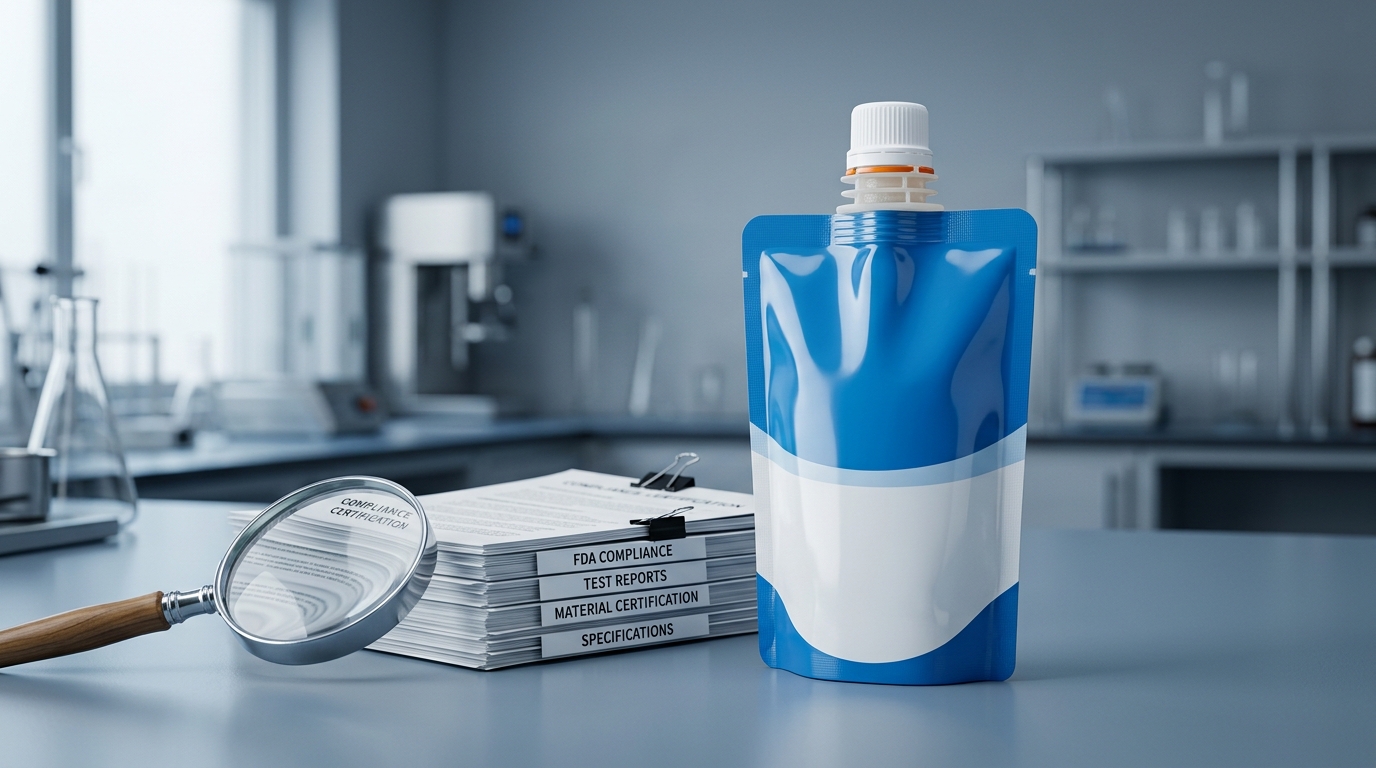
Then comes the sentence that decides what a test report is for. Article 5(6): compliance with paragraphs 4 and 5 "shall be demonstrated in the technical documentation drawn up in accordance with Annex VII". There is no test named anywhere in Article 5, and no certificate.
Why the closure is in scope at all: PPWR's definition of packaging includes components integrated into the packaging, so a spout and cap welded into a doypack is a packaging component, and both the limits and the documentation duty reach it directly. Our PPWR declaration of conformity checklist for spout pouches walks the Annex VII file item by item.
The numbers above come from Regulation (EU) 2025/40 on EUR-Lex; the Commission's packaging waste pages state the application dates in plain language.
Law and guidance are two different things
Here is a distinction that costs people real money. The regulation sets the limits and says nothing about how to measure them. The Commission has since published a Notice — guidance, not a regulation — recommending how competent authorities should enforce the PFAS limits. It is the Commission Notice C/2026/3702, and it opens with an admission worth reading twice:
"Several protocols and methodologies to test the presence of PFAS in different matrices exist, but there is no harmonised methodology for PFAS in food contact packaging at EU level."
What the Notice then recommends, for enforcement from 12 August 2026, is a three-step ladder:
- Total fluorine (TF) quantification. If TF is below 50 mg/kg, the sample could be considered compliant.
- If TF is above 50 mg/kg, a method such as pyrolysis-GC/MS is used to establish whether the fluorine is organic (PFAS) or inorganic. If the organic fluorine is below 50 mg/kg, the sample could be considered compliant.
- Direct TOP analysis (total oxidizable precursors) is recommended to check compliance with the 25 µg/kg and 250 µg/kg limits — the ppb thresholds in Article 5(5)(a) and (b).
The Commission adds that, on the evidence currently available to it, all samples compliant with step 1 are also compliant with steps 2 and 3.
Three consequences follow. A total-fluorine result is step 1 of a screening ladder — designed to let most material out of the gate, not to characterise it. The Notice is guidance: an authority is not bound by it, and a supplier's "step 1 compliant" statement is a claim about a Commission recommendation, not about a regulation article. And the ladder is a sequence, not a menu — you can pass at step 1 without ever learning which PFAS, if any, your component contains. If you want the regulatory calendar those steps sit inside, our PPWR timeline for spouted pouches sets it out milestone by milestone.
What a total-fluorine test proves — and what it does not
A total-fluorine test measures one thing: how much fluorine is in the sample, whatever it is bound to. The method matters because it explains the boundary. The common route is combustion-ion chromatography under IEC 62321-3-2:2020: the sample is burned in an oxygen-rich system, the released ions are absorbed in solution, and ion chromatography counts them. Nothing in that sequence asks what the fluorine came from.
Here is a real one. SGS-CSTC Standards Technical Services (Shanghai) issued report SHAEC26024760001 on 12 August 2026 for a sample described as "Spout cap with part RD", Model No. RD, submitted as two test parts. The method is "with reference to IEC 62321-3-2:2020", the test item is fluorine, the limit applied is 50 mg/kg, and the method detection limit is 20 mg/kg. Both parts returned ND — not detected, below the MDL. Conclusion: Pass. Ruihua holds that report for the sampled RD spout cap.

Total-fluorine screening burns the sample and counts fluoride ions: a measurement of quantity, not of which substance the fluorine sits in.
Now the boundary, in numbers rather than adjectives:
What the result establishes | What it does not |
|---|---|
Fluorine in the two tested parts is below 20 mg/kg — i.e. below the MDL, and below the Commission's step-1 screening level of 50 mg/kg | It does not establish that no PFAS is present. ND means "below 20 mg/kg fluorine", not "zero" |
On the Commission's stated evidence, a sample at that level "could be considered compliant" with the PFAS limits | It does not verify Article 5(5)(a) or (b). Those limits are 25 ppb (0.025 mg/kg) and 250 ppb (0.25 mg/kg) and are defined as targeted PFAS analysis — thresholds sitting roughly 800× and 80× below what a 20 mg/kg combustion screen can resolve |
Because PFAS molecules are largely fluorine by mass, a total-fluorine result below the MDL places a ceiling well under the 50 ppm polymeric-inclusive threshold in Article 5(5)(c) | It does not attribute the fluorine. Step 2 of the ladder (organic vs inorganic) and step 3 (TOP analysis) exist precisely because total fluorine cannot |
The screening level in the Notice was met on the date of test, for the parts tested | It does not travel: it says nothing about other models, other resins, or the same part after a formulation change |
The report itself is explicit about this, and that is the part worth copying into your own file. Its Notes reproduce Article 5(5), point (c) — the clause that triggers the proof duty once total fluorine exceeds 50 mg/kg — and conclude: "It is strongly recommended to perform PFAS test for confirmation."
The honest one-line reading of a total-fluorine Pass: it eliminates the high-fluorine cases and leaves the ppb-level question open by construction. Reading it as proof of a PFAS-free component inverts what the method can show.
What a heavy-metals test proves — and the limit it is not
The heavy-metals report is easier to read and just as easy to over-read. Article 5(4)'s 100 mg/kg is a content limit on the sum of lead, cadmium, mercury and hexavalent chromium — not a migration limit. Those are two different regulatory axes.
The worked example again comes from a report we hold. SGS report SHAEC26020677401, dated 15 July 2026, covers the same "Spout cap with part RD" sample as two parts. Lead, cadmium and mercury were measured by ICP-OES/AAS after acid digestion, with alkali fusion or dry ashing where needed; hexavalent chromium was extracted in boiling water and measured by UV-Vis after colour development with 1,5-diphenylcarbazide. Method detection limits: 5 mg/kg for Cd, Pb and Hg, 8 mg/kg for Cr(VI). Every item returned ND, and the sum against the 100 mg/kg limit returned ND. Conclusion: Pass on both parts, under the binary simple acceptance rule (w = 0) of the ILAC-G8 decision-rule framework — which is why the ILAC guidance series is worth bookmarking: it defines how a laboratory's conformity statement is supposed to be framed.

Trace-metal content analysis: the four Article 5(4) metals are quantified in the solid material, not in what leaches out of it into food.
What the result establishes is narrow and solid: for the tested parts, none of the four metals was detectable at 5–8 mg/kg, so the sum is far below the 100 mg/kg ceiling. What it does not establish is the part buyers most often assume:
What the result establishes | What it does not |
|---|---|
Total content of Cd, Pb, Hg and Cr(VI) in the tested parts is below the applied MDLs, and the Article 5(4) sum limit of 100 mg/kg is met | It does not establish food-contact compliance. Article 5(4) says so itself, applying "without prejudice to" Regulation (EC) No 1935/2004 |
The tested component meets the one content limit that PPWR sets for metals | It does not measure migration. That question is answered under Regulation (EC) No 1935/2004, whose Article 3 requires material not to transfer constituents in quantities that could endanger health, change the food's composition or degrade its organoleptic properties, and — for plastics — under Regulation (EU) No 10/2011, with its substance-specific migration limits in Article 11 and the 10 mg/dm² overall migration limit in Article 12, tested in food simulants |
Those four metals were not detected | It does not clear other substances. A fifth substance is governed by a different instrument — REACH Annex XVII or the authorised-substance lists of 10/2011 — not by Article 5(4) |
The parts tested conform on the date of test | It does not cover the film, the pouch body, or the finished packaging unit as a whole |
That gap is worth closing in your own file even if nobody else closes it: a content limit and a migration regime are not variations of the same test — one asks what is in the plastic, the other what leaves it. If your compliance thinking stops at "we hold a metals report and a fluorine screen", the migration layer is still open. The food contact rules for pouch closures set out how that layer sits alongside EU 1935/2004 in a spout-cap supply chain.
Your report is evidence for a file, not a certificate
Put the two worked examples back where Article 5(6) puts them: inside the technical documentation. Annex VII, Module A is the internal production control procedure — the manufacturer establishes the technical documentation, ensures and declares on his sole responsibility that the packaging meets the applicable requirements, and the documentation has to carry, among other things, a general description of the packaging and its intended use, plus "conceptual design, manufacturing drawings and materials of components".
There is no PPWR test to pass and no PPWR certificate to obtain: the regulation asks you to be able to show your reasoning and your evidence, and a laboratory report is an input to that showing. A laboratory's "Pass" is a conformity statement against a stated limit under a stated decision rule — neither a legal determination nor the declaration of conformity itself. The declaration is the manufacturer's, and under Article 3's definition that is usually the brand owner, not the converter who moulded the part.
And the file has to be component-level. A resin certificate for the material family, naming no component, is evidence for a chemical rather than for your packaging. That is the practical reason the PPWR documentation checklist separates component data from unit-level data: they come from different suppliers and neither substitutes for the other.

The Annex VII file is where a test report does its work: Article 5(6) requires compliance with the substance limits to be demonstrated in the technical documentation, on the manufacturer's own responsibility.
The sample is the report's real subject
Look again at what both reports describe: "Spout cap with part RD", Model No. RD, tested as two named parts with their own sample IDs. That is the scope of the evidence — not "our spout caps", not the pouch. One model, two parts, two dates.
This is not a defect in the reports; it is how testing works, and it is why a report is worth less than it looks until you map it onto what you buy. One question decides that mapping: is the sample the SKU on my purchase order?
For a spouted pouch the closure also needs its own evidence rather than an inference from the film. The cap and the spout base are separate mouldings, often from different resin grades with different additive packages, and a film supplier's report cannot cover them. That is why choosing a spout for a mono-material PE pouch and this document file are the same conversation seen from two sides — the material decision determines which evidence you will have to assemble.
One failure mode no report can protect you from: a report describes a formulation as it stood on the test date. A silent change of resin grade or additive package afterwards leaves the certificate in your file and a different component on your pallet. Put the tested specification in writing with your supplier, and ask to be told before it changes.
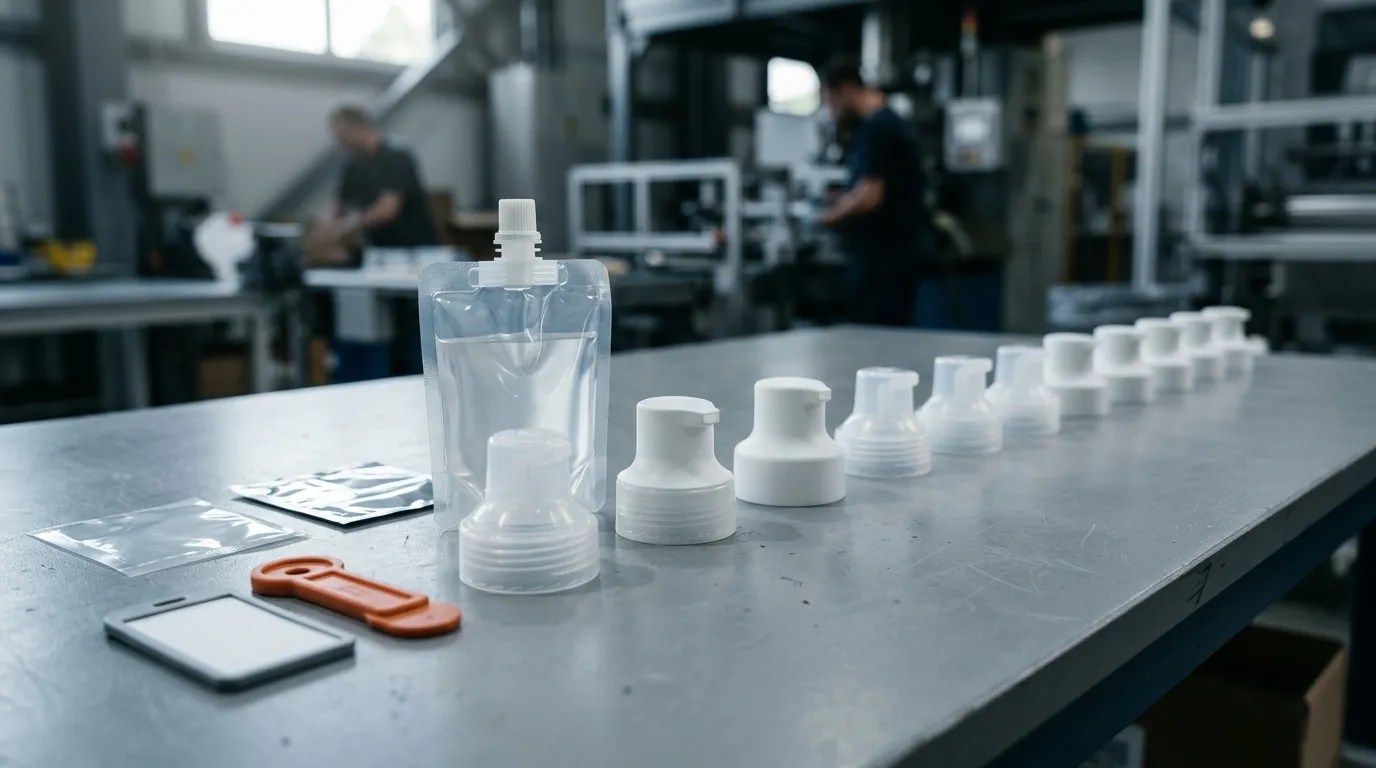
A single test report describes the model and sample it names; on a range like this, the first question is always which model the report actually covers.
Six questions that turn a report into usable evidence
You do not have to become a lab analyst. You do have to ask six questions in a form the supplier can actually answer, and file the answers next to the report.
- Which exact sample and model does the report cover, and is it the SKU on my purchase order? If the answer is "the RD spout cap, two parts", file it that way and ask for the models you actually buy.
- Was PFAS measured with targeted analysis, or only screened as total fluorine? If total fluorine only, request the targeted results and their detection limits — that is the difference between a screening level and the 25 ppb / 250 ppb thresholds.
- What limit was applied, and under what decision rule? A "Pass" without a stated limit and rule is not evidence you can defend.
- Which methods and which detection limits? You need the MDL to judge whether the result is even capable of speaking to the threshold you care about — a 20 mg/kg MDL cannot resolve 25 ppb.
- Can you supply migration data for the same material, not only content data? This is the layer Article 5(4) explicitly leaves to Regulation (EC) No 1935/2004 and, for plastics, 10/2011.
- Will you freeze the material specification in writing, and notify me before any resin or additive change? Everything above expires the moment the formulation moves silently.
The set is short because the regulation does not ask for more: it asks you to hold a file in which a lab report is one exhibit and the declaration is yours. Ruihua supplies food-grade spout caps for stand-up pouches with PPWR substance test reports for sampled models, and will confirm what a given report covers — and what still needs testing for your SKU — through a sample and quote request.
This article explains what Regulation (EU) 2025/40 requires of food-contact packaging components and how to read the reports that feed the technical documentation. It is not legal advice, and it keeps the regulation text separate from the Commission's guidance, which is not binding. Article numbers, thresholds and dates were verified against EUR-Lex and Notice C/2026/3702 on 13 September 2026; the test values quoted come from SGS reports SHAEC26020677401 and SHAEC26024760001 and apply to the samples those reports name, not to every product. Your compliance counsel and the authorities of the markets where you sell are the final referees.