
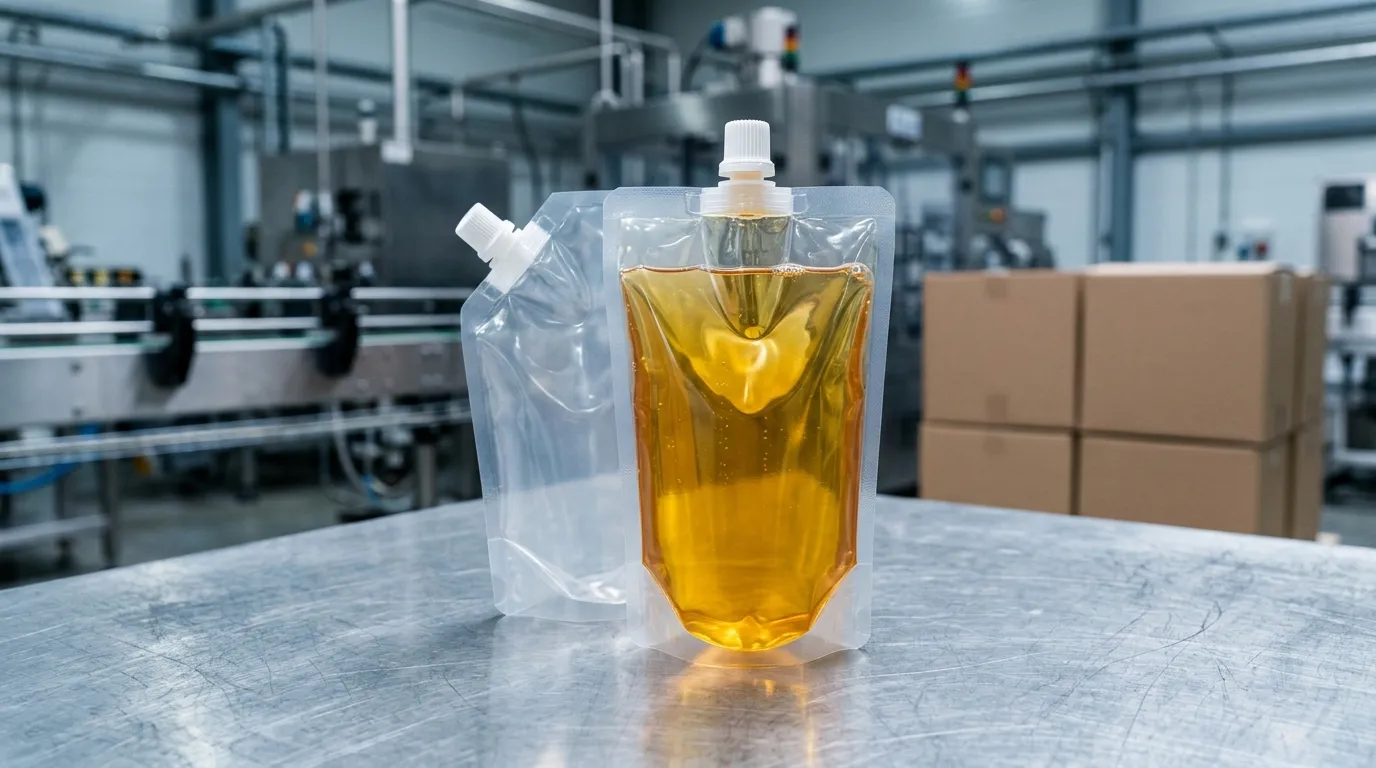
The EU's Packaging and Packaging Waste Regulation — Regulation (EU) 2025/40, universally shortened to PPWR — stopped being a future event on 12 August 2026. From that date, every piece of packaging placed on the EU market, including spouted stand-up pouches imported from China or anywhere else, has carried obligations that are enforceable today. The PPWR regulations then add two more waves: 1 January 2030 turns recyclability into a graded, market-access test, and 1 January 2035 adds a "recycled at scale" condition that is stricter than most summaries admit.
If you are a brand owner or buyer putting spouted pouches — stand-up pouches and doypacks with a plastic spout and cap — on the EU market, the hard part is not finding information. It is that most timelines online describe "packaging" in the abstract. This guide does the opposite: it walks the three milestones that matter to a spouted pouch, states which part of the obligation lands on the pouch film and which lands on small plastic components such as the spout cap, and flags clearly where the regulation text stops and interpretation begins. Every date below was checked against the regulation text on EUR-Lex on 6 September 2026, and it sits alongside the rest of the EU compliance guides in our Regulations & Recyclability hub.
This is the dates article. For the documentation side — what has to sit under the declaration of conformity once a date applies — read the PPWR declaration of conformity checklist; for the tooling decisions that a deadline can strand, read the PPWR fitment project brief.
What PPWR is — and where your spouted pouch sits in it
PPWR replaces the Packaging and Packaging Waste Directive (94/62/EC), which had governed EU packaging since 1994. The regulation was published in the Official Journal on 22 January 2025, entered into force on 11 February 2025, and — under Article 71 — applies from 12 August 2026, as the Commission's packaging waste page confirms. It applies to all packaging regardless of material or origin, which is the first fact a sourcing manager should internalise: a pouch made in China is governed by exactly the same rules as one made in Lyon. There is no "imported packaging" exemption.
For a spouted pouch, two structural points follow from the legal text:
- The whole unit is the packaging. Under the definition of packaging in Article 3, a component that is integrated into the packaging — the spout and cap welded into the pouch — is part of the packaging. There is no separate, lighter regime for closures.
- The brand owner is usually the "manufacturer". Article 3's definition of manufacturer points at the person who has the packaging designed or manufactured under its own name or trademark. For most private-label and branded pouch products, that is the brand, not the Chinese converter who printed the film or the component maker who moulded the cap. Only if a micro-enterprise (under 10 staff and under €2 million turnover) buys from a supplier located in the same EU member state does the supplier step into the manufacturer's shoes. A brand sourcing direct from China does not get that relief.
That second point is why this cluster of guides exists: the signatory of the EU declaration of conformity is usually the buyer, and the evidence behind that signature is collected from suppliers — including the spout cap supplier, who is easy to forget.
The PPWR regulations deadline map: 2026, 2030, 2035
| Milestone | What becomes binding | Where it lands on a spouted pouch | Legal hook |
| 12 August 2026 — already in force | Substance limits (heavy metals, PFAS in food contact); EU declaration of conformity + technical documentation; the general recyclability obligation | Film and spout cap alike; the DoC file is per packaging type | Articles 5, 15, 38–39; Article 6(1) |
| 1 January 2030 (or 24 months after pending delegated acts — see below) | Design-for-recycling criteria; recyclability performance grades A/B/C (below C = cannot be placed on the market); minimum recycled content in plastic; six single-use format bans | Pouch structure decides the grade; the spout cap's material must not drag the unit below C | Articles 6, 7, 25; Annex V |
| 1 January 2035 (or 5 years after pending implementing acts) | "Recycled at scale" condition joins the grade assessment | The pouch format must demonstrably be recycled at scale in the EU | Article 6(2)(b) |
One more date hides behind 2030 and is routinely missed: 1 January 2038, from which only grades A and B may be placed on the market. Grade C is not a permanent home — it is a decade-long runway. And the 2030/2035 dates above carry a legal "whichever is later" clause: where an obligation depends on a delegated or implementing act that has not yet entered into force, the clock starts when that act does. The design-for-recycling delegated acts are due by 1 January 2028; if they slip, the 2030 recyclability milestone slips with them. Watch the acts, not just the calendar — the Commission's PPWR overview page is the place to track them.
Already live since 12 August 2026: substances, the declaration file and a first recyclability duty
Three obligations were already enforceable the day this regulation began to apply. If your pouch has been landing in the EU since August 2026, these are in force for you right now.
Substance limits apply to every component. Article 5(4) caps the sum of lead, cadmium, mercury and hexavalent chromium in packaging and packaging components at 100 mg/kg — a limit that now sits in the regulation itself rather than the old directive. Article 5(5) goes further for food contact: from 12 August 2026, food-contact packaging may not be placed on the market if it contains per- and polyfluorinated alkyl substances (PFAS) at or above 25 ppb for any single PFAS (targeted analysis), 250 ppb for the sum of PFAS, or 50 ppm including polymeric PFAS. Above 50 mg/kg total fluorine, the manufacturer must be able to prove what share of that fluorine is not PFAS. For a pouch, that obligation is not theoretical for the closure: fluorine chemistry has been used in some closure and film processing, which is why suppliers are now asked for test data on the exact component rather than a generic material certificate.
A declaration file exists for every packaging type. Under Articles 15, 38 and 39 (Annex VII, Module A), the manufacturer must hold an EU declaration of conformity backed by technical documentation covering the requirements of Articles 5 to 12, kept for five years for single-use packaging (ten for reusable). The technical documentation must include component-level information — exactly why we published a separate PPWR declaration of conformity checklist for spout pouches that walks the Annex VII evidence file item by item.
Recyclability became a legal attribute — with the test still coming. Article 6(1) states it in one sentence: "All packaging placed on the market shall be recyclable." That obligation is live. What is not yet fully operational is the enforceable test: the design-for-recycling criteria and performance grades arrive through delegated acts (due by 1 January 2028), and the graded market-access rule starts in 2030. Between now and then, the practical reading — ours, not a quote from the text — is that "recyclable" is a design direction you must be able to argue in your technical documentation, not yet a scorecard.
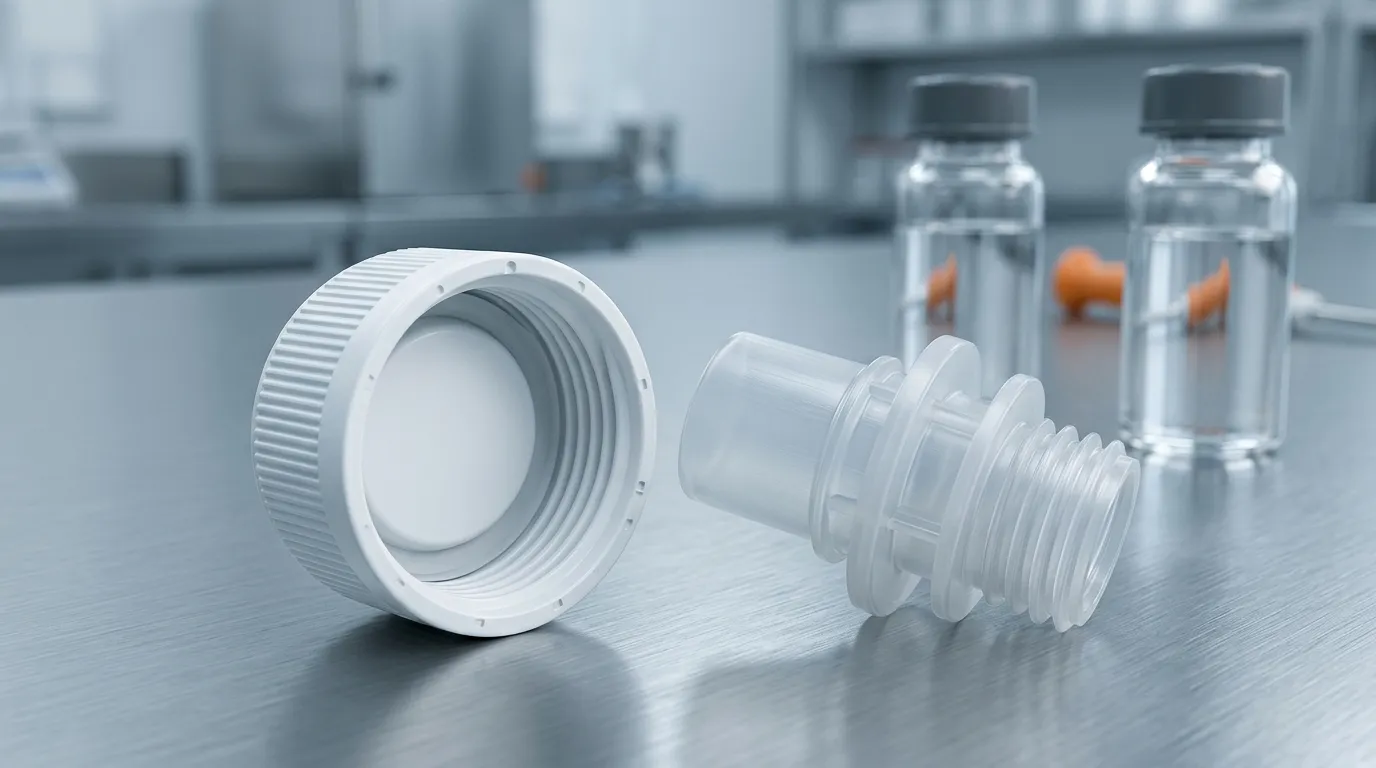
Component-level evidence: substance limits in PPWR apply to the closure as part of the packaging unit, not only to the film.
Food-contact law did not go away when PPWR arrived. Regulation (EC) No 1935/2004 and its implementing measures still govern what materials may touch food; PPWR's substance rules explicitly operate without prejudice to them. If you are new to that layer, our guide to food contact regulations for pouch spout caps covers the EU 1935/2004 picture alongside the US and China regimes.
The 2030 milestone: recyclability grades, recycled content and format bans
The 1 January 2030 milestone is actually four mechanisms arriving together, and they interact.
Recyclability becomes a graded market-access test. From 1 January 2030 — or 24 months after the design-for-recycling delegated acts enter into force, whichever is later — packaging may be placed on the market only if it is recyclable within performance grades A, B or C, as set out in Annex II: grade A at 95% recyclability or better, grade B at 80%, grade C at 70%. A unit scoring below 70% is classified as technically non-recyclable and cannot be placed on the market. From 1 January 2038 the bar rises to A or B only. These percentages are assessed per packaging unit across its components — our reading of how that lands on a pouch is that a mono-material PE pouch with a PE spout and cap has a realistic path to a high grade, while a multi-material pouch with a PP cap on a PE body has two mismatches to explain.
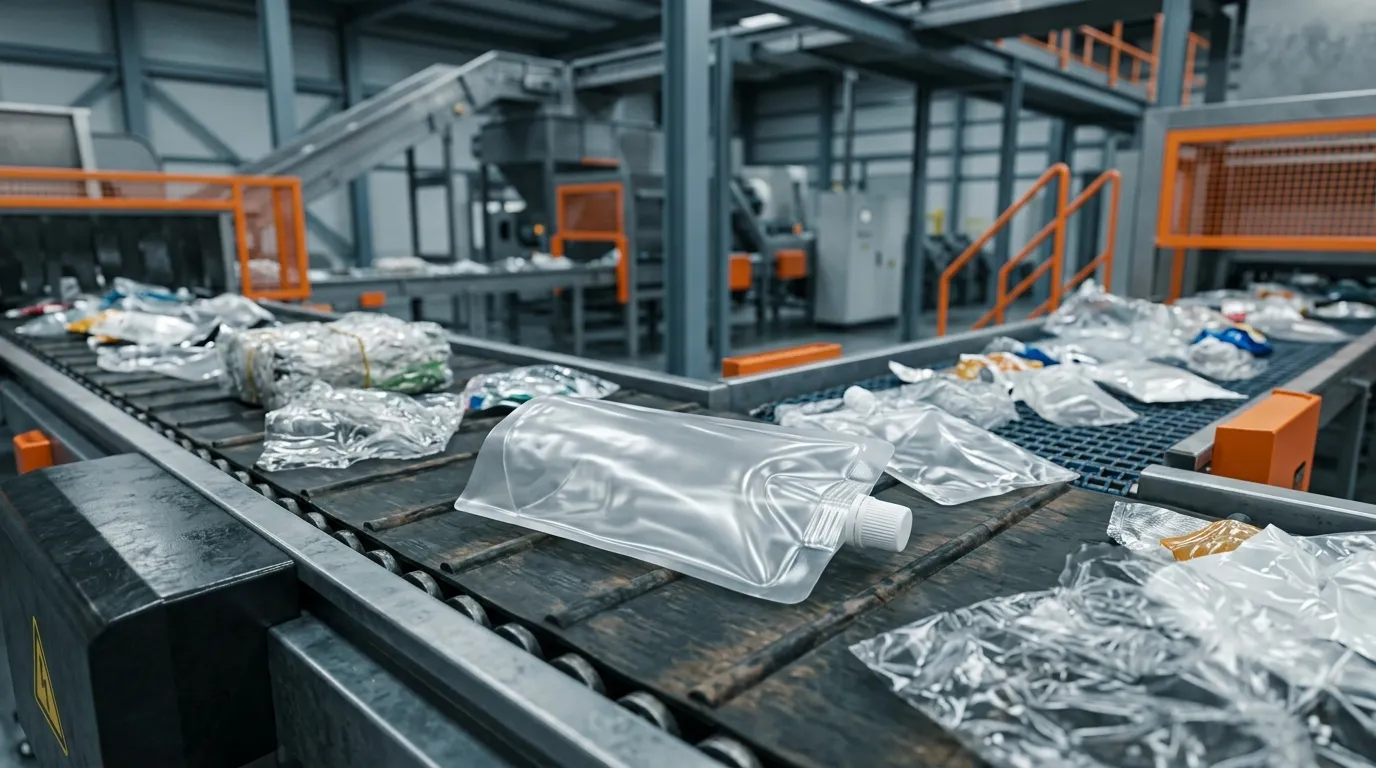
Design for recycling in practice: pouches whose film and closure share one material family sort cleanly and score better under the 2030 grade assessment.
Recycled content becomes mandatory in plastic packaging. Article 7 requires minimum post-consumer recycled content from 1 January 2030 (or three years after the calculation methodology's implementing act, due by 31 December 2026 — again, whichever is later). The bands: 30% for contact-sensitive PET, 10% for contact-sensitive plastics other than PET (the band most food-contact PE/PP pouches fall into), 30% for single-use beverage bottles, and 35% for other plastic packaging — the band that catches non-food pouches such as detergent refills. Targets climb again in 2040. Two carve-outs matter for pouch buyers: immediate packaging of medicines and some medical devices is out, and so is any plastic part representing less than 5% of the total weight of the whole packaging unit. Do not assume the spout cap qualifies for that last exemption automatically — measure it. On a lightweight pouch the closure can be a meaningful share of the packaging weight, even though it is trivial next to the product.
Six single-use plastic formats are banned. From 1 January 2030, Article 25 and Annex V stop the placing on the market of six formats: collation shrink-wrap used to group multi-packs at the point of sale, single-use packaging for fresh fruit and vegetables under 1.5 kg, food and drink packaging filled and consumed on HORECA premises, portion packs of condiments and sauces in HORECA, mini toiletries in accommodation, and very lightweight plastic carrier bags. Stand-up pouches as such are not on this list — but formats that travel with pouches can be. If you collate pouches into shrink-wrapped multi-packs, or supply HORECA portion sachets, check the exact wording of Annex V rather than assuming your product is outside it.
Labelling arrives before 2030. Under Article 12(1), a harmonised label showing material composition becomes mandatory from 12 August 2028 (or 24 months after its implementing act). Print space matters: for a spouted pouch the harmonised label will sit on the pouch body, which is exactly why artwork changes belong on your 2027 calendar, not your 2029 one.
The 2035 milestone: recycled at scale — and the 2038 follow-up
2030 answers "is this pouch designed to be recyclable?" 2035 answers a harder question: "is this type of packaging actually being recycled, at scale, in the EU?" Under Article 6(2)(b), the recycled-at-scale condition applies from 1 January 2035 — or five years after the implementing acts defining the assessment methodology (due by 1 January 2030), whichever is later. From 2035, the grade assessment adds a real-world factor: the quantity of material actually recycled from each packaging category, measured EU-wide, not the theoretical recyclability of your design.
For flexible packaging this is the milestone with teeth. Pouch formats have historically recycled at lower rates than rigid containers because of sorting realities — a reasoned expectation from industry practice, not a figure PPWR states — and a design that scores well on paper in 2030 can still fail at scale in 2035 if the format class as a whole is not being collected, sorted and recycled in sufficient volumes. This is also the honest place to say what the regulation does not do: it does not name spouted pouches, and it does not fix the flexible-packaging recycling rates itself. It sets the framework — delegated acts will define the design criteria, implementing acts will define the at-scale thresholds — and leaves the industry to meet them, a phasing the Commission described when the rules entered into application.

Recycled at scale from 2035 measures real EU recycling volumes per packaging category — the design that matters is the one that survives sorting.
What each milestone means for a spouted pouch, component by component
The section above is regulation text. This section is interpretation, clearly labelled as such: PPWR governs "packaging" and never once mentions spouted pouches, so everything below is a reasoned reading for your format, not a quote from the law.
Film structure is the biggest lever. Whether your pouch body is a mono-material PE structure or a multi-material laminate (for example PET/foil/PE for high-barrier needs) will largely determine your 2030 grade. Mono-material PE pouches are the direction the industry's own design-for-recycling protocols push for flexible packaging — the sort of criteria the delegated acts are expected to build on. If barrier needs force a multi-material structure, budget for the documentation burden of proving why, and for the grade ceiling that structure implies.
The closure must be part of the answer, not an afterthought. Because the spout and cap are components of the packaging unit, they enter the recyclability assessment and the substance documentation. The practical checklist: the spout cap's material family should match the pouch body (PE spout on PE pouch, not PP on PE), it must not be the component that introduces substances you then have to test away, and its data — resin, additives, test results — has to sit in the Annex VII file. This is the same logic as our guide to choosing a spout for a mono-material PE pouch, read with the PPWR clock in mind.

The closure is a packaging component under Article 3: its material, weight and substance data belong in the Annex VII file behind your declaration of conformity.
The separate tethered-cap rule is still standing. PPWR amends the Single-Use Plastics Directive (EU) 2019/904 rather than replacing it; for tethered caps on beverage containers up to three litres, the SUP Directive's rules continue to apply within their scope. So the tethered-cap obligation for beverage containers up to three litres — the rule that made caps stay attached — continues to apply on top of PPWR. Our explainer on the EU tethered cap rule for spouted pouches sets out which pouch products sit inside that scope; if yours does, you are managing two EU rules at once, not one, and choosing the right tethered cap is the product-side decision that follows.
A buyer's action timeline from today to 2035
| When | What to do | Why it cannot wait |
| Now (2026) | Map every EU-bound SKU to its packaging components; stand up the DoC file and technical documentation per packaging type | The 12 August 2026 obligations are already enforceable; a market-surveillance request can demand the documents within 10 days |
| 2026–2027 | Collect component substance evidence (heavy metals, PFAS/fluorine screens) from film and closure suppliers; check closure weights against the under-5% recycled-content carve-out | Substance limits apply to components now; test data on the exact SKU beats a generic certificate later |
| 2027–2028 | Fix the film-and-closure material strategy per SKU; start the redesign conversation for any multi-material structure | The design-for-recycling delegated acts are due 1 January 2028; artwork changes for the harmonised label land in 2028 |
| Before 2030 | Run each SKU against the coming grade criteria; confirm recycled-content sourcing is possible for the relevant band; retire formats that cannot reach grade C | Below-C packaging cannot be placed on the market from 2030; grade C itself disappears in 2038 |
| Before 2035 | Track the at-scale implementing acts and your format's real EU recycling outlook; revisit designs that rely on optimistic sorting assumptions | The recycled-at-scale condition starts in 2035 and is measured per packaging category, not per brochure |
The one habit that protects every other line on this table: treat 2030 and 2035 as moving dates until the underlying delegated and implementing acts exist. Bookmark the regulation text, follow the Commission's packaging pages, and re-check the later-of clauses before you freeze a packaging investment on a calendar assumption.
What to ask your supplier before the next EU order
You do not need your supplier to become an EU law expert. You need them to hand you component-level evidence in a form your technical documentation can absorb. Six questions cover most of it:
- What is the exact material family of the spout, cap and film, including additives? Mono-family (all-PE) answers are the ones that keep 2030 options open.
- Can you provide PPWR substance test data for this specific component — heavy metals per Article 5(4) and a PFAS/fluorine screen per Article 5(5) — not a generic certificate? A report for a sampled product is only useful if it matches the SKU you are buying; ask which sample it covers. As an example of the format to request, Ruihua holds SGS EU PPWR heavy-metal and total-fluorine test reports for sampled RD spout caps — the honest reading is that a report covers the tested sample, so read it against your exact component rather than treating it as a blanket pass.
- Does the spout seal onto your film at temperatures compatible with PE mono-material structures? Low-temperature sealing compatibility is what lets a closure stay in the same material family as a recyclable pouch body.
- What data can you contribute to the Annex VII technical documentation — resin, weight, dimensional drawings, material declarations? Component documentation is a stated ingredient of the file behind your declaration of conformity.
- If the cap is polypropylene on a PE pouch, what is the sorting and grade consequence, and what PE alternatives exist in the same mould? This is the single most common design conflict in spouted-pouch recycling.
- Can you freeze the material specification in writing? A silent resin change after your DoC is signed is how compliance quietly breaks.
Spouted pouch buyers have an advantage this regulation cycle: the EU's official guidance on PPWR, published by the Commission in 2026, exists to answer exactly the "who is responsible" questions above — a luxury earlier packaging regulations never offered. If this article leaves you with one action, it is to put your SKU list next to that guidance and your suppliers' data, and close the gaps the 12 August 2026 clock has already started measuring.
When you are ready to act on the dates, the two next steps are the ones the deadlines force. First, name the parts: Ruihua's spout caps for stand-up pouches page shows the range, and a sample and quote request is the fastest way to get SKU-specific substance and material data in hand. Second, if any SKU is still pre-mold — a new cap, a new spout, or a material change driven by the 2030 grade — run the PPWR fitment project brief before you commit tooling, and use our custom spout cap project planner to turn that brief into a form a supplier can quote against.
This article explains what Regulation (EU) 2025/40 says and where the spouted-pouch reading is our interpretation; it is not legal advice. Dates were verified against the EUR-Lex text on 6 September 2026 — delegated and implementing acts can shift the "whichever is later" dates, member states may interpret provisions differently, and your compliance counsel and the authorities of the markets where you sell are the final referees.