

The short answer: which pouch closure certification your product needs
If you sell filled stand-up pouches in the US, Europe or China, there is no single certificate that covers all three markets. Your pouch closure needs FDA 21 CFR compliance evidence for the US market, an EU 1935/2004 and EU 10/2011 Declaration of Compliance for Europe, and GB 4806.7 test reports for mainland China. A spout cap molded from polypropylene or polyethylene is a food-contact article in all three systems — but each system proves compliance differently, issues different documents, and enforces different limits.
This matters more than it sounds. Buyers frequently tell suppliers "we need food-grade certification" and get back a single PDF. That PDF only has value if you know which legal regime it maps to, whether it covers the finished cap or just the raw resin, and whether a migration test sits behind it. That is what this guide compares: the three certificate systems side by side, with the exact rules each one cites, so you can verify a supplier's documents instead of taking them at face value.
If you are new to the topic, start with our overview of food-grade spout cap certification, which explains the three layers of food safety for a molded cap. The rest of our Regulations & Recyclability center covers related rules such as the EU tethered-cap requirement.
What a food-contact "certificate" actually is — and what it is not
A certificate in the food-contact world is rarely a single official document. In practice it is a stack of evidence, and each market emphasizes a different piece of it:
- United States — the FDA regulates food-contact substances (FCS) under 21 CFR. It does not issue certificates of approval for individual products. Suppliers provide compliance letters based on the relevant 21 CFR sections, backed by migration testing.
- European Union — Regulation (EC) No 1935/2004 legally requires a written Declaration of Compliance (DoC) for materials and articles covered by specific measures; for plastics, Commission Regulation (EU) No 10/2011 details what that declaration must cover.
- China — GB 4806.7 is a mandatory national food-safety standard for plastic materials and articles; compliance is demonstrated with test reports from qualified laboratories against that standard.
So "certified" means different things in each market, and a phrase like "FDA approved" is itself a red flag: the FDA's own overview of packaging and food-contact substances describes a regulatory framework, not a product-certification scheme.
For a spout cap, food-contact compliance is also a three-layer stack: the resin must be permitted (or on an approved list), the finished molded article must pass migration testing, and the factory must operate under a food-safety quality system. A certificate covering only layer one (the resin) says nothing about the colorant, the sealing gasket or the silicone valve in your cap. When you ask a supplier for food contact material certification, ask which layers it actually covers.
At a glance: FDA vs EU 1935/2004 vs GB 4806.7
Dimension | US: FDA 21 CFR | EU: 1935/2004 + EU 10/2011 | China: GB 4806.7-2023 |
|---|---|---|---|
Legal nature | Regulations in the Code of Federal Regulations (indirect food additives) | Framework regulation + implementing regulation for plastics | Mandatory national food-safety standard |
Material authorization | FCS listed in 21 CFR (e.g. 21 CFR 177.1520 olefin polymers) or cleared via Food Contact Notification | "Union list" of authorized substances in Annex I of EU 10/2011, each with migration limits | Standard covers plastic materials and articles; additives controlled by companion GB 4806-series rules |
What a PP/PE spout cap maps to | 21 CFR 177.1520 (olefin polymers) | EU 10/2011 Annex I entries for PP/PE and their additives | GB 4806.7 for the article; resin scope merged in from 2023 |
Migration limits | Conditions of use per 21 CFR sections; compliance shown by migration testing | Overall migration limit of 10 mg per dm² plus specific migration limits | Overall migration and specific limits set in the standard, tested per the GB 31604-series methods |
Document you receive | FDA compliance letter (no FDA certificate exists) | Declaration of Compliance + migration reports | Test report from a qualified (CNAS) laboratory |
Who enforces | FDA (food-contact substances program); customs at entry | National food-safety authorities; EFSA for risk assessment | SAMR market-supervision authorities; customs |
Applies to | Products sold in the United States | Products sold in the EU / EEA | Products sold in mainland China |
Three takeaways from the table. First, the authorization mechanisms differ: the US regulates by listing permitted substances in 21 CFR (or clearing new ones by notification), the EU maintains a single Union list in EU 10/2011, and China folds the plastic resin and article requirements into GB 4806.7 itself. Second, the document you receive differs: compliance letter, DoC, or test report. Third, compliance is market-specific — none of the three documents transfers automatically to another market, even though the underlying migration data for PP/PE can be reused across all three.
US market: FDA food contact certification starts with 21 CFR
In the US, food-contact materials are regulated as indirect food additives. The general framework sits in 21 CFR Part 174, which sets the good-manufacturing-practice conditions for substances that contact food, and the polymer-specific rules sit in Part 177. For polypropylene and polyethylene — the two resins used for virtually all pouch spout caps — the relevant section is 21 CFR 177.1520, "Olefin polymers," which states that the listed polymers may be safely used as articles or components of articles intended for contact with food, subject to its specifications.
Three things follow from this that most "FDA certified" claims get wrong:
- The FDA does not certify caps. It regulates substances. A supplier cannot hand you an FDA certificate; the correct evidence is a compliance letter naming the resin and the 21 CFR sections it meets, plus migration data generated under the FDA's conditions-of-use framework. The FDA publishes guidance on determining the regulatory status of components of a food contact material — that is the procedure your supplier should have followed.
- The resin letter is not the finished article. 21 CFR 177.1520 covers the base olefin polymer. The color masterbatch, gasket and release agents in your molded cap are separate substances that must themselves be permitted — check that the compliance letter names the finished cap's full formulation.
- A Food Contact Notification (FCN) is the route for substances not already listed in 21 CFR; it is substance-specific and company-specific, so it does not transfer to your supplier's formulation.
A supplier selling into the US should be able to provide an FDA compliance statement covering both the resin and the finished article. Ruihua, for example, publishes its FDA food-grade compliance statement and other certificates openly — that is the level of documentation to expect.
EU market: EU 1935/2004 and EU 10/2011 compliance
The European system is two-layered. Regulation (EC) No 1935/2004 is the framework regulation for all food-contact materials. Its Article 3 sets the general requirements: materials must not transfer constituents in quantities that endanger human health, bring about an unacceptable change in the composition of the food, or deteriorate its organoleptic characteristics. Its Article 16 requires a written Declaration of Compliance for materials covered by specific measures, and Article 17 requires traceability at every stage. The European Commission's food-contact materials page is the official entry point for the whole system.
For plastics — which includes molded spout caps — the specific measure is Commission Regulation (EU) No 10/2011. It sets the Union list of authorized substances (Annex I, with a specific migration limit for each substance), the overall migration limit of 10 mg per dm² of contact surface, and the details of what the Declaration of Compliance must state. The DoC is not optional marketing: it is a legal document that must accompany the article at stages other than retail, and it must be backed by appropriate documentation — in practice, migration reports — available to national authorities on demand.
For a pouch closure, the practical checklist for the EU market is:
- A DoC for the finished spout cap (not just the resin), naming the supplier, the article and the regulation it complies with.
- Migration reports — overall migration and specific migration for the substances in the cap's formulation, including colorants.
- Traceability documentation so the finished cap can be traced back through the supply chain.
- Confirmation the cap also meets the sensory requirement (no taste or odor transfer), which Article 3 explicitly covers.
If your pouch is a single-use beverage pouch sold in the EU, the tethered-cap rule adds another requirement on top of food-contact compliance — we cover the details in our article on the EU tethered-cap rule for pouches.
China market: GB 4806.7-2023 for plastic food-contact articles
For pouches and closures sold in mainland China, the governing document is GB 4806.7, National food-safety standard — plastic materials and articles for food contact. The current version is GB 4806.7-2023, which replaced the 2016 edition and merged in the former resin standard GB 4806.6-2016 — so today the standard covers both the plastic resin and the finished article in one place. Its scope explicitly includes plastic materials and articles for food contact, including unvulcanized thermoplastic elastomers and starch-based plastics. The full Chinese text is published on government websites such as this official copy of GB 4806.7-2023.
What the standard requires in practice:
- Migration testing of the finished article against the methods in the GB 31604 series — overall migration, specific migration and sensory evaluation, with limits set for food-contact plastics.
- Additive compliance — substances used in the plastic must meet the additive rules in the companion GB 4806-series standards.
- Production qualification — Chinese manufacturers of food-contact plastic packaging are required to hold a production license (工业产品生产许可证) for the category.
GB 4806.7 applies to the article sold into China regardless of where it was made, so an imported spout cap needs the same test-report evidence as a domestic one. Chinese factories exporting closures to the US or EU, in contrast, must also hold the FDA and EU documentation described above — for the full picture of sourcing and verification, see our guide to sourcing spout caps from China.
Migration testing in food simulants is the evidence behind every food-contact certificate.
Migration testing: the evidence behind the certificate

Every system above — the FDA compliance letter, the EU Declaration of Compliance, the GB 4806.7 test report — points back to the same underlying evidence: migration testing of the finished article. The reason is that a molded cap, not a pellet, is what touches the food. Injection molding introduces heat history, the colorant adds new substances, and a silicone valve or gasket changes the contact surface.
Migration testing places the finished cap against food simulants under time and temperature conditions that represent the worst realistic contact (for a pouch closure, typically the hot-fill, ambient-storage or refrigerated conditions the filled pouch will actually see). It measures:
- Overall migration — the total mass of substances transferred, compared against the limit (10 mg/dm² under EU 10/2011; corresponding limits under GB 4806.7).
- Specific migration — individual substances against their specific limits, which for EU 10/2011 are listed per substance in Annex I.
- Sensory evaluation — the cap must not transfer taste or odor, a requirement written into EU 1935/2004 Article 3.
When you receive a certificate, the migration report behind it matters more than the certificate itself. A report should state the test standard, the simulants used, the time and temperature conditions, and the measured results — not just a "pass" line.
How to verify a supplier's certificate: a six-point checklist

A document that looks official can still be useless. Work through these six points before you accept any pouch closure certification:
Check | What to look for |
|---|---|
| "GB 4806.7-2023", not "GB 4806.7"; "21 CFR 177.1520", not just "FDA" |
| EU DoC from the business placing the article on the market; FDA compliance letter from the manufacturer or a testing laboratory; GB test report from a qualified (ideally CNAS-accredited) laboratory |
| Must cover the molded cap, not only the base polymer — otherwise colorant and gasket are unverified |
| Reference to the specific resin grade, colorant and gasket material, so it belongs to your cap and not a generic product line |
| Report number, test standard, simulants and conditions — a certificate with no test evidence is a piece of paper |
| US evidence does not satisfy the EU DoC requirement, and neither transfers to China — match the document to the destination market |
Some signals that a certificate does not mean what it claims: the phrase "FDA certified" or "FDA approved" (the FDA certifies nothing in this space), a standard number that has been superseded, a certificate in another company's name, and any claim that one document covers "all markets". Our broader pouch closure regulatory guide includes a deeper list of compliance red flags and how to catch them during supplier audits.
Batch-level quality control is what turns a tested sample into a repeatable claim.
Which regime applies to your pouch closure
Use the destination market as the primary decision driver:
- Pouches sold in the US → demand FDA 21 CFR compliance evidence (resin + finished article) with migration data.
- Pouches sold in the EU/EEA → demand a Declaration of Compliance under 1935/2004 and EU 10/2011, plus migration reports and traceability documents.
- Pouches sold in mainland China → demand GB 4806.7-2023 test reports from a qualified laboratory, and confirm the manufacturer holds the production license if it is a Chinese supplier.
- Multi-market products → stack the evidence. The good news is that one set of PP/PE migration data supports all three systems in practice, because the underlying science is the same; what changes is the document and the legal framing. Confirm the same data is presented in each required format.
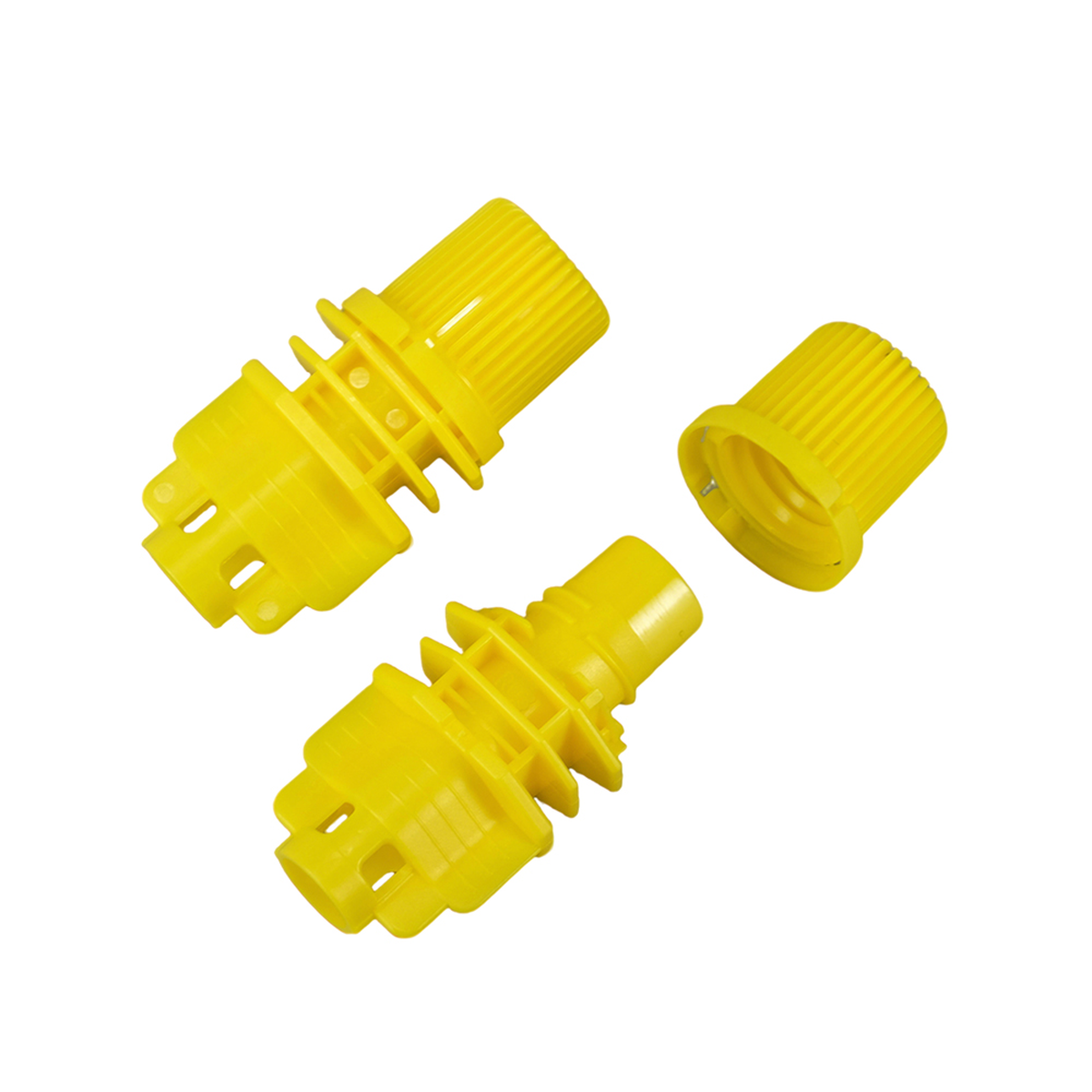
The article type matters too. A spout cap welded into a pouch is a food-contact article in its own right, so its resin, colorants and gasket are all in scope — a certificate for the pouch film alone does not cover the closure. And if your pouch is a single-use beverage pouch in the EU, add the tethered-cap requirement to the list. For closures destined for mono-material recyclable PE pouches, the low-temperature sealing behavior of the spout matters alongside compliance — see our article on mono-material PE pouch spouts.
The finished closure is the unit of compliance — its formulation, not just the resin, must be covered by the certificate.
Frequently asked questions
Is "FDA approved" a real thing for spout caps? No. The FDA does not approve or certify individual food-contact products. What exists is compliance with 21 CFR sections (for PP/PE, mainly 21 CFR 177.1520) demonstrated through testing, documented in a compliance letter. Treat "FDA certified" claims as a signal to ask for the actual 21 CFR references and test reports.
Does EU 10/2011 apply to spout caps on pouches? Yes. A molded PP or PE spout cap is a plastic article intended for food contact, so it is covered by EU 10/2011 and must be accompanied by a Declaration of Compliance under the 1935/2004 framework. This is separate from the tethered-cap rule, which applies only to beverage containers.
Does GB 4806.7 apply to imported spout caps? Yes. GB 4806.7-2023 applies to plastic materials and articles placed on the Chinese market regardless of origin, so an imported closure needs the same migration-test evidence as a domestically produced one.
Can one certificate cover all three markets? No single document does, but the underlying migration data can. A well-tested PP/PE cap can support FDA compliance evidence, an EU DoC and a GB 4806.7 test report from the same data set — you just need each document prepared in the correct format for its market.
Bottom line: what to demand from your supplier
Certificates are only as good as the evidence behind them. Before you approve a spout cap for a food pouch, demand: (1) a compliance document that names the exact standard with its year, (2) coverage of the finished article including colorant and gasket, (3) the migration report behind the claim, and (4) a match to your destination market — FDA 21 CFR evidence for the US, a DoC under EU 1935/2004 and EU 10/2011 for Europe, GB 4806.7 test reports for China. A supplier that cannot produce these on request has not actually done the work.
At Ruihua, every spout cap is molded from food-grade PP/PE, and we publish our FDA, EU 1935/2004 (issued by TÜV SÜD), ISO 9001 and HACCP certificates, with GB 4806.7 referenced at product level for China-bound orders. Browse the spout cap product line or request the certificate package with your sample — we will send the documents that match the markets you sell into.
Note: This article is for general information only and is not legal or regulatory advice. Regulations and standards change — verify current requirements with your compliance team, a qualified laboratory or the relevant authority before relying on any certificate.