
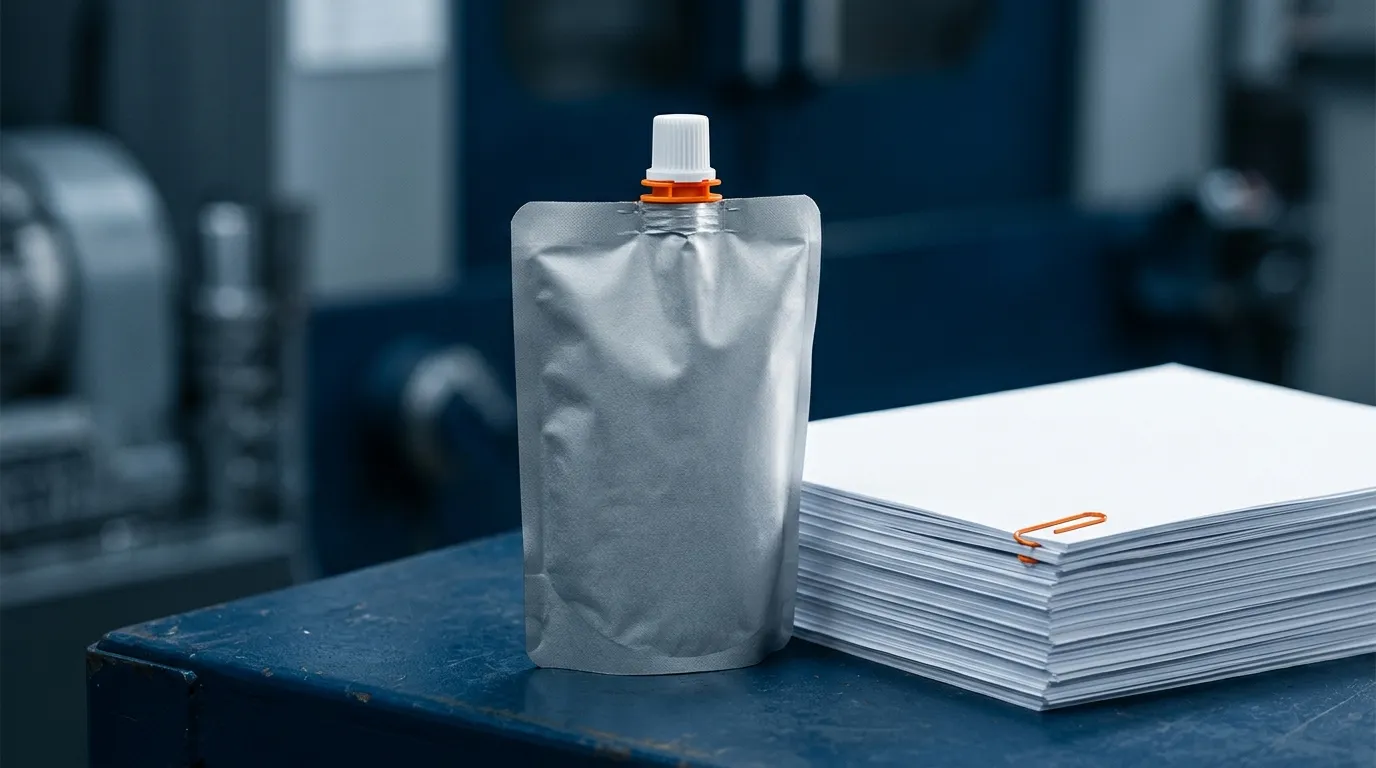
Since 12 August 2026, packaging placed on the EU market has to carry a traceable file behind it: an EU declaration of conformity backed by technical documentation. For a stand-up pouch, that file is only as strong as the component-level evidence underneath it — and the spout cap is the component buyers most often forget to ask about.
The PPWR declaration of conformity is not a form your pouch supplier mails you once. It is the top layer of a three-layer documentation chain, and the middle layer — the technical documentation required by Annex VII — has to contain "conceptual design, manufacturing drawings and materials of components". That phrase puts the spout cap squarely inside your paperwork. This guide walks through what the declaration must state, how component data flows into it, and the exact checklist to run against your spout cap supplier before your next EU order — and it lives in our regulations and recyclability hub alongside the rest of the EU compliance guides for pouch closures.
One note on scope before the checklist: this article is about what the file has to contain. The dates that file has to be ready for — and which obligations bite in 2026, 2030 and 2035 — are mapped separately in our PPWR timeline for spouted pouches, and if your pouch is still pre-mold, the PPWR fitment project brief is the earlier entry point. This guide stays on the documents.
What a PPWR declaration of conformity actually is
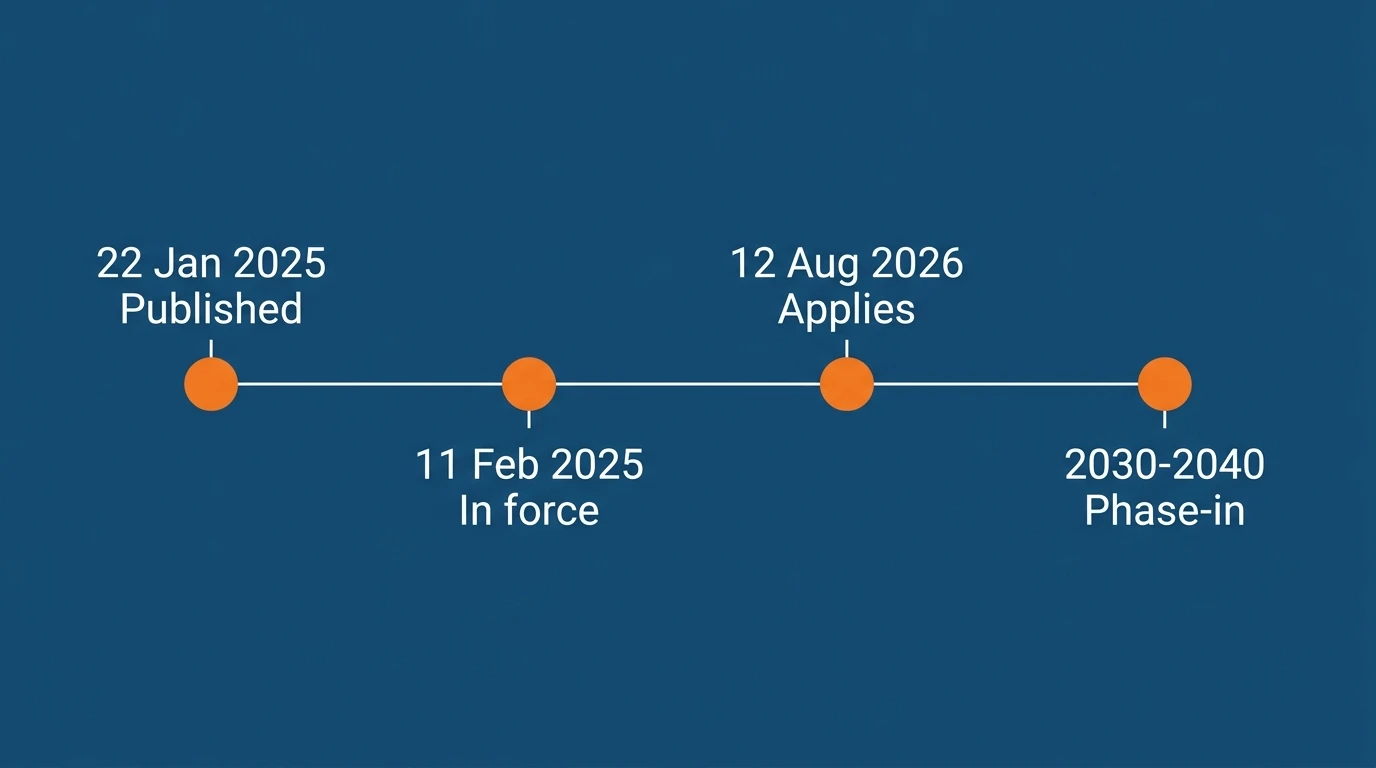
The Packaging and Packaging Waste Regulation — Regulation (EU) 2025/40, published in the Official Journal on 22 January 2025 and applying from 12 August 2026 — requires manufacturers to draw up an EU declaration of conformity for packaging before placing it on the market. Article 39(1) says the declaration must state that fulfilment of the requirements in or under Articles 5 to 12 has been demonstrated. Those articles cover: substances in packaging (Article 5), recyclability (Article 6), minimum recycled content (Article 7), biobased feedstock (Article 8), compostability (Article 9), packaging minimisation (Article 10), reusable packaging (Article 11) and labelling (Article 12). Everything a spout pouch must be in 2026 and beyond sits in that list — and two items in it are easy to under-prepare: packaging minimisation (Article 10) has to be demonstrated in the technical documentation, not asserted, and labelling (Article 12) moves to a harmonised material-composition label from 12 August 2028, so the label data and the declaration file need to stay consistent from day one.
Three legal details shape how the document works in practice:
- Structure is fixed. Article 39(2) requires the declaration to follow the model structure in Annex VIII: a unique declaration number, the manufacturer's name and address, a statement that the declaration is issued under the manufacturer's sole responsibility, identification of the packaging object, references to the Union legislation and harmonised standards applied, notified body details where applicable, and signature with place and date.
- One declaration can cover several laws. Article 39(3) allows a single EU declaration of conformity where packaging is also subject to other Union acts — it must list each act and its publication reference, and may be a dossier of individual declarations.
- It sits on top of a conformity assessment. Under Article 15(2), the manufacturer must first run the conformity assessment procedure in Annex VII (Module A, internal production control), build the technical documentation, and only then draw up the declaration.
The core obligation is short, and it is worth reading in the regulation's own words:
The EU declaration of conformity shall state that the fulfilment of the requirements laid down in or pursuant to Articles 5 to 12 has been demonstrated.— Article 39(1), Regulation (EU) 2025/40
| A PPWR declaration of conformity is… | …and is not |
| A signed statement by the manufacturer that Articles 5–12 requirements are met | A certificate issued by a notified body (third-party certification is only needed where a notified body is involved) |
| One document per packaging type, kept current and versioned | A one-time purchase order attachment |
| Backed by technical documentation held for 5 years (single-use) or 10 years (reusable) | A marketing claim about being "eco-friendly" |
| Drawn up in a language accepted by the member state where the packaging is placed on the market | A document you can write from a template without evidence |
One boundary is worth stating early: this article explains what the regulation says and what documentation to collect — it is not legal advice. Obligations and evidence requirements differ by packaging type and target market, and your compliance counsel and the relevant market authorities are the final referees.
Why spout pouches make the DoC a three-layer document
A stand-up pouch is never one material. The pouch film, the spout, the cap, and any gasket or liner are manufactured separately and joined at filling time. Under PPWR, "packaging" is assessed as the packaging unit, but the evidence trail is component-level — Annex VII's technical documentation must cover the "materials of components", and Article 5's substance limits apply to "packaging or packaging components" individually.
That creates a three-layer document chain that buyers of spouted pouches specifically need to understand:
- Component layer — each component supplier (film extruder, spout moulder, cap moulder) provides data on materials, substances, food contact and recycling design for its part.
- Technical documentation layer — the manufacturer of the packaging unit (typically the converter or the brand that places the pouch on the market) assembles that data into the Annex VII file: general description and intended use, design drawings, materials of components, and the analysis of conformity with each applicable requirement.
- Declaration layer — the manufacturer signs the Annex VIII declaration, taking sole responsibility for the whole unit.
Who signs matters for imported pouches. If you are a brand or importer placing a spouted pouch on the EU market, you are on the hook for the declaration even though you did not mould the cap — which is why the practical question is not "who signs" but "what did you collect from your suppliers before signing". Importers carry their own verification duty: before placing packaging on the market they must confirm that the manufacturer has carried out the conformity assessment and drawn up the Annex VII technical documentation, and that the packaging is accompanied by the required documents (Article 18(2)(a) and (c)). Distributors, in turn, must verify the labelling before making packaging available (Article 19(2)(b)). The file therefore travels with the packaging — not just with the manufacturer who signed it. Our pouch closure regulatory guide maps the same boundary for food-contact rules, where the pattern is identical: the finished article carries the obligation, and the components carry the evidence.
The timing also matters more than it looks. The regulation entered into force on 11 February 2025 (twenty days after publication), but the obligations bite from 12 August 2026 — so the 2026/2027 buying season is the first one where pouches placed on the EU market need this file from day one, and the phased targets (recyclability grades, recycled content) run to 2030 and 2040. The full milestone picture, date by date, is in our PPWR timeline for spouted pouches.
How component data becomes a signed declaration
The cleanest way to explain what you are collecting is the flow the regulation itself draws. Component data flows from suppliers into the technical documentation; the technical documentation is the basis for the conformity assessment; the assessment is what the declaration certifies; and all of it is what a market surveillance authority can ask to see.
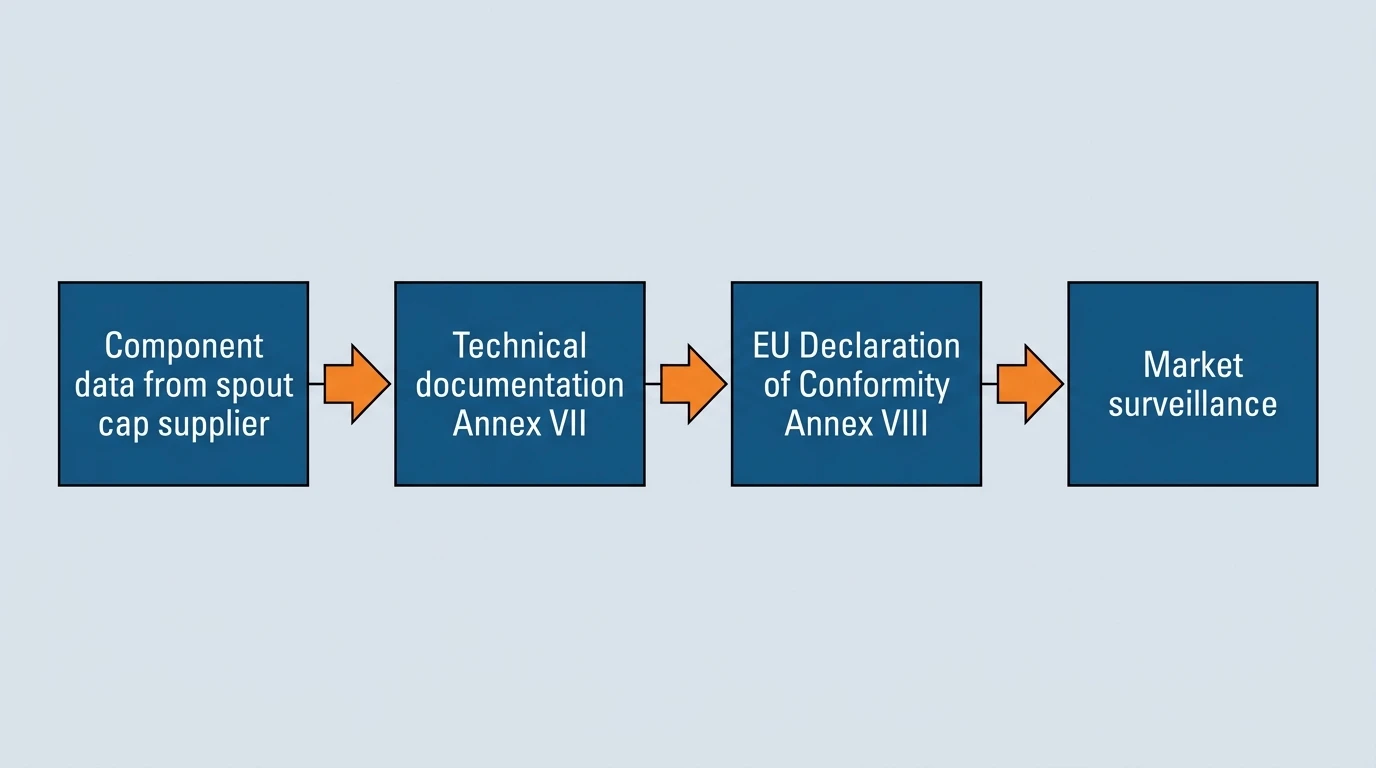
A few articles pin this chain down:
- Article 15(2) — before placing packaging on the market, the manufacturer carries out the conformity assessment, draws up the technical documentation per Annex VII, and draws up the declaration per Article 39.
- Article 15(3)(a) and (b) — the technical documentation and declaration must be kept for 5 years from the date of placing on the market for single-use packaging, and 10 years for reusable packaging.
- Article 15(5) — packaging must bear a type, batch or serial number or another identification element, so that the declaration can be matched to physical product. For a spout pouch, that identification usually lives on the pouch label and the cap batch code.
For a flexible packaging buyer, the operational takeaway is simple: every document you request from a supplier should be filed under the component it describes, with a batch or type reference, so that when a surveillance request arrives the file assembles itself instead of turning into a three-week search across email attachments.
The component documentation checklist for spout caps
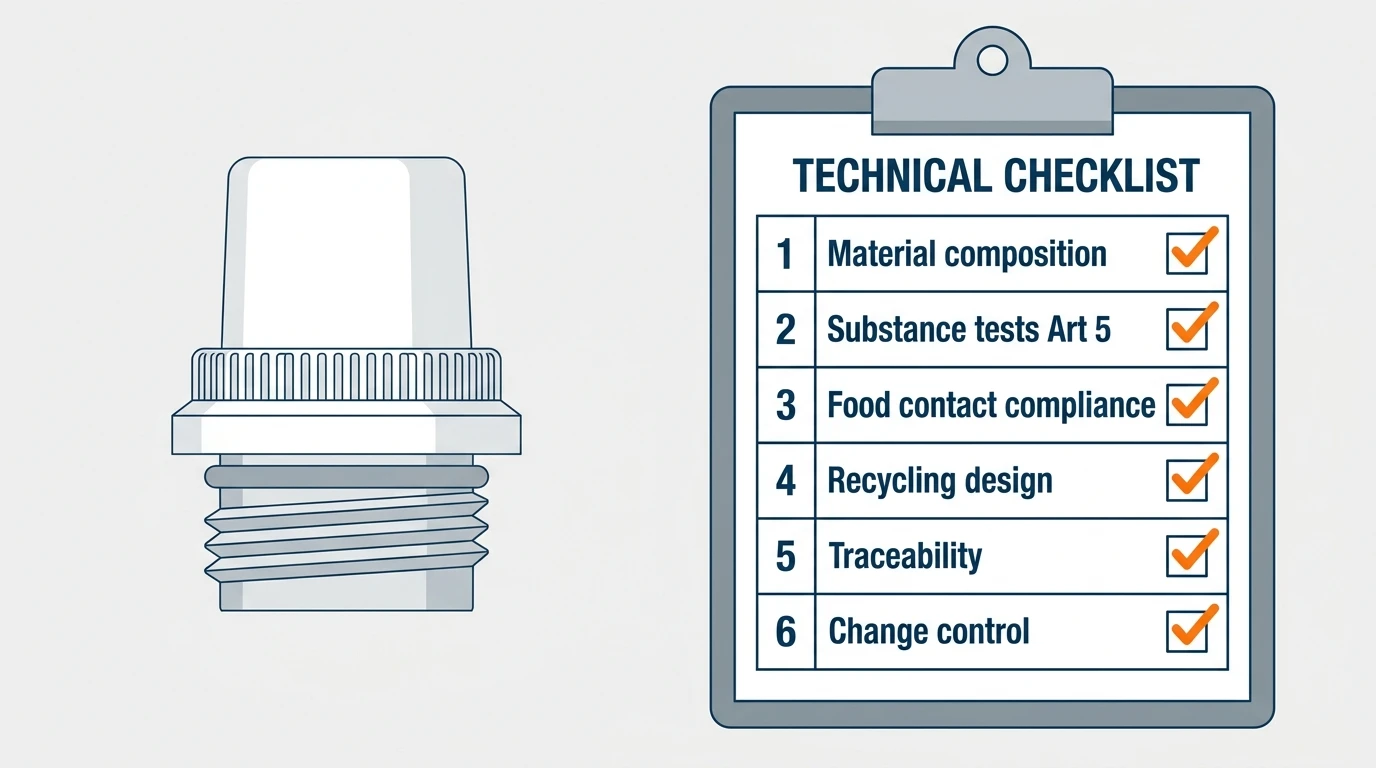
Here is the core of this guide: the checklist to run against your spout cap supplier. Six items, each with the document you should receive, why it matters, and where it lands in your Annex VII file.
| # | Ask the supplier for | Why it matters | Lands in the file as |
| 1 | Material composition statement — resin grades, additives, color masterbatch, filler | Annex VII needs "materials of components"; Article 5 substance limits apply per component; masterbatch changes silently alter migration behaviour | Materials section of technical documentation |
| 2 | Substance compliance evidence (Article 5) — heavy-metal sum test (lead, cadmium, mercury, hexavalent chromium ≤ 100 mg/kg) and, for food-contact caps, total-fluorine / PFAS screening | From 12 August 2026 the 100 mg/kg sum limit is mandatory and PFAS limits apply to food-contact packaging | Article 5 conformity analysis + test reports |
| 3 | Food-contact documentation — EU Declaration of Compliance under Regulation (EC) 1935/2004 and migration test data against Regulation (EU) 10/2011 where the pouch holds food | The cap is part of the food-contact surface; a food-contact claim needs the finished-component evidence, not just a resin datasheet | Component conformity evidence |
| 4 | Recycling design data — material identification (PP/PE), component weight and density, removability guidance, compatibility with the pouch film's recycling stream (e.g. RecyClass assessment support) | Article 6 recyclability is assessed on the packaging unit; an incompatible cap can downgrade the whole pouch | Article 6 recyclability assessment |
| 5 | Identification and traceability — cap type/batch/serial marking, drawing number, revision | Article 15(5) identification; lets you match the declaration to physical stock | Object identification in Annex VIII |
| 6 | Change control commitments — what happens to your file when the supplier changes resin, masterbatch or tooling | The declaration must be "continuously updated" (Article 39(2)); without a change notification you are signing stale evidence | Version log of the technical documentation |
The checklist is intentionally short — six items, all of which a serious spout cap manufacturer can answer from existing files. That is the point. If a supplier hesitates on items 1 and 2, the conversation has already told you how the audit would go. For food-contact markets we have covered the certification layer in more depth in our guide to food-grade spout cap certification; the PPWR checklist sits on top of that, not instead of it.
Substance limits to verify first: Article 5
Article 5 is where a spout cap most often fails quietly, because it is the requirement that applies to components before anything is assembled. Two limits matter from 12 August 2026:
- Heavy metals. Article 5(4): the sum of the concentrations of lead, cadmium, mercury and hexavalent chromium in packaging or packaging components must not exceed 100 mg/kg. This is a hard number, tested on the finished component — including the color masterbatch, which is the usual hiding place for these substances.
- PFAS. Article 5(5): from 12 August 2026, food-contact packaging may not be placed on the market if it contains per- and polyfluorinated alkyl substances (PFAS) at or above the limit values set directly in the regulation: 25 ppb for any PFAS as measured with targeted PFAS analysis (polymeric PFAS excluded from quantification), 250 ppb for the sum of PFAS, where applicable with prior degradation of precursors, and 50 ppm for PFAS including polymeric PFAS. Where total fluorine exceeds 50 mg/kg, the manufacturer or importer must, upon request, provide proof of the quantity of fluorine measured as PFAS or non-PFAS content in order to draw up the Annex VII technical documentation — which is why a total-fluorine screening report is the right first signal to request today.
The evidence you should accept is a third-party test report naming the component and the test method — for example, an SGS report on a spout cap sample against the Article 5(4) heavy-metal sum, or a total-fluorine test against Article 5(5). Read those reports with two caveats in mind. First, a report covers the sample tested, not "all products forever" — batch-level screening is what keeps the claim honest. Second, a total-fluorine pass is not the same as a PFAS-free statement; if your buyer requires a PFAS-free claim, ask for the specific PFAS analysis behind it. And where the pouch holds food, remember the cap is part of the food-contact surface: substance evidence under Article 5 does not replace the migration testing required under the food-contact framework — the Declaration of Compliance of Regulation (EC) No 1935/2004 and the migration limits of Regulation (EU) No 10/2011.
| Article 5 quick check | Threshold / rule | What to file |
| Heavy metals (Pb + Cd + Hg + Cr VI) | Sum ≤ 100 mg/kg from 12.8.2026 | Test report on the finished cap (incl. masterbatch) |
| PFAS in food-contact packaging | Any PFAS 25 ppb; sum of PFAS 250 ppb; PFAS incl. polymeric 50 ppm, from 12.8.2026 | Total-fluorine screening + PFAS analysis where required |
| Scope | Applies to packaging and packaging components | Component-level statements, not just pouch-level |
Recyclability and recycled-content data for the file
Article 6 makes the statement simple and the evidence hard: "All packaging placed on the market shall be recyclable." The regulation grades recyclability — performance grade A (≥ 95 %), B (≥ 80 %), C (≥ 70 %) — under design-for-recycling criteria phased in from 2030, with a recycled-at-scale assessment following from 2035. Article 7 adds minimum recycled content for plastic packaging: from 2030, 30 % for contact-sensitive PET and single-use beverage bottles, 35 % for other plastic packaging, and 10 % for contact-sensitive plastics other than PET; from 2040 those climb to 50 %, 65 %, 65 % and 25 % respectively.
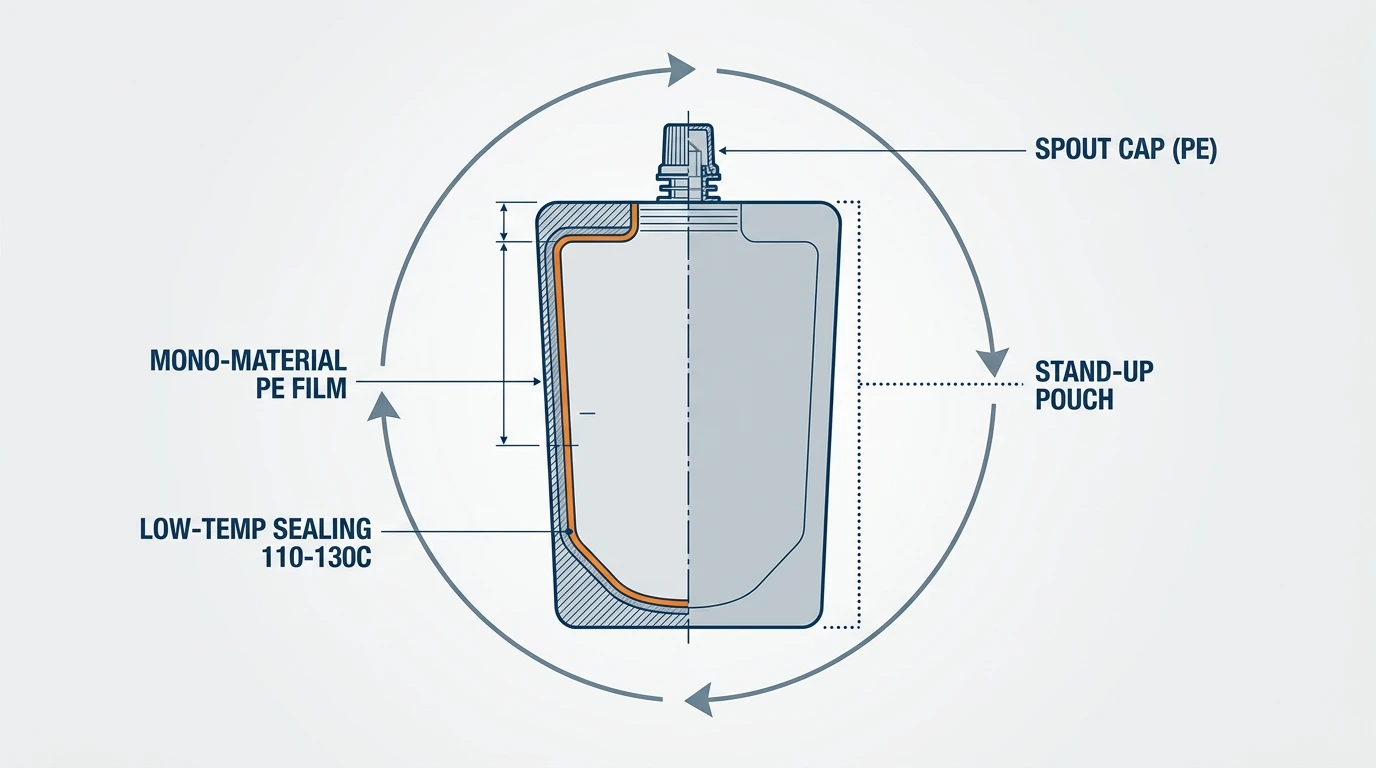
For spouted pouches, the component interaction is the part generic guides skip. A mono-material PE pouch can be a well-designed recyclable unit — until a cap made of a different polymer, a metal or glass-fibre-loaded resin, or a weld temperature that burns the PE seal layer quietly ruins its sorting or its seal integrity. In the EU, flexible packaging design-for-recycling is assessed against protocols such as RecyClass, which evaluate the whole unit, closure included. Three component properties decide the outcome:
- Polymer compatibility — the cap should match the pouch film's polymer family (PE for a mono-material PE pouch) so the whole unit sorts into one stream.
- Low-temperature sealing — spouts engineered to weld at 110–130 °C protect the PE seal layer; higher sealing temperatures burn the film and create a heat-damaged, hard-to-recycle edge.
- Removability and weight — a cap that separates cleanly, or is designed as part of a compatible system, keeps the film recyclable and the grade defensible.
We have written the mono-material side of this in detail in our guide to mono-material PE pouches and spout compatibility, and the beverage-pouch closure rule that interacts with recycling design in our EU tethered cap explainer for spouted pouches. For the DoC file, what you need from the supplier is written evidence on all three: polymer family, sealing window, and component weight/density for sorting models.
Keep the file audit-ready: retention, language, updates
A declaration of conformity is a living document, and the regulation says so in so many words: Article 39(2) requires it to be continuously updated. Three disciplines keep the file defensible:
- Retention. Keep the technical documentation and the declaration for 5 years after placing single-use packaging on the market (10 years for reusable packaging) — and keep supplier evidence for at least as long, because a surveillance request can arrive years after the shipment.
- Language. The declaration must be drawn up in, or translated into, a language required by the member state where the packaging is placed on the market. If you sell into several member states, budget for translations as a repeatable step, not a surprise.
- Update triggers. Re-issue the declaration and refresh the technical documentation whenever the evidence changes: new resin grade, new color masterbatch, a tooling revision, a supplier change, or a new harmonised standard. A change control clause in your component supply agreement (checklist item 6) is what makes "continuously updated" operationally true instead of aspirational.
Market surveillance authorities can ask to see the file at any point in the retention window, and the European Commission's packaging waste pages are the official starting point for checking how requirements are being applied. The difference between a stress-free response and a compliance incident is rarely the evidence itself — it is whether the evidence is organised, versioned and matched to batch identification before the request arrives.
Build the checklist into supplier qualification
The six-item checklist is not a one-time email; it belongs in your supplier qualification process. Add it to the request-for-information stage (so non-compliant candidates filter themselves out early), to sample approval (the test reports should accompany the first articles, not follow them), and to annual review (re-run items 1, 2 and 6 — materials and processes drift, declarations age). Every document should carry the supplier's name, date and a revision number, filed under the component it describes.
When you are evaluating spout cap suppliers, the practical test is simple: ask for items 1–6 and time the response. A supplier with a real compliance system answers from existing files within days. At Shantou Ruihua, the substance evidence is already on file — the EU 1935/2004 food-contact certification, plus SGS test reports on the RD spout-cap sample against Article 5(4) (heavy-metal sum) and Article 5(5) (total fluorine) — and the low-temperature-sealing spout range is documented for mono-material PE pouch programs. Any supplier you hold to the same standard is a supplier you can sign a declaration on top of.
Where this file fits your project
The checklist above answers one question: what evidence has to sit under the declaration. Two adjacent questions have their own guides:
- When must the file be ready, and what changes on 2030 and 2035? See the PPWR timeline for spouted pouches, where every date is checked against the regulation text.
- Still choosing the part? If the spout cap has not been tooled yet, the seven decisions that harden into steel are set out in the PPWR fitment project brief — get those right and this checklist becomes a filing exercise rather than a redesign.
Ready to collect the evidence? Ruihua's range of spout caps for stand-up pouches and doypacks is documented component by component, and a sample and quote request is the fastest way to get material, substance and food-contact data for your specific SKU in hand.
FAQ
Does every packaging type need its own declaration of conformity? Yes in practice: the declaration identifies the packaging object it covers (Annex VIII point 4), and the technical documentation is per packaging type and format. One declaration for "all spouted pouches" is not defensible; structure the file per pouch/packaging type, with the cap data as a shared, referenced component section.
Does the spout cap itself need its own PPWR declaration? Not as a separate declaration — the cap is a packaging component, and the declaration covers the packaging unit. But the cap's material, substance and recycling data must appear in the unit's Annex VII technical documentation, and Article 5 limits apply to the component directly. Component-level evidence is mandatory; a separate declaration is not.
Can one declaration cover several pouch sizes? Yes, where the packaging type is genuinely the same — same film structure, same spout system, same component data, differing only in dimensions. Name the type precisely in the object identification and keep a versioned list of formats covered. If any component changes, that is a new evidence set and a new declaration.
What if my spout cap supplier cannot provide the component documents? That is the finding — and better discovered at qualification than in an audit. Without item 1 (material composition) and item 2 (substance evidence) you cannot make the Article 5 analysis, and without item 4 you cannot make the Article 6 recyclability assessment. Options: request the documents formally, switch to a supplier that holds them, or have the tests run independently and add the cost to the component price. Signing a declaration on evidence you do not have is the one option that is not viable.
Certification requirements vary by market, product and packaging configuration — verify the specific obligations for your pouch with your compliance counsel and the authorities of your target market.