
A mono-material PE pouch spout can be part of a recyclable PE pouch system, but a PE spout on a PE film is not, by itself, a recyclability verdict for the whole pack. The claim holds only after you confirm the film and its sealant layers, the remaining components (barrier layers, inks, zippers), the sealing window, the filling conditions (hot-fill and similar), and the recycling criteria of your target market — CEFLEX, RecyClass, and How2Recycle each assess packs on their own basis. Treat the PE fitment as a strong starting point, then validate the system before you call the pouch recyclable.
When a PE fitment is a sensible starting point
A PE spout with a PE cap is the right starting point for a mono-material pouch when three conditions hold:
- The film is PE-based. A PE/EVOH/PE structure or a coated PE film, with a PE sealant layer where the spout welds. Whether the film is MDO-PE or BOPE does not change the fitment decision — the sealant layer does.
- The line seals at low temperature. Mono-PE film is heat-sensitive, and low-temperature sealing spouts are engineered for the 110–130 °C range, inside the window most mono-PE films tolerate. If your line already runs there, a qualified low-temperature spout is a natural match.
- The product is filled cold or at ambient temperature — or the filling profile is already validated. Ambient and cold-fill lines add no heat to the pack after the weld, so the spout's qualified window is the whole story.
That last condition is the one worth being explicit about: hot-fill and retort do not inherit this general conclusion. Pasteurization and hot-fill lines put heat into the pack a second time, after the spout weld, which tightens both the film's and the spout's requirements. A PE fitment can still work in those applications, but it needs its own qualification rather than being assumed from the ambient case. If you are at the start of a mono-material switch, the pouch fitment compatibility guide walks through how to check a spout against your film structure and filling profile before you commit.
Starting with a PE fitment also gives the recyclability assessment a clean base: a foreign-polymer closure is one of the most common reasons a mono-material pouch gets downgraded in classification, so removing that variable early makes the rest of the validation much easier to read.
Why the spout decides whether a "mono-material" pouch is truly mono
A "mono-material PE pouch" is only mono-material if every part of the pack — film, spout, cap, and the seals that join them — stays inside the polyethylene family or uses materials the PE recycling stream accepts. Converters sometimes build a clean PE/EVOH-PE film structure for a stand-up pouch, then fit a spout that silently breaks the system: a PP spout, a cap with a different-polymer insert, or a resin blend never designed for the PE waste stream. The result is a pouch that looks recyclable on the spec sheet and drops out of the PE stream in practice.
Design-for-recycling schemes such as CEFLEX's guidelines treat the pack as a whole, and classification systems like RecyClass grade closures separately. A spout or cap made from a different polymer family can push the entire pouch into a lower recyclability class, or out of the compatible stream altogether. So when you are choosing a mono-material PE pouch spout, the real question is not "does this spout seal well?" — it is whether the spout keeps the whole system inside one polymer family, and whether it welds without destroying the heat-sensitive mono-PE film around it.
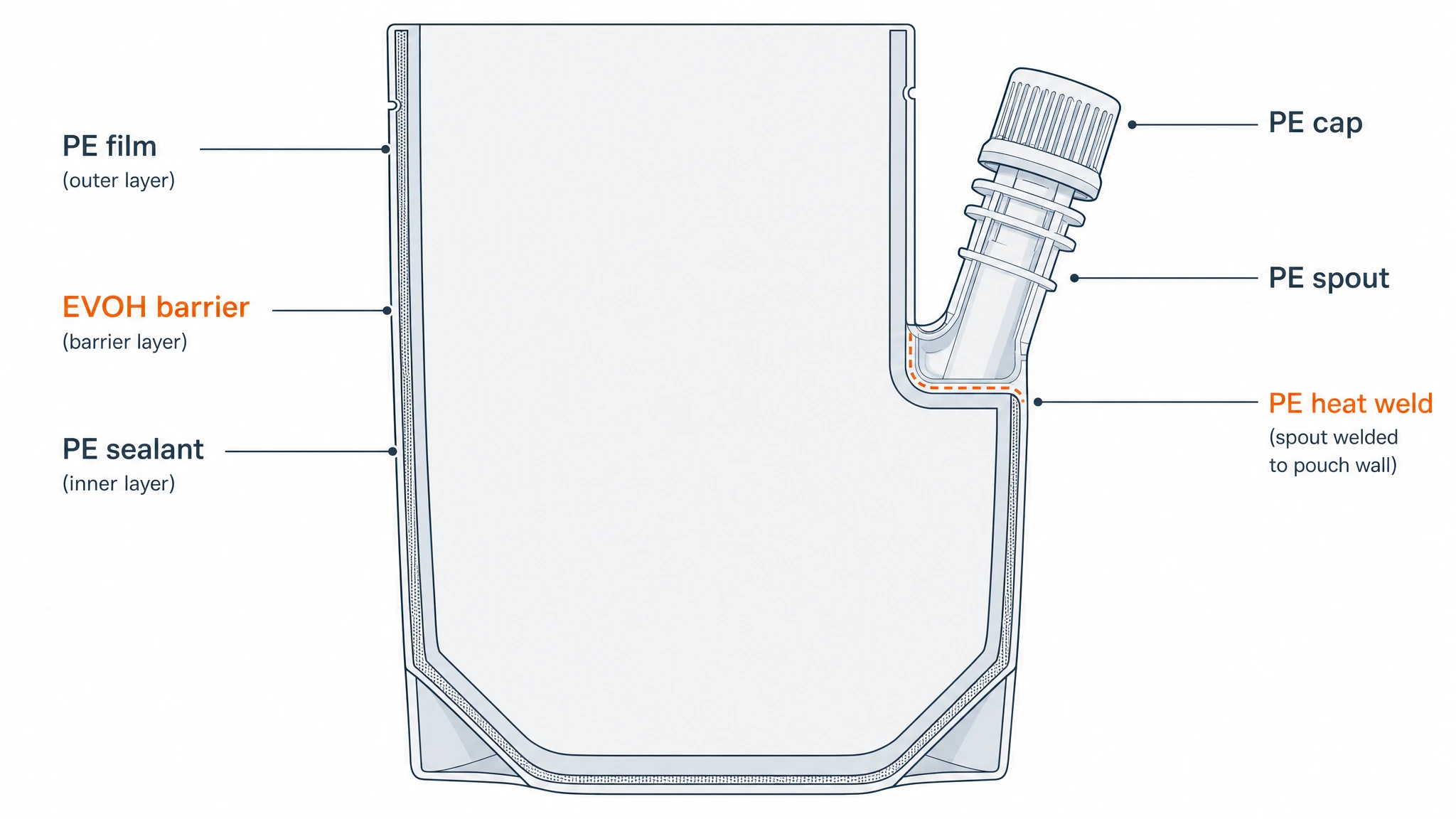
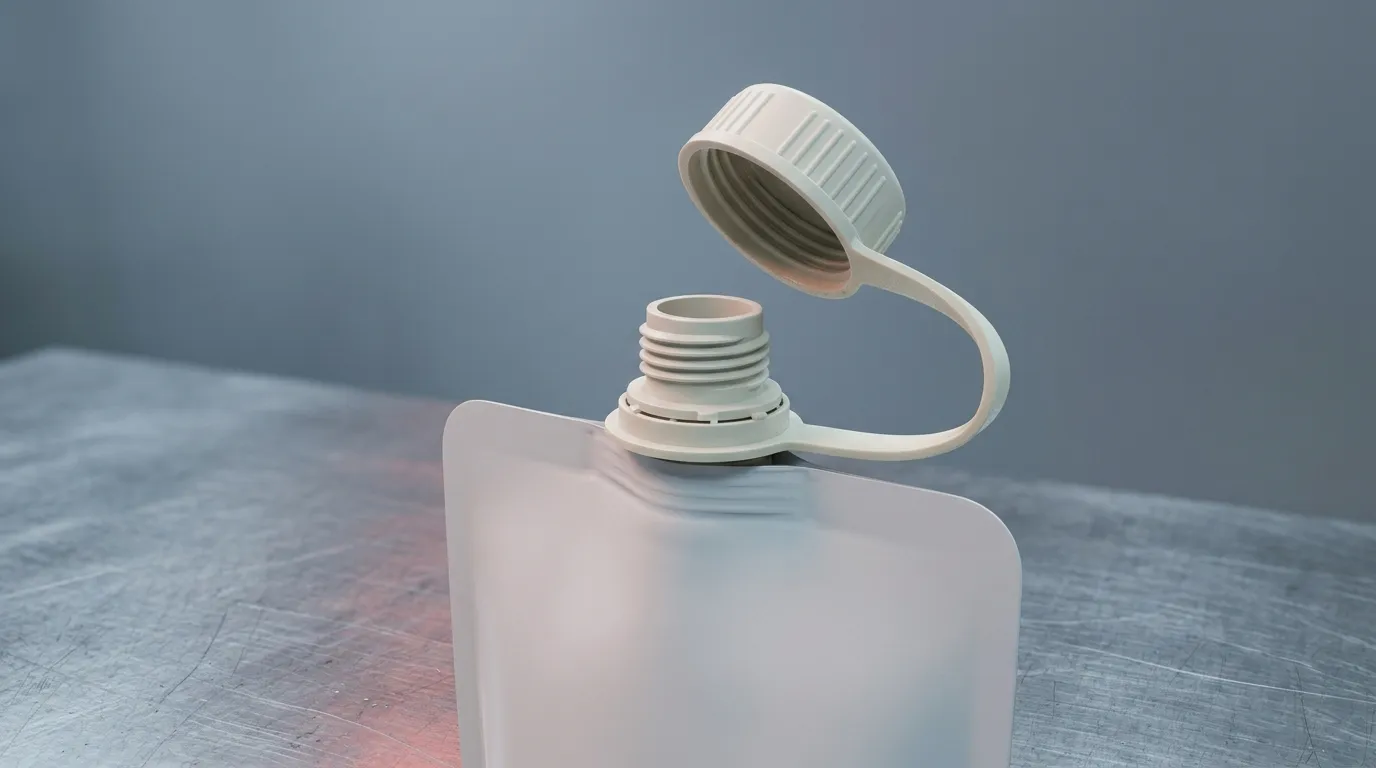
Cross-section of a mono-material PE pouch: PE film layers, an EVOH barrier layer, and a PE spout welded into the sealant layer.
The short answer: match the polymer, then match the heat window
For a recyclable mono-material PE pouch, the spout that fits does three things:
- Uses a PE-based resin (with a PE cap), so the pack stays in the PE recycling stream;
- Welds in the film's low-temperature window — mono-PE film is heat-sensitive, so the spout must seal cool enough not to burn through, wrinkle, or distort it; low-temperature sealing spouts are engineered around the 110–130 °C range;
- Carries the cap design your market needs — for the EU, that increasingly means a tethered (non-separated) cap.
That is the whole job in one paragraph. The rest of this article explains each point far enough to write a spout specification — material, bore, sealing window, cap style — before you talk to a supplier. If you are sourcing the fitment now, the common-shape PE spout cap range covers the food-contact PE fitments that weld into a mono-PE sealant layer, including the low-temperature sealing versions.
Spout material: what a mono-material PE pouch spout is actually made of
PE spout on a PE pouch. The cleanest choice. Spout, cap, and film share one polymer family, so the whole pack can be sorted into the PE stream. Food-grade PE spouts are standard for juice, sauce, detergent, and personal-care pouches.
PP spout on a PE pouch. Common on existing pouch lines, but it breaks mono-material logic. In design-for-recycling assessments, a PP closure on a PE pack counts as a foreign component — conditionally compatible at best, and a common reason to downgrade the pack's recyclability class. If your film supplier is certifying a PE structure, do not assume the old PP spout carries over.
Low-melting compound spouts. Some suppliers offer low-melting versions that weld more easily onto heat-sensitive films. They work, but they add cost and are usually a workaround. The alternative is spout geometry engineered so the weld concentrates heat where the film tolerates it — that is how some spout makers keep the sealing window low without low-melting additives.
| Spout material | Fit for a mono-material PE pouch | Effect on recyclability | Watch out for |
| PE spout + PE cap | Best fit | Stays in the PE stream; cleanest classification | Confirm food-grade resin if the product is food |
| PP spout + PP cap | Poor fit on a PE pouch | Foreign component in the PE stream; downgrades the pack's class | Works only if the whole pouch is switched to PP |
| Low-melting compound | Usable workaround | Depends on the base resin — ask which family it belongs to | Extra material cost; check long-term seal strength |
One film-side note: your film supplier will talk about MDO-PE or BOPE structures — the spout does not care which, as long as the sealant layer the spout welds into is PE. What matters for spout selection is the sealing window, not the film's orientation technology.
Three questions to ask a spout supplier:
- What resin family is the spout and cap made from — PE, and food-grade?
- What sealing temperature window is the spout qualified for, and does it overlap my film's window?
- Is a tethered (non-separated) cap available if I need it for the EU market?
Sealing temperature: the number your converter actually cares about
Mono-PE film is more heat-sensitive than the PET/nylon laminates most pouch lines were tuned for. Seal too hot and you burn through or wrinkle the film; seal too cold and the weld is weak — and a weak spout weld is a leak waiting for the drop test. That is why the sealing window is the most important compatibility number between spout and film, and why "low temperature sealing spout" shows up as a product category at all.
Low-temperature sealing spouts are engineered to weld in the 110–130 °C range, which sits inside the window most mono-PE films tolerate. At those temperatures the spout flange melts into the film's PE sealant layer without overheating the outer layers. The practical payoff: a spout qualified for a low window gives your converter room to adjust line speed and pressure without drifting out of the film's safe range. Hot-tack matters here too — the weld has to hold while the film is still warm and being handled on the line, so a qualified window is not just a number on a datasheet but a range the line can actually operate in. When a supplier quotes a window, ask what it is based on — lab film, or pouch films at line speed — because the number only helps if it holds on your structure.
Sealing temperature also interacts with what is inside the pouch. Hot-fill and pasteurization lines (fruit purees, sauces, beverages) put heat into the pack twice — once at the spout weld, once at filling — so spout, film, and filling profile have to be specified together. If you are deep in this topic, our guide on how sealing temperature affects spout cap performance walks through the trade-offs in more detail.
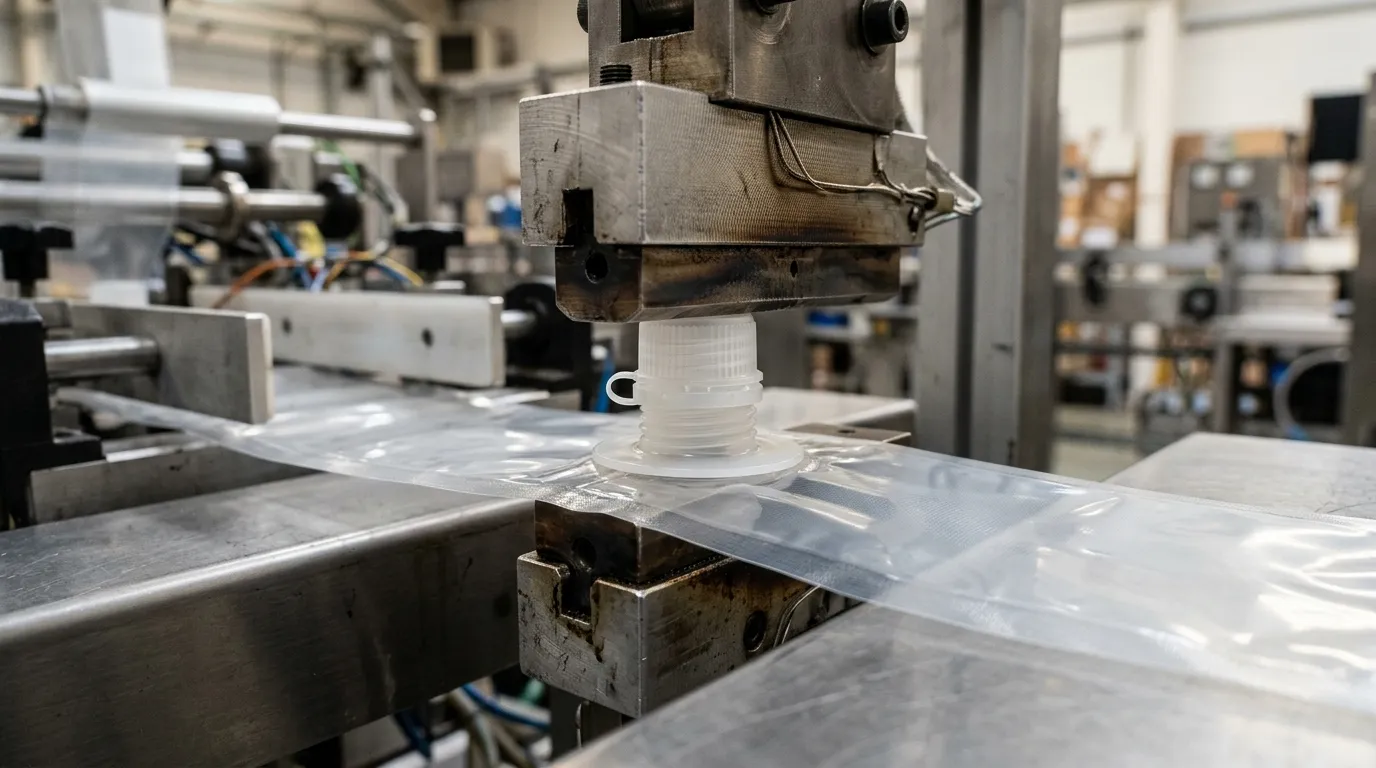
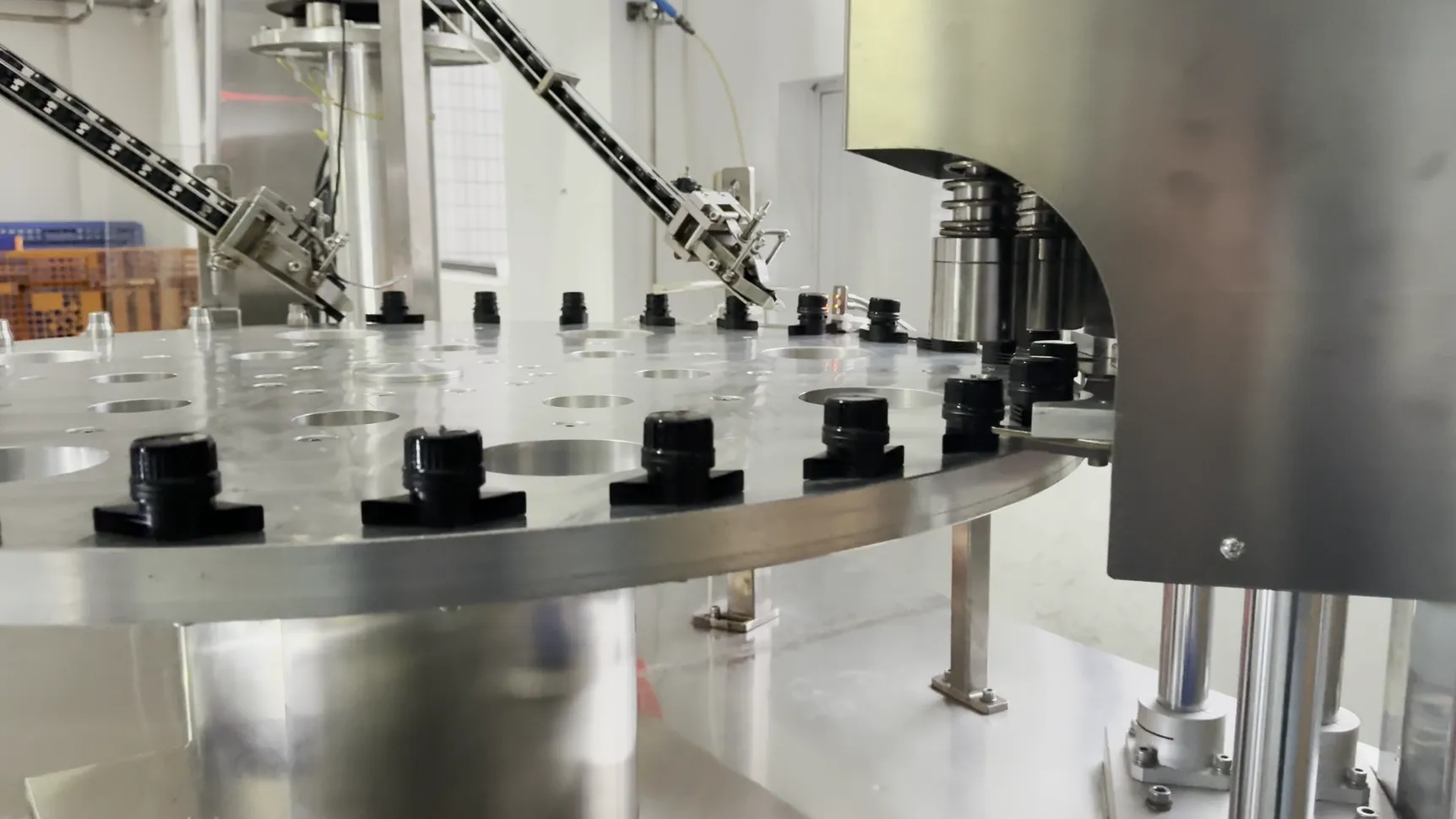
Low-temperature sealing on the line: the spout flange welds into the PE sealant layer without overheating the film.
Diameter and cap design: sizing to the product and the market
Bore size. The spout's inner diameter controls flow — both filling speed on the line and how the consumer dispenses the product. Small bores (5–8.6 mm) suit low-viscosity products and precise dispensing: beverages, oils, cosmetics. Mid bores (8.6–10 mm) are workhorses for juice, water, and sauce pouches. Large bores (20–40 mm) handle high-viscosity contents — ketchup, detergent, shampoo — and large-format pouches where fast fill or pour matters. Match the bore to how fast the pouch needs to fill and pour, then check it against pouch size so the spout does not dominate the pack. One more line-side detail: confirm how the spout is inserted on your filling line — pre-made spouts welded before pouch forming are the common route for mono-material pouches, and the spout's flange geometry has to suit that station. Our diameter guide goes through the matching logic bore by bore.
Cap style. The cap is a functional decision, not decoration. Flip-top caps suit repeat-use liquids. Screw caps with tamper-evident rings suit food products where proof of opening matters. And for the EU, cap design is now a regulatory input: since July 2024, single-use plastic beverage containers up to three liters sold in the EU must have caps that stay attached after opening, under Directive (EU) 2019/904 — a requirement the PPWR carries forward. Non-separated (tethered) spout caps, where the cap stays connected to the spout base, are the direct answer for pouch formats. A non-separated spout cap is a catalogued fitment here, not a custom-mold project. We have covered how the EU tethered cap rule applies to pouches separately if you need the details.
Don't expect the spout to add barrier
Oxygen and moisture protection in a mono-material pouch comes from the film — typically an EVOH layer inside a PE/EVOH/PE structure, or a coated PE film. The spout does not add barrier; it is an injection-molded part, and the closure interface is one of the few places a pack can pick up oxygen over shelf life. What the spout actually contributes is seal integrity: a well-welded spout keeps the film's barrier structure intact, while a poor weld or an ill-fitting cap undoes everything the film achieves.
Two consequences. First, judge a spout on dimensional consistency and seal performance, not on barrier claims — those are what protect the film's barrier. A spout whose bore or flange varies by fractions of a millimeter creates intermittent weld defects, and an intermittent weld is an oxygen and moisture path you cannot see from the outside. Second, if a supplier pushes a "high-barrier spout" as a selling point, ask what they mean: EVOH-containing spout materials can complicate the mono-material story, because barrier-layer share is one of the factors in recyclability classification. The film does the barrier; the spout's job is to not leak and not break the polymer family.
The practical consequence for shelf-life work: the film's oxygen and moisture transmission rates (OTR/WVTR) are what a shelf-life calculation uses, not the spout's. The spout only needs to keep its own interface leak-free — which is exactly why weld consistency and closure fit are the properties worth qualifying, and why a barrier claim on a spout is a red flag rather than a selling point.
Regulatory checks before you commit
Recyclability requirements. Under the EU Packaging and Packaging Waste Regulation (PPWR, Regulation (EU) 2025/40) — in force since February 2025 and applying since August 2026 — packaging placed on the EU market must meet design-for-recycling requirements by 2030 and be recyclable at scale by 2035. That is a whole-pack requirement — the spout and cap are part of the assessment. Design guidance from CEFLEX and classification from RecyClass are the working tools converters and brands use to check a structure before it ships.
Food-contact compliance. For food and beverage pouches, the spout and cap are food-contact materials: EU Regulation 1935/2004 is the framework in Europe, and FDA requirements apply for the US market. In practice that means asking for certificates at the material level — the EU framework requires a declaration of compliance from each supplier in the chain, and US buyers typically request FDA-compliant material documentation. Ask for the supplier's certificates rather than trusting a sales sheet — material-grade documentation is standard from a qualified spout manufacturer. Our overview of what food-grade spout cap certification actually covers explains how to read them.
Environmental claims. If you plan to print "recyclable" on the pouch, the claim has to be defensible in the market you sell into. The disciplined phrasing is "designed for recycling" or "recyclable where facilities exist" — collection and sorting availability varies by region, which is why US brands qualify claims with How2Recycle's label guidance. Our recyclability and regulatory hub for pouch closures pulls these threads together.
What still needs system validation
The spout is one component of the pack, and the mono-material claim is a whole-pack claim. Before you print "recyclable" or submit the structure to a classification scheme, five parts of the system still need evidence:
- Film structure. PE/EVOH/PE with an EVOH share inside the scheme's limits, or MDO-PE/BOPE with a PE sealant layer. Ask the film supplier for a structure declaration — layer composition and barrier share — because that data is an input to the assessment, not something the spout can compensate for.
- Remaining components. Barrier coatings, inks, zippers, and any other fitments each carry their own design-for-recycling rules. A PE spout does not offset a zipper or an ink system the scheme rejects.
- Flange-to-film weld. The spout flange has to weld into the sealant layer inside the film's window. Weld strength and hot-tack behavior come from line trials on your actual film at your actual speed and pressure — not from a datasheet.
- Post-fill performance. Fill flow, seal integrity, and drop-test results show whether the weld survives filling, handling, and distribution. A spout that seals well on a lab sample can still fail when the line runs faster or the pouch drops at warehouse temperature.
- Market recycling criteria. CEFLEX's design guidelines, RecyClass's classification grades, and How2Recycle's label rules each evaluate the pack on their own criteria. Check the structure against the scheme for the market you sell into, rather than assuming "PE" is enough everywhere.
Worth keeping the two words separate: mono-material describes the structure — every layer and component stays in one polymer family — while recyclable describes the outcome, the structure passing the collection, sorting, and reprocessing criteria of a specific market's scheme. A mono-material pack can still fail that check if a scheme's limits on barrier share or closure weight are exceeded.
Who holds each check matters as much as what it covers. The film supplier owns the structure data; your converter owns the flange-to-film weld qualification and the line trial; and the brand, using the converter's evidence, owns the submission to the target market's scheme. When a component supplier offers to "certify recyclability", ask which of those three layers they are actually covering — most can only speak to their own part.
A sample and validation planner sequences these checks — which need a lab sample, which need a production-line trial, and what data to collect at each stage — so validation happens before tooling commits, not after.
What Ruihua can support
Ruihua manufactures food-grade spout caps for stand-up pouches and doypacks, and the part of a mono-material project we can support directly is the fitment:
- Matched PE components. PE spouts paired with PE caps across a 1.2–40 mm bore range, including low-temperature sealing spouts engineered for heat-sensitive mono-PE film. Cap styles run from flip-top to screw with tamper-evident ring to tethered/non-separated for the EU market.
- Samples for your trials. Request samples so your converter can run flange-to-film weld trials and drop tests against your actual film — request samples and a quote to start the process.
- Model and material information. Spec sheets for existing models and material grades — resin family, sealing window, bore options — so you can compare them against your film data. The spout cap specification sheet guide explains what to read and what to ask for.
One boundary, stated plainly: Ruihua cannot issue a whole-pack declaration of conformity, and cannot certify that your pouch is recyclable. That verdict belongs to the brand and its supply chain — it depends on the film structure, components, filling conditions, and market recycling evidence listed above, and no single component supplier can sign it. What we can provide is the fitment data that goes into that assessment. Send your film structure and line conditions — sealing window, fill temperature, bore target — and we can flag which existing PE models fall inside your window before you commit to tooling.
A five-point spec checklist before you order
Before you send the RFQ, be able to answer these five points:
| Spec point | Why it matters |
| Polymer family — spout and cap are PE and food-grade, same family as the film | Keeps the pack in the PE recycling stream and clears classification |
| Sealing window — spout qualified for a low-temperature window (110–130 °C class) overlapping your film's window | Prevents burn-through, wrinkles, and weak welds on heat-sensitive mono-PE film |
| Bore size — inner diameter matched to product viscosity, fill speed, and pouch format | Controls filling line speed and consumer dispensing |
| Cap design — flip-top, screw with tamper-evident ring, or tethered/non-separated per market and product | Matches usage and keeps you aligned with EU tethered-cap requirements |
| Documentation — food-contact certificates, material data, and sealing recommendations in writing | Makes compliance review and audits straightforward |
A spout that clears those five points will weld cleanly, stay inside the PE stream, and survive the compliance review. Ruihua engineers spout caps for stand-up pouches and doypacks across a 1.2–40 mm bore range in food-grade PP/PE — including low-temperature sealing spouts for recyclable mono-material PE pouches. Request samples or a spec review through our samples and quote page to check your structure against a qualified spout.