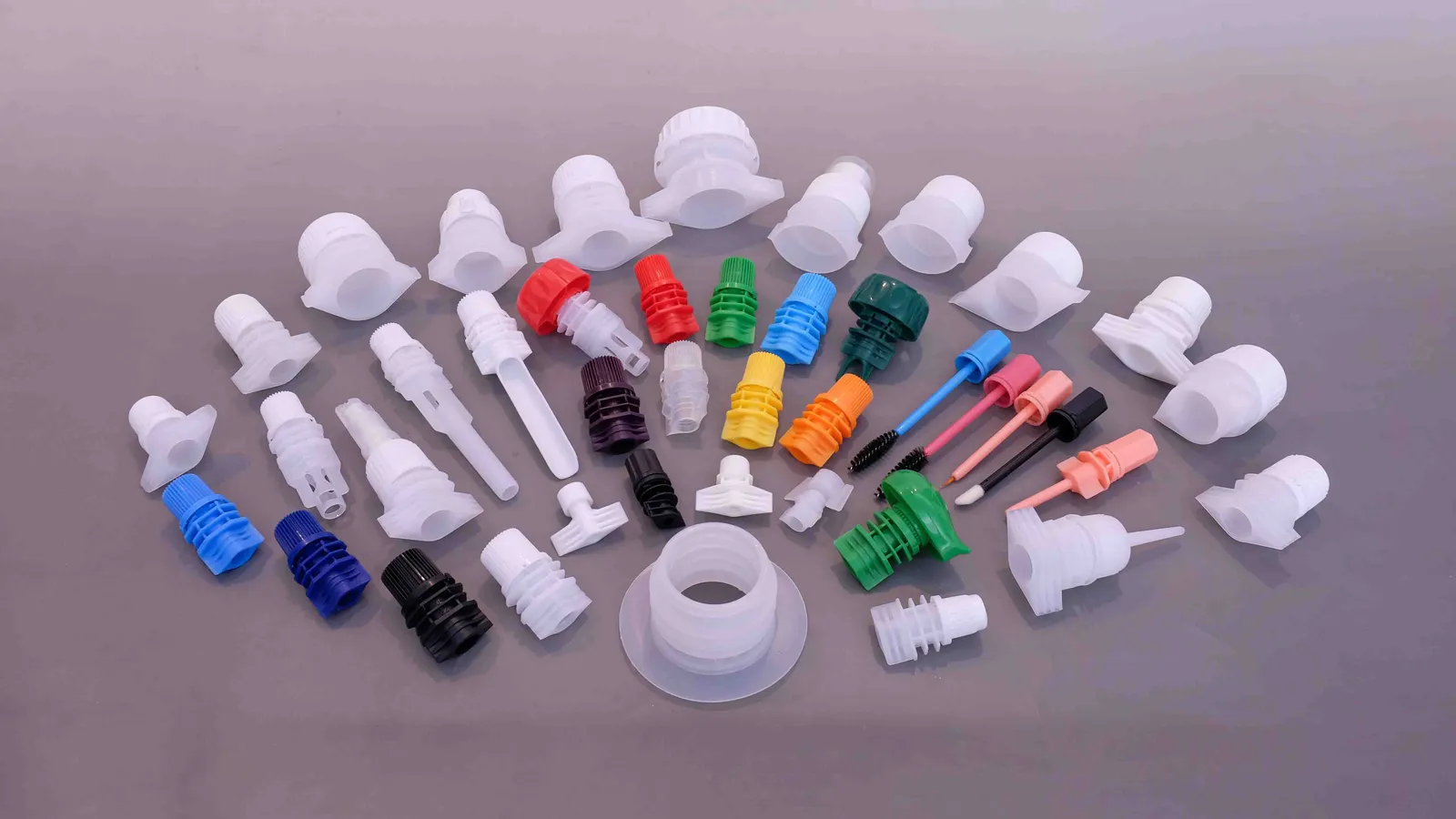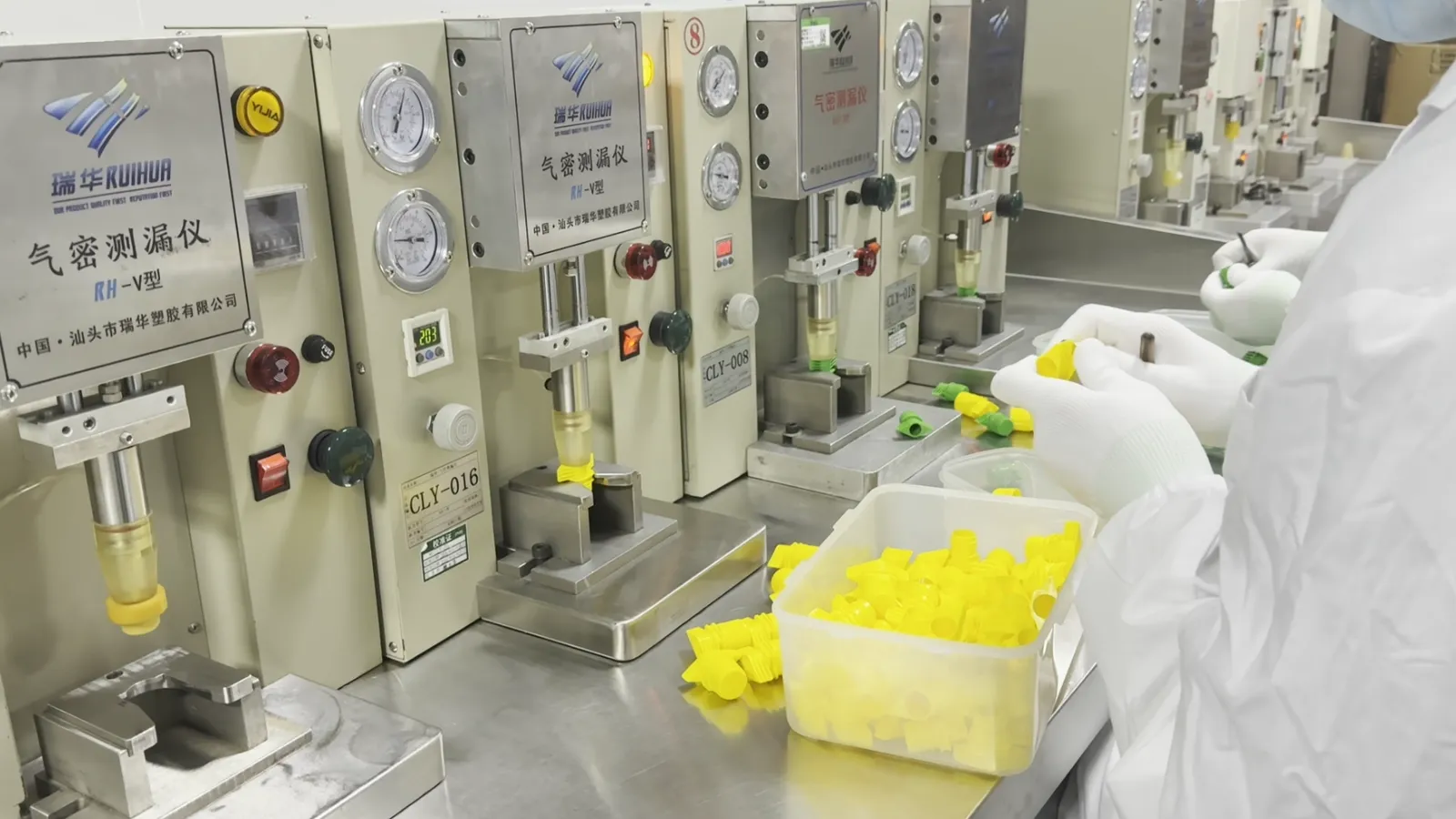

A supplier sends one migration report and says it covers the whole spout cap range. You buy eight of those caps: two spout diameters, natural, white, and two colours. The report looks complete — laboratory, method, simulant, result, a pass. What it does not tell you is whether the cap on the bench was at least as demanding as the seven it is meant to stand for.
That is the whole of worst-case sample selection in food contact testing. One test can legitimately cover a family of caps, and doing so is normal practice rather than a shortcut. What separates a defensible family claim from a convenient one is narrow: whether the parts share a formulation basis, whether the tested part sits at the worst case on every axis that varies, and whether the reasoning was written down where your customer or an inspector can read it.
What a family claim has to prove
A report does not say "this cap passed". Read properly, it says something comparative: this sample is at least as demanding as every other article in the range it is offered for. Once the claim is stated that way, it becomes testable, and it fails in a specific way — not because the laboratory did anything wrong, but because one of the other seven caps is more demanding than the one that was tested.
Three conditions carry the claim.
Condition | What it means for a moulded closure | What breaks it |
|---|---|---|
Same formulation basis | Resin grade, colour masterbatch, additive package and any regrind are the same across the range, or the tested variant is the most heavily loaded | A second masterbatch, a different carrier, a new slip agent or a switch to recycled content |
Worst case on every axis that varies | Where formulation genuinely differs, the tested part is the most demanding on pigment loading, wall thickness, contact area and use condition | The sample was chosen for availability — the natural cap that was already in the warehouse |
Written reasoning | The justification for grouping is in the supporting documentation, not in an email | "They told us it covers all colours" |
The useful consequence: a family claim rarely fails as a whole. It fails for the SKU that is more demanding than the sample. Narrowing the family to the parts the sample genuinely covers is usually cheaper than re-testing everything, and it is a legitimate answer — as long as it is written down.
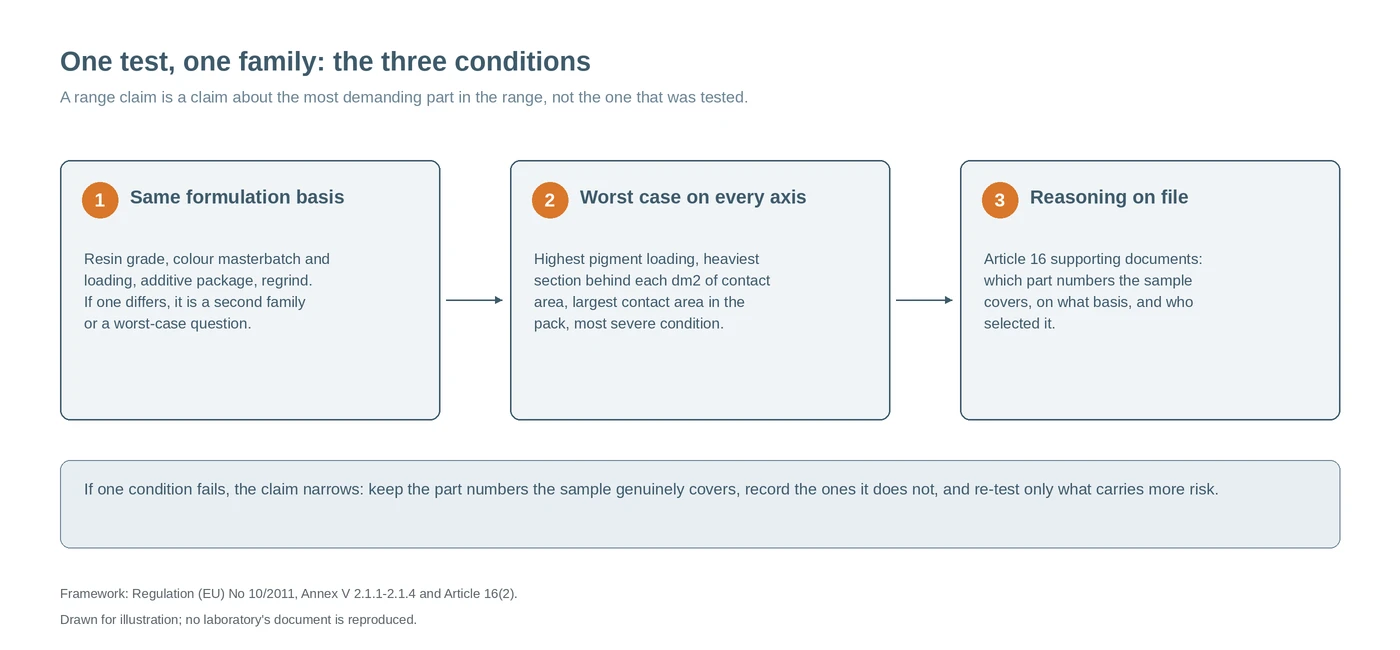
All three have to hold at once. The third is the one buyers can check without a laboratory.
Where spout caps vary, and which variation moves migration
A spout cap is four things at the same time: a resin grade, a colour system, a tool with a fixed number of cavities, and a process. Buyers tend to compare the first and the third — material and drawing number — because those are the fields on a purchase order. The variation that moves a migration result usually sits in the second and fourth, and in one geometric property nobody puts on a drawing.
Variable | What it looks like in a real order | Moves migration? | What to do |
|---|---|---|---|
Colour masterbatch | Natural, white, four colours, one "special" for a promotion | Yes — carrier resin, pigment and dispersant loading all enter the formulation | Test the highest loading, or treat heavily loaded colours as a separate family |
Wall thickness at the spout base | The same cap at two weights, or a lightweighted revision of an old tool | Yes — it changes how much polymer sits behind each dm² of contact surface, which is the basis a result is reported on | Compare the thickest and thinnest sections and state which one the report used |
Food-contact area in the assembled pack | Spout bore, inner cap face, weld flange onto the pouch | Yes — it is the denominator of the result | Fix the area basis in the report, not after the fact |
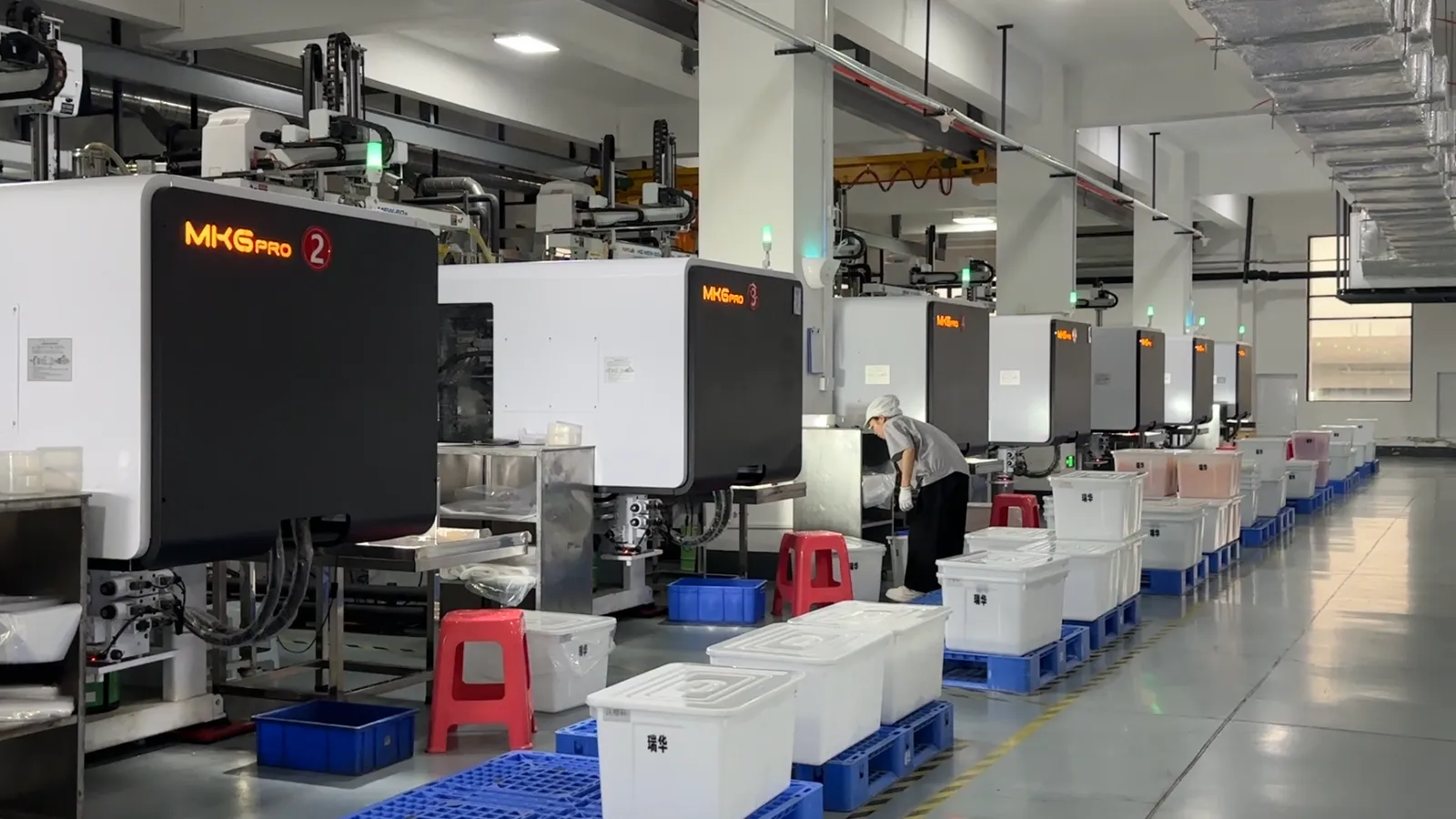
Cavity number, machine, lot | 8, 16 or 32 cavities; several presses; daily lots | Usually not, unless gate, cycle or cooling shift the moulded morphology | Keep to one tool and process window; record the cavity on the sample |
Additives and lubricants | Slip, antistat, nucleating agent, release aid | Yes — these are the substances most likely to have specific limits | Ask for the additive package, not just the resin datasheet |
Regrind or recycled content | Factory regrind, or a recyclable mono-PE programme | Yes — composition change | Separate declaration and separate evidence |
The cavity row is where suppliers and buyers talk past each other. Cavity-to-cavity variation is a dimensional and cosmetic question in most cap programmes; it becomes a migration question only when the process window actually changes the polymer at the gate or in the wall. That is an argument a moulder can make in one paragraph — but it has to be made, and it has to name the tool and the process window it applies to.
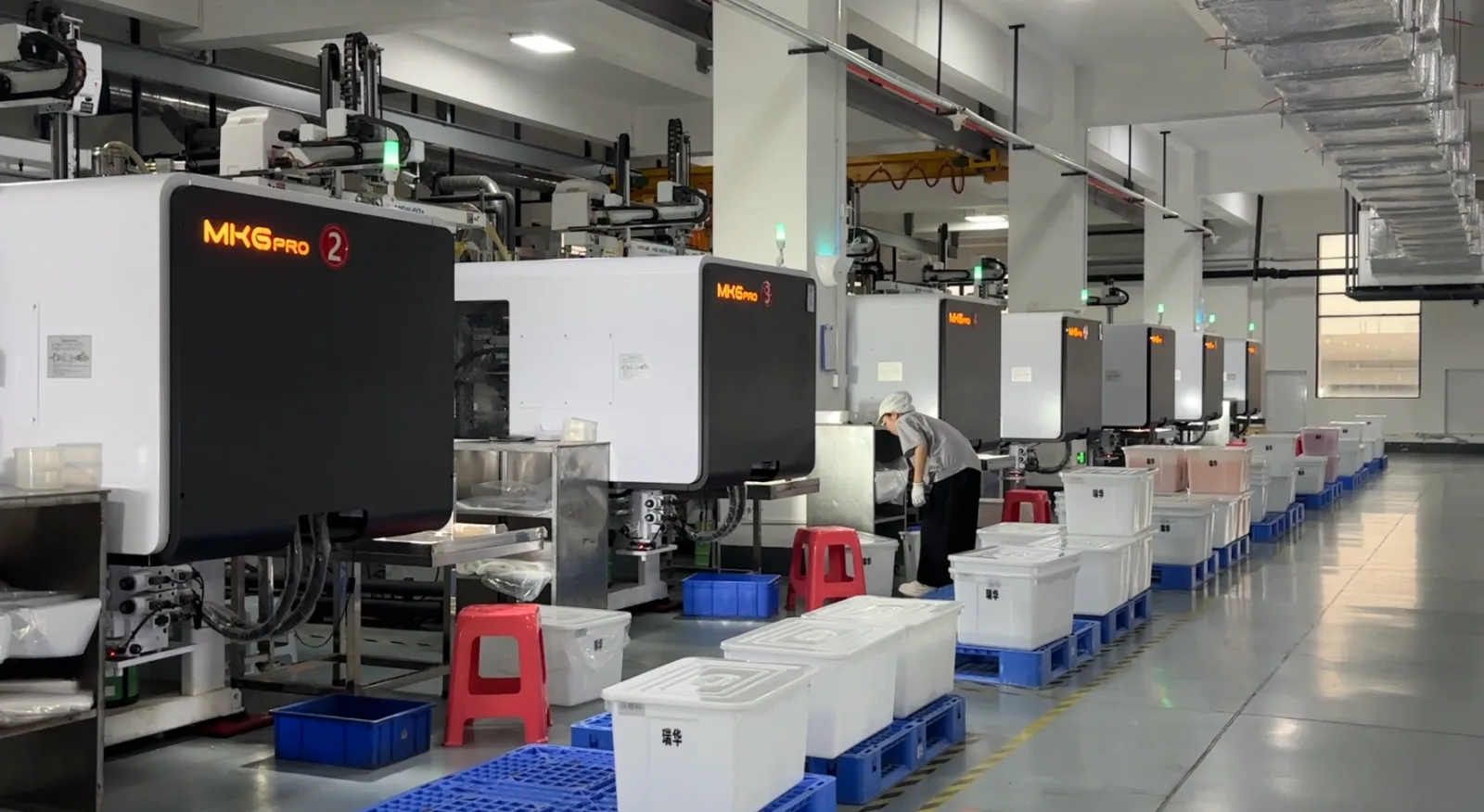
Cavity count, machine and lot are production variables. Whether they belong in the family argument depends on whether they change the polymer, not on whether they change the part number.
Formulation is the line you cannot argue across
Pigment is treated as cosmetic by almost everyone outside the laboratory, and it is not. A colour masterbatch is a carrier resin plus pigment plus dispersants and stabilisers, and the loading percentage decides how much of all three ends up in the moulded part. A cap moulded in 4% white masterbatch is not the same formulation as the same cap left unpigmented natural, even when the drawing, the tool and the resin code are identical.
The European route makes that concrete rather than theoretical. The written declaration that accompanies plastic food-contact articles has to be renewed when "substantial changes in the composition or production" occur that bring about changes in migration, or when new scientific data appears — that is Article 15(3) of Regulation (EU) No 10/2011. A new masterbatch supplier, a higher pigment load, or a switch to regrind is exactly the kind of change that triggers the question, whether or not anyone files it as one.
So the comparison to run is not "are these the same colour". It is three lists, side by side:
- Resin grade — the specific grade and its supplier code, not "PP".
- Colour system — masterbatch code, carrier and loading percentage.
- Additive package — slip, antistat, nucleating and release agents, and whether regrind is permitted.
If the three lists match across your SKUs, you have a family candidate. If one differs, you have either a second family or a worst-case question, and both are answerable. What is not answerable is a range claim built on colour names.
Worst-case sample selection: the biggest cap is rarely it
The intuitive choice is the largest cap in the range, on the reasoning that more material means more migration. Which cap is the worst case depends on what the result is expressed against — and the two bases do not point at the same part. An overall migration result is reported per square decimetre of food-contact surface, 10 mg/dm² under Article 12 of the regulation; where the article is intended to contact food for infants and young children, that article sets the overall limit at 60 mg/kg of food simulant instead. For the per-area number, what counts is how much polymer sits behind each square decimetre. For a limit expressed per kilogram of food, the ratio of contact area to the amount of food in the pack takes over.
That is why a small-bore cap with a long spout can be the demanding case on one basis and an unremarkable one on the other. On a limit set per kilogram of food, what counts is contact area relative to the volume of contents, and a long narrow spout adds surface without adding much capacity. The per-area number measures a different property: its denominator is the area itself, so what raises it is the mass of polymer behind each square decimetre, and that is a question about section, not about size. Add the highest pigment loading and the most aggressive simulant your food requires, and the worst case frequently turns out to be the least impressive-looking part in the box.
Four places it hides:
- Pigment and additive loading. The most heavily loaded colour, not the darkest.
- The section thickness behind the contact area. Thickness is named in both directions because two mechanisms sit on it. For a per-dm² result the number scales with the mass of polymer behind each square decimetre, so a heavy boss or a reinforced wall carries more migratable material than a lightweighted version of the same part; on that basis the heavy section is the demanding one, and it need not be on the largest cap. A thin section is a candidate for the other reason: it cools fastest, so the surface the simulant meets is not the same polymer as the bulk. Naming a section settles nothing on its own — thick or thin, the report has to say which mechanism it was chasing. A note that names only the thinnest wall has answered the morphology question and left the mass one open; a note that names only the heaviest section has done the reverse. Ask which section was tested, and why that one rather than its opposite.
- The largest contact area in the assembled pack. A cap tested on its own, with an assumed area, produces a number that cannot be compared to your pouch.
- The most severe condition. Long shelf life at ambient is not the same rung as hot-fill, and neither is a retort cycle.
There is a wrinkle that even careful buyers miss: worst case is per endpoint. The sample that is worst for overall migration is not automatically worst for a specific additive with its own limit, and the condition that is most severe for an aqueous food is not the one for a fatty sauce. If a declaration covers specific migration limits as well as the overall limit, the fair question is which sample and which condition were used for each — and whether one sample carried both.
What the EU text does and does not authorise
The compliance rules are short and worth reading in the regulation itself, because the permission people assume is in them is not there.
Annex V, point 2.1.1 of the consolidated text says migration is determined on the material or article, "or, if this is impractical, on a specimen taken from the material or article, or a specimen representative of this material or article". Read closely, the allowance is for a specimen of this material or article — the same composition, whether or not it was cut from the part you are buying. What the sentence does not do is let a different formulation stand in for yours, and it says nothing about one part answering for a range; that permission has to come from somewhere else.
Point 2.1.2 sets simulants: articles intended for all food types are tested with A, B and D2, and articles for specific foods with the simulants Annex III assigns to those foods. Point 2.1.3 requires the "worst of the foreseeable conditions of use", with a derogation where the prescribed test conditions physically change the specimen in a way real use would not. Point 2.1.4 sets the accelerated long-term conditions: 10 days at 40 °C covers refrigerated and frozen storage, 10 days at 50 °C covers up to six months at room temperature, and 10 days at 60 °C covers longer storage — each of them including hot-fill and short excursions to between 70 °C and 100 °C.
Grouping appears one level down, in guidance rather than in the article-level rule. The Commission's Joint Research Centre, in draft technical guidelines for compliance testing issued for stakeholder consultation, states the official-control sampling rule more directly: where a sample is intended to represent "a range of materials of different brands or grades", the material chosen has to "represent the worst case situation in the migration testing, e.g. the highest concentration of additive or co-monomer or thickness of the sample". It is a draft issued for consultation, not adopted guidance — which is the point: the practice of nominating a worst-case representative lives in documents of this kind, while the regulation itself only requires a specimen representative of this material or article.
That paragraph is also where a refillable pack drops out of the analysis if you let it. Where a closure is intended for repeated contact, point 2.1.6 requires the migration test to be run three times on a single sample with a fresh portion of simulant each time, with compliance judged on the third result and on stability across the three. A single-run report on a cap that will be refilled answers a question nobody asked.
And the document that holds it is specified. Under Article 16(2), the supporting documentation "shall contain the conditions and results of testing, calculations, including modelling, other analysis, and evidence on the safety or reasoning demonstrating compliance". Reasoning is the operative word: it is where a family argument lives, and it is the part a buyer can ask for without any laboratory expertise. The outer layer is Article 16 of Regulation (EC) No 1935/2004, which requires a written declaration of compliance and appropriate documentation available to competent authorities on demand.
Where the argument sits | What it can carry | What it cannot |
|---|---|---|
The article-level rule (Annex V 2.1.1) | A specimen of this material or article, tested with each simulant assigned to your food | A specimen of a different formulation, or any basis for one part covering a range |
Supporting documentation (Article 16(2)) | Conditions, results, calculations including modelling, and the reasoning that demonstrates compliance | A conclusion the reasoning does not actually reach |
Guidance on sampling practice | Nominating one part as the worst-case representative of a range, with the justification recorded | An exemption for a variant that is more demanding than the nominated sample |
The middle row is where a family is really built. Article 16(2) accepts calculations, including modelling, as evidence, and Annex V allows modelling as a screening route for specific migration — so part of a range can be screened by a documented calculation rather than tested colour by colour. The limit is worth stating plainly: that route screens for specific migration. It is not a substitute for the overall migration test, which still has to be run. A modelled argument with no stated assumptions is the same as no argument.
One document check belongs here rather than in the argument: whether the method in the report sits inside the laboratory's accredited scope is a separate question with its own paper trail, covered in checking the test method rather than the laboratory badge. A valid family argument does not repair a method that sits outside the scope.
The US route is a different document, not a different answer
In the United States the paper a buyer receives is usually a compliance letter and a specification reference, not a migration report, and the two get conflated.
21 CFR 177.1520 lists the olefin polymers permitted for food-contact use and the specifications a resin has to meet — density range and extractables limits among them. Those are identity and quality specifications for the resin. They are not a migration result for a moulded cap, and FDA says so in its own words: the published end tests "bear no relation to the migration testing recommended for evaluating probable exposure". That sentence appears in FDA's chemistry recommendations for premarket submissions, which is also where the American version of worst-case selection is written down:
- use "the highest proposed concentration" of the substance in the article when preparing test samples;
- if the formulation is plasticised, test "the most highly plasticized formulation";
- for an additive, test the polymer with "the lowest average molecular weight" that still meets the 21 CFR 177 specifications.
Same logic as the European text, expressed as a rule about which sample to prepare. The structural difference is what a Food Contact Notification covers: a substance and its intended use, not an article. So for a spout cap the useful request is a compliance letter that names the resin grade and the finished part, backed by extractives data — and, separately, the migration evidence for the article. How the two markets' limits differ is set out in FDA, EU 1935/2004 and GB 4806.7 compared; the sample question is the same in both.
Reading a report against your own part list
Everything above collapses into one exercise: put the report next to your purchase list and check the bridge between them.
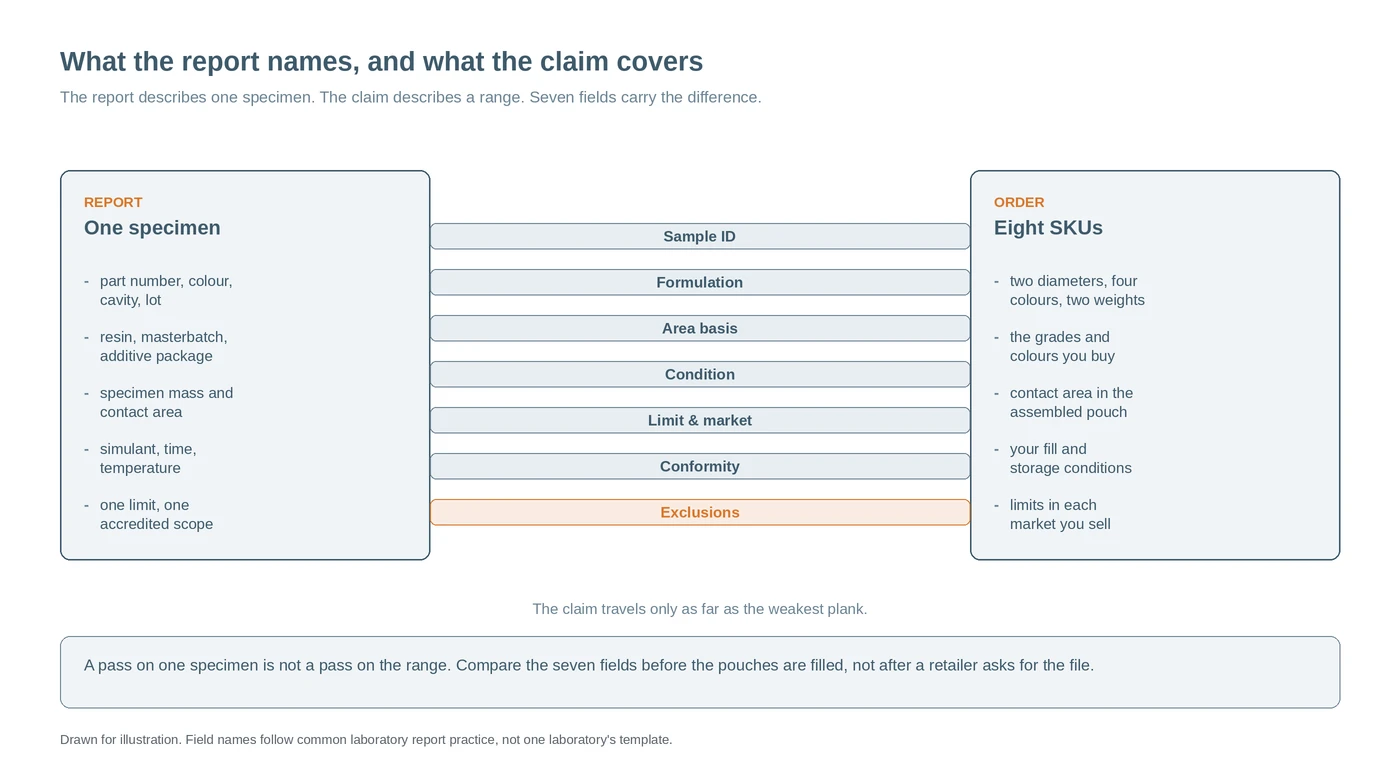
The report describes one specimen. The claim describes a range. Seven fields carry the difference, and the last one is the plank that usually gives way.
Field in the report | What it must say | Red flag |
|---|---|---|
Sample identification | Part number, colour, cavity, lot, and a photograph or retained-sample reference | "One spout cap, representative" with no identifier |
Formulation | Resin grade, masterbatch code and loading, additive package, regrind status | A resin family name only ("food-grade PP") |
Geometry and area basis | Specimen mass, contact area, and whether the result is per dm² or per article | A result with no stated denominator |
Simulant and condition | The simulant assigned to your food type, and the time/temperature actually run | A condition below your process, presented as a pass |
Limit and market | Which limit, from which regulation, at which revision | A threshold with no citation |
Conformity statement | Whether the result is inside the accredited scope, and the decision rule near the limit | A pass with no uncertainty statement at a marginal result |
Exclusions | Film, seal layer, inks, liner, or any part of the pack not covered | Silence on what the cap report does not cover |
Two habits make the table work. First, ask for the retained sample reference and keep your own reference part against it — if the report cannot be tied to a physical specimen, it cannot be tied to a family either. Second, hand the same table to your converter or co-packer: the closure is one material in a pack that also contains film, seal layer and ink, and a cap report says nothing about those. The logistics of getting the right parts to a trial in the first place are covered in assembling a spout sample kit for a line trial, and the fields you need on your own side are in the spout cap specification sheet.
The difference the table describes looks like this on paper — the first line is the shape most reports arrive in, the second is the same result with the fields filled in. The figures are arranged to show the shape of the two sentences, not quoted from any report:
As received: "PP spout cap, representative — overall migration 4.2 mg/dm², pass." >What the claim needs: "PP spout cap, 16 mm bore, white (masterbatch MB-xx at 4% loading), cavity 7 of 16, lot 26-31 — overall migration 4.2 mg/dm² of contact surface (spout bore, inner cap face and weld flange, 11.4 cm²), simulant D2, 2 hours at 100 °C, against the 10 mg/dm² limit, inside the accredited scope. Film, seal layer and inks not covered."
The first line supports a purchase order. The second supports a range claim. Try to write the second line for a part you did not test, and the field with nothing behind it becomes obvious.
What to put in the RFQ
Five questions produce answers you can file:
- Which sample was tested — part number, colour, cavity and lot — and can you send a photograph and the retained-sample reference?
- Which formulations does that sample represent, and which of my SKUs differ from it in masterbatch, additive package, wall thickness or regrind?
- Is the tested sample the worst case for overall migration and for each declared specific limit — and if not, which sample is?
- Which simulant and condition were run, and which of my products fall outside them — including any that will be refilled, where three successive tests apply?
- Who wrote the family justification, and is it in the supporting documentation I can pass to my own customer?
A supplier who has done the work answers all five in one reply. One who has not will answer the first and become vague on the third, which is the answer you needed.
If you are building that request list for an order, the technology and quality page shows which documents exist for the spout caps and spouts we mould for stand-up pouches, the sample and validation planner is where a test method and acceptance criteria get written down before a trial, and the sourcing and supply section collects the rest of these checks in one place. Ask for the family justification in writing. It is a reasonable question, and the documents either support it or they do not.
The report in front of you may be entirely genuine and still not describe your part. That is not a laboratory failure or a fraud — it is a claim about a range that nobody tested. The three conditions, the four places the worst case hides and the seven fields above are enough to tell the difference before the pouches are filled.