
An ISO/IEC 17025 certificate pasted into a supplier's quotation is a statement about a laboratory, not about a spout cap, a pouch, or the sauce inside it. Buyers who read it as a statement about the product end up with a folder of PDFs and no answer to the question their retail customer asked.
That question is narrower: for this food, in this pack, filled at this temperature and stored for this long, was a migration test run on a sample of the closure I buy, by a method inside that laboratory's accredited scope, and does the number sit below the limit that applies? ISO 17025 food contact testing only becomes useful when it is read as evidence for that sentence rather than as a badge on a certificate.
What ISO 17025 food contact testing actually certifies
ISO/IEC 17025:2017 sets out what a testing or calibration laboratory needs in order to produce valid results: competent staff, calibrated equipment, verified or validated methods, controlled sample handling, an uncertainty budget and a report that states what was done. UKAS describes the standard as covering competence, impartiality and consistent operation. Nothing in that list refers to the material in the sample: the standard is about the laboratory, not the resin.
There are two layers to the claim. A laboratory saying it operates to 17025 is unverifiable from a PDF; accreditation is the checkable layer, because an accreditation body has assessed the laboratory and published a schedule of the tests it may report as accredited. Cross-border acceptance rests on the schedule too: the Global ACI MRA gives a report from one accredited laboratory weight in another market, and Global ACI has run it since IAF and ILAC were replaced on 1 January 2026.
Two laboratories can both display "ISO 17025 accredited" while only one holds the method cited in your report. The same failure runs through certification schemes, as in reading a BRCGS or FSSC 22000 logo without the scope behind it — identical on page one, a different product family on page four. The sourcing and supply section collects the rest of these checks.
The evidence chain a migration report has to complete
A migration report is only as strong as its weakest link, and there are six: the use case, the method design, the sample, the result, the limit it is compared against, and the signature that turns it into a claim. Food contact migration testing moves one number through all six, and each stage is separately checkable — so you do not have to trust the whole document at once, only find the link that does not hold. A well-run test of the wrong simulant is still the wrong test.
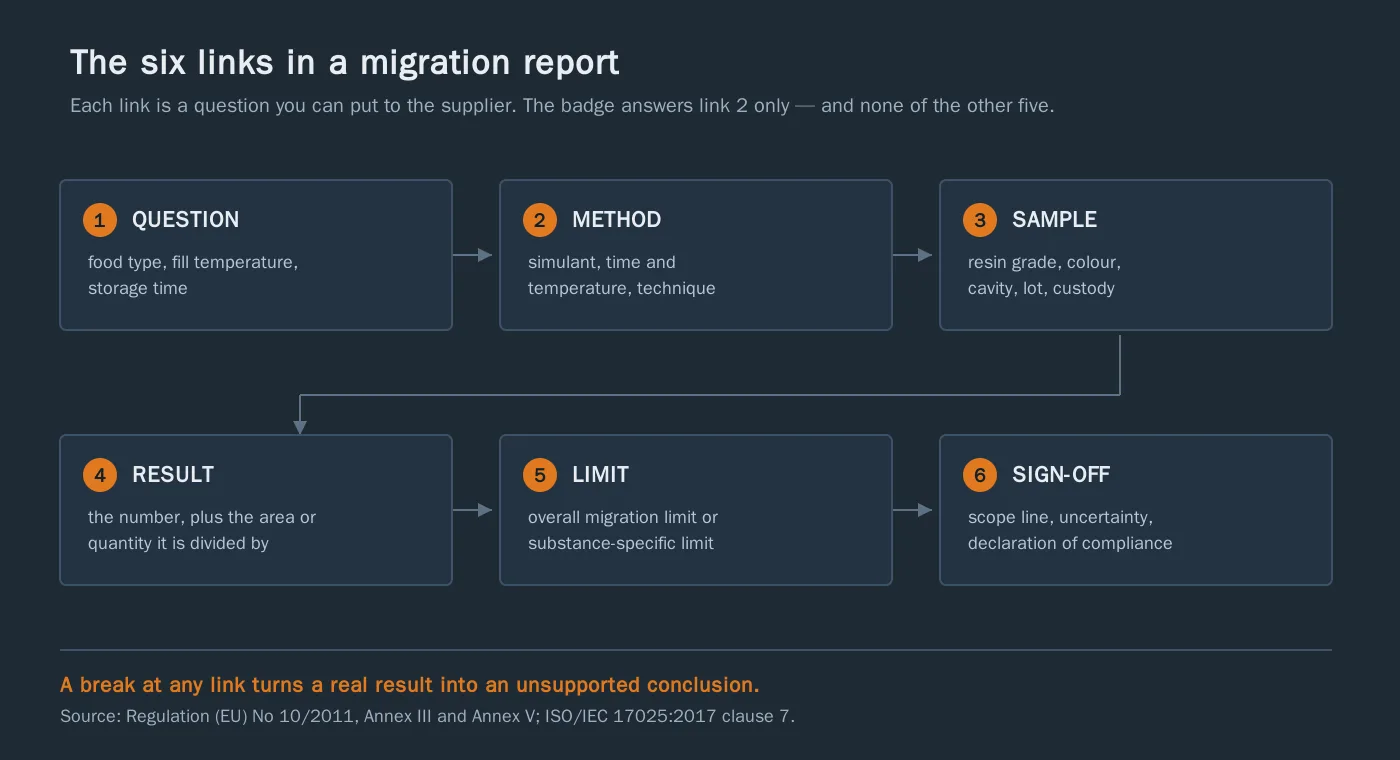
Every link is a question to put to the supplier. The badge sits at link 2 — the method — and answers none of the other five.
Scope of accreditation versus test report
Four documents circulate in food-contact projects, and they answer four different questions. Most misunderstandings come from treating one as a substitute for another.
Document | What it establishes | What it cannot establish |
|---|---|---|
Accreditation certificate | That an accreditation body has assessed the laboratory against ISO/IEC 17025 | Which tests are covered — the certificate is a cover page, not the schedule |
Schedule or scope of accreditation | Which tests, on which materials, by which method and version, over which range, at which site | Anything about your sample, or whether the test suits your food |
Test report | What was tested, how, under which conditions, and the result for that sample | That production matches the sample, or that conditions outside those stated are covered |
Declaration of compliance | That the supplier takes responsibility for a material or article meeting a regulation, per Regulation (EC) No 1935/2004 | A result — unless it cites one, and unless that result covers the grade you buy |
The declaration of compliance is the document a retailer will ask for, and it is not a test report. Under EU rules the supporting documentation may hold test results, calculations or modelling, so a declaration can exist without a migration report — and it must be renewed when a composition change shifts migration. A report without a matching declaration leaves you with evidence and no claim; a declaration without a report leaves you with a claim and no evidence.
How to read one line of an accreditation scope
The scope of accreditation is a public schedule, and its operating rule is blunt: anything not on it is not accredited. That is the whole reason to ask for the extract rather than the certificate.
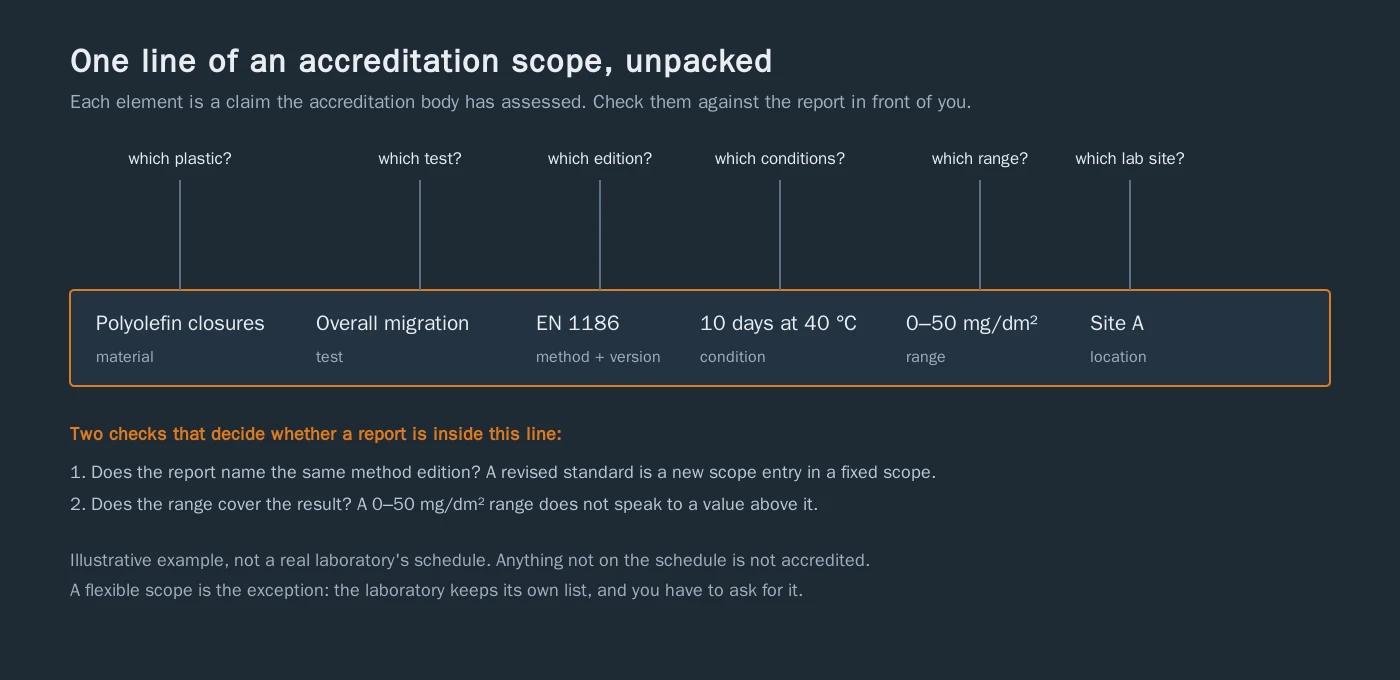
An illustrative line, not a real laboratory's schedule. Check the material, the method edition, the condition and the range against your report.
A competent line names the material, the test, the method and its version, the range the laboratory has demonstrated, and the site where the work happens. Guidance on writing these schedules treats the material field as a boundary: an item line that says "All materials" or "various samples" rests, it notes, on no validation file. A closure line reads the other way: overall migration in polyolefin closures, 10 days at 40 °C — something a report can be checked against.
Fixed and flexible scopes. A fixed scope lists each method, usually with its version, and a new method or revised standard needs an extension assessed by the body before it can be reported as accredited. A flexible scope describes a boundary instead and lets the laboratory bring new methods inside it under its own validated procedure, reviewed at the next assessment. If the method in your report is not on the public schedule, that is a question rather than a finding — ask whether the laboratory holds a flexible scope and request its current internal list. A verbal yes with no document is not an answer.
Four choices inside a migration test that decide whether it covers your pouch
Once the method is inside the scope, the test still has to fit the product. Regulation (EU) No 10/2011 fixes the vocabulary and the arithmetic; four choices inside it do most of the damage when they are wrong.
Choice | What it decides | What a mismatch hides |
|---|---|---|
Food simulant | Which food the result represents: A (10% ethanol), B (3% acetic acid), C (20% ethanol), D1 (50% ethanol), D2 (vegetable oil), E (dry foods) | A dry-food test in simulant A says almost nothing about a fatty sauce, where simulant D2 is the assigned medium |
Contact time and temperature | Whether the storage and heating profile of your pack is covered | 10 days at 40 °C covers storage at room temperature or below, hot-fill included, plus 70–100 °C heating for t = 120/2^((T-70)/10) minutes; a retort cycle is not in that envelope |
Area or quantity basis | What the number is divided by, and therefore what it can be compared with | A result expressed per article cannot be compared with a limit expressed in mg/dm² without the pack the closure was intended for |
Limit and regulation version | Whether the threshold quoted is the one that applies in your market | A pass against one market's limits is not a pass everywhere; see FDA, EU 1935/2004 and GB 4806.7 compared |
The area basis is not the same for a cap as for a film. The overall migration limit is 10 mg per dm² of food-contact surface, with 60 mg per kg of food simulant where the material is intended to contact food for infants and young children. For caps, gaskets, stoppers and similar sealing articles, the regulation expresses the overall migration value per dm² using the total contact surface of the sealing article and the sealed container when the intended use is known, or per article when it is not. The denominator therefore depends on the pack you declare: a closure tested on its own, with an assumed area, produces a number that cannot be compared to your pack. Specific migration limits work the other way — each substance carries its own limit in mg per kg of food, so the report has to name the substance, the analytical method and the limit.
Test conditions are a ladder, not a single rung. The condition table runs from short contact at chilled temperatures up to 121 °C for the fatty and dry simulants, with pressure where needed, then continues in 130, 150, 175, 200 and 225 °C steps — a 125 °C retort falls in the 121–130 °C band; for aqueous simulants a 100 °C or reflux test for four times the contact time may replace the high-temperature run. A hot-fill pouch and a retort pouch sit on different rungs. If the report states 10 days at 40 °C and your process is a retort cycle, the result is real and the conclusion does not follow. The regulation also notes that small packs have a higher surface-to-volume ratio and correspondingly higher migration, so a 100 g pouch is not the cubic one-kilogram pack behind the 10 mg/dm² figure.
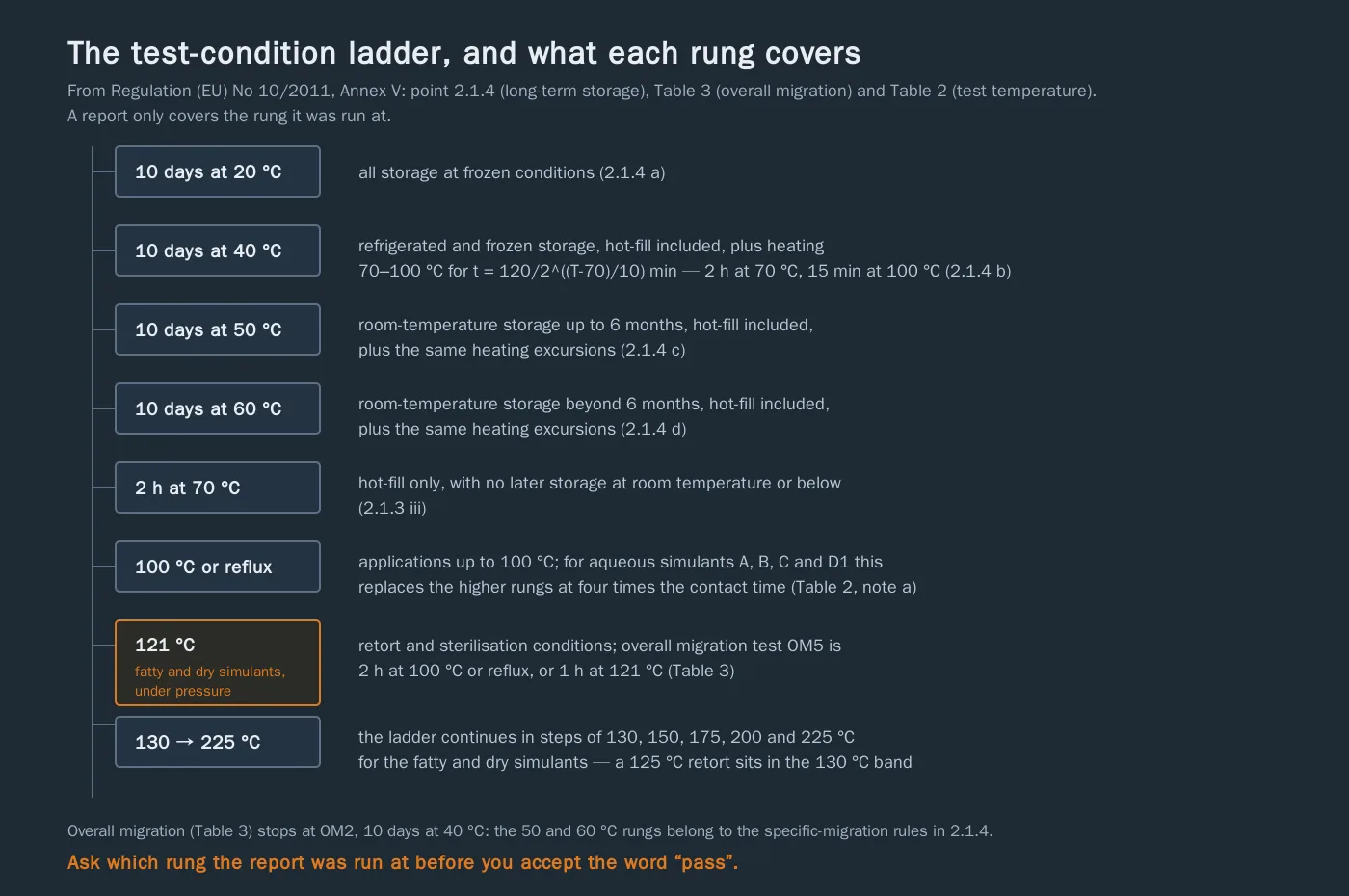
A report names one rung: 20–60 °C are the accelerated long-term conditions of 2.1.4, and above 100 °C the ladder runs to 225 °C. When the rung sits below your process, the pass does not travel up.
The sample problem: representative, worst case, and who chose it
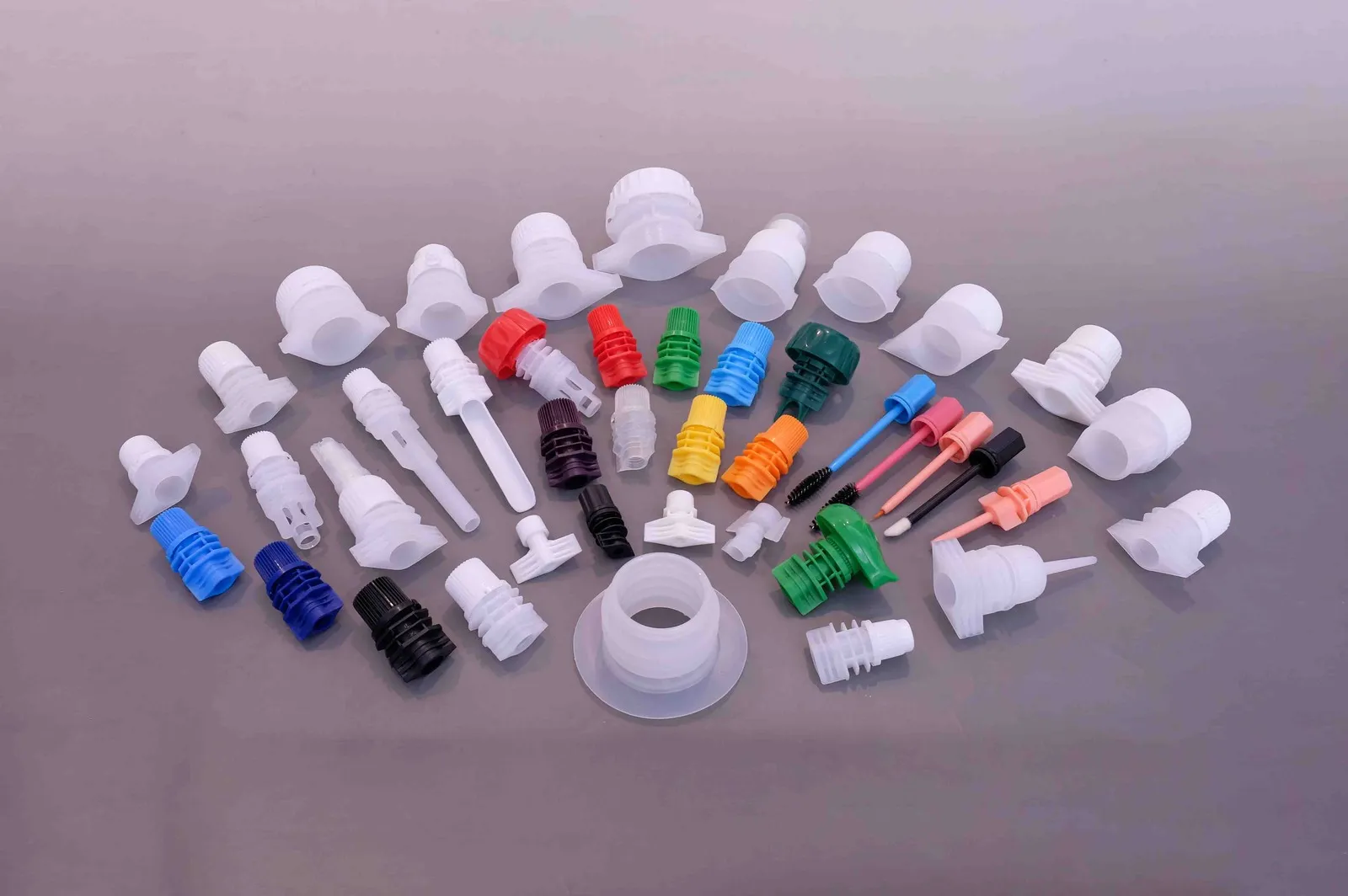
One tested sample has to stand for a range of colours, sizes and mould cavities. Which one was chosen is a decision, not a detail.
A moulded closure is not one material. It is a resin grade, a masterbatch or colour concentrate, a mould with several cavities, a machine and a production lot. Change any of those and you have changed what the test was run on, even when the drawing number stays the same.
Representative sampling therefore starts with variants. If a supplier sells one cap body in natural, white and four colours, a report on the natural version does not automatically describe the black one: pigment loading changes the formulation, and the most heavily loaded colour is usually the more demanding case. The same applies to cavity and lot. Whoever selected the sample should be able to say why this variant is the one most likely to fail — the highest pigment loading, the thinnest wall, the largest contact area in the intended pack. If nobody can say that, the sample was chosen for convenience.
Then there is custody, and it has a wrinkle buyers miss: a scope includes sampling only when the laboratory claims it, and many do not. Where it sits outside the accreditation, the laboratory reports on what arrived, and the supplier who packed the bag is outside the accredited system. Ask for the sample identification used in the report and keep the retained sample against it. Where a closure is intended for repeated use, the test must be run three times on a single sample with fresh simulant each time, and compliance is judged on the third result. Factory-side checks such as non-sterile pouch leak test methods answer a different question: whether the pack holds, not what it releases.
What to request before you accept a migration report
Eight items turn the sections above into a request list. None needs laboratory expertise; all of them are documents.
- The scope extract, with the method line highlighted. Not the certificate. If the method is not printed, ask for the flexible-scope list and the accreditation body's directory entry.
- The report page naming method, sample ID, simulant, time and temperature, and the area or quantity basis. Without the basis the number cannot be compared with a limit.
- A statement on whether the result sits inside the accredited scope. Laboratories report accredited and non-accredited work; the report should say which one you hold.
- The statement of conformity and its decision rule, when a result sits close to the limit. The standard requires the rule to be defined and stated when conformity is reported; an uncertainty figure is what keeps a "pass" honest near the threshold.
- A declaration of compliance naming the exact grade, colour and intended use you buy. A declaration written for the product family is not a declaration for your variant.
- The sampling route: who selected the sample, when, which cavity and lot, and the retained sample identification.
- The use case tested against — food type, fill and storage temperature, shelf life — compared line by line with your specification.
- What the report does not cover. Film, seal layer, inks and closure are separate materials; a cap report is not a pouch report.
Item 6 is the one buyers skip most often and the cheapest to close. A factory audit checklist is a reasonable place to put it, because the audit is already asking how samples leave the building.
Putting it into the RFQ: what to ask a spout cap supplier
Replace "do you have ISO 17025?" with three questions that produce checkable answers:
- Which test, for which food type, at which condition, on which sample? The answer should name a method and a condition, not a standard number alone.
- Which document will you send — the report, the declaration, or both? Both is the normal answer for a retail or export customer.
- Which variant was tested, and is it the worst case among the colours and sizes I order? A supplier who cannot answer has not chosen the sample deliberately.
The evidence requirement can be tiered to risk. An ambient-stored aqueous product usually needs an overall migration result against an aqueous simulant plus a declaration covering the grade. An acidic hot-fill product moves it to simulant B and a condition that includes the fill temperature. A fatty or retort product needs simulant D2 and a high-temperature condition; an infant-food application moves the limit itself onto the 60 mg/kg basis. Writing that tier into the purchase order once is cheaper than arguing later.
We apply the same test to ourselves. We hold third-party reports — an SGS heavy-metal content report and a total-fluorine report under the EU packaging regulation — and they cover a tested sample, not the catalogue, which is what the documents say if you read the scope line on them. A total-fluorine pass is also not a PFAS-free claim. The technology and quality page sets out what exists and what each document covers.
The badge is where the ISO 17025 food contact testing check starts, not where it ends. A report is only as good as the method it names, the sample it describes and the limit it was compared against — and those three are what a buyer can verify before signing.