
A spout sample kit is the set of closure components — spout bodies, matching caps and the documents that describe them — that you send to a co-packer so their line trial can test the pack you intend to sell, not just the pouch that holds it. When a pouch co-packer asks for packaging samples ahead of a line trial, most buyers send film swatches, printed pouches and a pail of product. The spout travels as an afterthought: a handful of units in a bag, no drawing, no lot number, no second size.
That is where trial days get wasted. The trial is the one shift in which your pouch, your spout and somebody else's line are in the same room, and the question is narrow: will this closure feed, weld, fill, cap and hold on this machine, at this speed, with this product inside? A kit that cannot answer that turns a booked slot into a demonstration. This is the component half of the handoff, and it is the half the guides currently ranking for this question leave out: none of the five we read for this piece names a spout cap at all.
What a spout sample kit has to prove
A line trial is a compatibility test with a deadline, and the closure is the part of the pack with the most ways to fail it.
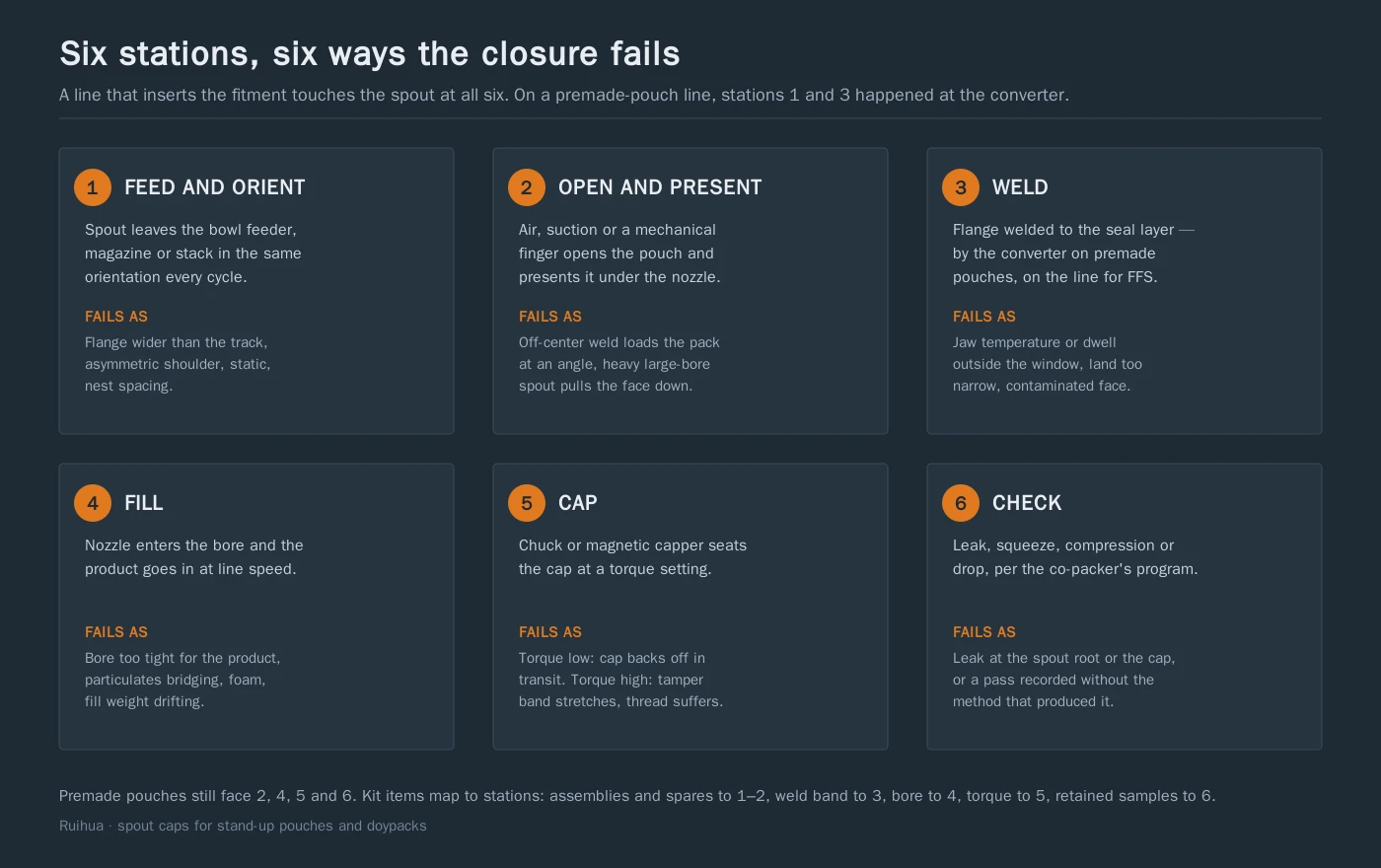
Every station after the magazine is a separate way for the day to end early. On a premade-pouch line, stations 1 and 3 are the converter's problem.
Six questions follow in sequence: can the magazine pick and orient the spout; can the line open the pouch without crushing it; if the spout is welded on the line, does the weld hold at the settings the co-packer runs; does the nozzle clear the bore without bridging; does the capper seat the cap at a torque that survives shipping; and does the pack pass the leak or compression check. Every item in the kit answers one of those six; the sourcing and supply section collects the pre-production checks around them.
One distinction decides what you pack. On a premade-pouch line the converter has already welded the spout in, so the co-packer only fills and caps. On a line that makes the pouch from film, the spout is inserted and welded on the filling machine, which puts fitment feed, jaw tooling and weld settings in the co-packer's hands. Ask which one you are preparing for before you count anything; Lancing's trial guide sets out the rest of the discipline — representative samples, stated measurements, agreed observations — and the closure is what makes that discipline concrete.
What the line does to your spout, station by station
The walk below follows a packaging line trial on a line that inserts and welds the fitment, because that is where a closure has the most ways to go wrong. On a premade-pouch line the feed and weld stations belong to the converter; opening, fill, cap and check still apply, and the cap and check stations are where premade-line trials tend to fail.
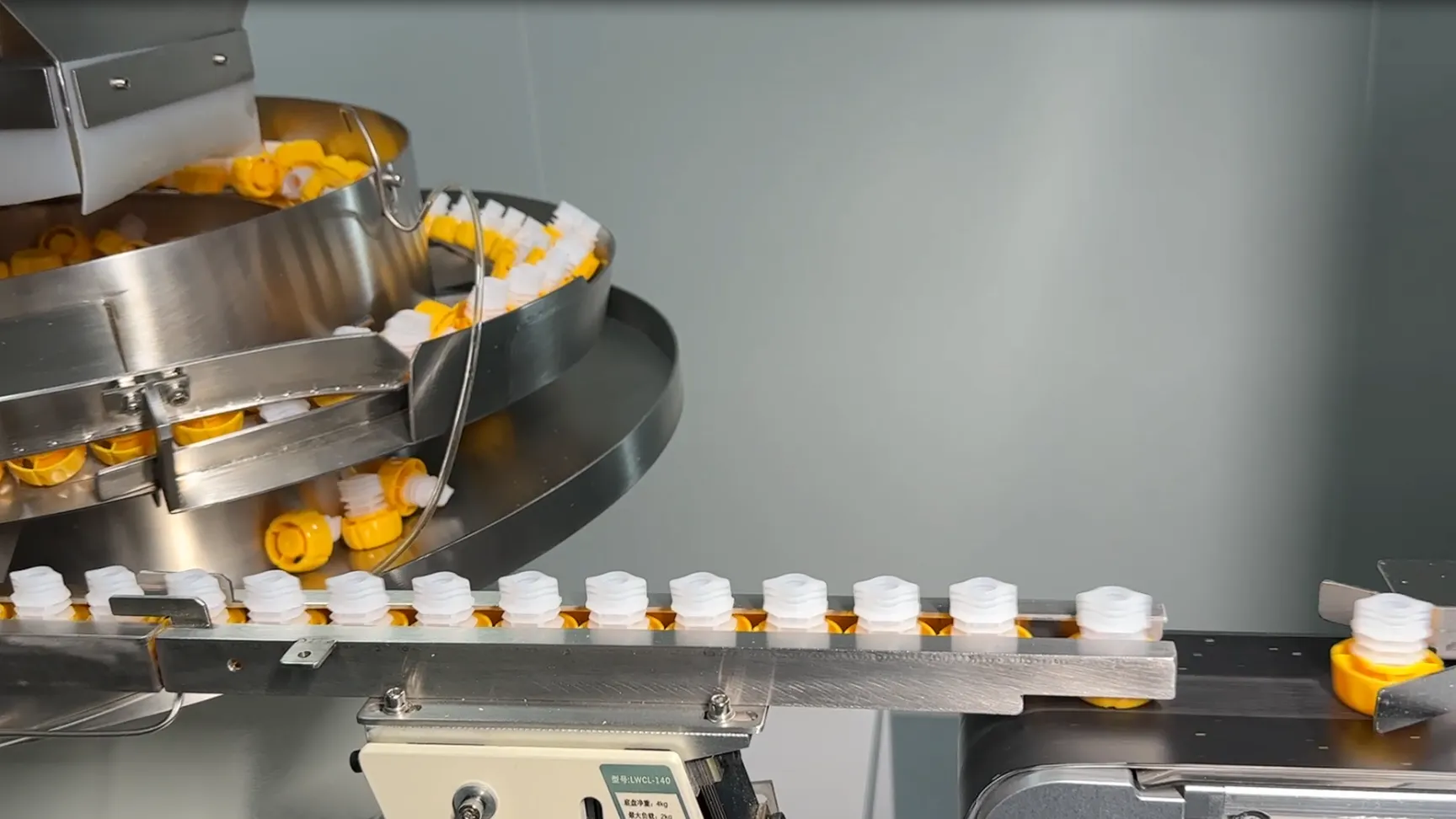
Feed and orient. Spouts must present the same face every cycle. A flange 0.2 mm wider than the track, an asymmetric shoulder or a static-prone resin turns a 60-a-minute line into a stop-start. It usually gets blamed on the machine and is actually a geometry decision made months earlier.
Open and present. A stiff spout welded off-center loads the pouch at an angle; a heavy large-bore spout with a handle pulls the face down. Both surface as misalignment at the fill station, which is why spout misalignment on the filling line tends to be diagnosed one station too late.
Weld. On premade pouches this happened at the converter; the co-packer inherits the result. On a form-fill-seal spouted line it happens here, and the variables are temperature, pressure, dwell and how squarely the flange sits on the weld face. Our spouts are engineered to weld in the 110–130 °C band that suits PE seal layers and mono-material structures, but the number that matters on the day belongs to the co-packer's jaw — get their window before you ship.
Fill. Nozzle diameter, viscosity and bore have to agree. A 9.6 mm bore that fills a sauce cleanly at 40 pouches a minute may bridge on particulates or foam on detergent. Bore also sets drain-out at home, so the trial tests both at once.
Cap. The cap is applied by a chuck or magnetic capper at a torque setting, and that setting is a line parameter, not a cap property. Too low and the cap backs off in transit; too high and the tamper band stretches. If the co-packer has never run your cap style, the trial is the first time anybody finds out — capping and sealing machine compatibility covers what to check first.
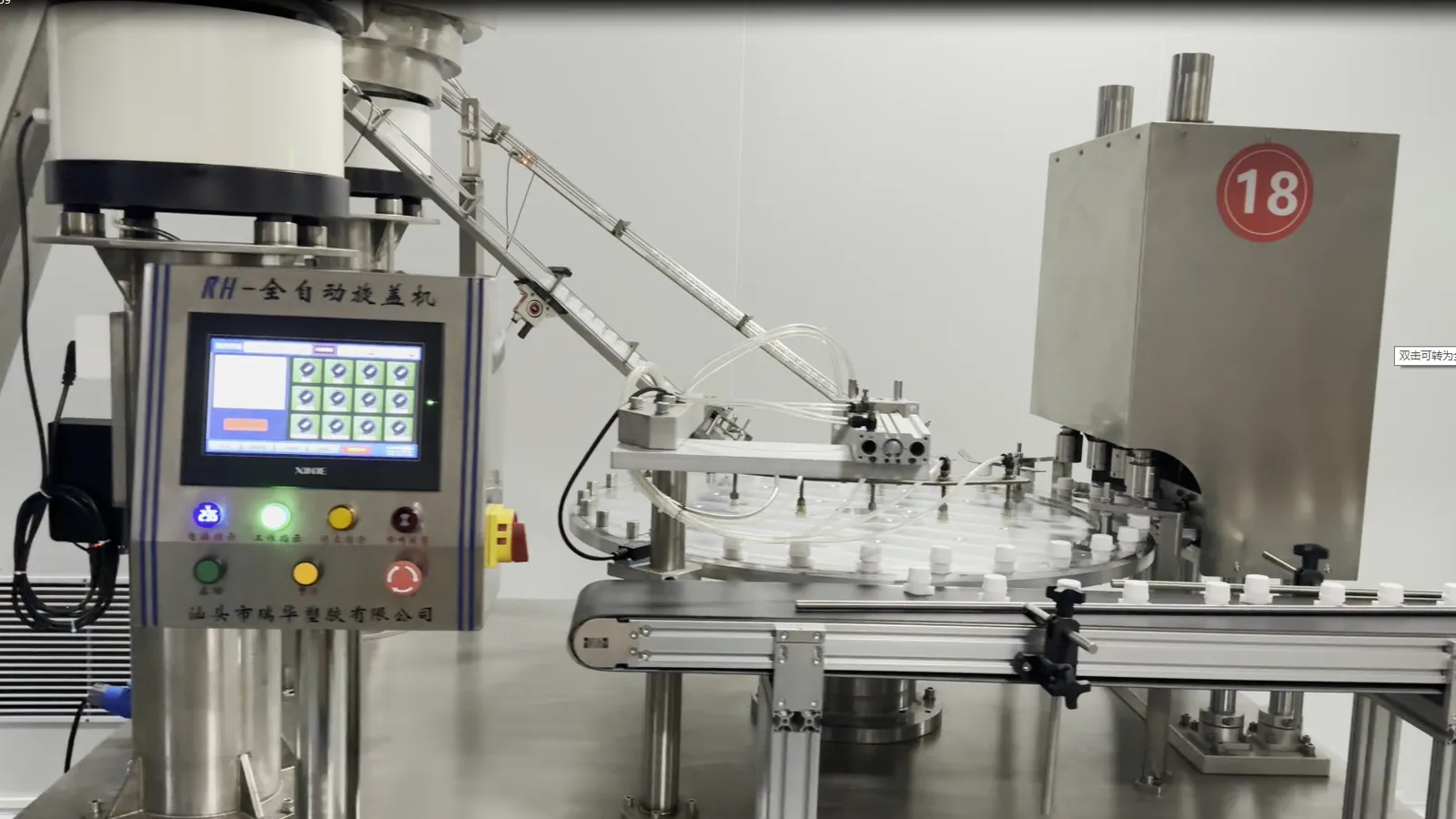
A capper applies torque, not pressure. The setting that seats your cap is a line variable the co-packer has to find — and it is worth watching them find it.
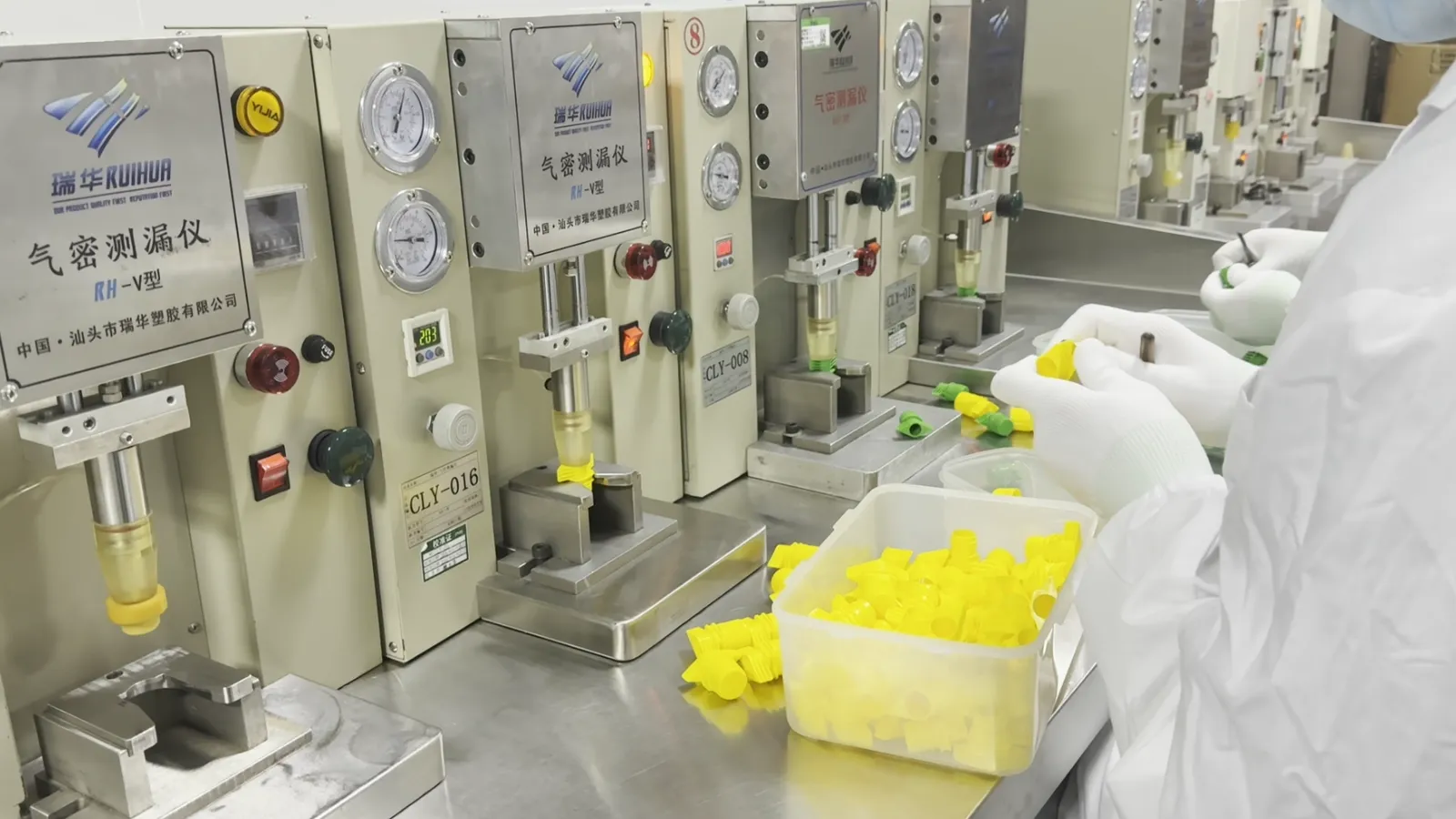
Check. Leak, squeeze, compression or drop, per the co-packer's program. This station produces the number your customer will ask for later, so record the method, not just the pass.
What goes in the box
The box holds three kinds of thing: the spout cap samples themselves in trial quantity, the paperwork that describes them, and the retained evidence you keep afterwards. Buyers who think of it as "pre-production packaging samples" usually stop at the first kind, which is why the last two kinds get left out.
Item | How much | Why |
|---|---|---|
Spout-and-pouch assemblies, exact configuration you will sell | Quantity method below | The trial tests an assembly; loose spouts cannot be tested on a premade-pouch line |
Spare loose spouts, same lot | 50–100 | Feeder trials, deliberate mis-feed, transit damage |
Matching caps, same lot | Assemblies + 5% | Caps are consumed while the capper finds torque |
A second variant, if the line will ever see one | 50–100 per variant | A trial that passes on white and fails on black matters before the print run |
Dimensional drawing with the measurement convention | 1 | The most useful sheet in the box |
Material and food-contact declaration | 1 set | Quality asks before the pack goes near a food line |
Lot and cavity identification | 1 note | Turns "the weld leaks" into "cavity 7 of lot 24-1103" |
Resin grade and the weld band it is rated for | 1 line on the drawing | What the converter or line engineer starts from; pressure and dwell are theirs to set |
Cap torque range | 1 line on the drawing | A starting point, not a substitute for their setting |
Retained sample, same lot | 3–5, kept by you | Your reference when a defect appears weeks later |
Two items get skipped and both matter. The second variant, because a molded closure is a resin grade plus a color concentrate plus a multi-cavity mold; the black version carries a higher pigment load than the white, and pigment loading shifts a weld. The lot and cavity note, because without it a defect reported as "the spout leaks" cannot be traced to anything and the fix becomes a guess.
How many spouts and caps to send
assemblies = (line speed × planned running minutes) + setup allowance + challenge runs, then × 1.15
A worked example, invented for illustration and not a client figure: 60 pouches a minute, a 20-minute trial, 150 pouches lost to threading and first-off adjustment, and two challenge runs of 100 pouches each — one at the bottom of the weld window, one with the capper under-torqued. That is 1,200 + 150 + 200 = 1,550 assemblies; 15% headroom takes it to about 1,780 spout-and-pouch assemblies, and caps to about 1,870. Retained samples come out of that total, not on top of it.
The 15% is a planning allowance, not a measurement: it covers setup scrap and the packs lost while the operator dials in, which on a first trial is rarely under 10%. If you send spout fitment samples in a single size, the line also cannot tell you whether a bad pack came from the bore or from the capping.
Three things follow. The challenge runs are not optional: a trial that only produces good packs proves the line can run, not where the window ends, and the defective packs are what let the co-packer write a defect definition you can both inspect against — the point Lancing's guidance makes about planning material around the full sequence. Rejects are consumed, not returned: if the line throws away 10% of output, that 10% is gone, and buyers who send "a couple of hundred" discover it in the second half. And a second trial is normal, so one trial plus a spare half-kit costs less than an air shipment.
Trial quantities are also the one place where small volumes are normal, and the ordering rules reflect that: stock models ship at any quantity, a custom color carries the high minimum (100,000 pieces at Ruihua), and once a mold exists there is no minimum at all. The mixed-model ordering rules set the three tiers out.
The five dimensions that decide fit
Most of those fit questions come down to five measurements; the rest — shoulder shape, nesting, static — are geometry and handling rather than dimensions. Put the five on a single drawing with the convention stated, and you prevent the commonest trial-day argument: two parties measuring the same spout differently.
Dimension | What it governs | Whose decision |
|---|---|---|
Spout bore (inner diameter) | Fill rate, particulate clearance, drain-out, nozzle fit, and the fill weight the line can hold | Yours, driven by the product |
Neck outer diameter | Capper chuck fit; feeder track acceptance | Shared: spout drawing and line tooling |
Flange width | Weld land on both sides of the spout root; pouch opening cut to match | Shared: spout drawing and pouch opening |
Cap height and diameter | Chuck clearance, headspace, case and pallet fit | Yours, with the pouch design |
Thread form and cap skirt | Torque that holds, tamper band, cross-threading | Shared: cap drawing and capper setting |
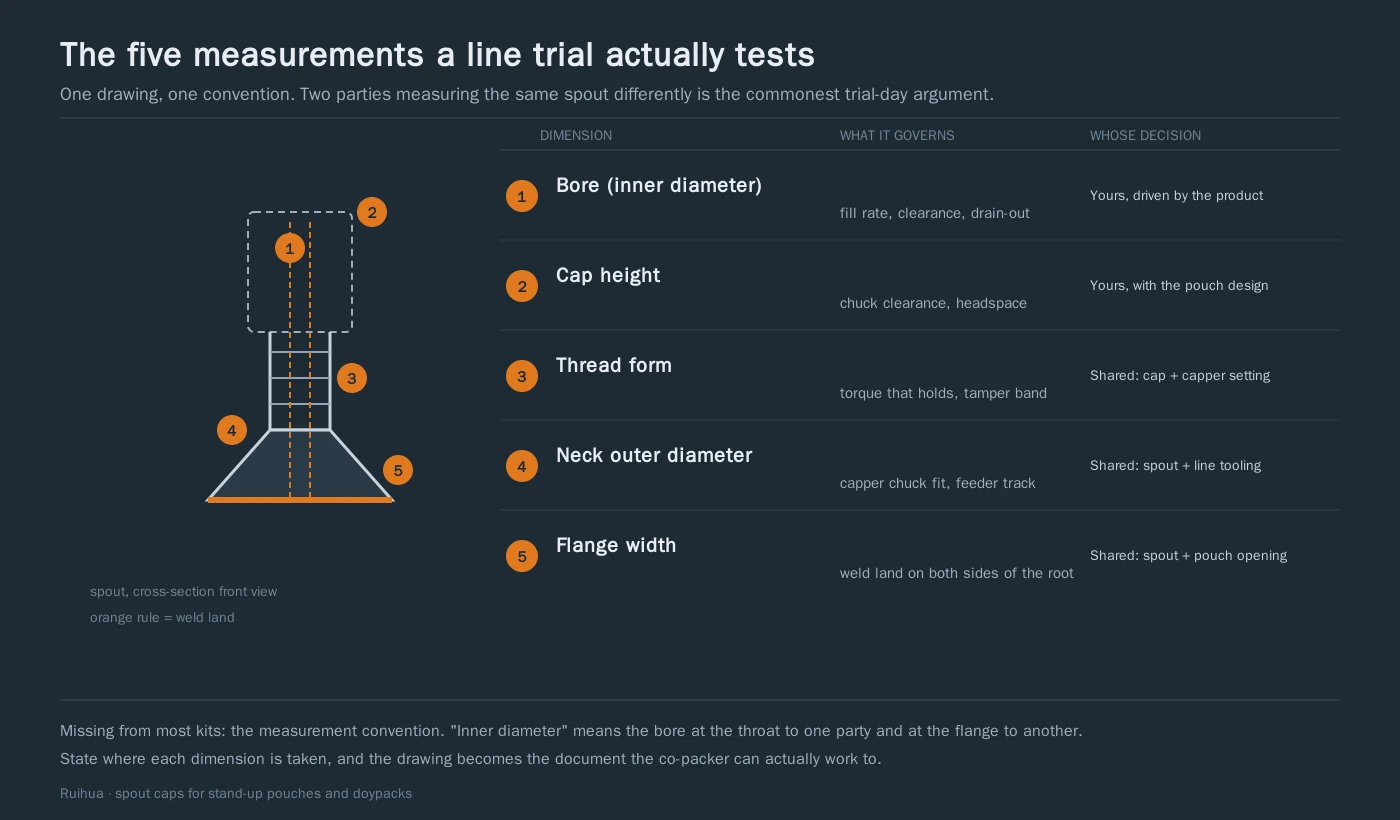
Five measurements, five owners. The argument on trial day is almost always a measurement convention, not the pack.
Two deserve dwelling on. Bore behaves like a machine decision: 9.6 mm and 16 mm both fill a sauce, but not at the same rate, and bore is also what makes a fill weight repeatable — a nozzle choked back to fit a small bore drifts, and the trial records it as weight variation rather than as a spout problem. Our range runs from 1.2 mm to 40 mm, and inner diameter is held to within ±0.1 mm of nominal — a tolerance that matters once a nozzle is sized to it. Flange width is where pouch and spout drawings collide: the weld land has to be wide enough for the jaw to seal on both sides of the spout root, and the pouch opening has to be cut to match. A spout cap specification sheet stating inner diameter and resin is the minimum; add flange and neck data and the converter stops guessing.
Wall section and resin are deliberately not on that list. They are a material decision rather than a measurement, and they set what the trial will expose: the weld band (our spouts are rated to weld at 110–130 °C against PE seal layers, which keeps a mono-material PE pouch's spout weld inside the film's own window), and hot-fill or retort tolerance. They also have to match the film or rollstock the pouch is made from — the weld joins two materials and only one of them is yours.
Pre-assembled or loose: who welds the spout in
This changes the kit more than any other question, and the co-packer's paperwork rarely answers it.
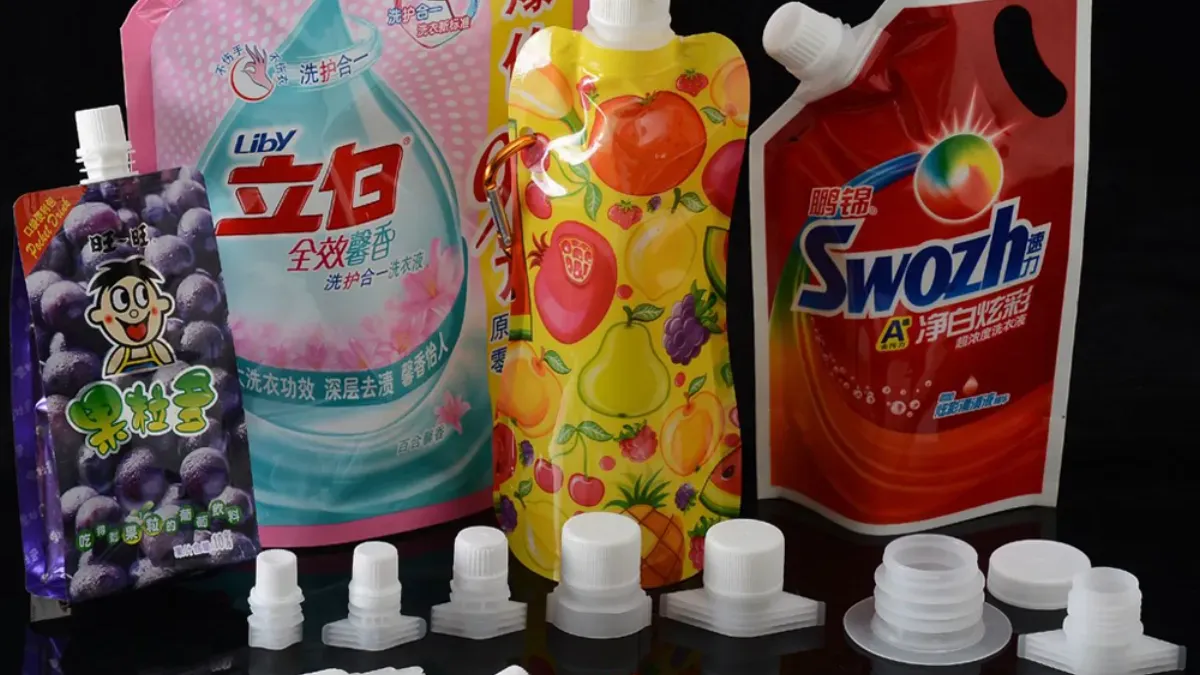
Both states in one frame: spouts welded into filled pouches, and loose spouts and caps. Which one the co-packer needs depends on who does the welding.
If pouches arrive pre-assembled, the line only fills and caps: your kit is pouches, caps and drawings, and weld quality is a converter subject settled before the trial rather than discovered on the day. If the co-packer inserts and welds the fitment on a form-fill-seal line, the kit needs loose spouts in quantity, the welding window and ideally the jaw profile the fitment was designed for. Sending pre-assembled pouches to an insertion line wastes a trip in both directions.
The middle case bites hardest: pre-assembled pouches plus a co-packer who also offers insertion for a second SKU. Then two weld operations exist in one project and the kit carries evidence for both. Our note on pre-assembled spouts and caps covers how that route changes what the converter supplies.
The same question, laid out as responsibilities rather than components:
What the trial needs | Brand owner | Pouch converter | Co-packer | Closure supplier |
|---|---|---|---|---|
Pouch and film structure | Approves the pack | Makes it to the agreed spec | Runs it on the line | Not involved |
Spouts and caps in trial quantity | Pays for them | Welds them in (premade route) | Inserts them (insertion route) | Molds and ships them, with lot and cavity |
Dimensional drawing | Owns the pack specification | Needs flange and opening data | Checks it against the machine range | Issues bore, neck, flange and cap height (thread form where the converter's drawing needs it) |
Food-contact paperwork | Passes it to its retail customer | Holds the film declarations | Checks it before the run | Issues the closure declaration and test evidence |
Tooling and change parts | Approves the spend | — | Owns jaws, feeder and capper | Quotes tooling when geometry has to move |
Whichever applies, one party should say in writing at which station the spout becomes part of the pouch, and who signs off the weld. If nobody can, settle it before the trial.
The paperwork that travels with the spouts
Who asks for which document varies. The co-packer's quality team wants the drawing and the declaration long before the run; their engineers want the resin grade, the weld band, the torque range and the lot record in hand on the day.
The dimensional drawing, with the convention: where the bore is measured, whether neck height includes the thread, how the flange is defined. Without a convention you get two measurements of the same part.
The material and food-contact declaration. In the EU the framework is Regulation (EC) No 1935/2004, which requires that food-contact materials do not transfer constituents in quantities that endanger health or change the food unacceptably, and which puts supporting documentation behind a declaration of compliance. In the US, polyolefin closures sit under the olefin polymer section of the food-additive regulations, 21 CFR 177.1520.
Which one a co-packer wants depends on where the pack is sold, and some ask for both; the FDA, EU and GB 4806.7 comparison shows where they diverge. Ruihua's own paperwork is ISO 9001:2015 and HACCP through CQC, FDA food-grade material compliance, and EU 1935/2004 through TUV SUD — and it describes a tested sample and a system, not a promise about every cavity.
The resin grade and the weld band it is rated for: which resin the closure is molded in, and the temperature range that resin welds in against your seal layer. For the closures we supply that band is 110–130 °C for PE seal layers — a range rather than a per-model table, because pressure and dwell belong to the jaw and stay with the converter or line engineer. A named resin plus a band beats "low temperature sealing" in any conversation.
The cap torque range and the lot record. Torque gives the capper a starting point; the lot record makes a defect traceable. Neither has to be taken on trust.
What to record on the day, and what to send back
The trial produces a decision and data. Only one usually gets written down. Photograph the HMI before and after any change, and record date and line; pouch lot and spout lot with cavity; weld temperature, pressure and dwell used; capper torque used; line speed; pieces produced; defects by type; samples retained; decision taken. A shared defect vocabulary makes those fields usable:
What you see | What usually causes it | Who can fix it |
|---|---|---|
Spout jams or flips in the feeder | Flange or shoulder geometry, nesting, static | Spout geometry or feed tooling |
Weld leak at the spout root | Jaw temperature or dwell outside the window; contaminated or too-narrow land | Converter, or line engineer on an insertion line |
Film wrinkles or pinches around the spout | Jaw profile against pouch opening; off-center weld | Pouch design and jaw tooling |
Cap cross-threads | Chuck alignment, torque too high, damaged thread start | Line setting first, then cap drawing |
Cap backs off in transit | Torque too low, thread interference, liner compression | Capper setting and cap specification |
Leak at the cap after compression | Liner or seal face; tamper band distortion | Cap design and the test method |
Spout cracks after hot fill | Resin grade not matched to fill temperature | Material specification |
Send back defect counts, settings, retained samples and photographs — not a summary sentence. "The trial went well" tells a supplier nothing; weld leaks at 118 °C against 124 °C tells them whether the window moves or the resin does. Because we run our own mold shop, a geometry answer is a tooling change we can quote rather than a limitation we apologize for. For what a released specification should hold afterwards, PackagingHQ's handoff guide is a useful second opinion.
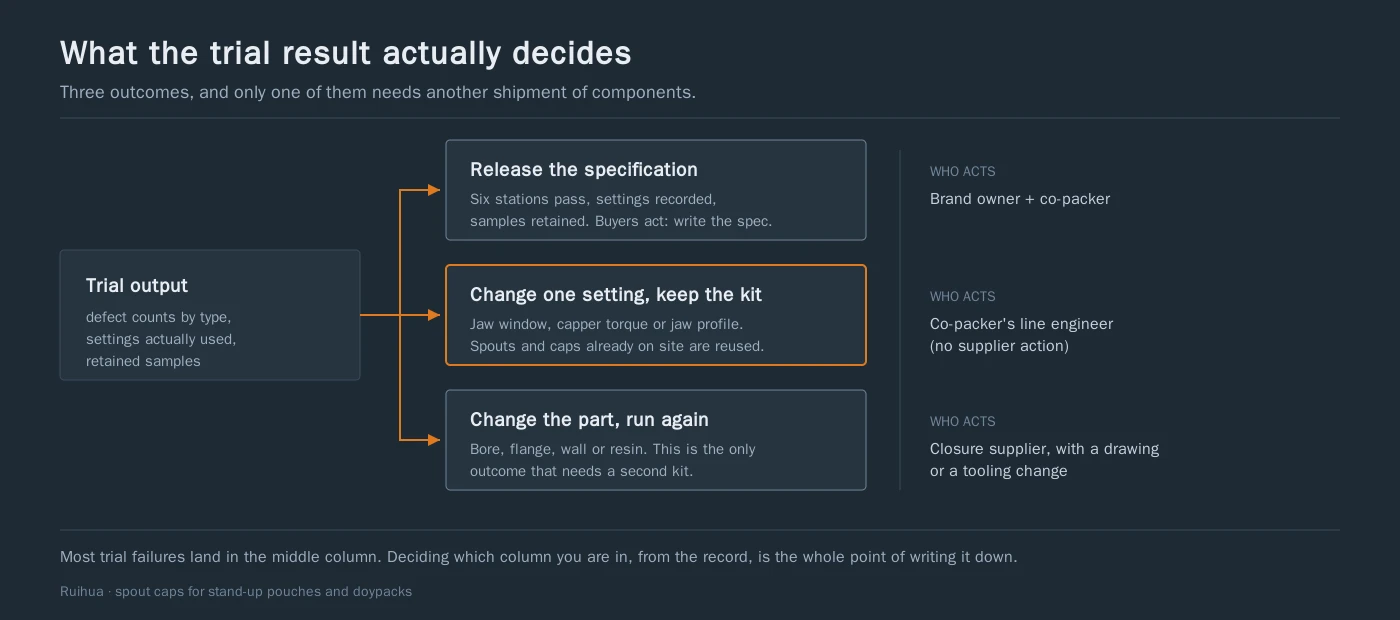
The record decides which column the trial landed in. Only the third column needs another shipment of components.
Before the box is sealed: a nine-line check
- Which line is this — premade pouch, or fitment inserted on the line?
- Are the assemblies pre-welded, and if so by whom, against which window?
- Is the count derived from line speed and running time, including setup and challenge runs?
- Is there a second variant if the line will ever see one?
- Are caps counted at assemblies plus 5%?
- Is the drawing in the box, with the measurement convention on it?
- Do the material documents name this grade, not the product family?
- Does the lot note identify cavity?
- Is there a retained sample from the same lot, kept on your side?
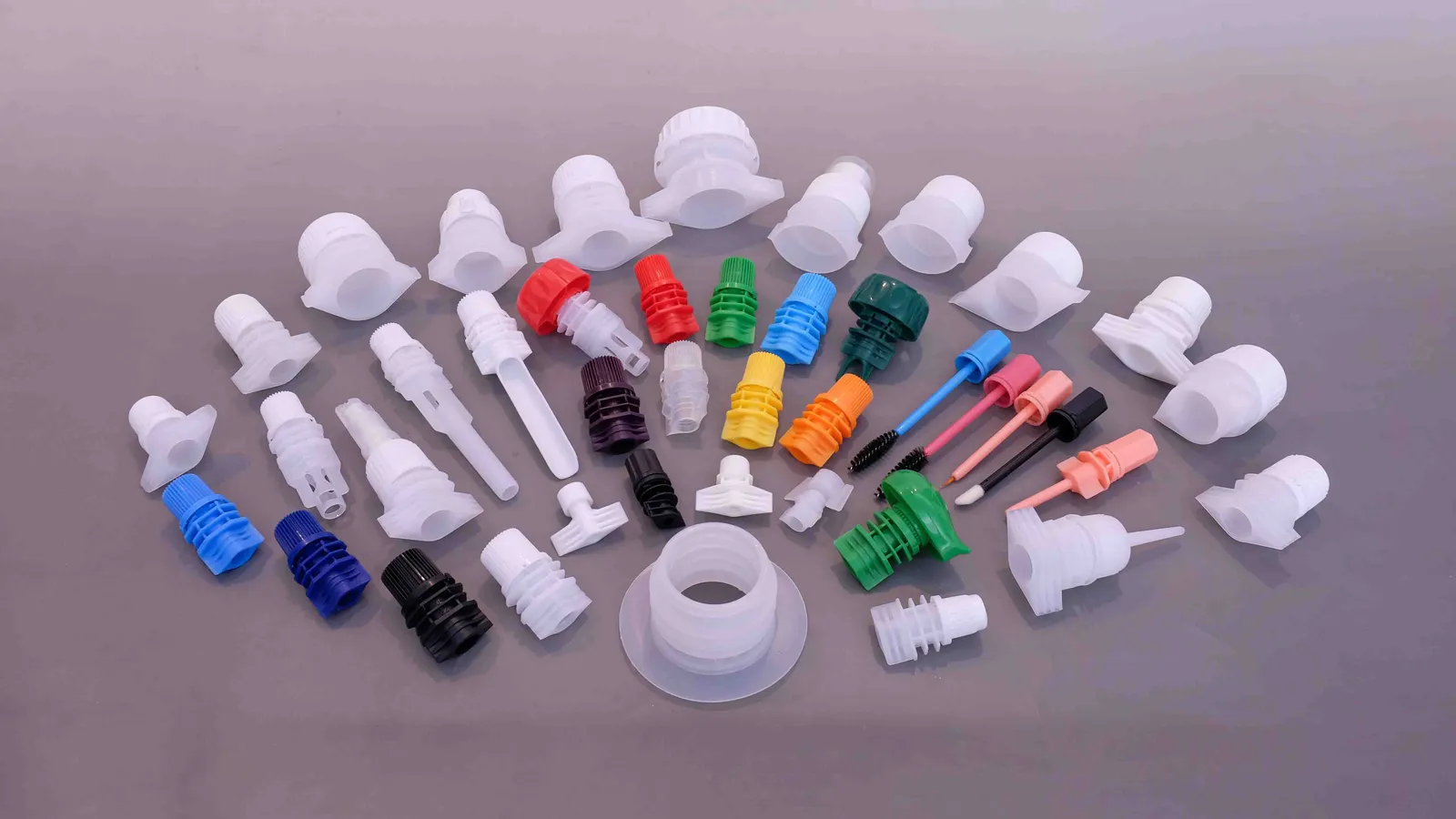
Answer all nine and the trial has a chance of producing a released specification instead of a polite conversation. What we need from your side is short: the spout inner diameter or a drawing, the pouch type and the liquid or powder it carries, the fill temperature, and the co-packer's line type and speed. Send those with the pouch specification and we will put the spouts, the caps, the drawing and the documents we hold into one shipment, so the kit is complete when it lands — the sample and quote route is the fastest way in, and the spout cap range shows the bores and styles a kit can be drawn from.
One honest limit. A trial can settle whether this spout, this pouch and this line work together at this speed with this product. It cannot settle shelf life, migration compliance or retail handling — those need their own tests on their own samples. Packing the kit with that boundary in mind keeps a good trial from being read as a guarantee.