

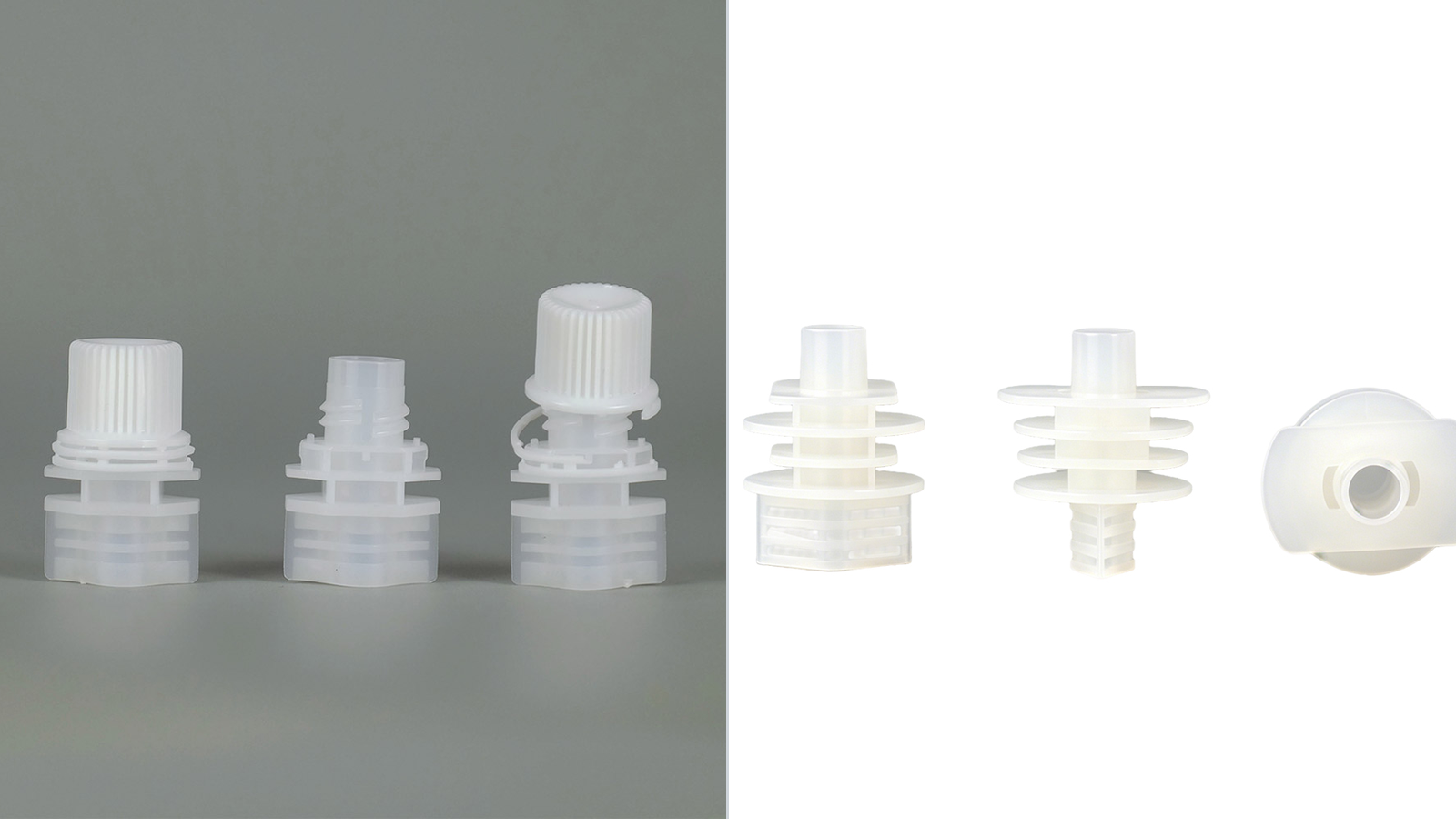
Pre-assembled spouts and caps are one of four delivery states
A purchase order for a stand-up pouch — a doypack, the flexible pack with a spout welded into its top seal — usually describes the part: bore, material, colour, quantity. It stops there, and the delivery state — whether the cap arrives already on the spout or in a separate bag — is left to whoever packs the carton. That is how two buyers order the same fitment and receive two different things. One opens a carton of spouts with the caps seated and torqued down. The other gets a carton of spouts and, next to it, a carton of loose caps.
Both are normal. Neither is a defect. What causes trouble is not choosing, because the delivery state quietly decides who does the next step — and the answer on the bench is not always the answer that survives a filling line.
This is a buyer's checklist for pre-assembled spouts and caps and the three states that sit beside them: what each one changes downstream, what to write on the purchase order so the supplier and the line are working from the same picture, and what to verify when the goods land. It applies to any supplier; it is written to be copied into an email. It sits in the wider sourcing and supply series, which covers the commercial decisions around a spouted-pouch order.
Four delivery states are common, and they are not interchangeable:
Delivery state | What arrives | Who seats the cap |
|---|---|---|
Pre-assembled | Cap already screwed or pressed onto the spout; spout and cap travel as one unit | the spout supplier |
Separate components | Same order, packed apart — caps bagged or boxed on their own | your filling line |
Spout base only | The fitment alone; the matching cap is a different part number | you, with caps from another source |
One-piece | Cap and spout moulded as a single part; there is no separate cap to fit | nobody — nothing to assemble |
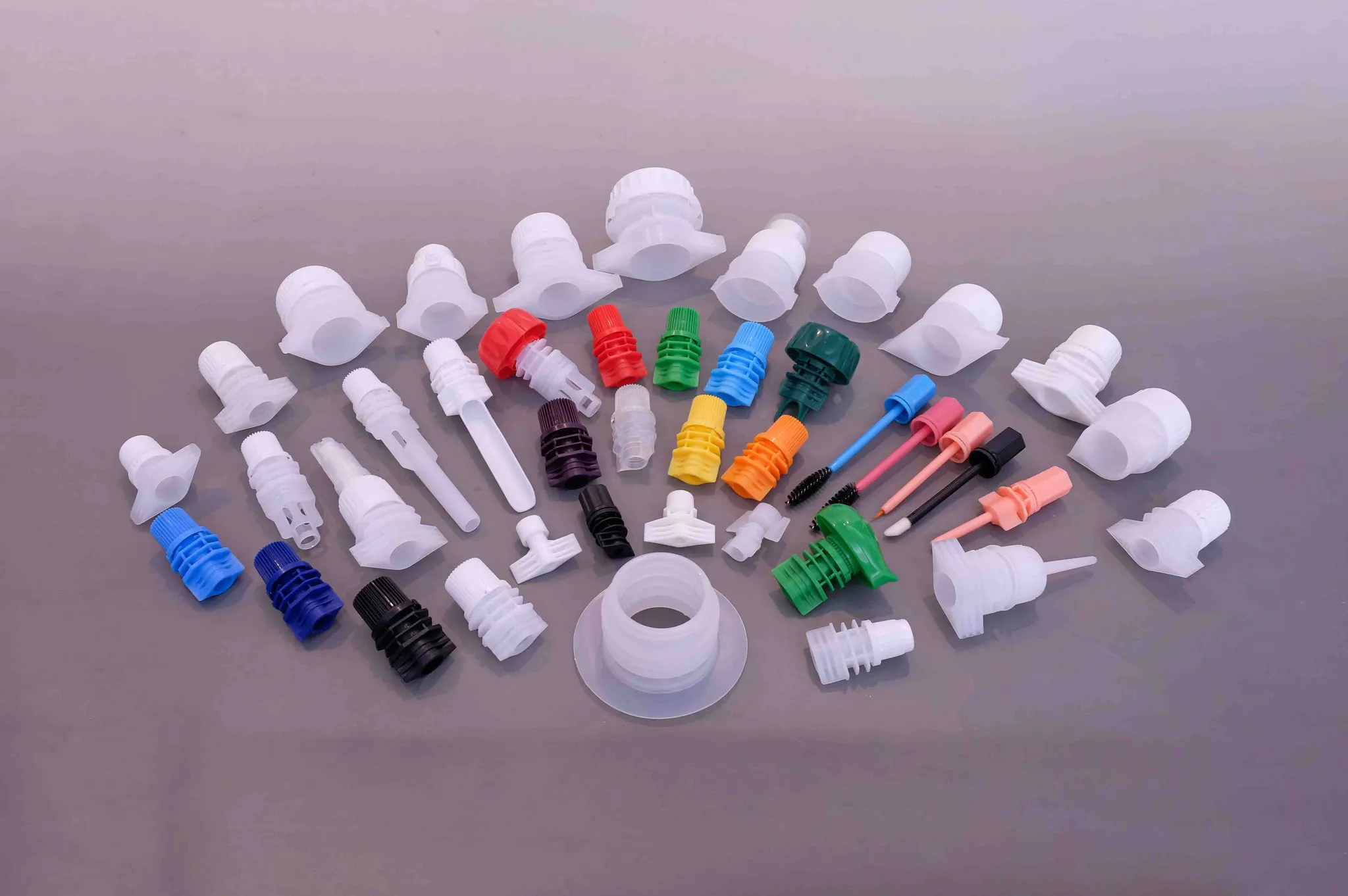
One product family, shown both capped and as bare spout bases. Whether the cap is on the spout at packing is a choice on the order, not a property of the part.
The four names are worth fixing in writing because the market uses "assembled" for something else entirely. A supplier describing an integrated or one-piece cap is talking about the moulded product — the cap and the spout base are one part and cannot be separated by the consumer. That says nothing about how the goods were packed. A two-piece cap can be supplied pre-seated or loose; a one-piece cap is neither, because there is no second part. Confusing the two is the most common way a specification and an order end up describing different things.
What each delivery state changes on your line
The state you choose is really a decision about where the assembly step happens, and that step has to land somewhere: at the supplier's capping station before packing, or at your own filling and capping line. Moving it changes labour, changeover and what you have to hold in stock.
Delivery state | Where the work moves to | What it costs you downstream |
|---|---|---|
Pre-assembled | Supplier | You receive a finished spout-cap unit; your line never touches a loose cap — but the seat has to survive transit, and the cap format is fixed at the supplier |
Separate components | Your line | Your capping head does the seating, so torque, orientation and cross-threading become your settings to control; you carry two part streams into one order |
Spout base only | You, across two suppliers | Maximum flexibility on cap choice, and two supply chains to time to the same build |
One-piece | Neither | Nothing to assemble, and no way to change the cap format without a new mould |
If you are filling through the spout, the seating step is usually your own capping head regardless — the cap goes on after the fill, so a pre-seated cap has to come off first or the fill head cannot reach the bore. Pre-assembly pays off where the pouch is filled open-top and the spout is welded on capped, or where the spout-cap is supplied as a component to someone else on your line. That is a production-flow question, and the interfaces it touches — bore to filler, flange to sealing jaw, cap profile to feeder — are worked through in the guide to running a new spout on an existing sealing line. The point here is narrower: decide the state before the PO, because it is the one variable that decides whether your capping station is in the critical path.
There is also a stock consequence. A pre-assembled unit is one SKU to count and one thing to reorder; separate components are two, and they can run out at different times. If your reorder point is set on the spout, you can be holding three months of fitments and no caps.
What to write on the purchase order
A delivery state that is not on the PO is a preference, not a specification. These are the lines that remove the ambiguity — most of them are a sentence each.
- Delivery state, named. Write "caps seated on spouts" or "caps packed separately", not "assembled" alone. The word has two meanings; the sentence should have only one.
- Bore, as a number with a tolerance. The spout inner diameter, in millimetres, is a spec dimension the PO has to carry, not a noun in a description — it is what your filler nozzle and your stack-up are matched against. Nominal is not a specification: a catalogue that spans 1.2 mm to 40 mm will quote one model at one bore, and the tolerance accepted on that bore is the number your own paperwork needs.
- Counting basis. State whether the quantity is counted in sets (one spout plus one cap) or in pieces per component. A PO that says 200,000 "units" will be read one way by the supplier and another by your goods-in team.
- Cap-to-spout ratio, and spares. Separate supply rarely arrives at exactly one-to-one after a run of rejects. State the ratio you need and whether a small surplus of caps is wanted so a damaged cap does not scrap a spout.
- Packout unit. How many units per bag, bags per carton, and how the cartons are labelled. This is the field that decides whether goods-in can reconcile a delivery without opening everything.
- Matched-set identification. If parts arrive apart, ask how the supplier marks them so a cap bag can be traced to its spout bag — a lot or batch code that appears on both.
- Cap orientation and seat, if pre-assembled. Ask whether the cap is hand-seated or machine-torqued, and to what torque, so you know what you are receiving.
- Tamper-evident or seal state. If the closure carries a tamper band or a foil seal, say whether it must be intact and closed at delivery.
- Compliance scope. Food-contact suitability belongs to the finished article and its paperwork, not to the resin name. Ask for the declaration by name and read its scope line — whether it covers the model you are buying or only a resin grade. The United States handles food-contact substances through the FDA's Packaging & Food Contact Substances framework; the European Union's framework is Regulation (EC) No 1935/2004. A supplier can hold a complete paper set — ISO 9001, HACCP, US FDA food-grade and EU 1935/2004 (TÜV SÜD) are the documents behind our own range — and still only be able to declare what each certificate's scope covers. That is why you read the scope line, not the list of certificates.
- Inspection level. If receiving requires a full inspection rather than sampling, say so when you request the quotation, not after the run.
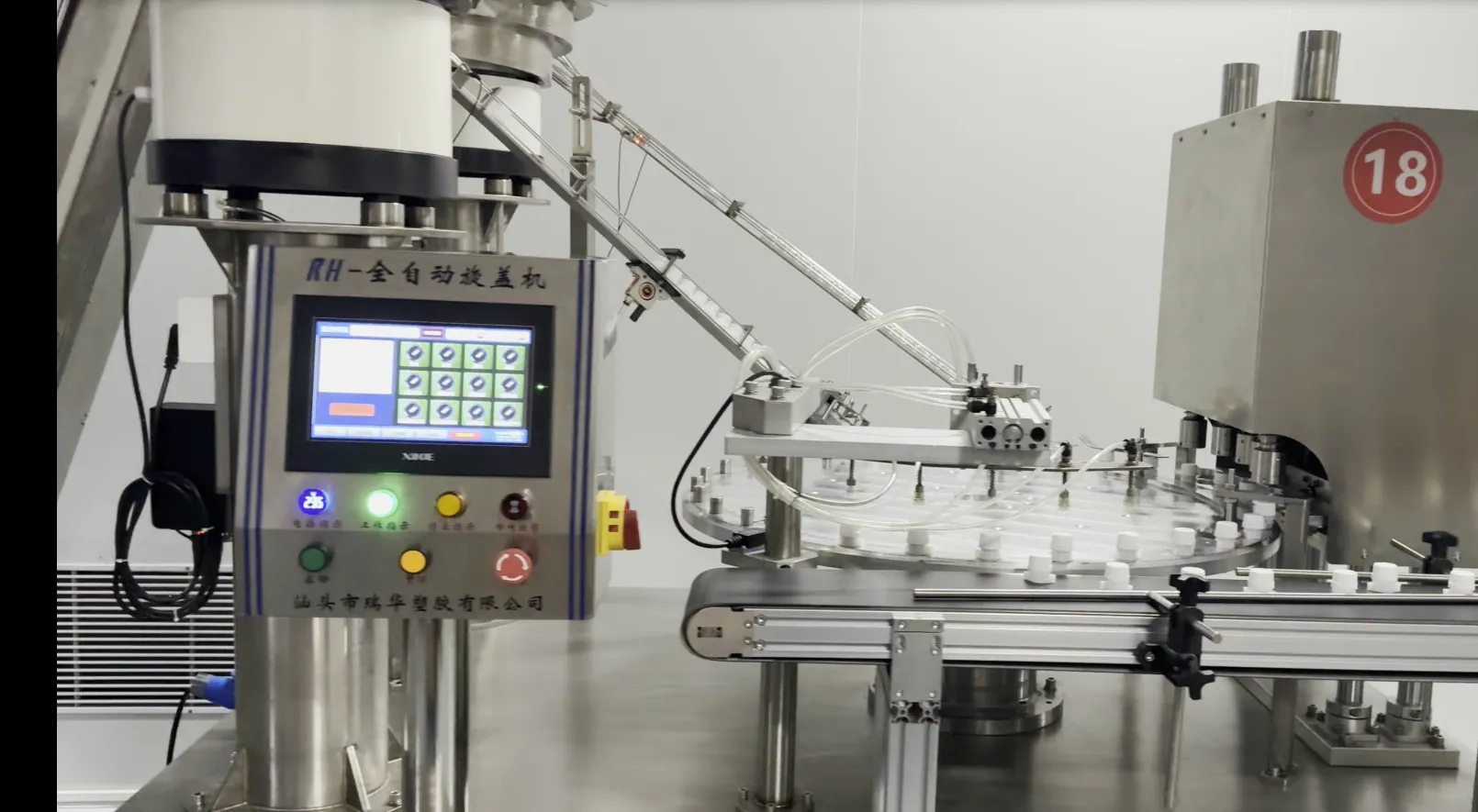
Where the cap is seated decides what the PO has to describe. A pre-assembled unit is finished at the supplier's capping station; a separate-component order leaves that station to you.
If you already have a specification sheet for the fitment, the delivery state is one field on it, and the rest of the spout cap RFQ checklist covers the part itself. The two documents should agree — a spec that names a torque the delivery state never uses is a contradiction waiting to reach the line.
Counting and identification: keeping matched parts together
Bulk packaging is where separate supply quietly goes wrong. A pallet of caps and a pallet of spouts look like stock; what they are supposed to be is matched stock, and nothing enforces that unless the order does.
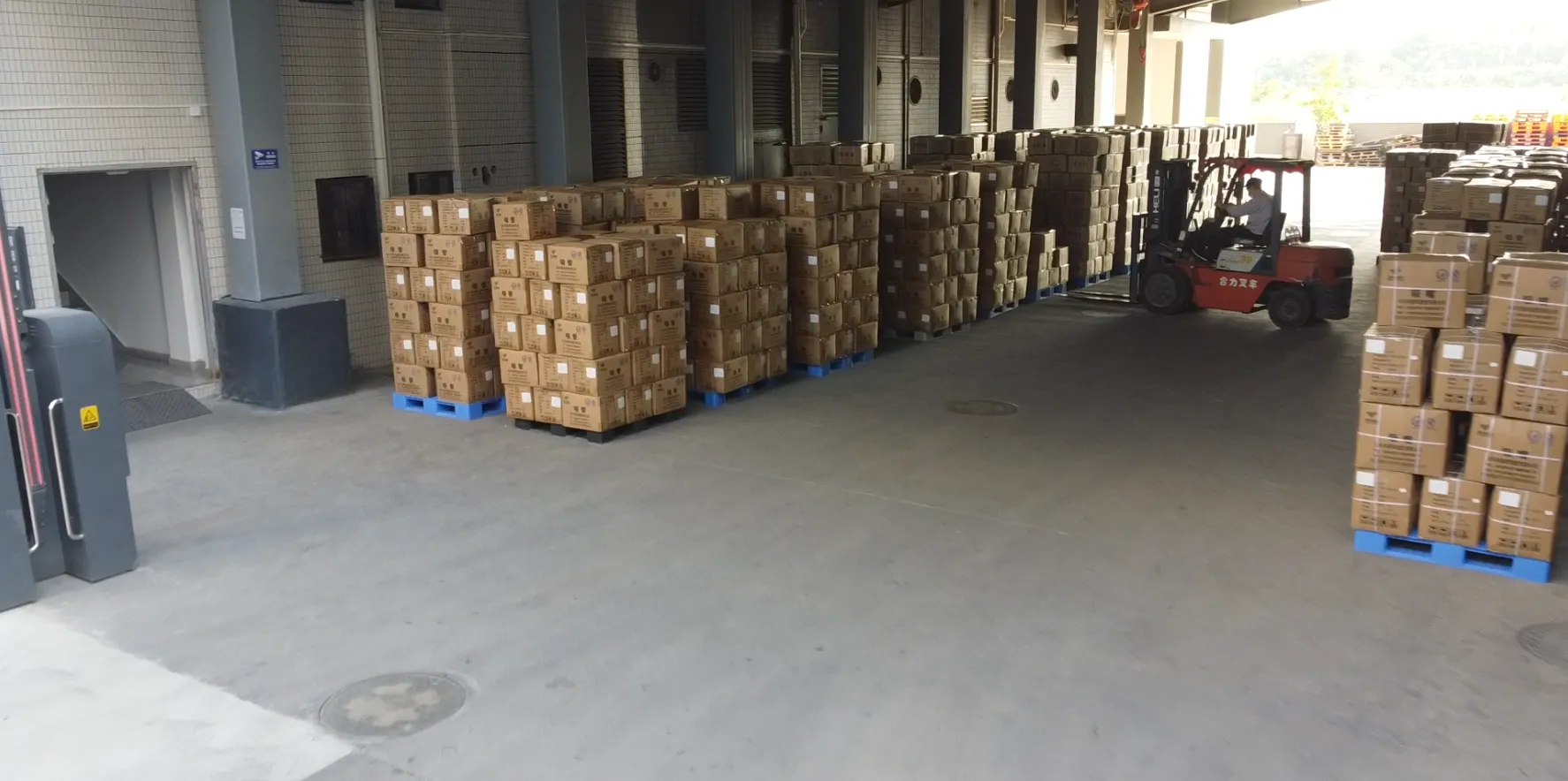
Matched parts arrive as separate pallets. If the only thing linking a cap carton to its spout carton is the packing date, they will be split eventually.
Three practical rules keep a matched set matched:
- One lot code across both components. When the spout and cap are produced and packed as a family, both should carry the same production or lot identifier. That is what lets goods-in open one carton, read one line, and know the other pallet is its counterpart — and it is what lets you trace a leak back to a batch rather than a shipment.
- Pack the ratio, don't assume it. If the closure is a two-part assembly and one part is scrapped on the line, the count drifts. Bag the caps and spouts to the ratio the PO states, and label the ratio on the carton so the drift is visible before it becomes a shortfall.
- Keep format changes apart. If one order carries more than one closure model — perfectly possible when formats are mixed within a single order — each model's caps must be identified against its own spouts. A mixed order with no per-model identification is a sorting job waiting at your warehouse.
A standing position in stock is what makes a mixed or trial order practical: a supplier holding a handful of fast-moving models can pair them with made-to-order lines in one delivery, so the trial does not carry a minimum for every format. Four of our models — RD-001, RD-010, RD-013 and RD-014 — are kept in stock and can be ordered at any quantity, and that is the set a format trial usually starts from.
There is a commercial choice underneath this too. The reliable relationships tend to be the boring ones: parts held in stock and reordered on a known cadence, or parts made to order against a fixed specification. Mixing the two — some of the order from stock, some made to order — is where identification and lead time start to diverge, which is the trade-off covered in stock versus made-to-order spouts.
What to verify on receipt
Receiving is the last cheap place to catch a delivery-state error, and the checks are not the ones a visual scan performs. Count and state first, then condition.
- Count sets, not parts. If the PO said sets, the goods-in count is caps and spouts against one number. A pallet that balances per component but not per set is a mismatch, not a rounding difference.
- Confirm the state matches the PO. Open a carton and check that a pre-assembled order really arrived seated, and that a separate-component order really arrived apart. "Assembled" read as a preference is how a loose-cap delivery passes goods-in unnoticed.
- Check the seat survived transit. A pre-seated cap that popped off, cross-threaded or loosened is no longer pre-assembled in the sense the PO meant. It is a claim to raise with the photograph attached, not a defect to discover at the capping head.
- Read the lot codes. Confirm the spouts and caps carry the matched identifier the order specified, and that a single delivery has not mixed batches.
- Inspect against an agreed sampling plan. Attribute sampling — a scheme such as ISO 2859-1 — sets sample sizes and accept/reject limits from an agreed quality limit, so "we checked a few" becomes a number both sides accepted in advance.
- Test a sample if the closure is pre-seated. A torque check and a leak test on a handful of units confirm that the seat is what the paperwork claims. A leak test bench presses a sealed unit and reads the pressure drop directly:
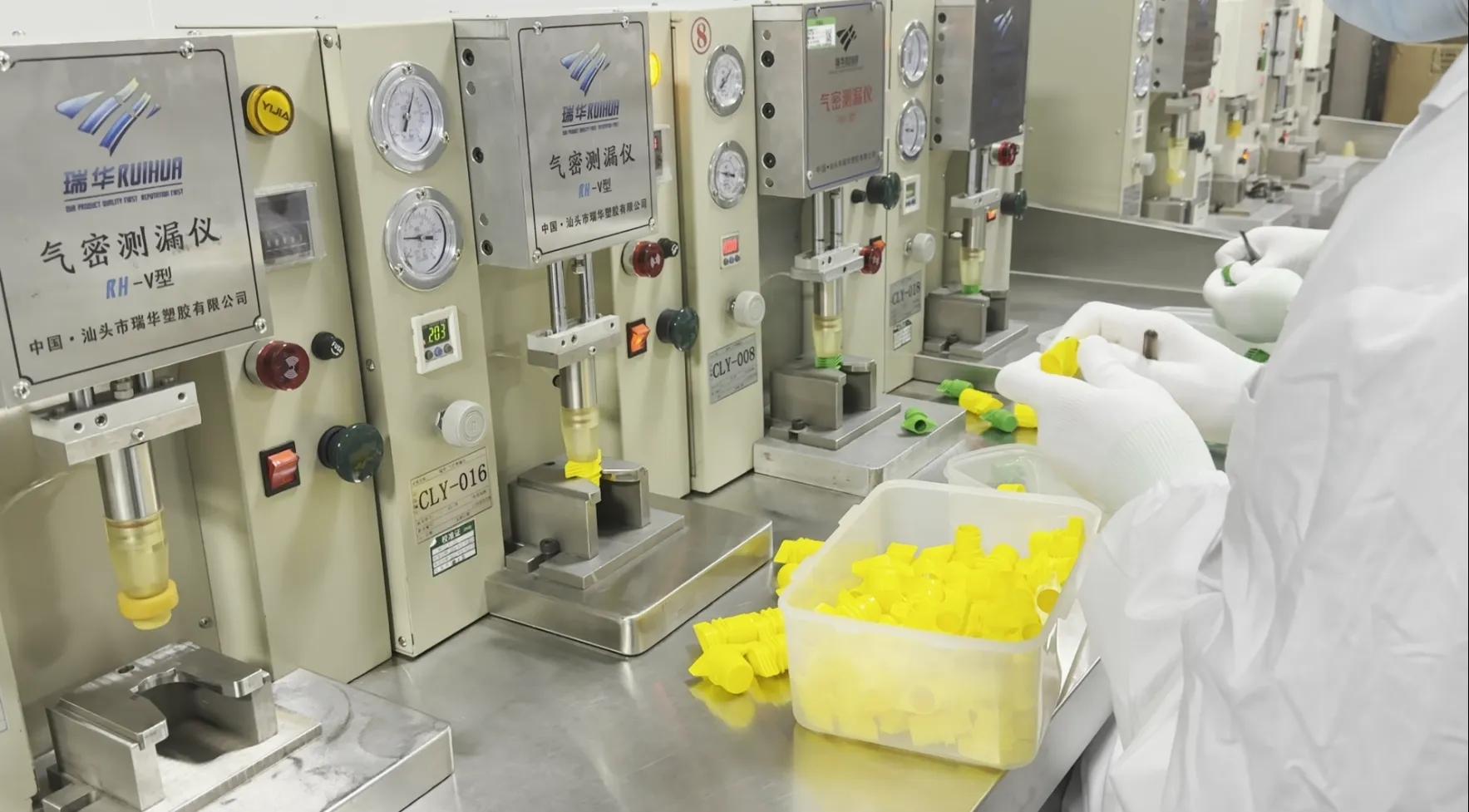
A seat is a measurable property, not an impression. Torque and leak checks turn a delivery-state claim into something goods-in can sign off.
None of this needs new tooling. It needs two sentences on the order and one page at goods-in — the difference between a delivery that can be reconciled and one that has to be argued about.
If you are not sure which delivery state your line should specify, that is the question to ask the supplier before the quotation, not after the carton is open. A supplier who can answer it in writing — and say plainly which states a given model is supplied in — has told you as much about their process as about their product. You can request a quote and a sample set and put the question in the same message; how a supplier answers it is usually the start of the working relationship, not a footnote to it.
Last reviewed: October 2026 by the Ruihua Technical Team. Delivery-state terms, packout and identification should be confirmed in writing with your supplier for each order; the checks here are written to be agreed with whoever supplies the fitment.


