


We make both, so here is the comparison we walk our own buyers through: if you need spout caps for stand-up pouches in days and at low volume, stock spout caps ship fastest — made-to-order is only worth the wait when the catalog genuinely cannot give you what your product needs. A stock model that matches your diameter and closure style is almost always the right first move; a custom diameter, a brand color or a closure that does not exist yet is the reason to go made-to-order, where the real cost is weeks and tooling, not MOQ anxiety. This guide puts numbers and structure on both paths.
What "stock" and "made to order" mean for pouch spout caps
If your search for spout caps surfaced results about fuel-can pourers, you are in the right place anyway: this article covers plastic spout caps for stand-up pouches and doypacks — the injection-molded fittings that are heat-sealed into a pouch film, then reclosed after every pour.
Two sourcing paths exist for these parts:
- Stock spout caps are catalog models the manufacturer keeps in inventory. Nothing is made for your order — you buy from what is already produced and sitting in the warehouse. Common diameters like 8.6 mm, 9.6 mm, 12 mm and 14 mm accumulate stock because they fit the most pouch sizes.
- Made-to-order spout caps start from your specification. The lightest form is a color change on an existing model; the deepest is a new mold for a diameter or closure that does not exist in the catalog, plus sampling rounds before mass production.
The two paths differ on four axes — lead time, MOQ, cost structure and customization ceiling — and each decides part of the answer. The sourcing and supply hub on this blog collects the related guides, including how the wider China sourcing process works.
At a glance: stock vs made-to-order
Dimension | Stock spout caps | Made-to-order |
|---|---|---|
Lead time | Days — pick-and-pack from inventory; freight sets the schedule | Weeks for custom colors; ~60 days of mold machining plus sampling for new tooling |
MOQ | Any quantity on stock models | Custom color: ~100,000 pcs (negotiable); after tooling: no MOQ |
Cost structure | Unit price only, no tooling or setup fees | Unit price plus color-change or tooling costs; tooling quoted only after 3D drawings |
Customization ceiling | Diameter and closure style fixed by the catalog; color change possible at the color MOQ | Diameter, closure, color, logo, material and sealing temperature all negotiable |
Inventory risk | Low — you order what you need | Low — but you commit to the tooling project |
Best for | Tight timelines, small first orders, testing markets, standard fits | Differentiation, exact fit, brand colors, long-run volume, special contents |
These are planning figures from our own commercial terms; industry ranges vary by supplier, so confirm them in your inquiry.
Lead time: where the weeks go
Stock is fast for a simple reason: the parts already exist. An order draws down finished goods, so production time is near zero and the clock is mostly freight — days rather than weeks, at any order size.
Made-to-order splits into two speeds:
- Custom color on a standard model: the injection line must be cleaned, color masterbatch matched, a color sample approved, then the run scheduled around everything else in the factory. Expect weeks, plus a sample round.
- New mold (custom tooling): this is where the calendar goes. The realistic sequence is 3D design → tooling quotation → 3D-printed sample for shape and fit → mold machining → trial shots → sample approval → mass production. On our side, mold machining runs about 60 days once the design and tooling are confirmed — the single largest block in the project. The guide to sourcing spout caps from China walks through the full sample-to-shipment timeline in more detail.
Practical translation: six to eight weeks to launch? Stock is your comfortable option. Four to six months? A custom-color or even a new-mold project fits — if you freeze the 3D design early, since every change after tooling starts moves the date.

Stock spout caps ship from finished goods — the fastest lead time in flexible packaging.
MOQ: the counterintuitive ladder
Buyers usually expect MOQ to fall as commitment rises. In spout caps it works the other way:
Sourcing path | MOQ |
|---|---|
Stock catalog models | No meaningful minimum — any quantity, because the factory is moving inventory, not starting a run |
Custom color / logo on a standard model | ~100,000 pieces, negotiable for specific cases |
Custom tooling (new mold) | No MOQ once the mold exists — the customer owns the tooling project, so the factory supplies to the requirement |
The reason the middle rung is the steepest is production physics: changing color means flushing the line, running color masterbatch through the machine and cleaning again — a fixed cost that only makes sense spread across a large batch. Injection molding is built around long stable runs, and a color change breaks that stability. Custom tooling, by contrast, has already bound the factory to your project, so volume follows your needs rather than a threshold.
Two notes: models can be mixed in one order — combining sizes toward a single shipment is normal, request it explicitly; and the color MOQ applies only when you leave the standard white, which is the factory default.
Cost: what each path really charges
Neither path has a public shelf price — spout cap quotes depend on diameter, material, volume and destination — but the cost structure is predictable:
- Stock: unit price, no tooling, no setup. The cheapest way to test a market or bridge a launch.
- Custom color: unit price plus the color-change overhead, which is why the MOQ is high — the premium is spread over the batch.
- Custom tooling: a one-time mold investment plus unit price. The mold fee cannot be quoted until the 3D drawing exists, because tooling cost is driven by geometry, cavity count and steel — a supplier who quotes firm tooling before seeing your design is guessing. Our custom spout cap tooling cost guide breaks down what drives that number, and the pricing drivers guide covers the per-unit side.
For most projects the math resolves quickly: if the mold cost divided by your expected lifetime volume stays under a few cents per cap, tooling pays for itself; if your volume is small, the same math says stock. We do not publish unit prices here, but any serious supplier will give you a landed-cost breakdown on request.

Injection molding rewards long stable runs — the production reality behind MOQ and color-change pricing.
Customization ceiling: what stock can't give you
The catalog is a ceiling, not a floor. Before you invest in tooling, check the catalog — with 117 models spanning 1.2 mm to 40 mm inner diameter, the answer to "does anyone make my size" is more often yes than buyers expect. If the answer is yes, stock plus a color change covers you.
When the catalog cannot cover you, made-to-order removes the ceiling entirely:
- Geometry — a new diameter, an anti-choking lip for baby-food pouches, a tamper-evident ring, a flip-top or brush closure that no catalog model matches.
- Color and branding — Pantone-matched caps with embossed or printed logos, at the color MOQ.
- Material and performance — food-grade PP or PE chosen for your contents, and low-temperature sealing spouts (110–130 °C) that weld cleanly onto recyclable mono-material PE pouches without burning the film.
- Compliance — food-contact materials and certifications (FDA, EU 1935/2004) are part of the specification for either path; declare them before tooling starts. The FDA food-contact substances rules and the EU framework regulation (EC) No 1935/2004 are the two documents your supplier should know cold.
The good news: a 3D-printed sample can be made as soon as the 3D drawing is approved, before any steel is cut — shape and fit get validated on a cheap prototype, not on the mold itself.
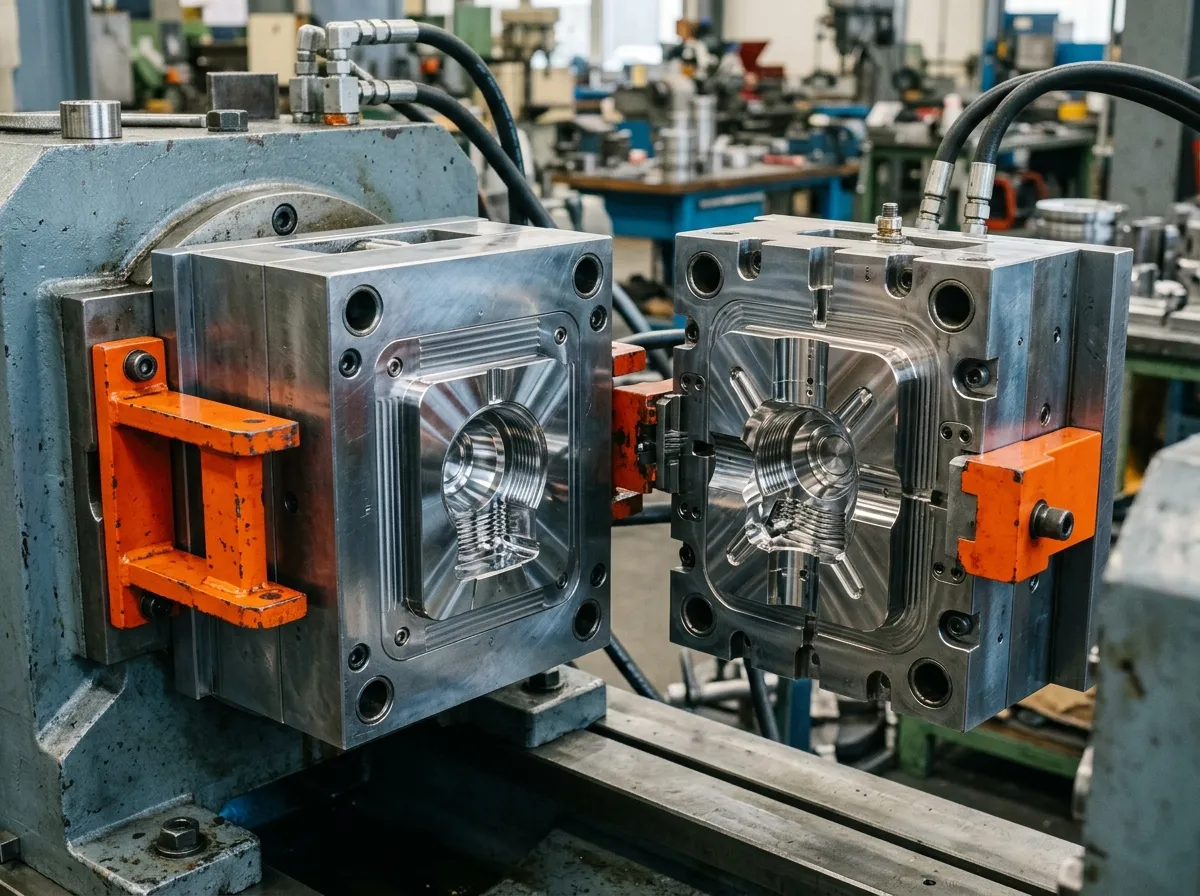
The made-to-order ceiling: a dedicated mold gives you geometry no catalog model can.
When stock wins — and when made-to-order wins
Choose stock spout caps when: your launch is measured in weeks; your first order is small; your diameter and closure exist in a catalog (our stock line includes RD-001, an 8.6 mm food-grade screw cap); or you are testing a market and want minimal commitment. Stock also wins when you need caps now — speed is its whole business model.
Choose made-to-order when: the catalog has no fit for your contents; your brand needs a specific color or closure to stand out on shelf; your volume is large enough that tooling amortizes; or your packaging spec includes performance the catalog does not offer, like retort resistance or low-temperature sealing for recyclable pouches.
And the honest warnings. Stock loses when the fit is wrong — a cap that nearly matches your pouch geometry can still leak, and the catalog cannot adapt. Made-to-order loses when you do not actually need it: if a standard part fits, paying for a mold is buying a solution to a problem you do not have. If you are torn, start with a small stock order to validate the pouch-and-cap marriage, then tool up once volume justifies it.
How to choose: a three-question check
- Does a catalog model match your diameter, closure and content? Check the catalog for your inner diameter (1.2–40 mm) and closure style. Yes → stock, done. No → made-to-order.
- How far is your launch? Weeks → stock only. Months → custom color fits; a new mold fits if you freeze the design now.
- What is your lifetime volume? Small or uncertain → stock. Large enough that the mold fee lands at a few cents per cap → tooling pays for itself.
Structure your first inquiry to ask three things at once: which stock models are available in your size, the MOQ for your chosen path, and what samples cost — any supplier should answer all three in one reply. Requesting samples before committing is cheap insurance on both paths, and our quote and samples page is the direct way to start that conversation.
Bottom line
Stock spout caps ship fastest because they already exist; made-to-order is a deliberate trade of weeks for fit, differentiation and long-run unit economics. Neither path is "better" — the decision is your timeline multiplied by your volume, and the fastest way to make it is to ask your supplier for stock availability, MOQ and samples in a single inquiry.


