


Why "spout cap price" has no single answer
Search "spout cap price" and you will get quoted wildly different prices per piece — for products that are not even the same thing. In the US market, "spout cap" mostly means the pour spouts on gas cans, oil tins and bottles. If you buy closures for stand-up pouches and doypacks, none of those prices apply to you, and neither does the comparison.
For flexible packaging, the spout cap price is not a number a supplier can give you upfront. It is the output of five decisions you have not made yet: which resin, which size and cap style, how many pieces, whether a mold is involved, and how much customization you want. Change any one of them and the quote moves. That is why two suppliers can quote the same part and land far apart — they priced different specifications, not the same product.
This guide walks through each driver, what it does to your quote, and what to send a supplier so the numbers you get back are actually comparable. For the wider picture of buying this product family, the sourcing and supply hub collects the practical buyer guides for spout caps on stand-up pouches.
The five drivers behind every spout cap quote
Every spout cap quote for flexible packaging is built from the same five blocks:
- Material grade — food-grade PP and PE are the baseline; specialty grades add cost.
- Diameter and cap design — more resin per part and more moving parts mean a higher unit price.
- Order volume — quantity tiers, minimums and whether the model is stock or custom.
- Mold and tooling — a one-time cost that either appears as a separate line or hides inside your unit price.
- Customization — color matching, branding, and any deviation from a catalog item.
A quote is only as good as the specification behind it. A "plastic spout cap price" with no diameter, no material, and no quantity is not a price — it is a placeholder. The rest of this article explains each block so you can spot which one is moving the number.
Material grade: PP, PE and the specialty resins
The resin is the price floor. Polypropylene (PP) and polyethylene (PE) are the workhorse materials for food-grade spouts and caps, and both are commodity polymers — cheap, predictable, and well understood in injection molding. The moment the application needs more than a standard grade, the resin price moves:
- Food-contact compliance. In the US, olefin polymers used in food contact fall under FDA 21 CFR 177.1520. In the EU, the framework is Regulation (EC) 1935/2004 with the plastic-specific migration limits of Regulation (EU) 10/2011. Resins that document compliance with these (typically via a migration test report) cost more than generic grades — and they should, because the certificate is what your product safety auditor will ask for.
- Low-temperature sealing. A spout designed to weld onto a mono-material recyclable PE pouch seals at roughly 110–130 °C instead of the higher temperatures conventional structures need. That formulation is a deliberate engineering choice and carries a small premium — but it is also the difference between a pouch that is recyclable as PE and one that is not.
- Specialty grades. PLA (compostable) and PCR (post-consumer recycled) resins are priced above virgin PP/PE and have tighter process windows. They are worth the premium only when your market requires the claim.
A useful question to ask any supplier: "Which grade exactly, and can you share the food-contact test report?" A quote based on an unverifiable "food-grade material" is a quote you cannot defend to your own customer.
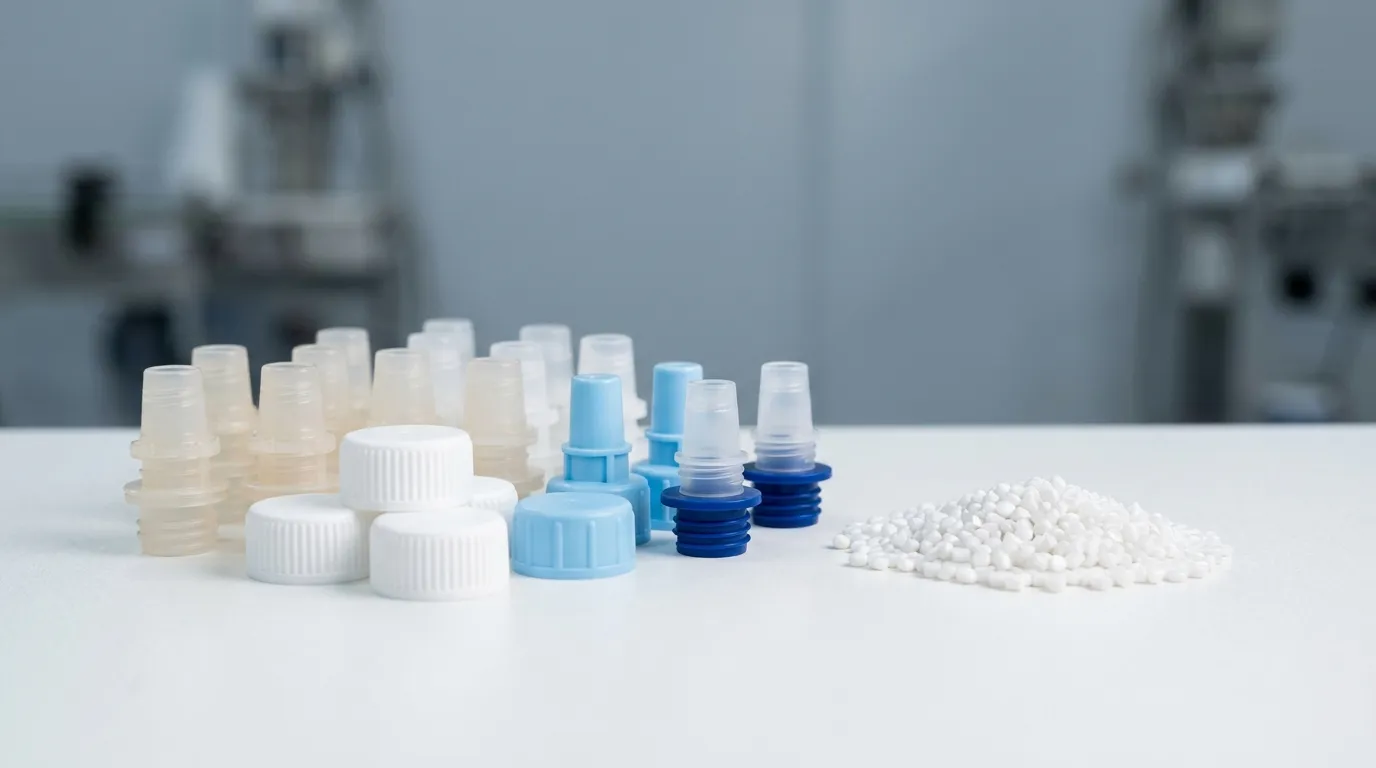
Material choice is the first cost driver: the resin grade sets both the safety profile and the price floor.
Diameter, cap style and parts count
The second driver is how much plastic goes into each part — and how many parts there are. Spout inner diameters for stand-up pouches range from about 1.2 mm for sample sachets to 40 mm for high-flow detergent and pet-food pouches. Bigger diameter means more material per shot, and the resin cost scales with it. Ruihua's product family spans this whole range across 117 stock models; the full spout cap range is a good reference for how much the diameter spread actually varies.
Cap style matters as much as size. A simple screw cap is one molded part. A flip-top cap adds a hinge and a living spring. A tamper-evident or anti-theft cap adds a breakable band, and an anti-choking design adds an insert. Every extra part or feature means an extra cavity, an extra assembly step, or both — and each step shows up in the unit price.
Dimensional tolerance is part of this block too. A spout that must seal reliably in a high-speed filling line needs consistent inner diameter; a published tolerance such as ±0.1 mm is a quality statement, not a marketing one. Tight tolerances are achievable, but they are a process capability the factory has to hold — ask whether the quoted price assumes it.
Order volume: price breaks, MOQ and mixed models
Volume is the most powerful lever you control. Injection molding has high fixed costs per setup, so the marginal cost of the next thousand pieces is far below the average cost of the first thousand. Suppliers build this into tiered pricing: the more you commit, the lower the per-piece price. The practical question is where the tiers sit, and that is where supplier terms differ sharply — which is why one-sentence minimums like "MOQ 10,000" hide more than they reveal.
Real-world terms are usually a three-tier structure rather than a single MOQ number. Taking one supplier's confirmed terms as an example: standard stock models ship at any quantity (there is a standing inventory, so there is no setup cost to amortize); a custom color carries a higher minimum because changing color means stopping the line and flushing the material system; and once you have opened a dedicated mold, there is no minimum at all, because the tooling investment has already committed the supplier to your program. The counter-intuitive takeaway: for a custom-color run, the minimum can be higher than for a brand-new mold. Ask for the tier table instead of accepting a single MOQ figure.
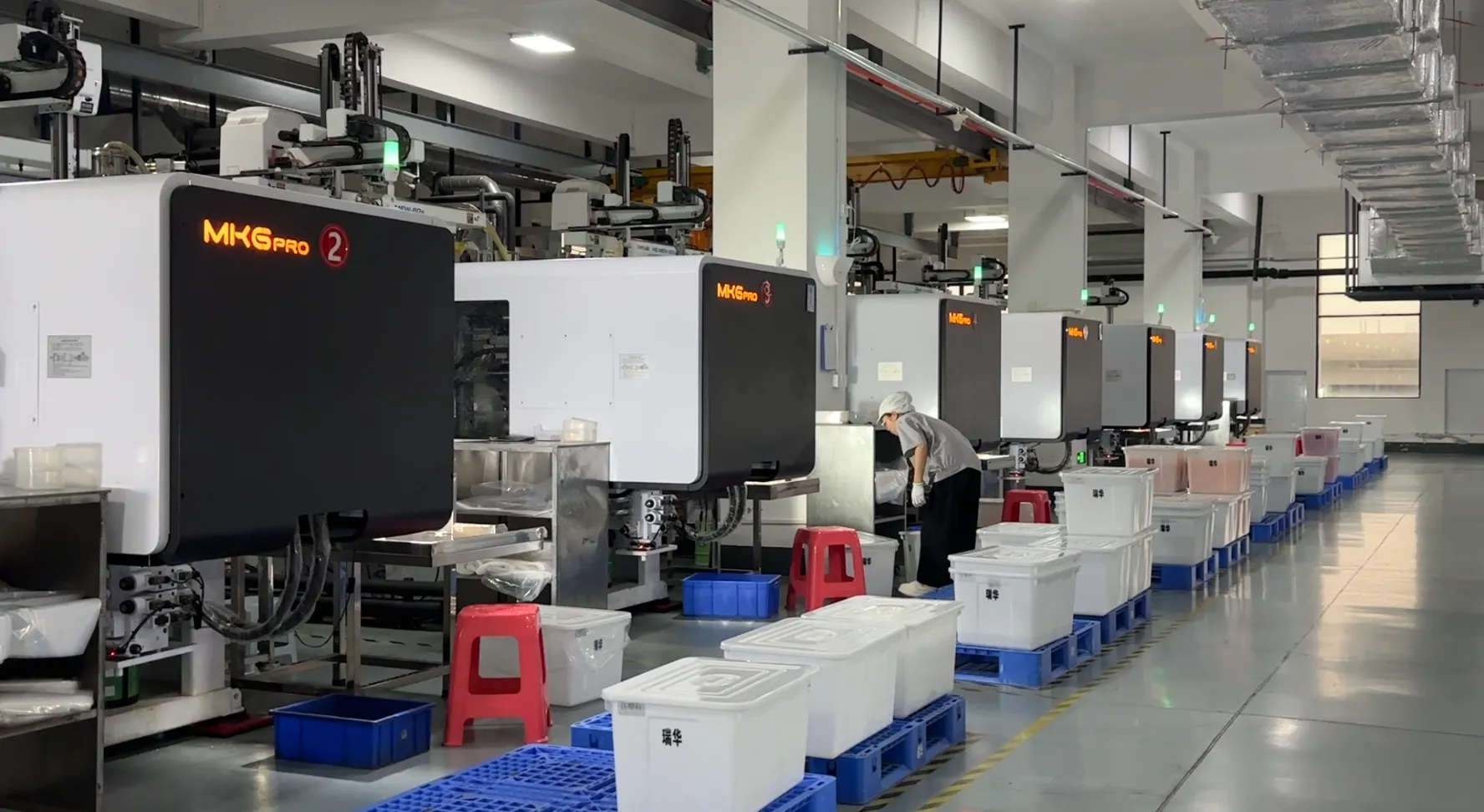
High-volume production is where injection molding becomes cheap per piece — volume is a price driver, not a side note.
Two practical notes on volume. First, most suppliers let you mix models in one order — combining several diameters and cap styles into a single shipment is a standard way to reach a volume tier without overstocking one size. Second, if your project is below the custom tier, start with stock models and a standard color; the price difference versus a custom spec is often larger than buyers expect, and it buys you speed. For the full procurement picture — payment terms, lead times and inspection — our guide to sourcing spout caps from China covers what happens after the quote.
Mold and tooling: the cost hiding in your unit price
A catalog spout cap is molded in a tool the supplier already owns — you pay nothing for it, and its cost is already spread across everyone who buys that model. A custom spout needs a new mold, and that mold is a real engineering investment: it is machined from steel, built to your 3D drawing, and it determines every part that comes out of it for the life of your product.
Mold cost is driven mainly by part complexity, cavity count and steel grade — the same factors any injection molding cost guide will list, as Protolabs notes in its injection molding cost guide. Two things matter for your quote:
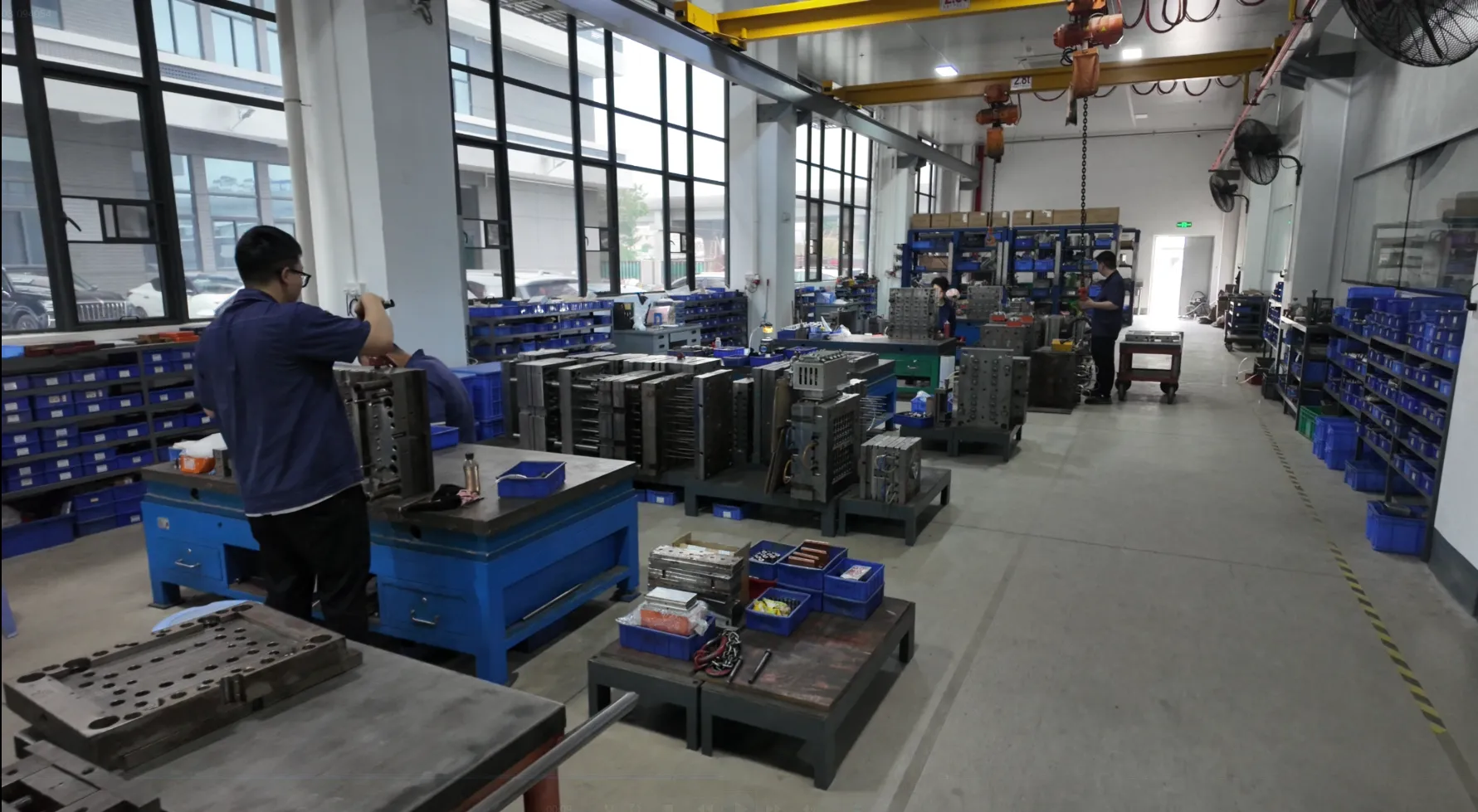
A custom mold is a one-time investment that gets amortized into every unit you order.
- Where the mold fee appears. Some suppliers quote it as a separate one-time line; others fold it into the unit price. Always ask which. If it is folded in, ask how many pieces the amortization assumes — a "cheap" unit price may simply be spreading the mold over a much larger volume than you will ever order.
- When amortization makes sense. Divide the mold fee by your expected lifetime volume. If the per-piece share is small relative to the material and production cost, a custom mold is the right call — you get exactly the diameter, cap style and branding you want. If your volume is low, the mold fee can swamp the savings, and a stock model is cheaper in total.
A good supplier will not quote a mold fee from thin air: mold pricing requires a finished 3D drawing, because complexity is what drives the number. Expect the flow to be drawing → 3D-printed sample → mold production (roughly 60 days at Ruihua) → parts. If a custom tool is on your roadmap, our breakdown of custom spout cap tooling cost covers the cost structure and sampling rounds in detail.
What to send a supplier to get an accurate quote
The fastest way to raise your spout cap price is to ask for one without a specification. Suppliers quote what they can see; a vague inquiry gets a defensive number. Send these eight items and the quotes will come back comparable:
- Inner diameter — the spout bore in mm (8.6, 10, 22…), or a photo/drawing of the part.
- Cap style — screw, flip-top, push-pull, tamper-evident, anti-choking.
- Material requirement — PP or PE, food-grade, low-temperature sealing, recyclable-PE compatibility, or a specialty resin.
- Quantity — expected annual volume and the initial order size; mention if you can mix models.
- Color — standard colors are cheapest; custom color matching changes the minimum and the price.
- Product to be filled — liquid, powder, viscosity and fill temperature, because they influence cap design and sealing.
- Pouch structure — especially if you need low-temperature sealing for a mono-material PE pouch.
- Destination and documents — port of destination, Incoterms preference, and any certifications you need documented.
Half of these (diameter, material, quantity) are hard inputs that determine the price floor; the other half are what turn a price into a quote you can sign. If the supplier offers customization options — color matching, logo printing, or a dedicated mold — state up front which of these you are considering, because each one changes the structure of the answer.
How to compare quotes beyond the unit price
The unit price is the most visible number in a quote and the least informative one. Compare quotes on total cost, which has four parts:
- Unit price × volume — the piece cost, but check which volume tier it assumes.
- Mold or setup fees — one-time costs, amortized across your real volume.
- Freight and Incoterms — FOB vs. CIF vs. DDP changes who carries shipping, insurance and risk; two quotes with the same unit price can land at noticeably different total costs once freight is included.
- Risk — the cost of a bad batch is not in the price: failed sealing, off-spec diameter, or a food-contact certificate that does not survive scrutiny.
On risk, two cheap checks beat any contract clause. First, order samples and test them on your own filling and sealing line — sealing temperature windows and cap torque feel different in the hand than on paper. Second, look at how the supplier controls quality: a certified quality system such as ISO 9001 is a baseline, and machine-vision inspection of every part is available from some manufacturers on request. A supplier who can show you the inspection step is pricing quality into the quote; a supplier who cannot is pricing hope.
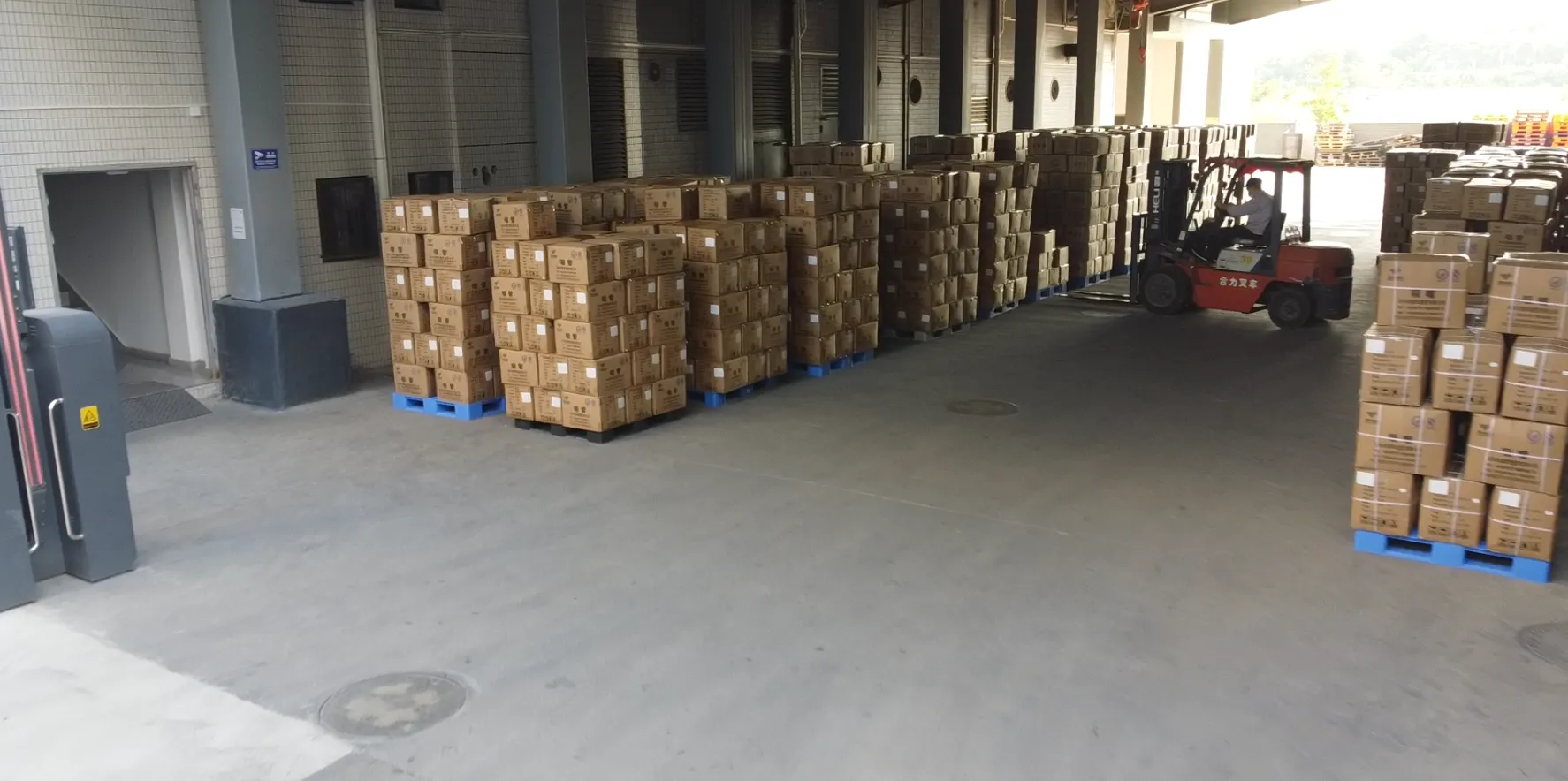
Stock models skip tooling cost entirely — the fastest and often cheapest way to start.
The pattern to avoid is comparing the unit-price column alone. The supplier with the highest unit price can be the cheapest total if their mold fee is lower, their freight terms are better, or their quality record means you never absorb a rejected batch. When you have your specification and your volumes, send the same eight items to three suppliers, put all four cost parts in one table, and let the totals argue.
If you are at that stage, request samples or a quote with the spec list above — a complete inquiry is the shortest path to a price you can compare, and to a supplier who takes your program seriously.


