

Bore size is the first question in almost every enquiry we get, and it is usually asked the wrong way round. Buyers ask "what sizes do you have?" when the useful question is "what is going through it, and how fast does it need to come out?"
The bore is a flow-rate decision before it is a dimensional one. Get it wrong in the generous direction and thin liquid glugs out faster than the person expects. Get it wrong in the mean direction and a thick purée refuses to move at all, which the end customer reads as a defective pack rather than a mismatched fitment.
This guide walks the range the way it actually divides in practice.
The short answer
If you want the three that cover most of what leaves our factory:
Bore | Models we hold | Typical use |
|---|---|---|
8.6 mm | 27 | Juice, purée, sauce, yogurt drinks, baby food |
10 mm | 13 | Beverages, liquid foods, powders and sugar |
22 mm | 11 | Sauces, cooking oils, detergents, sports-drink pouches |
Those three are 51 of our 111 spout-cap models — just under half the range — and there is a reason the distribution is that lumpy: they are the sizes that filling lines are already tooled for. Choosing one of them is the cheapest decision you can make, because it rarely requires anything new on your side.
The full range runs from 1.2 mm to 40 mm across 27 bores. You can browse every size if you already know the number you need.
How the range divides
1.2 – 6 mm — controlled dosing, not pouring
At this end the bore is there to restrict flow. Nobody wants a lip gloss to pour. These sizes go into cosmetic sample sachets, essential oils, reagents and pharmaceutical trial packs, where the user expects to squeeze deliberately and stop precisely.
Two things to watch. First, the thinner the outlet, the more the fill's viscosity matters — a 2.5 mm outlet tube that works for a serum will clog with anything pigmented or particulate. Second, dip-tube length becomes a real cost lever at this size, because expensive contents left in the bottom of the pouch is money thrown away. Our cosmetics and makeup range includes long thin-tube versions with adjustable tube length for exactly that reason.
7 – 13 mm — the everyday band
This is where most food and beverage packaging sits, and where we hold the most stock: 8.6 mm alone has 27 models, and 7 mm, 9.6 mm and 10 mm add another 27 between them.
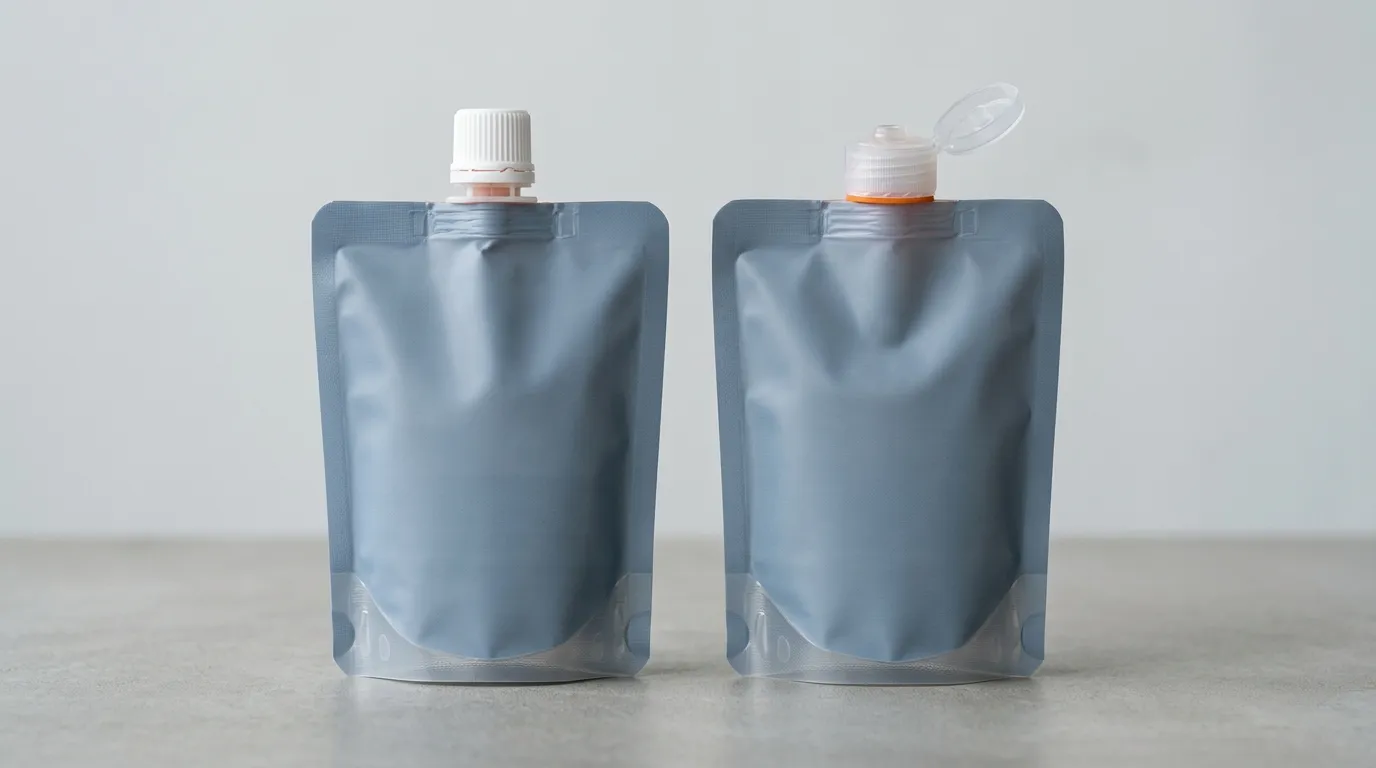
The band pours drinkable liquids at a rate that feels right in the hand — juice, milk tea, jelly, yogurt, liquid foods. It is also where the safety-cap variants concentrate, because this is the band used for baby and toddler packaging. If your pack is going to a child-facing market, look at the mushroom and split-petal anti-choking caps rather than a plain screw cap.
A worked example: RD-001 is a plain 8.6 mm screw cap rated for retort up to 121 °C, which is the combination most chilli and tomato sauce pouches need. RD-005 is the 10 mm equivalent for thinner beverages and for powders, where the extra 1.4 mm stops the fill bridging in the neck.
14 – 22 mm — thicker fills and daily chemicals
Above 13 mm the reason for going wider changes. You are no longer matching a drinking rate; you are getting a viscous product to move at all. Condiment sauces, cooking oils, laundry liquids and hand sanitiser all live here.
This is also the band where material choice stops being a formality. A detergent or an acidic cleaner will attack a cap compounded for food use — that is a different resin decision, not just a different size. Our detergent and corrosion-resistant range exists as a separate line for this reason.
RD-016 is the reference 22 mm here: a wide bore that still takes a conventional screw cap, so it drops into lines already running smaller sizes.
25 – 33 mm — wide bore, and the granule boundary
Something changes around 25 mm that catches people out. Below it, wider means "pours thicker liquid faster". Above roughly 26 mm, most of the demand is not liquid at all — it is rice, cereal, flour, pet food and other granular or powdered products, usually in a pack big enough to need a carry handle.
So this narrow band is genuinely two different jobs sitting next to each other. RD-075 at 25 mm is the liquid answer: a wide bore with a dual tamper-evident tear ring, aimed at thick fruit purée, syrup, edible oil and chilled beverages. Move up to 30 or 33 mm and you are into granule territory, where we pair the spout with a handle rather than treating it as a pour spout.
40 mm — refill packs, not servings
At 40 mm the bore has stopped being about flow rate and become about decanting. Nobody drinks from a 40 mm spout. They use it to empty a 3–20 kg pouch into something else.
RD-132 is our 40 mm cap, and its brief reads differently from everything above: bulk honey and maltose, 5 kg and 10 kg commercial edible-oil pouches, wet pet food, thick soup, and bulk infant-food raw material going into a food factory. Weight is 20.25 g, which is roughly five times an 8.6 mm assembly — worth knowing before you cost a container.
If your product is sold to a business rather than a household, this is usually the size you want, and it is usually the size nobody quotes you because most spout-cap ranges stop at 33 mm.
Three mistakes worth avoiding
Sizing from the old pack rather than the contents. The most common cause of a mismatched bore is copying whatever the previous supplier shipped. If the formulation changed — more pulp, higher viscosity, a switch from a clear to a filled product — the bore that used to work may now be the bottleneck.
Ignoring the sealing side. The bore is one number; the base that welds into your film is another. A wider bore usually means a wider flange, and a wider flange needs the sealing jaws to accommodate it. Check both before committing, and see what sealing temperature your film can take — our low-temperature grades seal at 110–130 °C, which matters if you are moving to a mono-material recyclable structure.
Treating anti-choking as an upgrade. For baby and toddler packaging in most export markets it is not optional. Decide it at the same time as the bore, not after.
What we need from you to quote
Three things get you a firm answer quickly:
- What is in the pouch, including viscosity if you know it, and whether it is acidic, alkaline or contains solvents.
- The pouch and film — structure, thickness, and the sealing temperature your line runs at.
- Target bore, or the flow behaviour you want if you would rather we recommend one.
We hold 111 spout-cap models across 27 bores from 1.2 to 40 mm in food-grade PP and PE, certified to ISO 9001, HACCP, FDA and EU 1935/2004 (TÜV SÜD), and we cut our own molds in-house when none of the 111 is right.
Send us the three items above and we will come back with a size, a material and a sample.