
Direct answer. A spout for sauce with particulates is settled by testing, not by a table. Viscosity describes how the sauce flows as a liquid; it says nothing about the solid pieces sitting in it. Those pieces add a second, separate problem: particles that bridge across an opening, settle into a dense layer at the bottom of the pouch, or lodge at the narrowest point of the fitment before they ever reach the bore you measured. The bore diameter is where the investigation starts, not where it ends — what approves a closure for a chunky sauce is the sauce itself, run through the actual pouch.
This article is for brand owners and packaging engineers specifying stand-up pouch and doypack closures: the spout-and-cap fitment welded into the film, not the pour spout on a bottle or a gas can. If you have already worked through how fills are classified — liquid, powder, granular, corrosive — treat that classification as the shortlist step. The content-first hub on spout caps is the map, and the fill-type guide covers the family a sauce belongs to. This one picks the hardest sub-case inside that family: a sauce that is not uniform. Chunky tomato and marinara with basil, salsa and pico de gallo, relishes and piccalilli, chilli and bean sauces, sambal, vegetable-and-herb pasta sauces, fruit-piece jams and marmalades, and many soup bases all sit here — a continuous liquid phase carrying a dispersed solid one.
Why a Spout for Sauce with Particulates Cannot Be Chosen by Bore Size
Most spout-pouch selection advice is written for a liquid. A catalogue lists a nominal inner diameter — say 8.6 mm, 15 mm, 22 mm — and the assumption is that a thicker product needs a wider opening and a thinner one a narrower opening. That assumption holds while the product is homogeneous. Add visible solids and it stops holding, because four failure modes appear that a viscosity number cannot see:
- Bridging. Particles stack into an arch across an opening and hold the rest of the fill behind them. The arch is stable because of friction and cohesion between particles, not because the sauce is thick.
- Settling and separation. Solids drop out of suspension in storage. The first pour runs thin, the last runs thick, and the last is the one that clogs.
- Lodging at a restriction. A particle that is comfortably smaller than the nominal bore can still wedge at a cap orifice or a valve, where the real cross-section is smaller than the figure on the drawing.
- Residue after a partial pour. Solids left in the thread or at the mouth dry, cake and stop the cap seating cleanly on the next close.
None of these is a property of the bore. All four are properties of the particle plus the flow path plus the way the sauce is used. The rest of this article is the method for each, and it ends with a test protocol you can run against a real filling line.
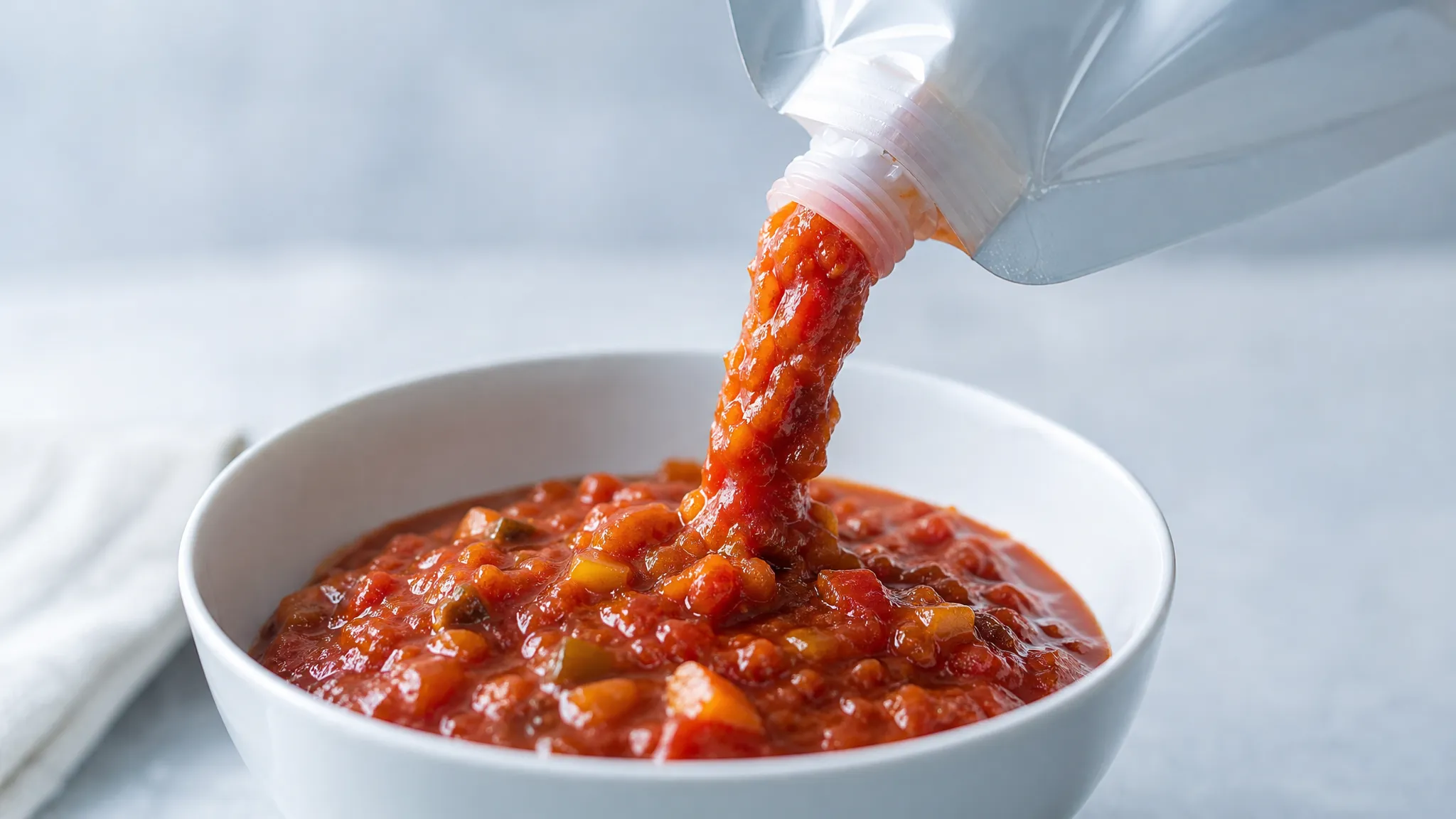
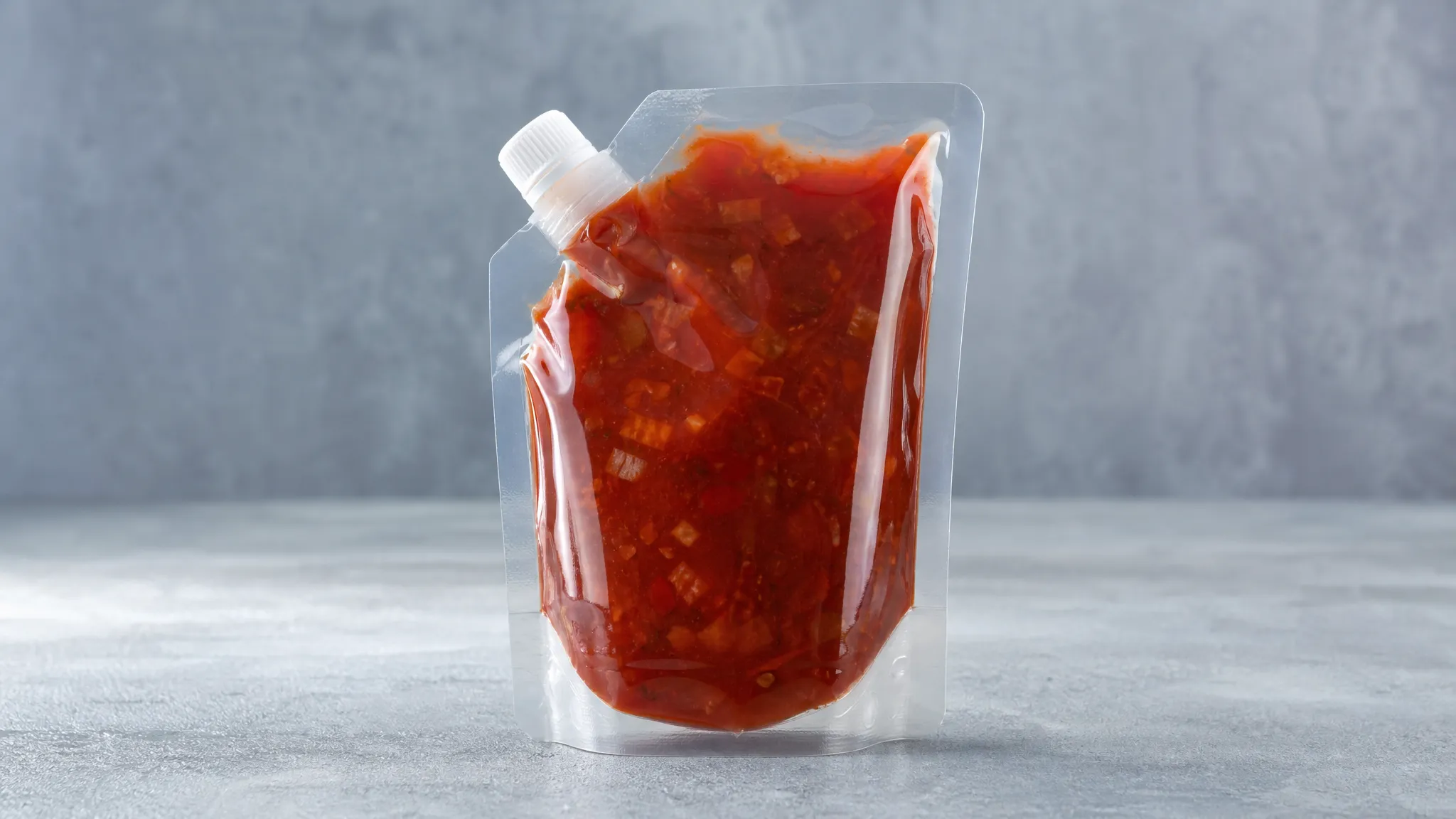
A sauce with visible solids is a suspension, not a liquid: the pieces decide how it pours.
Characterise the Particulate Before You Look at Any Spout
You cannot test something you have not described. Before comparing spouts, ask for a description of the solids — you do not need the commercial recipe, only the physical facts of what must pass:
- The largest single particle, in millimetres. Not the average, not the typical — the biggest piece a customer could legitimately find.
- The size distribution, not just a mean. A sauce described as "3 mm pieces" can carry a tail of 6 mm pieces, and the tail is what bridges.
- Shape and stiffness. A hard, round seed behaves very differently from a fibrous herb or a soft diced vegetable that deforms under pressure and can squeeze through a gap its nominal size says it cannot.
- Whether the particle swells. Dried flakes — chilli, herbs, onion — rehydrate in the pouch over shelf life and grow, so the particle that passed on day one is not the particle that has to pass in month four.
To turn "chunky" into a number, a sieve analysis is the standard route: a stack of woven-wire test sieves (specified, for example, under ASTM E11) sorts a sample into size fractions so you can read off the fraction that matters. The method is long-established and well documented; the deliverable is a distribution curve and a stated top size, which is the number you will size the flow path against. Where the solids are too soft or irregular for sieving, a simple wash-and-measure of a representative sample gives the same figure. Either way the output you want is a single sentence — "top particle size X mm, 95th percentile Y mm" — because everything after this compares against it.
There is a direct parallel in a neighbouring field. Anti-clog geometry for powders is a solved problem the anti-clog powder pouch spout work already covers, and the same instinct applies here: the thread and the opening must shed product rather than trap it. The difference is that a powder bridges at almost any opening, while a chunky sauce bridges only when the opening is close to the particle size — which is why the next step is to find the opening that actually matters.
Find the Real Flow Path, Not Just the Nominal Bore
The single most useful correction to make before you quote any spout: the nominal bore is not the flow path. The sauce does not pass a single clean cylinder. It passes a chain of restrictions — the spout throat, the shoulder where the spout meets the cap, the cap orifice, and, if there is one, a valve or a dispensing insert. The narrowest of those is the real constraint, and it is often noticeably smaller than the bore printed in the catalogue.
Measure it. With a representative sample and a pair of calipers, work through the fitment and record the smallest cross-section a particle must clear in each position. Then compare that number — not the bore — against the top particle size from the previous step. The starting rule of thumb comes from bulk-solids handling, where hopper outlets are sized from the material's own flow tests rather than from a guess: a dependable outlet runs to several times the largest particle. The exact multiple depends on friction and cohesion, which is precisely why it is a thing to measure rather than assume — the overview of hopper outlet geometry and arching shows how that critical dimension is computed for a given material and geometry.
The physics behind the rule is worth internalising, because it kills the idea that there is a "safe" bore. In granular-flow research — the clearest published result comes from a two-dimensional disc hopper, a useful analogue rather than a like-for-like model of a sauce pouch — the probability that particles form a stable arch and clog an opening falls steeply as the ratio of opening to particle diameter grows, following roughly an exponential of the square of that ratio, but it does not reach zero at any practical size. There is no size at which bridging becomes impossible; there is only a probability that gets small. Keep that result distinct from the design rule above rather than reading the two as a single claim: the granular-flow work describes a residual probability that never fully vanishes, while the hopper-design method returns a critical dimension below which a stable arch forms and above which it does not. The design method is the usable one because it gives you a number; the residual-probability result is the reason to build in margin and confirm by test instead of trusting that number alone — and it is why the method is computed from the product rather than assumed.
For a pouch fitment the practical translation is: keep the smallest real restriction generously clear of the top particle size, and then confirm it, because the geometry of a pouch spout is far less forgiving than the tall cone of a silo. Because diameter plays more than one role — flow, dose and consumer control are all tied to it — the guide to matching spout diameter to the pouch is worth reading alongside this one, and the spout cap specification sheet is the reference for how fitments are described so your request to a supplier names the right dimensions.
What the Sauce Does in the Pouch Between Filling and the Last Pour
A chunky sauce is a suspension, and suspensions are not stable by nature. Left on a shelf, solids denser than the liquid phase migrate downward; the process is ordinary sedimentation, and its speed depends on particle size, density difference and the viscosity of the continuous phase. The practical consequences for a spouted pouch are orderly and predictable:
- The top of the pouch ends up with a thinner, clearer phase. That portion pours easily through almost any opening.
- The bottom of the pouch ends up with the densest, most particulate-rich portion. That is the portion that has to pass the real flow path, and it is the portion most likely to clog.
- Re-mixing is not guaranteed. Whether a consumer can shake the pouch back into suspension depends on the yield stress of the sauce — the stress below which it behaves like a soft solid rather than a liquid. A high-yield-stress sauce resists settling but is harder to pour; a low-yield-stress sauce shear-thins readily on pouring but separates faster in storage. Neither behaviour is "better" — but you need to know which one you have, because it decides whether the clog test is run on a fresh, well-mixed sample or on the settled pouch a customer actually opens.
Two geometry choices then decide how much of that settled layer a customer can actually get out, and both are easy to overlook when the fitment is chosen on its own. Fill volume and headspace set the size of the clear layer: a one-litre pouch with a generous headspace carries more free liquid above its solids than a 250 ml pouch of the same recipe, and the fill level you choose also governs how much headspace the settled solids need if the pouch is to be shaken back into suspension. Spout placement decides whether the settled layer can be emptied at all — a corner spout drains the densest material more completely than a top-centre spout, because gravity collects it in the corner the spout sits in, and the last of it is exactly the portion most likely to bridge.
This is the reason a sauce can pass a lab flow test and still fail in the market. If the flow test uses freshly mixed product, it never encounters the caked lower layer that the last customer to squeeze the pouch meets. Test the settled state, not only the mixed one.
Filling Method Changes What You Have to Test
How the pouch is filled determines which geometry the particulate has to survive. Two sequences dominate:
Filling through the spout. The sauce is dosed through the fitment itself, then the cap is applied. This forces the entire product — including the largest legitimate particle — through the smallest restriction at line speed, every cycle. It is a stress test by construction, and it exposes three things at once: whether particles lodge at the throat, whether the fill leaves residue at the mouth that interferes with capping, and whether the pump and the passage shear soft particles into smaller ones or damage fibrous ones.
Filling through the open top, then welding the spout. The pouch is filled before the fitment is sealed in, so the cap never receives product during filling. Here the fitment is purely a dispensing closure, and the questions move downstream: does the spout base weld cleanly to a film that may already be slick with product near the seal area, and does the fill level leave the right headspace for the settled solids?
Filling also puts a question to the film rather than the fitment. The laminate — the multi-layer film structure the pouch is built from — has to accept the spout base without delaminating or wrinkling near the seal, and a film selected for a thin sauce may not behave the same way once solid particles press against the seal area during handling.
Whichever route you use, two process facts belong in the test brief. Fill temperature interacts with the sealing window — recyclable mono-material PE pouches need the spout to seal in a low-temperature window so the film is not burned, which is a constraint on the fitment, not on the sauce — and particle integrity is worth checking before and after filling, because a sauce whose particles were 5 mm at the mixer and 2 mm at the spout has changed its own specification.
Re-Open and Reseal After a Partial Pour
The failure that only shows up weeks into a product's life is the one after a partial pour. A whole pouch that has never been opened tests the fill and the first impression; a half-used pouch tests the closure under residue. Chunky sauces leave solids in the cap thread and around the mouth, and those solids dry into a hard deposit that prevents the cap seating fully on the next close. The result is a pouch that leaked once, dried, and now weeps a little every time it is inverted for the next serving.
Three checks catch it before your customers do:
- Repeated open-and-close with residue in place. Open, pour a portion, close, and repeat enough times to cross the shelf life, without cleaning the mouth between cycles.
- Inverted and squeeze storage. Stand the partly used pouch on its cap, and squeeze it, and look for weeping at the seal and the closure.
- Closure feel. A cap that stops turning at the same point every time is seating; one that turns further after a few servings is not — that difference is the residue.
If your pouch also has a reseal feature or a removable liner, the same residue logic applies to it, and the reliability of the reseal is really a question about the product left at the seal, not about the mechanism.
Food-Contact and Tethering Rules Still Apply to Chunky Sauces
None of the flow reasoning above changes the regulatory frame. If the sauce is food, every surface that touches it is a food-contact material: in the US, food-contact polymers sit under the FDA's indirect food additives rules collected in 21 CFR Part 177, and in the EU under Regulation (EC) 1935/2004. Ask for the certificate numbers and confirm the resin named on them is the resin actually moulded into the fitment — the same documentary discipline that applies to any food-grade closure. Ruihua — the spout-cap manufacturer behind this site — moulds from food-grade, virgin, brightener-free resin and holds ISO 9001, HACCP, FDA and EU 1935/2004 certification (verified by TÜV SÜD).
Material choice is not the only rule that touches particulates. If the filled pouch is retort-processed or pasteurised, the heat softens fibrous and vegetable particles, which changes both their size and their tendency to bridge once the product has cooled — so a fitment that passed on raw sauce needs re-checking after the thermal process. And for products sold into the EU, the recyclability expectations now bearing on spouted pouches sit in the Packaging and Packaging Waste Regulation (PPWR), the same framework the site's PPWR timeline for spouted pouches tracks — which is why a mono-material PE pouch paired with a low-temperature sealing spout is the combination most often requested here.
One rule people over-apply to sauces: the EU's Single-Use Plastics Directive, Directive (EU) 2019/904, requires caps and lids on single-use plastic beverage containers up to three litres to remain attached during the product's intended use stage. That scope covers beverage containers; a chunky cooking sauce or a relish is generally outside it, and whether a specific product counts depends on its definition and on how the requirement is implemented in each member state. Do not assume tethering applies, and do not assume it never will — check it against your target markets as part of the same fitment decision.
A Particulate Sauce Spout Test Checklist
Everything above collapses into one neutral checklist, written so you can hand it to a supplier and to your own line team. Work down it in order; each row is something to confirm, not something to assume.
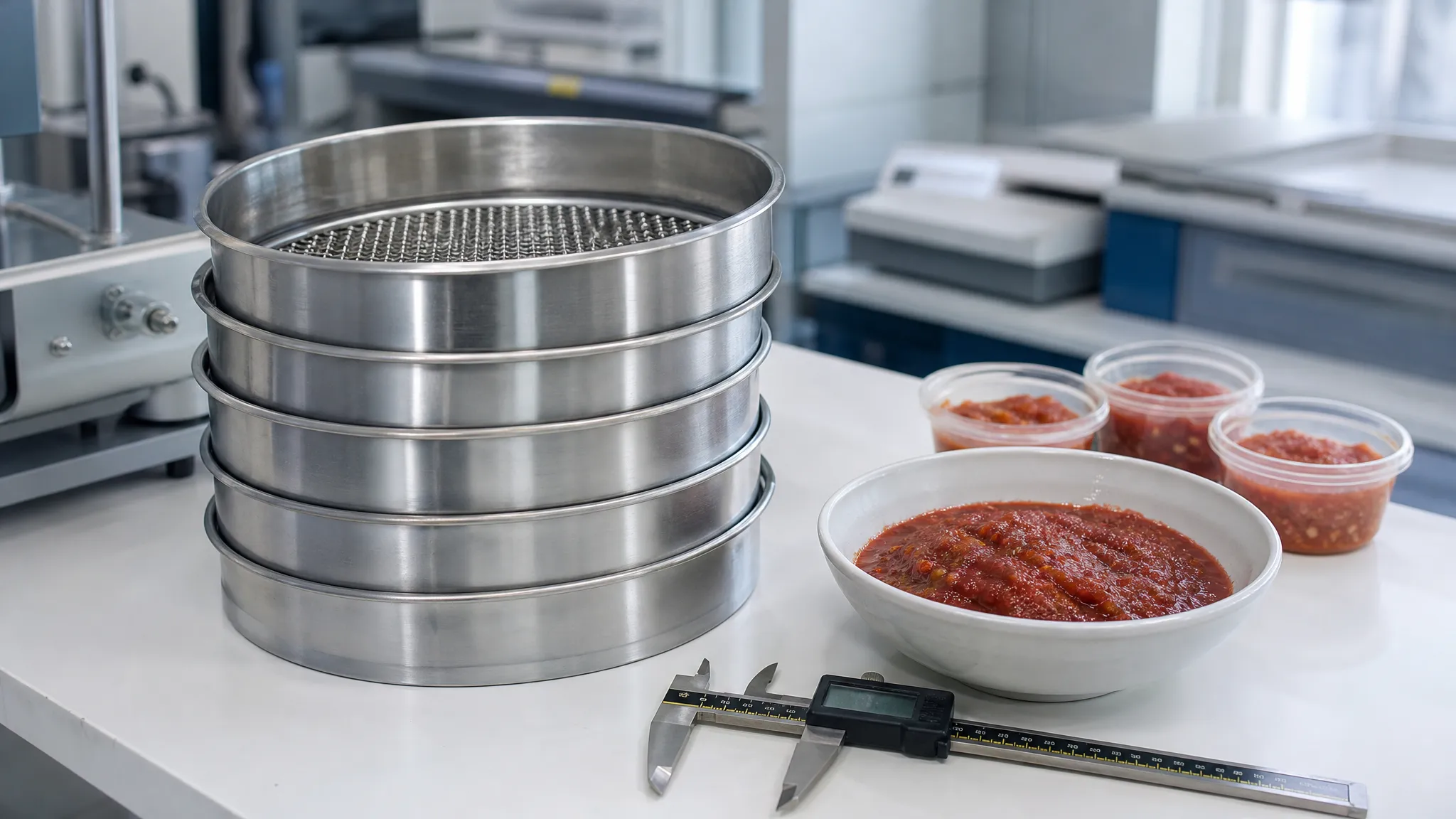
Turn "chunky" into numbers: sieve the solids, then caliper the path they have to clear.
What to test | How to test it | What counts as a pass |
|---|---|---|
Particle size | Sieve a representative sample; record top size and 95th percentile | A stated top size, not a range |
Real flow path | Caliper the narrowest restriction in the assembled fitment | Opening clears the top particle size with margin |
Mixed-state flow | Fill and pour freshly mixed sauce through the pouch | Free flow, no bridging at the mouth |
Settled-state flow | Store, then pour the settled bottom layer | Same flow as mixed — this is the real test |
Re-open with residue | Open, pour, close, repeat without cleaning | Cap seats fully and does not weep |
Inverted / squeeze | Store inverted and squeeze a part-used pouch | No leakage at seal or closure |
Particle integrity | Measure top size before and after filling | Particle size unchanged across the line |
Material and documents | Request food-contact certificate numbers and resin grade | Certificate matches the moulded resin |
This checklist is not a compatibility approval. It narrows the field and tells you what to test; it cannot tell you in advance that a given spout suits every sauce. Two products with the same top particle size can still behave differently because of how the particles deform, how the sauce settles and how the pouch is filled. The test on your own sauce, in your own pouch, is the only thing that approves the closure.
Then run the test the way the product will actually be used: your sauce, your pouch film, a sample filled and capped on your own line, cycled through the storage and temperature conditions the market will impose, and poured from a settled, part-used pouch as well as a fresh one. A supplier with an in-house mould shop can iterate on a sample quickly, which matters when a test failure means the geometry has to change rather than just the resin; a sample validation planner is a useful frame for planning those rounds so each iteration tests one variable.
Start with the particle, measure the path, watch what the sauce does at rest, and let the checklist approve the closure — not the catalogue. If you are specifying a fitment for a sauce with visible solids now, describe the particles and the filling sequence and put the shortlist of spout caps through a test on the actual pouch before anything is tooled. Send Ruihua the particle description and your filling sequence, and request samples and a quote to start that round.