
Direct answer. Molded vs die-cut pouch handles is not a style question. A die-cut handle is a hole punched through the pouch film, so the load is carried by the film itself; a molded handle is a separate injection-molded part welded or riveted on, so the load is carried by a component. Three numbers decide which one your pouch can take: the maximum weight a single unit will hold, the structure and thickness of your film, and where on the filling line the handle gets attached. Get those three right and the choice is usually obvious; get them wrong and you find out at the pallet.
This article is written for the person choosing plastic handles for flexible pouches — the specifier of a stand-up pouch or doypack for rice, flour, grains, pet food, coffee, laundry or liquids. It is not about luggage handles, handbag hardware, paper shopping bags or carton handles, which is what most search results for this phrase turn out to be; on a flexible pouch, both handle families are decisions about one film panel and one weld zone. If you are specifying the closure at the same time, the spout caps by content hub maps which fitment suits which fill.
Molded vs Die-Cut Pouch Handles: The Three Numbers That Decide It
Before the mechanics, the fast path for pouch handle selection. Read your situation on the left, take the middle column as your default direction, and put the right column on the list to confirm.
Your situation | Where to start | Confirm before you approve |
|---|---|---|
Single unit up to about 1–2 kg, cost-sensitive | Die-cut aperture, no extra part | Film thickness at the aperture, and a patch if the film is thin |
Around 5 kg and above, repeated lifting by hand | Molded handle | Handle polymer, the weld or rivet area, and a load test on your pouch |
Thin or mono-layer film at the handle area | Molded handle, or die-cut with a welded patch | Tear propagation from the aperture with a filled pouch |
Mono-material / recyclability target | Die-cut keeps one polymer | If you must use molded, whether the handle polymer matches the pouch |
Spout plus handle on the same pouch | Both, planned together | Where the spout flange sits relative to the aperture or handle weld |
What Each Handle Family Actually Is
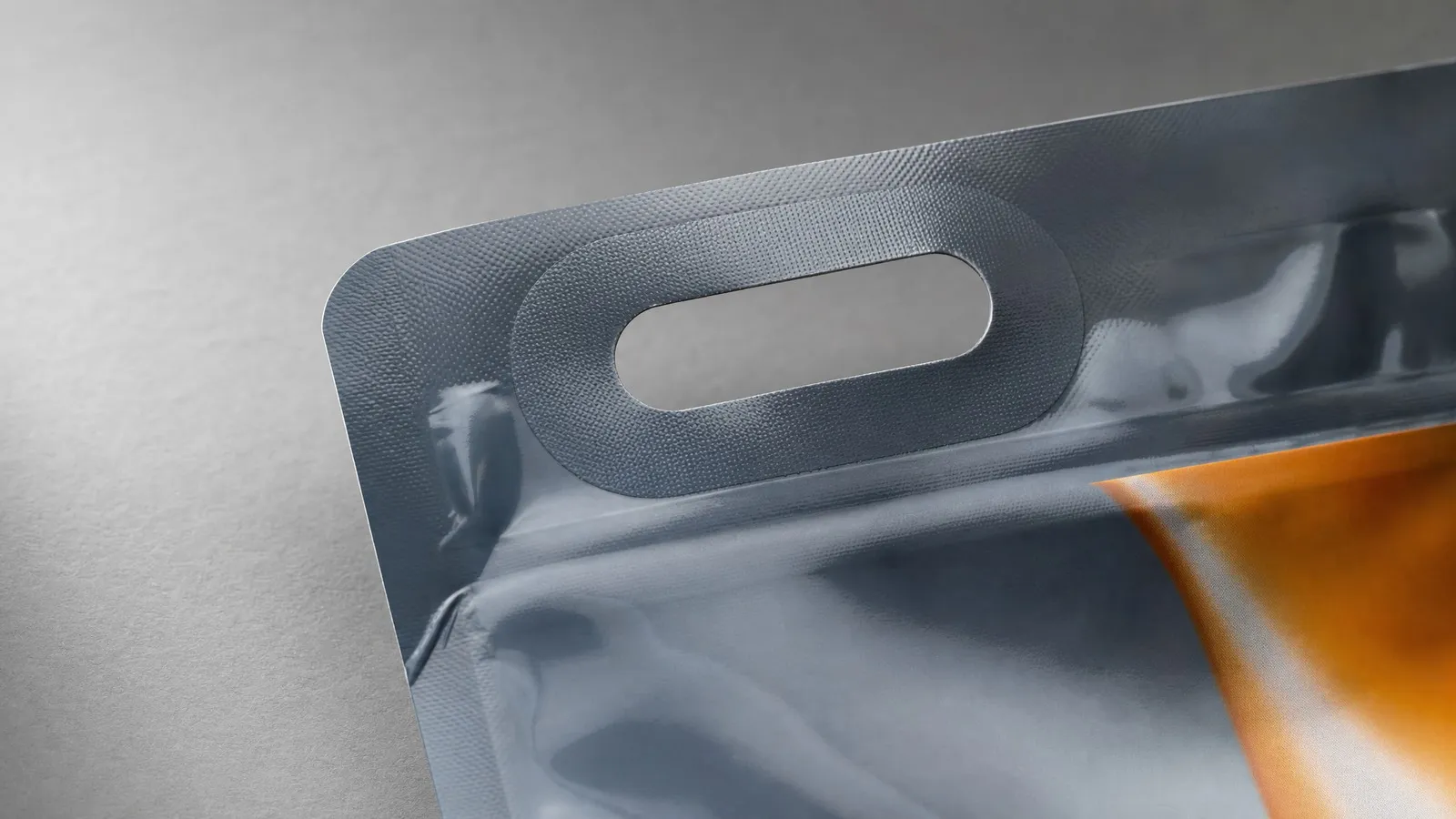
Die-cut handles: an aperture cut into the film itself
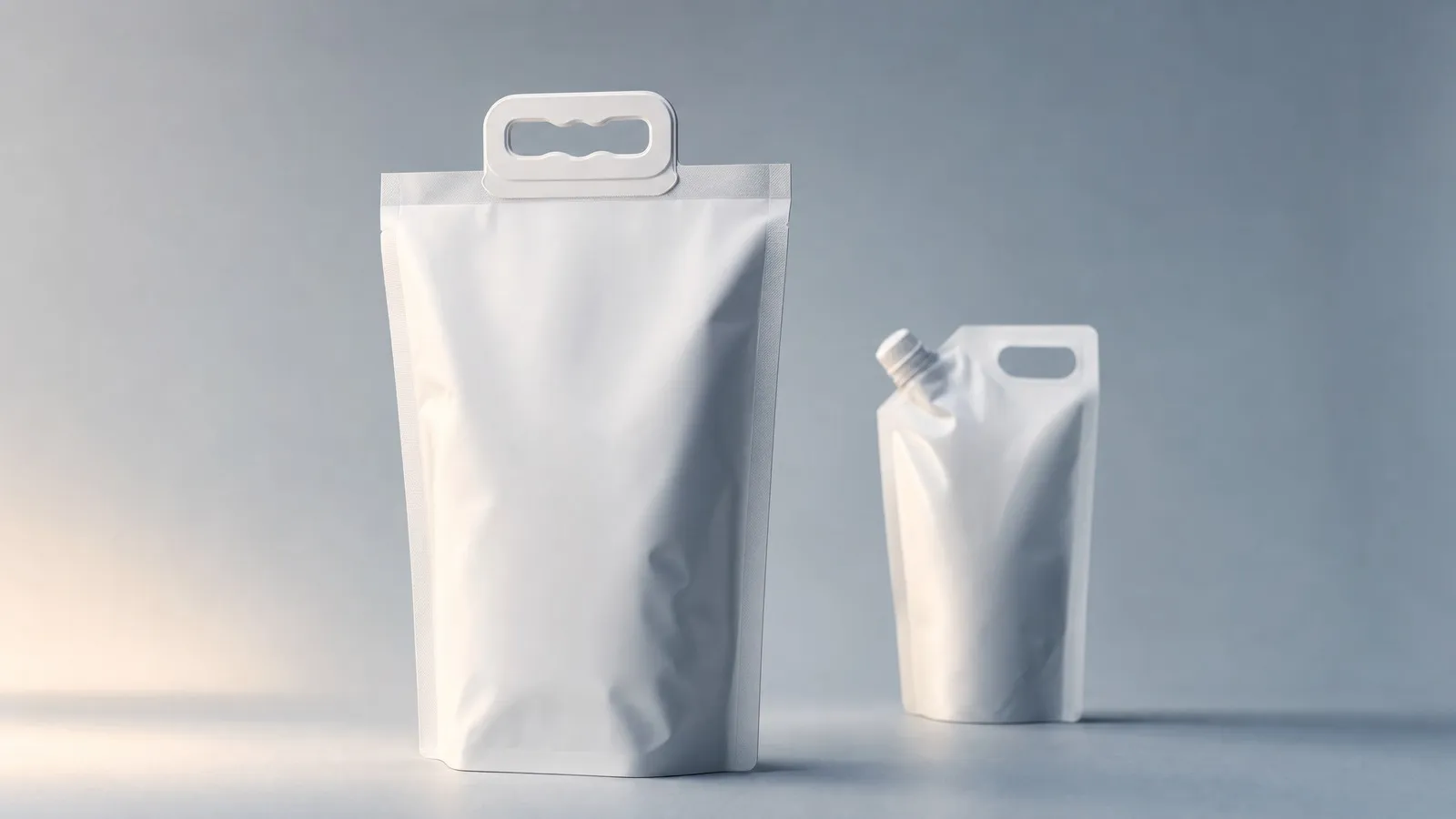
A die-cut handle pouch is made by die cutting an aperture — usually an oval or rounded rectangle — straight through the film. Nothing is added; the material that was removed is waste, and the material around the hole becomes the load path.
That single fact explains most of what follows. A polymer film is not a woven sheet with fibres that redistribute a load around a hole; it is an oriented, laminated material, and the edge of the aperture is where stress concentrates and where a tear starts. Two design responses follow: keep the aperture clear of the top seal and any spout flange, and — on thinner or heavier-duty films — weld a reinforcement patch around the opening so the load spreads over more film.
Molded handles: a separate part welded or riveted on
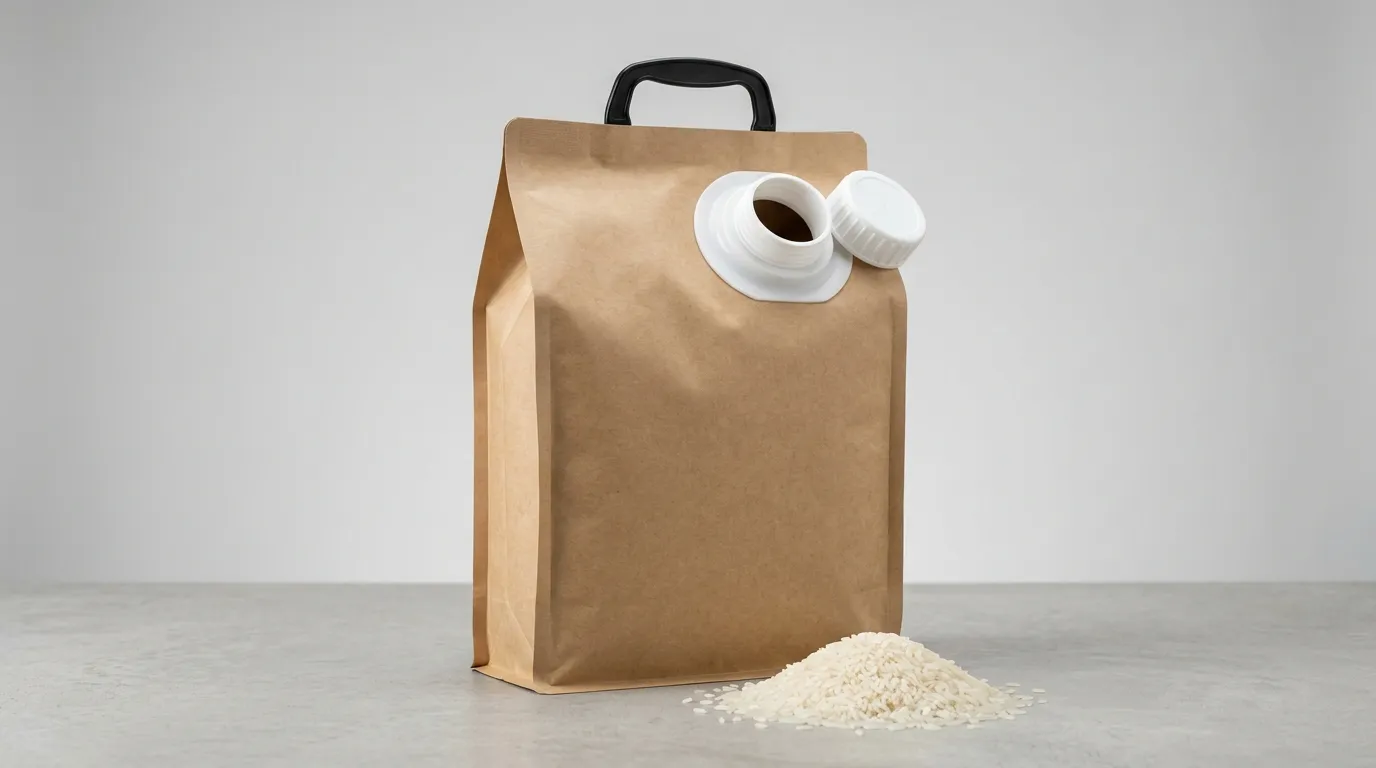
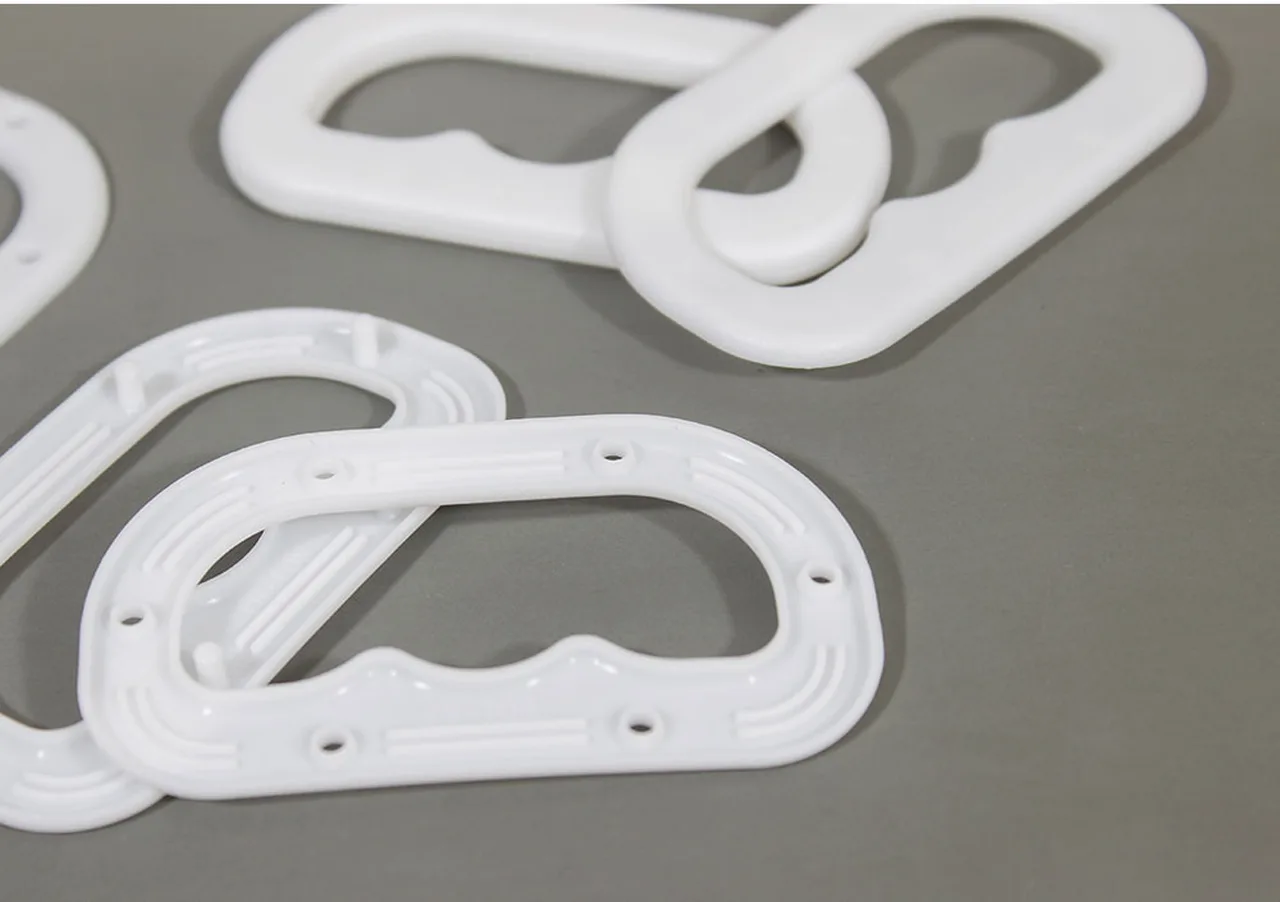
A molded handle is produced by injection moulding as a rigid part with the grip form built in, then attached to the pouch — welded onto the film, or riveted through it. Ruihua's pouch handles are molded in food-grade PP and PE in two families: the wider RD-090 (101 × 56 mm at 9.1 g, or 79.4 × 44.6 mm at 4.85 g, both 6 mm section) for coffee, feed, seed and rice pouches, and the slimmer RD-109 (86.5 × 35.3 mm at 2.7 g, 2.8 mm section) for flat-bottom rice and grain bags, where it is riveted to the bag — the rice bag handle on a 5 kg grain bag is normally a molded part, not an aperture.
The advantage is real: the part is dimensioned for a hand, with a wall thickness that suits the load, and molded to match your print. The cost: one more component, one more weld or rivet line, one more polymer in the pack.
Side by Side: Molded vs Die-Cut Compared
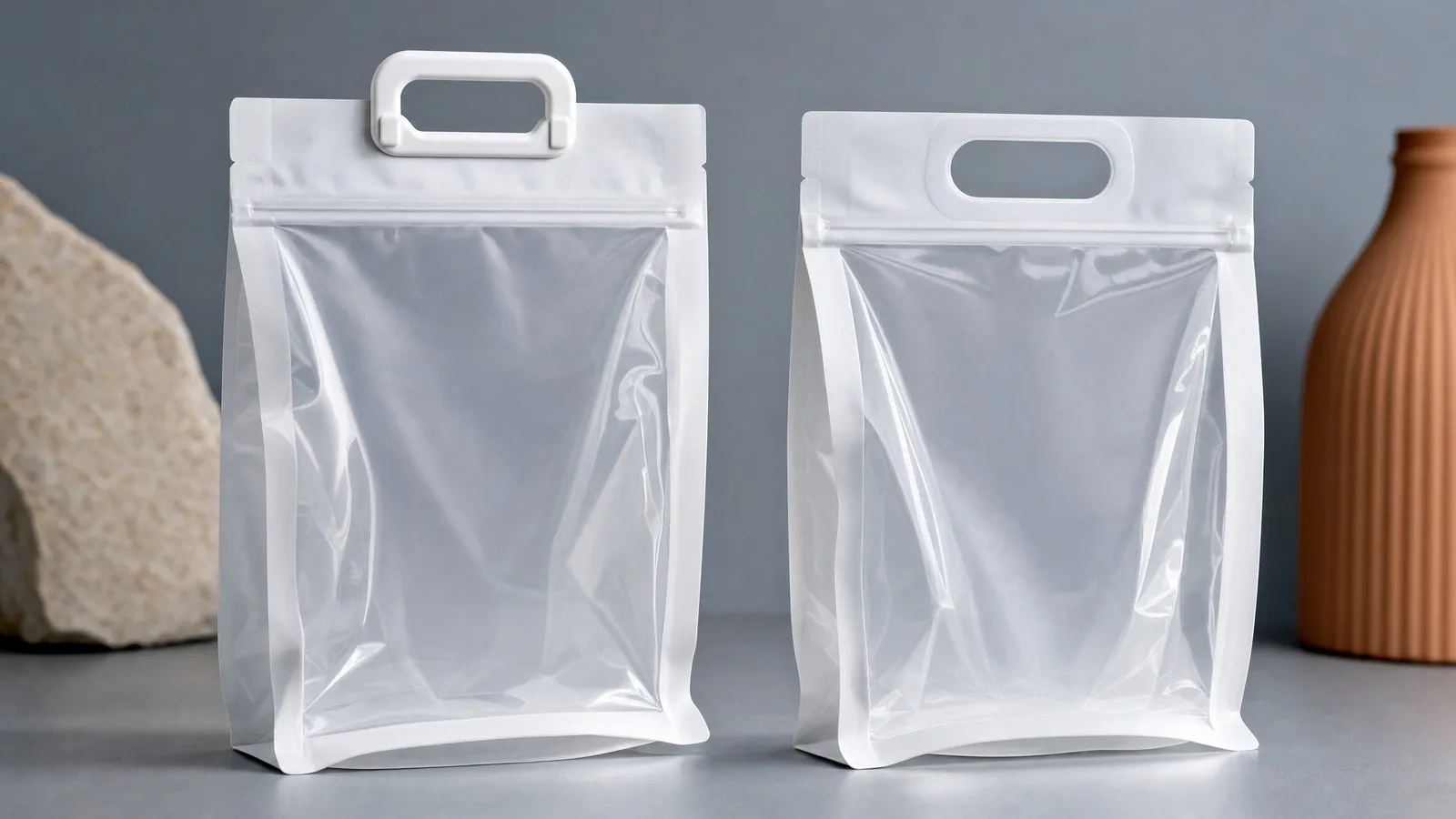
The table below reduces the molded vs die-cut pouch handles comparison for flexible packaging to the dimensions argued about in a spec review.
Dimension | Die-cut handle | Molded handle |
|---|---|---|
Load path | The film around the aperture | The part, then the weld or rivet line |
Comfortable load | Light to moderate, single-unit | Heavy, repeated lifting |
Film requirement | Enough thickness and toughness at the aperture; patch if thin | A weldable or rivetable area; film grade still matters |
Typical failure mode | Tear propagating from the aperture edge | Weld peel, rivet pull-through, grip fatigue |
Tooling | A punch die held by the pouch converter | An injection mold, plus an attachment step |
Cost behaviour | Material and punching only — cheaper at low volume | Tooling up front, then a low per-part cost at volume |
Mono-material | Keeps one polymer | Adds a second polymer unless matched |
Filling line | No change to how the pouch is handled | Pre-attached handles change stacking and pick-up |
Read that as a set of trade-offs, not a ranking: both are viable, and they put the load in different places.
Load: Where Die-Cut Stops and Molded Starts
Around a die-cut aperture, the film carries the entire weight of a filled pouch across a narrow band of material, and every lift loads the same edge. A molded handle moves the grip into a part with a section thickness chosen for the job and spreads the load along a weld or rivet line — which is why handles of this type are specified from around 5 kg upward, while die-cut apertures dominate lighter retail pouches.
Three factors move that boundary:
- Film structure and thickness. A thicker sealant layer and a stronger core layer (PET or PA against PE) tolerate far more load at an aperture than a thin mono-layer film. Die-cut handles rarely fail because the idea is wrong; they fail because the film around the aperture was specified for the pouch, not for the handle.
- How the load is applied. A pouch lifted once from a pallet is not the same as one picked up repeatedly by hand on a shelf or in a warehouse.
- Geometry. A wider radius spreads stress better than a sharp corner, and a longer weld line or larger patch spreads load better than a short one.
Ask for the load figure with the method attached: how long a static hold, whether a dynamic drop was included, at what temperature, filled or empty. A supplier who cannot say how the number was produced is quoting a catalogue, not your application. The large-bore spout and handle guide works through the same logic for bulk dry fills, where weight usually settles the closure question.
Film, Seal and the Weld Zone
Both handle families interact with the same two features of your pouch — the top seal and the weld zone — and this is where most specification mistakes happen.
Die-cut: keep the aperture out of the seal. The aperture and the top seal compete for the same strip of film. Cut too low and the handle opens the seal or leaves too little material to carry the load; cut too high and the grip is unusable. Treat the handle position as a film-layout constraint, not a print decision — and if the pouch also carries a spout, the aperture has to clear the flange too.
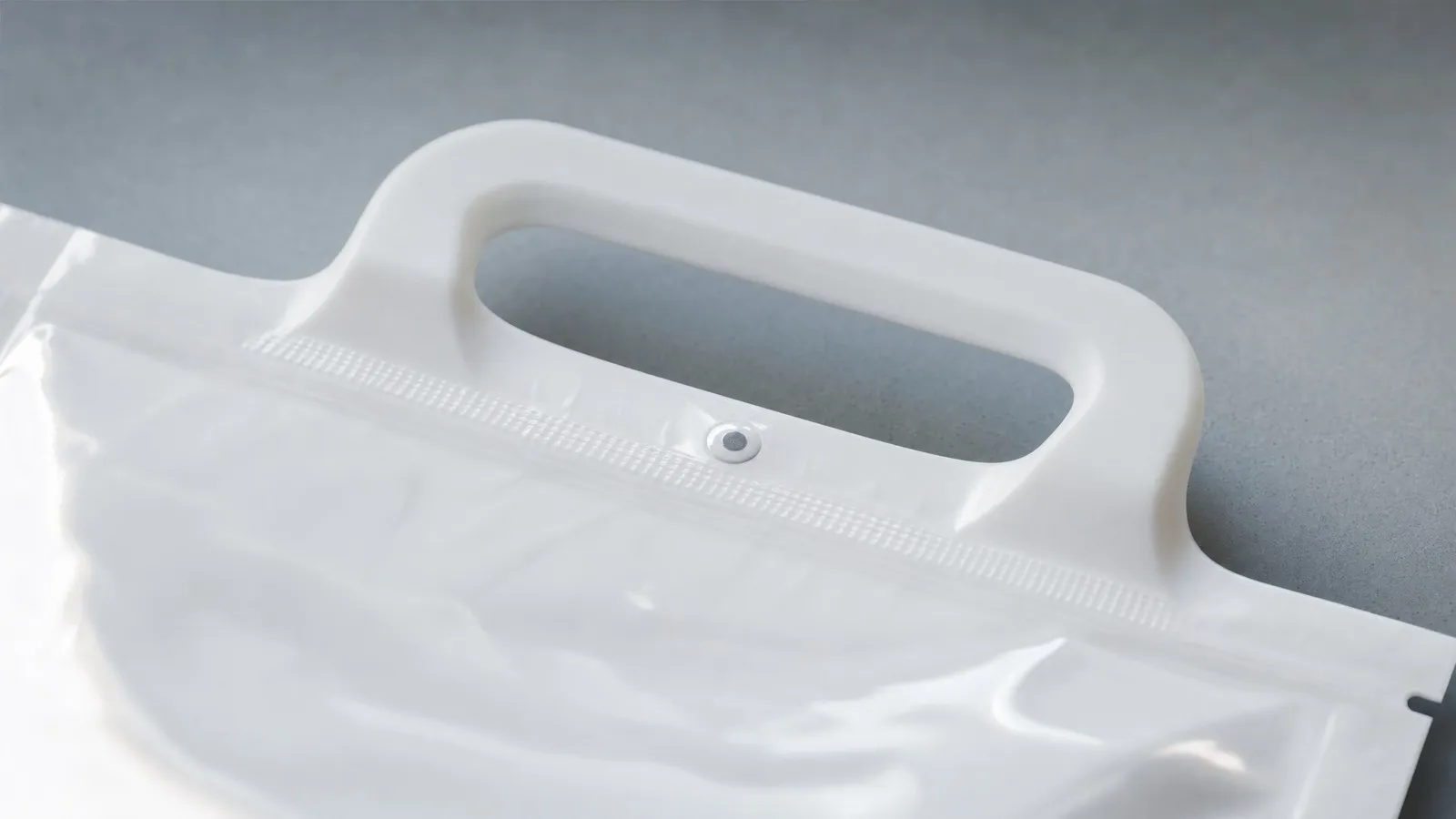
Molded: a weld line is a new joint to specify. Welding a handle onto film creates a joint that must survive the same load as the grip. Weld width and peel strength depend on the film's sealant layer, because the handle polymer and the film sealant have to be compatible under your converter's welding window. A riveted handle puts the load through discrete points instead, which suits a flat-bottom bag with a reinforced top edge.
Either way, the answer is a test on your own pouch, not a data sheet: fill it to working weight, hang it by the handle, and look at the joint and the aperture edge. That is where trouble appears first.
Component Count, Tooling and Order Size
A die-cut handle is a change to how the film is cut; a molded handle is a new part and a new mold.
Tooling. A die-cut aperture needs a punch die — usually the pouch converter's business, and cheap next to a mold. A molded handle needs an injection mold. The RD-090 and RD-109 are existing tooling, so they can be ordered in any quantity without a mold fee, while a new shape or load rating means a new mold, quoted after a drawing rather than before, as it works on the handle product page.
Per-unit cost. Die-cut handles carry no part cost, which is why they are common on light retail pouches. Molded handles carry a per-part cost that falls with volume, on top of tooling — the crossover depends on your order size.
Order size. Standard molded models have no minimum, but a custom color does, because the machine has to run a color-matched batch. Once a custom mold exists, the minimum that applied to opening it no longer applies to repeat orders — worth knowing before you ask for a colored handle on a small volume.
Mono-Material Recyclability: The Dimension Most Buyers Miss
If your packaging carries a recyclability claim, the handle choice changes it, and this is the part buyers miss.
A die-cut handle keeps the pouch one material: the handle is the film, there is nothing to separate, and a mono-PE pouch with a die-cut aperture is still a mono-PE pouch. A molded handle is a second polymer unless it is deliberately matched to the pouch body — a PP handle on a PE pouch is a component the recycling stream has to deal with, and it can put a mono-material claim out of reach even when both materials are technically polyolefins.
The EU's Packaging and Packaging Waste Regulation (PPWR), Regulation (EU) 2025/40, sets design and recyclability requirements for packaging placed on the EU market and applies from 12 August 2026 — a live question for anything shipping into Europe. The practical brief: decide what claim you are making before choosing the handle, prefer die-cut if you need the claim, and if you take the molded handle for load, record that the pouch carries a second-material component. The mono-material PE pouch notes cover the same trade-off on the closure side.
None of this makes a molded handle wrong on a heavy pack — a 10 kg rice pouch that tears open at the aperture is not recyclable either. The handle belongs in the recyclability calculation, not the aesthetics column.
The Handle-and-Spout Check: Two Weld Zones, One Film
If the pouch has both a spout (screw cap, large-bore pour spout, tap) and a handle, the two compete for the same top panel. Ruihua makes spout caps from 1.2 mm to 40 mm inner diameter and supplies handles alongside them; for heavy formats the usual pairing is a large-bore spout cap and a carry handle on one pouch, which is what the large-bore spout range is specified for.
Sequence the checks rather than doing them one at a time:
- Place the spout flange first. It has fixed geometry and a minimum weld footprint; the handle can move.
- Then place the handle or aperture in what is left of the top panel, with clearance from the flange weld and the top seal.
- Then check the load path across the panel: with a spout on one side and a handle on the other, a full pouch can hang slightly off-centre.
- Then check the filling line. A pre-attached molded handle changes how pouches stack, feed and pick up.
- Then confirm the cap. A handle that survives the lift is no use if the cap cannot be opened one-handed on the same product.
The pouch fitment compatibility tool is a quick way to check which spout and handle combinations belong on the same pouch before you brief a supplier on a tool.
What to Put in the Brief Before You Approve a Handle
Handles are specified badly more often than they are made badly, and most molded vs die-cut pouch handles mistakes are decided in a two-line email. Put these lines in the brief and you will get a useful quotation instead of a catalogue number.
Item | What to write | Why it changes the outcome |
|---|---|---|
Working weight | The heaviest filled unit, not the nominal fill | The handle is rated against the worst case, not the average |
Lift pattern | Once per pallet, or repeatedly by hand | Repeated lifting at an aperture pushes you to molded |
Film structure | Layers and thickness at the handle area | It is the film, not the handle, that limits a die-cut |
Line stage | Where the handle is attached | Pre-attached handles change stacking, filling and storage |
Attachment | Weld or rivet, with weld width or rivet pattern | A weld line is a joint to specify, not a detail |
Claim | Mono-material, recyclable, recycled content | Decides whether a second polymer is acceptable |
Test | Static hold and drop, on your filled pouch | The only number that describes your pouch |
Two habits help: send a sample pouch with the weight already in it, and ask for one handle of each family against your own film.
Next Step
Start from your worst case, not your average: the heaviest unit you will ever sell, lifted the way your customer will lift it. Under about 2 kg with a single-material target, a die-cut aperture is usually all you need. At 5 kg or above, or lifted repeatedly by hand, plan for a molded handle and treat the weld or rivet line as part of the closure specification.
Ruihua molds food-grade PP and PE pouch handles (RD-090 and RD-109) and the large-bore spout caps they pair with, is certified to ISO 9001 and HACCP with FDA and EU 1935/2004 food-contact documentation, and can quote a handle in a custom color or a new shape from a drawing. To compare the two handle families against your own film, request samples and a quote with your fill weight, film structure and where the handle sits on your line.