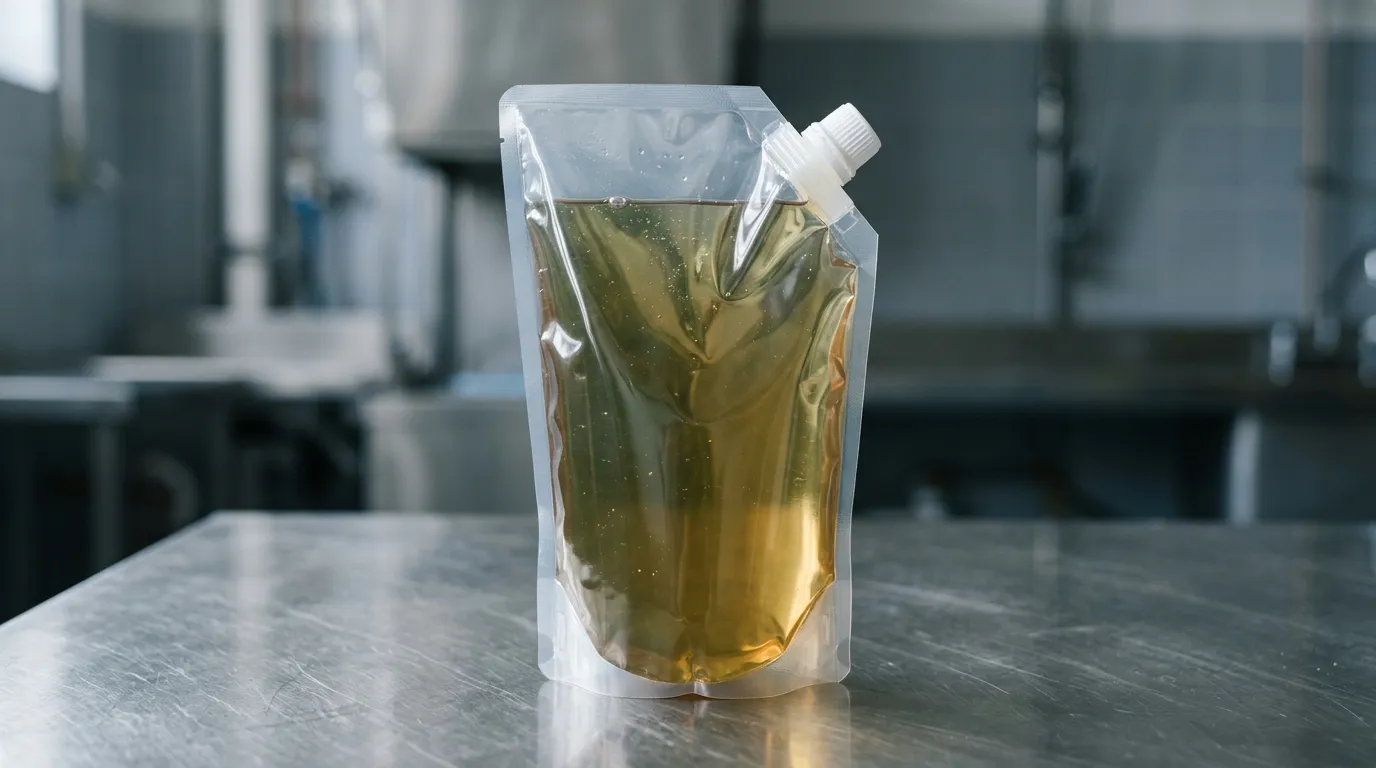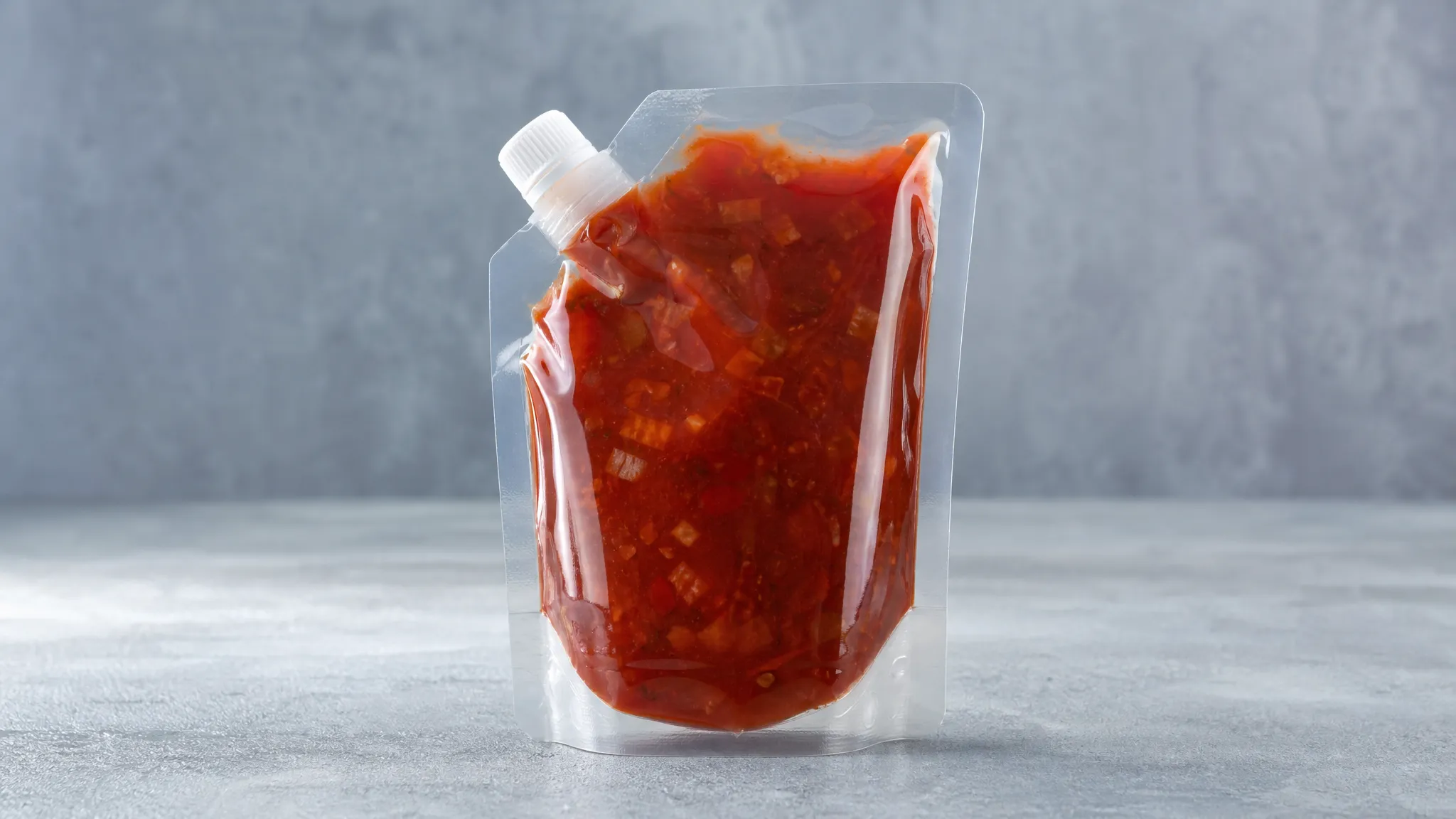

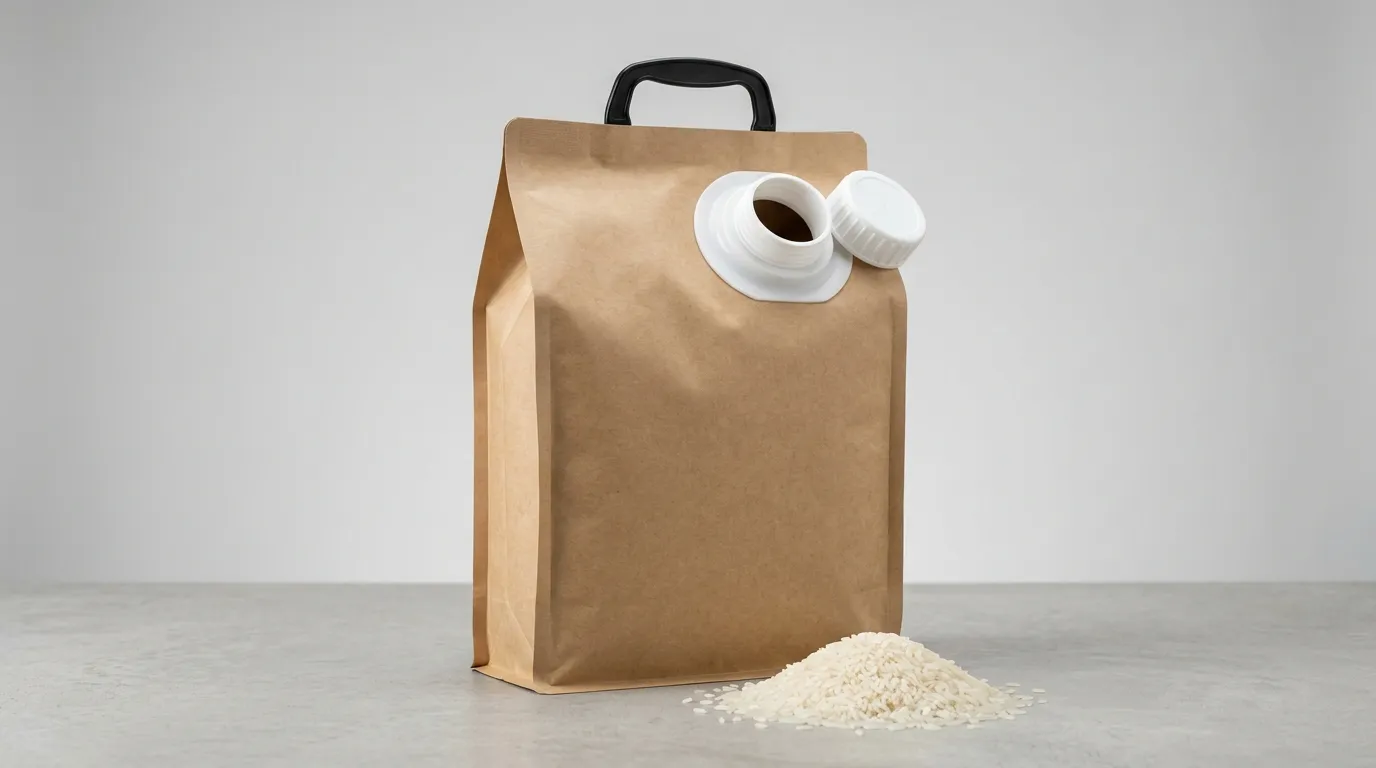
Direct answer. A large bore pouch spout for rice, pet food or grain is chosen in four steps that have to agree with each other: the largest granule and the pour speed you want set the bore size, your pouch film sets the sealing window the spout flange must weld into, the dry contents set the protection the cap has to provide after opening, and the bag weight sets the handle. Most specification mistakes come from picking these four as separate line items instead of as one closure system.
This guide is written for brand owners, packaging engineers and pouch buyers specifying closures for stand-up pouches and doypacks — the screw-cap-and-spout fitment welded into the pouch film, not the pour spout cap on a gas can or a bottle, and not the finished spouted pouch itself. If you are sourcing empty pouches with a fitment already attached, most of what follows still helps you ask your pouch supplier the right questions; if you are buying the closure component to weld into your own pouch, it is the whole job. The full landscape of which closure fits which fill lives on the spout caps by content hub page; this article goes deep on the bulk dry-fill corner of that map — the corner a standard juice-pouch spout cannot serve.
Quick Decision Table: From Fill to Spout-and-Handle Shortlist
Before the full argument, the fast path. Find your product in the left column; the middle column is the first question to answer; the right column is what to confirm with your supplier.
| Application / fill | First question to ask | Performance or structure to confirm |
| Retail rice, 1–5 kg stand-up pouch | What is the largest grain, and how fast should a full bag pour? | 30–33 mm bore; steady stream; tamper-evident first opening; moisture-tight reclose |
| Pet food kibble, 5–15 kg bag | Kibble diameter and how dusty the fines are | 30–33 mm bore; thread that does not trap fines; carry handle specified for around 5 kg |
| Cat litter and other dusty granulars | Does dust bridge or cling at the cap? | 30 mm bore; easy-wipe opening; dust-shedding thread geometry |
| Cereal, oats, muesli, granola | Flake size and fragility when poured | 30–33 mm bore; short, wide drop that does not crush flakes; secure reclose |
| Whole grains, beans, seeds — bulk 10–25 kg | Bag weight and where it is poured from | 33 mm bore for coarse/heavy pours; reinforced handle for bulk weights |
| Flour, meal, powder blends | Dust behavior, not granule size | These follow powder rules more than granule rules — the companion liquid-and-powder fill framework covers the powder half |
One pattern runs through the whole table: the moment your product is a dry granule instead of a liquid, the boring questions change. Viscosity stops mattering; granule size, pour-stream control, dust and moisture after opening take over.
Why Large-Bore Pouch Spouts Suit Granular Fills
Watch someone pour from a 5 kg rice pouch fitted with an 8.6 mm or 10 mm spout — the sizes that dominate juice and sauce packaging — and you will see the whole problem. The stream comes out in fits: a plug of rice bridges across the opening, the bag glugs, a burst of grains dumps out, then it stops again. The user tilts harder, the pouch flexes at the seal, and kitchen counters end up wearing the rice.
Granular fills punish small bores in four ways:
- Bridging. Grains arch over the opening and stop the flow until the bag is shaken or squeezed hard enough to break the arch.
- Dust. Rice dust, kibble fines and flour particles work their way into the cap threads and seat, where they harden and make the cap stiff to open or slow to reclose.
- Slow, erratic dispensing. A 5 kg bag poured through a 10 mm opening takes far longer than anyone wants to stand there holding it, which pushes the user to squeeze or tip aggressively — and that is how seals and pouches get damaged.
- Perceived defect. To the end customer, a spout that pours badly reads as a bad pack, not as a mismatched closure. The retail complaint comes back to the brand either way.
The demand for a fix is visible even outside professional packaging: the do-it-yourself hack that cuts a bottle neck into a bag of rice circulates widely online. The hack exists because the need is real — a resealable, controlled way to dispense a heavy dry staple. Your job as a packager is to meet that need with a properly welded, food-contact fitment instead of a bottle neck and tape.
That is what "large bore" means in this product family: a spout whose inner diameter is sized for a stream of granules, not a trickle of liquid. In practice the useful band starts where the everyday liquid band ends.
Large Bore Pouch Spout Sizing: 25, 30 and 33 mm (plus 40 mm for bulk liquids)
Bore size is a flow decision before it is a dimensional one, and for dry fills the flow decision is set by the largest piece that must pass and the pour speed you want. The table below is how the band actually divides for granular products. The full 1.2–40 mm range across every fill type is laid out in the spout cap diameter guide; here we only cover the bores a dry-fill packer will actually shortlist.
| Bore | What it serves | Typical pouch sizes | What to confirm |
| 25 mm | Transition band: moderately heavy pours, mixed-size retail packs, some bird-seed and pet treats | 1–3 kg | Whether the largest piece still passes with margin; cap thread dust behavior |
| 30 mm | The default for large-capacity granular and powdered products — rice, pet food, cat litter, cereal | 2–10 kg | Smooth stream; cap closes clean over fines; tamper-evident option |
| 33 mm | Rice, miscellaneous grains and pet-food bags that want a visibly generous pour | 3–15 kg | Same as 30 mm, plus pairing with a carry handle |
| 40 mm | Bulk refill and high-flow pouches. Catalogued for high-viscosity liquids and pastes — oil, honey, wet pet food — rather than dry grain, so prove it on your own granule and pour test | 3–20 kg bulk and refill | Weld quality on heavy film; cap geometry that seals without excessive torque |
Treat that band as an indicative shortlist that follows from our catalogued models and their published use cases, not a standard: the mapping from granule to bore still has to be proved on your own product, film and pour test.
Two of those bores do most of the work in dry food. A 30 mm spout cap is the specification for large-capacity granular and powdered products such as pet food, cat litter, rice and cereal; a 33 mm cap is the one specified for rice, miscellaneous grains and pet-food bags when the packer wants the pour to feel decisive. In our own catalogue these are the shapes behind models RD-008 (30 mm, spout body roughly 64 × 33 mm) and RD-092 (33 mm, spout body roughly 67 × 37 mm), both food-grade and both certified for food contact. A 40 mm model (RD-132, made from virgin PE) is catalogued for 3–20 kg bulk refill pouches, and its published use case is high-viscosity liquids and pastes — oil, honey, wet pet food — rather than dry grain, so treat 40 mm as a size to prove on your own granule and pour test rather than a default for grain. You can browse the current 30 mm spout cap models to see the band's real geometry. If one of these bores has to coexist on a line with the smaller liquid-fitment sizes your plant already runs, the change parts and re-validation that costs are worked through in our spout size changeover guide.
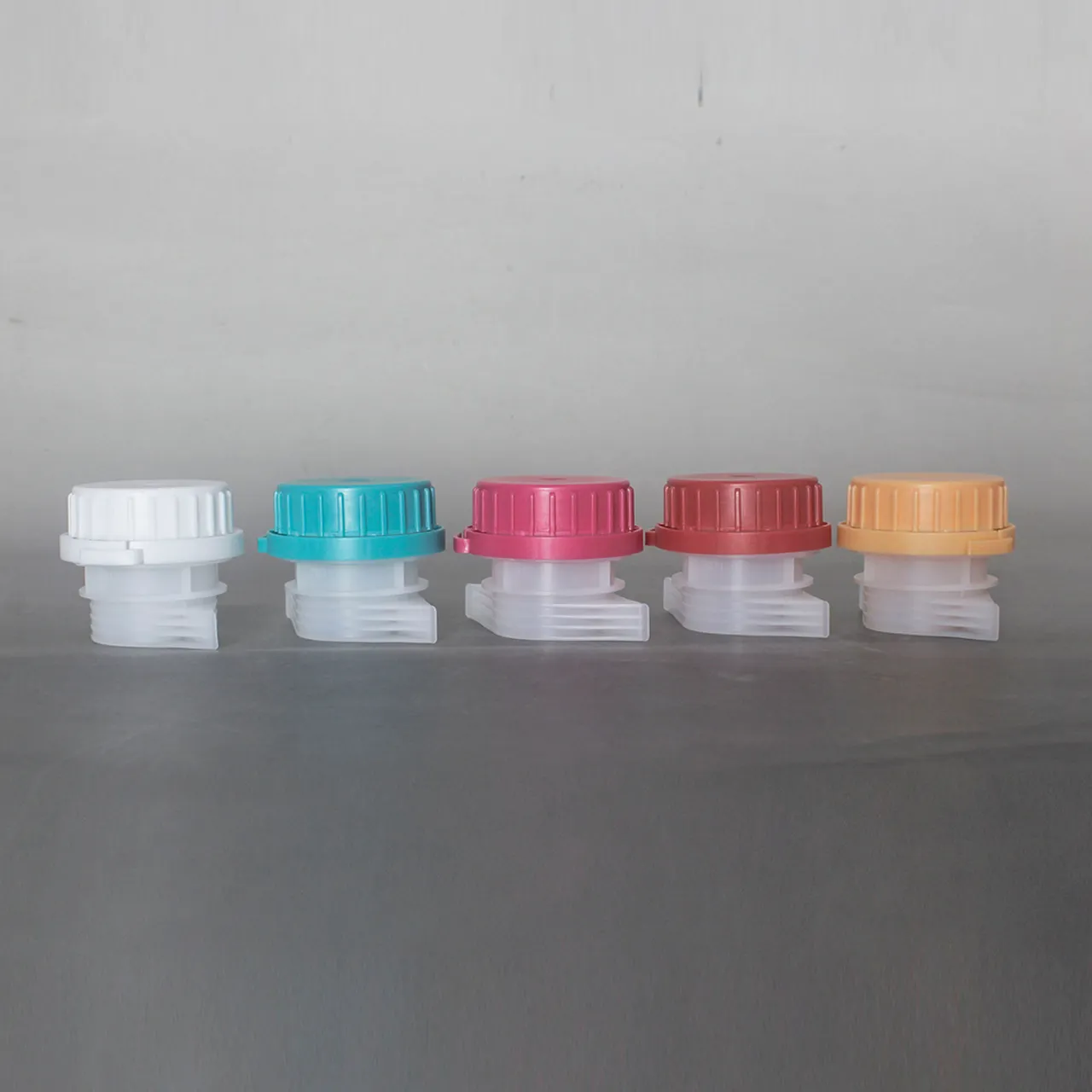
A 33 mm screw-cap-and-spout fitment — the workhorse bore for rice, cereal and pet-food pouches.
A rule of thumb that saves most trial rounds: size the bore for the biggest granule times comfortable margin, then check the pour against a full bag — not against a half-filled sample. A spout that looks generous on the bench can still stall when 5 kg of grain presses down through it.
The Seal Window: Keeping a Large Spout in the Film
A spout can have the perfect bore and still fail a week after launch, because a fitment is only as good as the weld that holds it in the pouch. Large-bore spouts carry two extra burdens at the sealing station: a bigger flange area has to bond completely (a pinhole that is cosmetic on a small spout is a leak path on a big one), and heavier contents put more shear on the weld every time the bag is lifted and tilted.
The seal window is the overlap between three variables, and all three belong to different people in your supply chain:
- The spout's resin and flange design. The flange must be made from a resin that bonds with your film's inner sealant layer. Food-grade PE spouts are the standard match for PE-based sealant films; PP spouts suit films whose sealant is PP.
- Your film's sealant layer and seal temperature. The line seals the spout into the film at a temperature the film can survive without shrinking or burning through. Pouches built for recyclable mono-material PE structures seal at lower temperatures than conventional multi-layer films, which is why spouts engineered to weld at roughly 110–130 °C exist — they keep the whole structure mono-material-compatible. The mechanics of seal temperature are covered in depth in our guide on spout cap sealing temperature.
- The machine's sealing time and pressure. Same spout, same film, two different lines can produce a perfect weld and a weeping weld. Nothing substitutes for running your actual film on your actual machine with the actual spout.
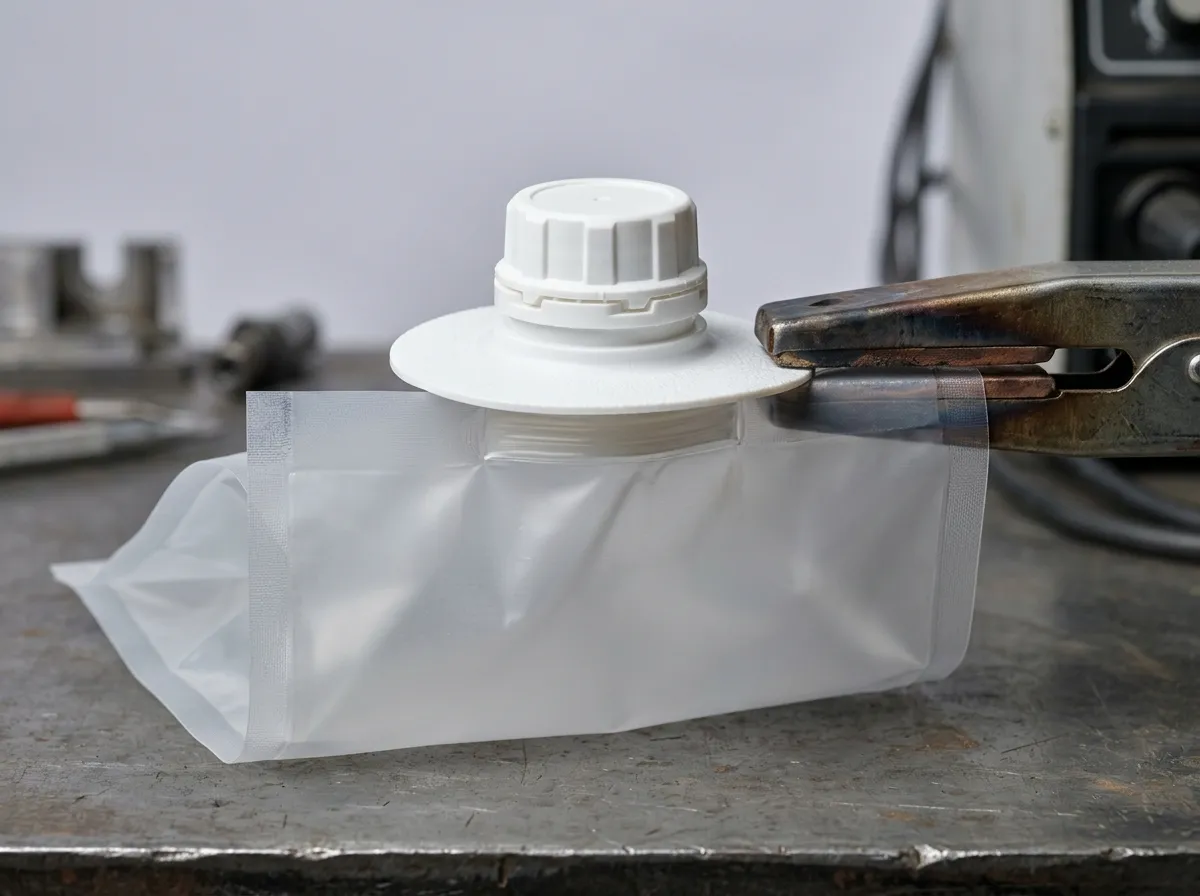
The flange-to-film weld is the closure's real seal — a pinhole that is cosmetic on a small spout is a leak path on a large one.
Two failure signatures are specific to dry fills. First, granules that sit between the flange and the film at the moment of sealing — a trapped grain is a certain leak path, so the sealing station must be clean of loose product. Second, dust on the flange face, which prevents a true bond. Both are line-discipline issues that samples will expose long before a production run will.
If your pouch structure is moving toward recyclable mono-material PE, check the spout's low-temperature sealing compatibility before you commit — the closure is part of the structure, and a spout that demands a high sealing temperature quietly blocks a mono-material design.
What Clogs a Grain Spout — and How Cap Design Prevents It
Clogging on a large-bore spout is rarely about the granules being too big for the opening. It is about three quieter mechanisms:
- Bridging at the transition. Granules arch where the flow narrows — at the spout base, at the cap mouth, or at any internal step. A bore with a short, straight, wide flow channel and no sharp internal shoulders gives granules nowhere to lock.
- Fines in the threads. Rice dust and kibble fines settle into the thread helix. On a screw cap they get crushed and compacted each time the cap is turned, until the cap feels gritty, stiff or impossible to reclose. Thread geometry that sheds fines, and an opening geometry that is easy to wipe, matter more on a dusty fill than on a clean one.
- Product left in the cap. A cap that collects a few grains every pour looks unclean on the kitchen counter and invites moisture in. A cap whose interior is open and drainable returns each pour cleanly.
The cap design does the human-facing half of the job: first-opening evidence, one-hand reclose, and a clean mouth. For dry food, a tamper-evident or pilfer-proof ring gives the buyer the assurance that the bag was not opened before it reached them — important for a staple that sits in a pantry for months. And because granules bridge more readily than liquids flow, the correct cap for a grain spout is usually the simple screw cap with a wide, open interior, not a narrow flip-top built for dosing liquids.
Keep the Contents Dry: Moisture, Reclose and Food Contact
After the bag is opened, the spout cap becomes the pack's only controllable moisture door. The film's barrier layers protect the rice or kibble before first opening; after that, every time the cap is left loose, the pouch's headspace exchanges with the kitchen's humidity. For a dry staple, that is how texture changes, how rice can stale, and how stored grain invites problems. A large-bore cap that re-seals firmly and completely is not a convenience feature — it is the product-protection feature, and it is why the spout should be specified with the cap, not around it.
Two compliance questions ride along with every food-contact closure, and they should be asked early because they are cheap to answer before tooling and expensive after:
- Is the resin food-contact compliant for your market? In the United States, the relevant rules for the olefin polymers used in these spouts and caps sit in the FDA food-contact regulations for olefin polymers, 21 CFR 177.1520. In the European Union, the framework is Regulation (EC) No 1935/2004 on materials and articles intended to come into contact with food. Ask the supplier for the document, not the word — a certificate or a test report you can file.
- Does the virgin resin claim hold? Recycled or reprocessed material in a food-contact part is a compliance and safety risk. Require virgin food-grade resin and, for larger orders, ask for the production documentation to back it.
For a packager, the practical checklist is short: demand food-grade virgin resin, demand the FDA/EU documentation, and verify the cap's seal when it is closed — a dry-fill spout whose cap does not seal is a moisture hole in a pack that was designed to protect its contents for months. Our deeper walkthrough of food-grade spout cap certification lists exactly which documents to demand from any supplier.
The Handle: Load, Grip and the Pour-and-Carry System
Once a pouch holds 5 kg or more, a flat bag with a spout is still awkward to lift — the film digs into the hand, the weight concentrates on the seal, and pouring with one hand while bracing with the other is a two-person job for many users. This is where the second component of the system earns its place: a plastic carry handle heat-sealed or attached to the pouch top, sized for the load.
The pairing is deliberate. Handles and large-bore spouts are specified together because they fix two halves of the same use: the handle carries the weight, and the spout dispenses it. The technique the packaging is designed around is simple — hold the handle to aim, support the pouch base with the other hand, and pour — which is exactly what a 5 kg rice or pet-food pouch needs for one-handed, no-spill dispensing. Empty, the pouch still folds flat, so the handle adds nothing to storage.
What to confirm when you add a handle:
- Load rating vs. your filled weight. Ruihua's bag handles are specified for bags around 5 kg; a heavier bag — 10, 15 or 20 kg — needs the load range confirmed for that specific model, and a reinforced or custom design where the standard one does not cover it. Ask for the handle's intended load range and test it with your heaviest fill, not your average one.
- Attachment integrity. The handle's fixing must survive repeated lifts and drops, and it must not pull at the spout's weld. Test the carried bag as the end user carries it: by the handle, tilted, swung onto a shelf.
- Grip geometry. A smooth arc that spreads the load across the hand makes a 5 kg bag feel lighter and keeps the film from cutting in. Ergonomics is the difference between a handle that exists and a handle that gets used.
- Food-grade and color. The handle touches the same hands as the food; food-grade material is the baseline, and custom colors let it match the pouch design.
On our side, the plastic bag handles product family is specified to pair with our 30 mm and 33 mm large-diameter spout caps — rice, flour, grain and pet-food pouches get the easy-pour spout and the secure carry handle as one packaging system, with custom colors and dedicated molds available for heavier or unusual loads. If your pack sits outside that pairing, send us the fill weight and the spout you have in mind and we will confirm which handle suits it before you commit. Specify them together and you define the whole user moment; specify the handle last and you will retrofit around the spout you already picked.

A food-grade carry handle sized for 5 kg-and-up pouches — the load-bearing half of the spout-and-handle system.
Validating the Spout and Handle on Your Actual Line
No datasheet settles a closure choice; samples on your real film and your real line do. Before you commit to a spout-and-handle set, run this validation pass:
- Send the supplier a fill profile, not just a name. Largest granule size, bulk density if you know it, dust level, filled pouch weight, target pouch dimensions and film structure. If you are quoting a spout-and-handle set, add the two things only you can nominate: the service load the handle must carry (your heaviest filled weight, not the average) and the market you ship to, so the food-contact documentation is scoped before the quote. The more the supplier knows about the fill, the more honest the recommendation.
- Weld samples into your actual film at your actual seal temperature and pressure. Check for full flange bonding, then peel-test the weld and inspect the failure mode — a clean film-tear is a good weld; a peel at the flange interface is not.
- Pour-test with the real product and a full bag. Open, pour, reclose, repeat. Look for bridging, dust accumulation on the threads, and product left in the cap. Test the bag at its full weight, tilted as a real user tilts it.
- Carry-test with the heaviest fill. Lift by the handle, swing, set down hard. Check the handle fixing and the spout weld for strain.
- Leave the cap closed and weigh or inspect for moisture ingress over the time your product actually sits open in use, if shelf-life testing is part of your program.
- Run a short pilot on the filling line — granules are usually filled through the top of the pouch before sealing, so confirm the spout does not interfere with your filling, sealing and case-packing stations, and that the cap survives handling downstream.
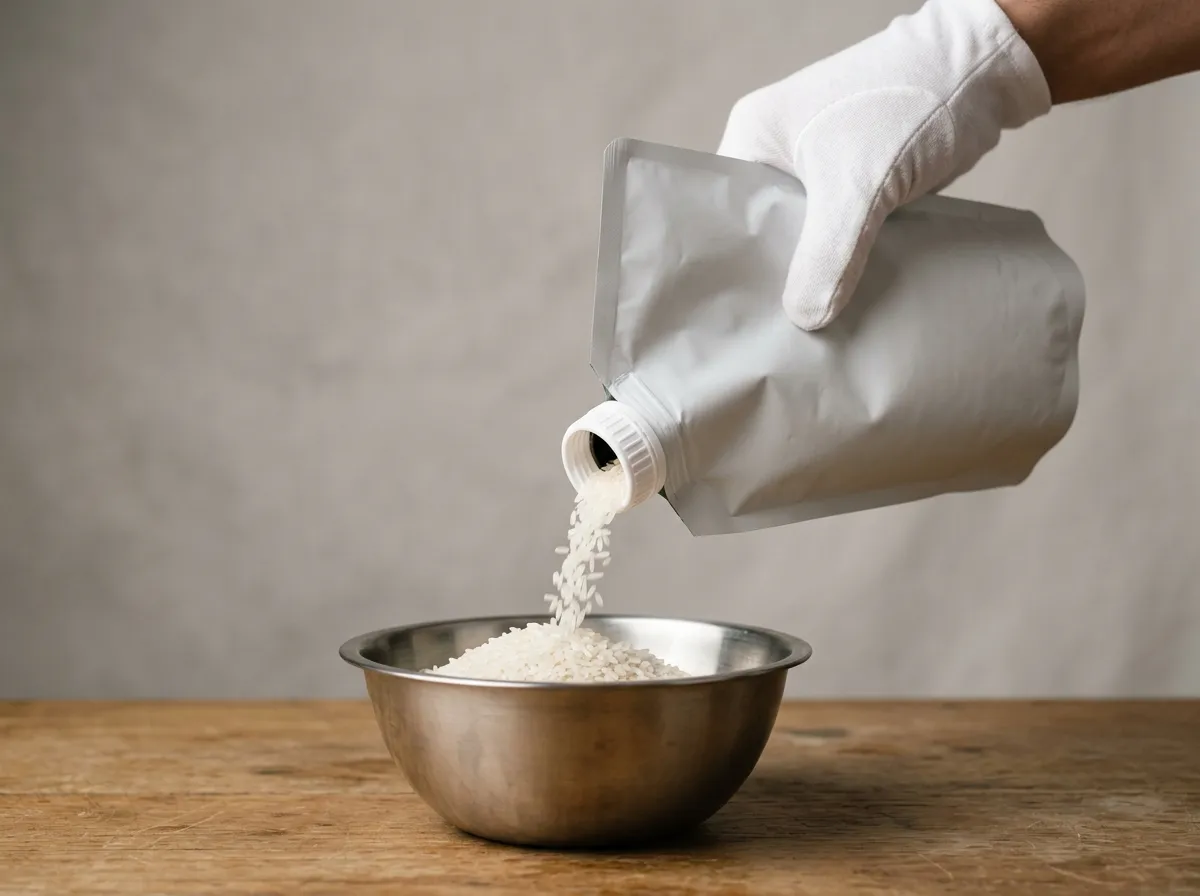
The pour test with a full bag: a steady, controlled stream of granules through a large-bore spout.
A supplier that cannot or will not produce samples for you to weld into your own film is the wrong supplier for a system this load-bearing — most closure failures we see in the field trace back to a component chosen from a price list and never validated against the pack it was meant to serve. Choose the bore for your granules, match the seal window to your film, protect the contents with the cap, carry the weight with the handle — then prove all four together, and the pouch will behave the way your customer expects it to on the first pour.