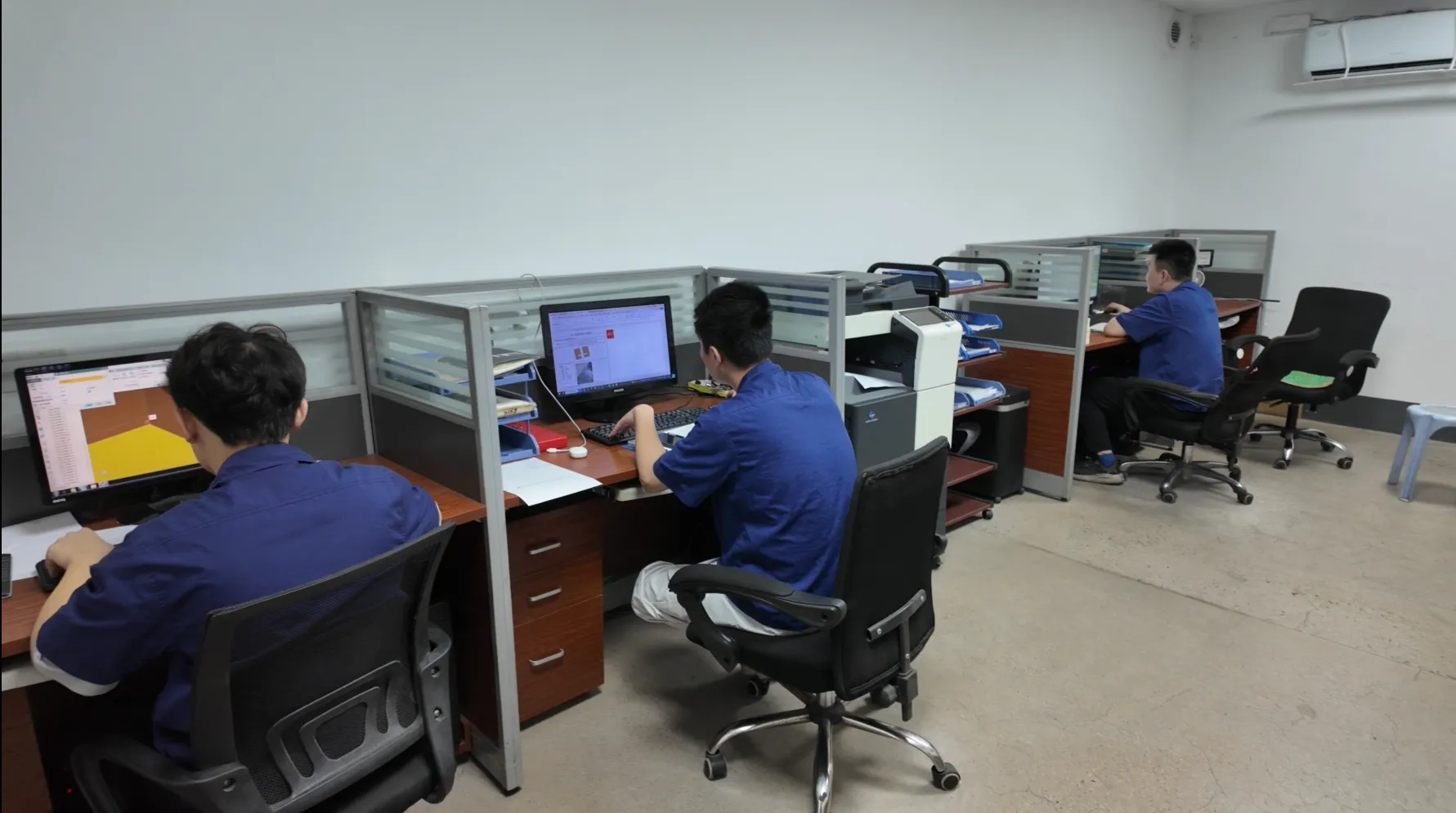


When a supplier quotes your custom spout cap for stand-up pouches and mentions an in-house mold shop, you are hearing about the one department that controls most of your launch date. For most custom spout cap projects, a supplier with an in-house mold shop tends to bring you to production sooner than one that buys tooling from an outside mold maker — not because their machines are faster, but because they remove the handoffs between the people who design your part and the people who cut the steel. An in-house mold shop, in the manufacturing sense used here, is the tooling workshop inside a molder that designs and machines the injection molds for its own products. This is from Shantou Ruihua Plastic, a spout cap manufacturer that runs its own mold-making department, so it includes the honest parts too: a real section on when outsourced tooling is the better call, and the limits of what an in-house shop can do.
Where the lead time goes in a custom tooling project
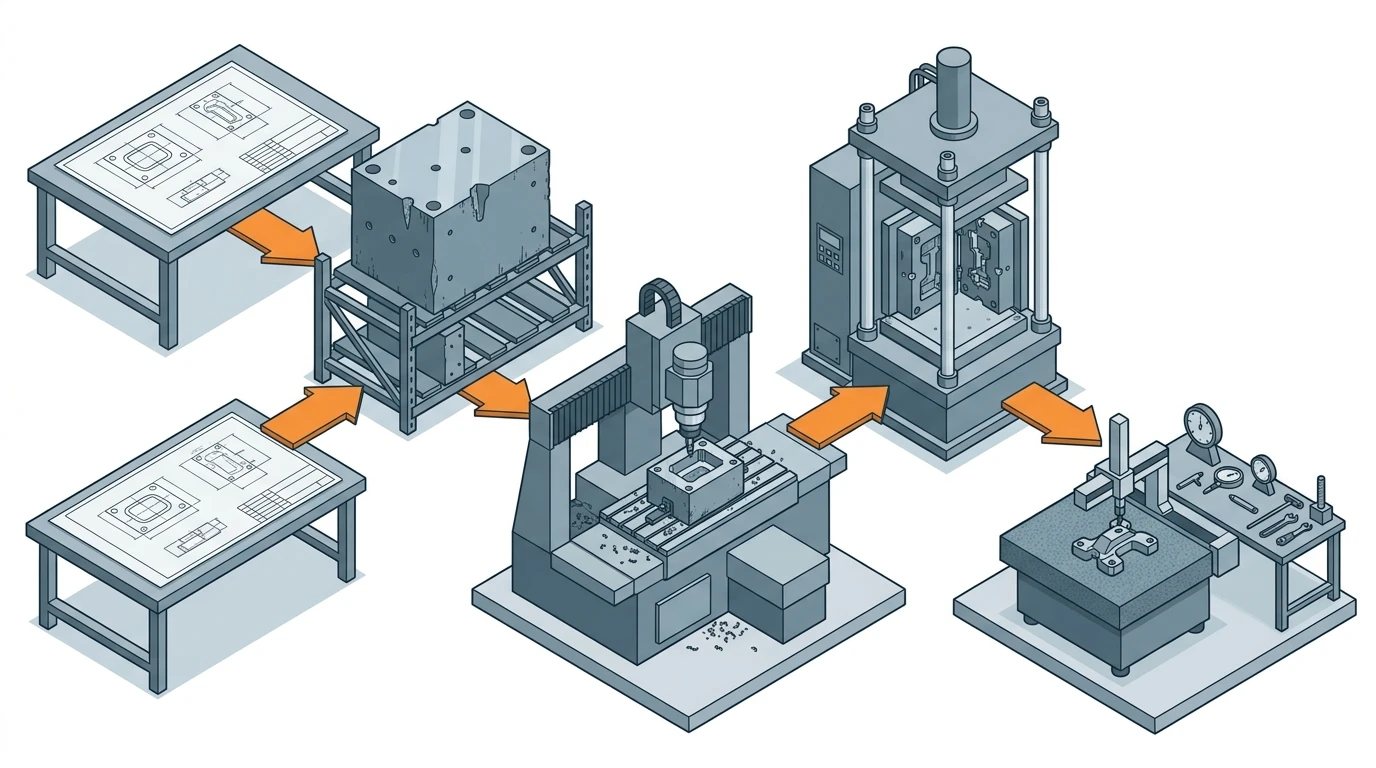
A custom spout cap mold is not a shelf item. From drawing to production-ready tool, the calendar is consumed by five phases:
- Design and DFM — turning your sketch into a moldable cap geometry, checked against the pouch, the contents and the filling line.
- Mold base and steel — procuring the frame and the hardened cavity steel.
- Machining — cutting the cavities with CNC and EDM, then polishing and fitting.
- Trial shots — test runs that expose sealing, filling and ejection problems.
- Adjustments and release — modifying the tool and re-testing until the cap seals, threads and opens as specified.
On-demand manufacturing guides put the mold-manufacturing slice of a generic injection molding project at roughly four to six weeks, before production and shipping add more (Hubs' injection molding guide). For a spout cap specifically, Ruihua's own confirmed figure is about 60 days of mold production once the 3D drawing is approved — longer than that generic slice, because a pouch closure carries more sealing and thread detail than a plain part. But the number that actually decides your date is not the machining hours — it is the gaps between the phases. Every phase handoff carries a queue: the mold maker's schedule, the design-review wait, the trial-room booking. The full five-stage sequence, including where samples get approved, is covered separately in our guide to the custom cap production process; the point here is which model — in-house or outsourced — shrinks the gaps.
In-house mold shop vs outsourced tooling: five differences that move your date
| Dimension | In-house mold shop | Outsourced tooling |
| Scheduling | Own queue; the molder controls priorities | Third-party queue; your tool waits behind other customers |
| Design feedback | DFM input comes from the people who will run the mold | Round trips by email across time zones |
| Trial rounds and changes | Internal loop; fixes scheduled immediately | Back into the vendor's queue for every revision |
| Tooling range | Focused on the molder's own product family | A specialist shop may handle broader or more exotic tooling |
| Cost profile | Capacity overhead spread across programs | Explicit per-project quote plus freight and import steps |
The rest of this section walks each dimension, because the difference that matters for your calendar is not always the one you expect.
Scheduling: your project vs their queue
An outsourced mold lives in someone else's production plan. When the mold maker runs at capacity, your tool waits — not because anyone is slacking, but because you are one customer among many. An in-house mold shop belongs to the same company that needs the mold, so its capacity plan is the company's own launch plan. That is the first and largest lead-time difference, and it costs nothing in machine speed.
Communication: who carries the design intent
Every custom mold starts with a design-for-manufacturability (DFM) pass: thread forms, wall thickness, gate placement, ejection. When the mold maker is down the corridor from the injection workshop, that pass happens face to face with the people who will actually run the tool. When it is a vendor in another city, each question becomes an email, a photo, a revised file, a wait. For a small precision part like a spout cap — where the sealing lip and thread tolerances decide whether the cap leaks or binds — the DFM loop is where weeks hide.
Modifications: the real cost of a trial round
A trial shot almost never passes first time. The mold comes back, a detail is cut or polished, and the tool runs again. Under outsourcing, every modification re-enters the vendor's schedule; under in-house tooling, the machinist is on the same floor and the fix is planned around your program, not around a third party's backlog. The custom cap shape rules explain which geometries tend to need the most revision cycles, so you can judge how many loops your design will realistically require.
Capability: the honest trade-off
Independent mold shops exist for a reason. A specialist toolmaker can take on tooling far outside a spout cap manufacturer's range — large containers, multi-material parts, unusual steels. If your project needs that, no amount of in-house convenience replaces the specialist. The honest statement is that an in-house mold shop is a focused shop: it is excellent at its own product family, and that is the trade the buyer accepts.
Cost profile: the same money, different shape
In-house tooling is not free — the capacity is paid for through the supplier's pricing — and outsourced tooling is not always cheaper. What changes is visibility: an outsourced tool shows up as a line on the invoice, while in-house tooling is folded into the quote. The economics of custom spout cap tooling pricing — cavity count, steel grade, amortization — are identical under both models; the difference shows up mainly on the invoice.
Why trial rounds, not machining speed, decide your launch date
Machining a cavity takes a set number of shifts; that number barely changes between models. The variable that moves your date is the trial-and-adjust loop. A spout cap is a demanding geometry: the cap must seal against the spout, thread on without binding, survive filling, and often include tamper-evident or anti-choking features. Each of those functions is verified in trial shots, and each fix restarts a mini-cycle. On-demand manufacturing platforms publish injection molding lead-time guides for the same reason toolmakers do: most of the schedule is consumed by iteration, not by cutting.
The in-house model collapses that loop. The engineer who designed the cavity walks to the trial machine, watches the shot, marks the correction, and the machinist starts that night. Under outsourcing, the same correction travels to a vendor, waits for a slot, and comes back as a new trial date. Over two or three revision rounds, the difference compounds into weeks. This is also why suppliers invest in faster iteration: 3D-printed mold inserts and in-house mold R&D exist to shrink the same loop, not to make the cutting step faster.
A trial round is not a milestone — it is the loop that decides your date. Plan for the loop, not for the shot.
Each loop verifies a different function of the cap, so a failure on any one of them sends the tool back:
| What a trial shot verifies | When it fails, the mold needs |
| Seal between cap and spout | Cavity or core correction, then a re-trial |
| Thread or closure fit | Thread-form rework so the cap turns without binding |
| Filling behavior | Gate or cooling changes for flow marks or short shots |
| Ejection and tamper evidence | Ejector redesign when parts stick or rings break |
When outsourced tooling is still the right call
An in-house mold shop is not automatically better, and pretending otherwise would be dishonest. Outsourced tooling wins in four situations:
- Tooling outside the supplier's family — a giant container mold, a multi-material tool, or an unusual steel that a spout cap maker has no reason to stock.
- One-off tooling with no iteration expected — a single production run where revision rounds are not part of the plan.
- A proven specialist relationship — if your supplier has run a decade of successful tools with one mold maker, that relationship already provides the coordination an in-house shop would.
- Tool ownership — when you want to own the mold outright and move it between molders, an independent toolmaker is the neutral party that makes that work.
If any of these describe your project, ask the supplier how their vendor relationship is managed rather than treating "in-house" as a requirement. And check first that you need a new mold at all: the custom spout cap service guide separates the three routes — stock model, custom color, new tooling — and for many projects one of the first two answers the brief without any tooling spend.
What a supplier's in-house mold shop can and can't do
Disclosure: Ruihua runs its own mold-making department (established 1999) as part of a vertically integrated line — design office, mold shop, injection workshop, quality control under one roof. That integration is why we can schedule a trial against our own shop's queue instead of waiting on a vendor's availability, and why 38 patents on spout cap mold technology (anti-choking and anti-theft structures among them) sit next to the production line rather than in a filing cabinet.
The limits are just as real. Our mold shop is built for spout-cap-class tooling — the small, high-precision tools that make pouch closures — not for container-scale molds or exotic multi-material work. If a project needs that, the right answer is an outside specialist, and we will say so in a quote rather than stretch our shop into a job it is not set up for. The same honesty applies to lead time: we can say where your tool sits in our queue, but no supplier can guarantee a date that ignores the trial rounds your design will actually need.
How to check whether a supplier's mold shop is real
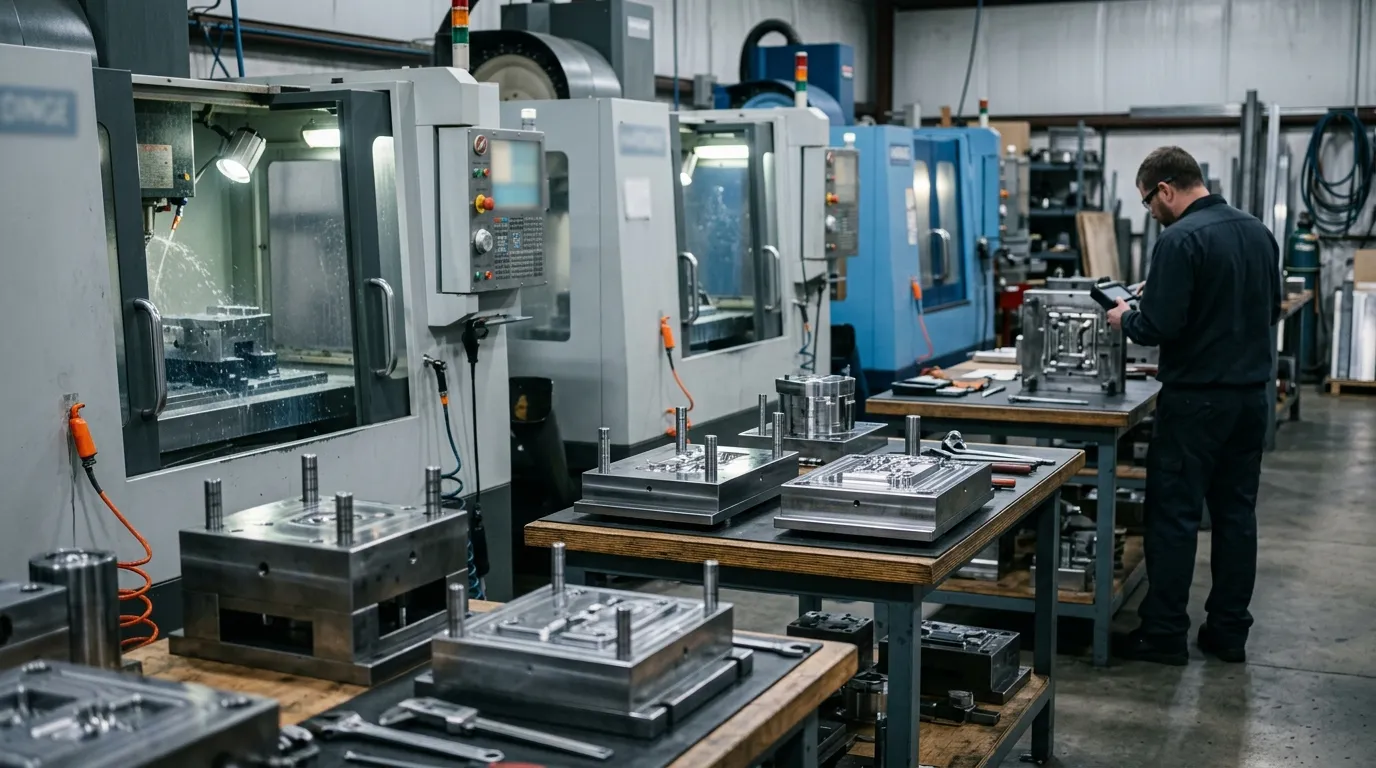
"In-house mold shop" is a phrase buyers hear often and verify rarely. Four questions separate a real capability from a marketing line:
- Where is the mold physically cut? Ask for the address of the machine shop and the machines used. A supplier that brokers tooling from a third party will struggle to answer concretely.
- Who does the DFM review? The answer should be an engineer who works with the injection workshop daily, not a salesperson relaying questions.
- What happens after trial one? Ask who attends the trial, how long a correction takes to implement, and whether the mold returns to a queue.
- Who maintains the mold? Tooling needs cleaning, steel checks and repairs across its life. In-house maintenance means the mold is serviced by the people who built it.
Treat "we have our own mold shop" as a claim to verify, exactly like a certification or a test report. The verification habit is what turns a marketing phrase into a scheduling advantage you can plan around.
Bottom line: what to ask before you commit
For a custom spout cap — a small, precision part that will go through several trial rounds — the in-house model usually delivers the shorter lead time because it removes handoffs, and the outsourced model wins when the tooling is outside the supplier's specialty. Neither answer is universal, and the supplier that tells you honestly which one applies to your project is the one worth the next call.
Before you commit, ask three things: where the mold is cut, who runs the trial rounds, and what happens to the tool when a change is needed. Then map your project onto the three routes — stock, color or new tooling — in the custom spout cap service guide, and use the tooling cost guide to sanity-check the number you are quoted against the four cost drivers behind it. The custom tooling hub collects the rest of the process, from feasibility to sampling. When you are ready to turn a drawing into a date, start a custom spout cap project and our engineers will walk the DFM with you from the first call.