

What "custom spout caps" means for stand-up pouches
In flexible packaging, "custom spout caps" refers to the injection-molded spout-and-cap assembly welded into a stand-up pouch or doypack — the fitment that lets consumers pour, squeeze or sip the contents and reseal the pouch. A spout cap is really two parts working as one: the spout base that seals into the pouch film, and the cap that closes it. When we say custom, we mean the whole assembly is engineered for your product rather than picked from a catalog.
One clarification matters if you are searching from North America: "spout cap" also describes gas-can spouts and bottle pour spouts. This guide always means the closure for flexible pouch packaging — the part that turns a stand-up pouch into a practical container for juice, sauce, detergent, lotion or baby food.
The supplier's scope matters too. A custom spout cap manufacturer such as Shantou Ruihua Plastic makes the closure itself — it does not make the pouches, films or filling lines. Your pouch converter buys the spout caps and welds them into the finished bag. That division of labor is what makes spout cap customization an OEM/ODM exercise: the cap's geometry, material, color and function are built to match your pouch, your contents and your target markets, while the pouch itself stays your converter's job.
Three routes to a custom spout cap — pick one before you ask for a price
Most buyers arrive asking for a "custom" cap. In practice there are three routes, and they are not interchangeable: adapt nothing and pick a stock model, order custom color and branding on an existing mold, or commit to new tooling for a geometry the catalog does not cover. Each route asks you to send different information, carries a different minimum order, and moves at a different pace — so choose the route first, then the quote.
| Route | When it fits | Order quantity | What you send | Next step |
| [Stock selection](https://www.ruihuaspoutcap.com/products/spout-caps) | A catalog bore and closure already deliver your flow, seal and look | Any quantity — stock models have no minimum | Pouch film, fill conditions, target bore and cap style | Send the RFQ checklist |
| Color customization | Standard geometry, but you need a Pantone-matched color or an embossed logo | From 100,000 units for a custom color; negotiable in special cases | Pantone reference and logo artwork, on the model you chose | Request a quote and samples |
| New tooling | No catalog part fits — an in-between bore, a new closure, a combined feature, or a regulation-driven shape | No minimum once the mold is open | Pouch sample, contents, annual volume, target markets | Read the tooling cost guide |
Three things decide the route: specification fit, branding, and volume. Customization earns its keep when no catalog part fits your specification, when branding is a hard requirement, when a regulation shapes the design (a tethered cap for the EU, an anti-choking geometry for children's products), or when annual volume is high enough that a one-time mold amortizes into the per-cap price. When none of those applies, stock is the right answer — and the simplest one. The sections below give the full menu of customization options and the commercial terms behind each route.
What you can customize: seven dimensions of a pouch spout cap
A custom spout cap project is a set of specifications, not a single request. These are the seven dimensions a supplier will ask about, in the order that usually matters.
1. Spout inner diameter
Inner diameter controls flow rate, and flow rate must match your contents. Small bores (1.2–7 mm) suit low-dose cosmetic and pharmaceutical pouches — essence, serum, hand sanitizer. Mid bores (8.6–10 mm) are the workhorses of juice, milk tea, jelly and condiment pouches. Large bores (22–40 mm) handle high-viscosity or bulk refill products: laundry detergent, honey, edible oil in 3–20 kg refill pouches, where a 40 mm opening makes pouring fast and mess-free. The selection logic — bore size against viscosity, pouch volume and filling speed — is covered in detail in our spout cap diameter guide.
2. Cap style and closure
The closure style defines the user experience. Screw (twist-off) caps are the default for resealable food pouches. Flip-top caps give one-handed dispensing for shampoo, body wash and hand wash pouches. Long-nozzle spouts aim the flow precisely for jelly, cooking oil and cosmetics. Mushroom-shaped anti-choking caps guard small children — a safety-critical geometry with its own mold design rules. Tamper-evident rings (single or double) prove first opening. Push-pull sport caps serve on-the-go water and energy pouches. Cosmetic lines can even integrate a brush into the cap for lip gloss, eyeliner or mascara pouches.
3. Material
Material choice is driven by contents and market, and it constrains everything else in the project. Food-grade PP and PE from virgin resin are the default for direct food, beverage and cosmetic contact — with no optical brighteners or fluorescent agents, which is a standard condition for food-contact use. Retort-resistant and hot-fill-tolerant grades cover shelf-stable products that are processed after filling. Bio-based PLA and PHA grades exist for brands with compostability or renewable-content goals. An acid- and alkali-resistant compound handles aggressive daily-chemical contents such as bleach and disinfectant refills.
For recyclability-minded brands, the critical spec is sealing temperature: spouts engineered to weld at 110–130 °C work with mono-material recyclable PE pouches, because the low welding temperature keeps the pouch film compatible with PE recycling streams. That link between closure design and pouch recyclability is why material is a day-one decision, not an afterthought — our spout sealing temperature guide explains the mechanics. Industry design guidelines for flexible packaging recyclability, such as CEFLEX's design for circularity, treat the fitment as a first-class input to whether a pouch can be recycled at all.
4. Color
The factory standard color is white. If you need a brand color, it is matched to your Pantone reference per order — colored caps are not held as a stock range — and the colorant is part of the food-contact evaluation, not just a cosmetic detail. One commercial quirk worth knowing before you plan: a custom color has a higher minimum order than custom tooling does (the number is in the MOQ section), because changing color means stopping the line, purging the machine and re-qualifying the resin.
5. Branding
Branding on a spout cap is typically embossed into the mold — a raised logo on the cap top that is permanent, tamper-resistant and adds no assembly step. Options also include, on some models, adjustable tube length or other geometry tuned to your product. Because the logo is cut into the tool, branding decisions must be final before the mold is cut; a logo change after tooling means re-cutting steel.
6. Functional features
Custom projects often combine features that no single stock model offers. The combination list includes dual anti-theft rings, anti-choking lips, induction seal liners for freshness evidence, non-spill designs for high-viscosity sauces, and foil liners for oxygen-sensitive products. Each added feature increases mold complexity and trial rounds — a double tamper-evident ring that must flex reliably over repeated open-close cycles is exactly the kind of geometry that needs more sampling iterations, not fewer.
7. Compliance-driven design
The most underrated customization driver is regulation. Since the EU's Single-Use Plastics Directive requires caps and lids to remain attached to containers, EU-bound food and liquid-detergent pouches increasingly need tethered, non-separated caps — a cap that stays connected to the spout base at maximum opening. The same design doubles as an anti-choking measure because the cap cannot be lost and swallowed. Food-contact law is the other half: materials destined for EU food packaging must comply with the EU framework regulation on food contact materials (EC 1935/2004), and the US market looks to FDA clearance under 21 CFR 177.1520, the regulation covering olefin polymers such as PP and PE. Compliance requirements should be declared before the mold is cut, because they lock the material and additive choices into the tool.
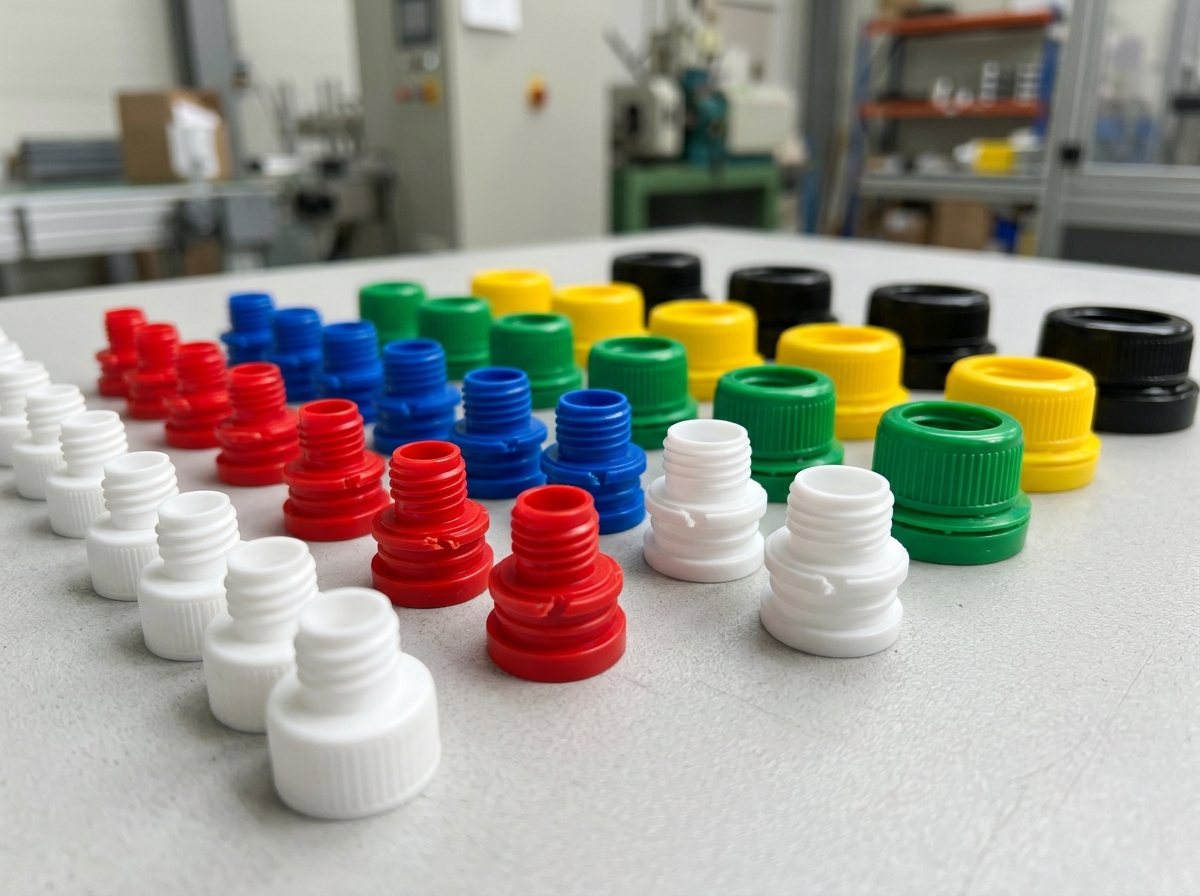
The same spout cap family in different diameters, colors and cap styles — customization dimensions are specified independently, then combined in one mold.
How a custom spout cap project runs: design to mass production
A custom project is a sequence of four stages, and each one exists to retire a specific risk before you spend on the next.
- Design. You share the pouch, the contents and the target spout diameter. The supplier draws the spout cap against your actual pouch and filling context. Nothing is priced yet — the mold fee can only be quoted after the 3D drawing is confirmed, because mold cost is driven by cavity count, steel grade and feature complexity, none of which exist before the design does.
- 3D sample. Before any steel is cut, the design is printed as a 3D prototype so you can confirm shape, feel and fit against your pouch. This is the cheapest round in the whole project, and skipping it moves every mistake into expensive steel trials.
- Mold. The production tool is machined in-house. For a spout cap, mold production typically takes about 60 days once the 3D drawing is approved.
- Trial sample and mass production. Test samples are molded from the finished tool and verified for fit and leak-proofing against your pouch before sign-off. Then mass production runs on the supplier's injection lines — at scale, with quality checks at each stage.
At Shantou Ruihua Plastic, the same sequence — design, mold, sample, mass production — runs under one roof, with the mold shop, injection workshop and inspection lines on site. That integration is not just convenience: it is what lets a supplier iterate a design revision on its own schedule instead of queueing behind a subcontractor's.
Two things to budget for beyond the mold itself. First, sampling rounds: complex features (anti-choking lips, tamper-evident rings) routinely need more than one trial iteration, so a realistic plan includes multiple sample rounds before sign-off. Second, the tooling economics: the mold is a one-time investment, and its quality determines the per-part cost for the entire production life — injection molding cost analyses from production service providers consistently rank tooling complexity and cycle time as the dominant price factors. If you want the full breakdown of what a spout cap mold costs, which sampling rounds to expect and how ownership works, our custom spout cap tooling cost guide goes through it line by line. The rest of the custom tooling hub explains how in-house mold capability changes what a supplier can promise.
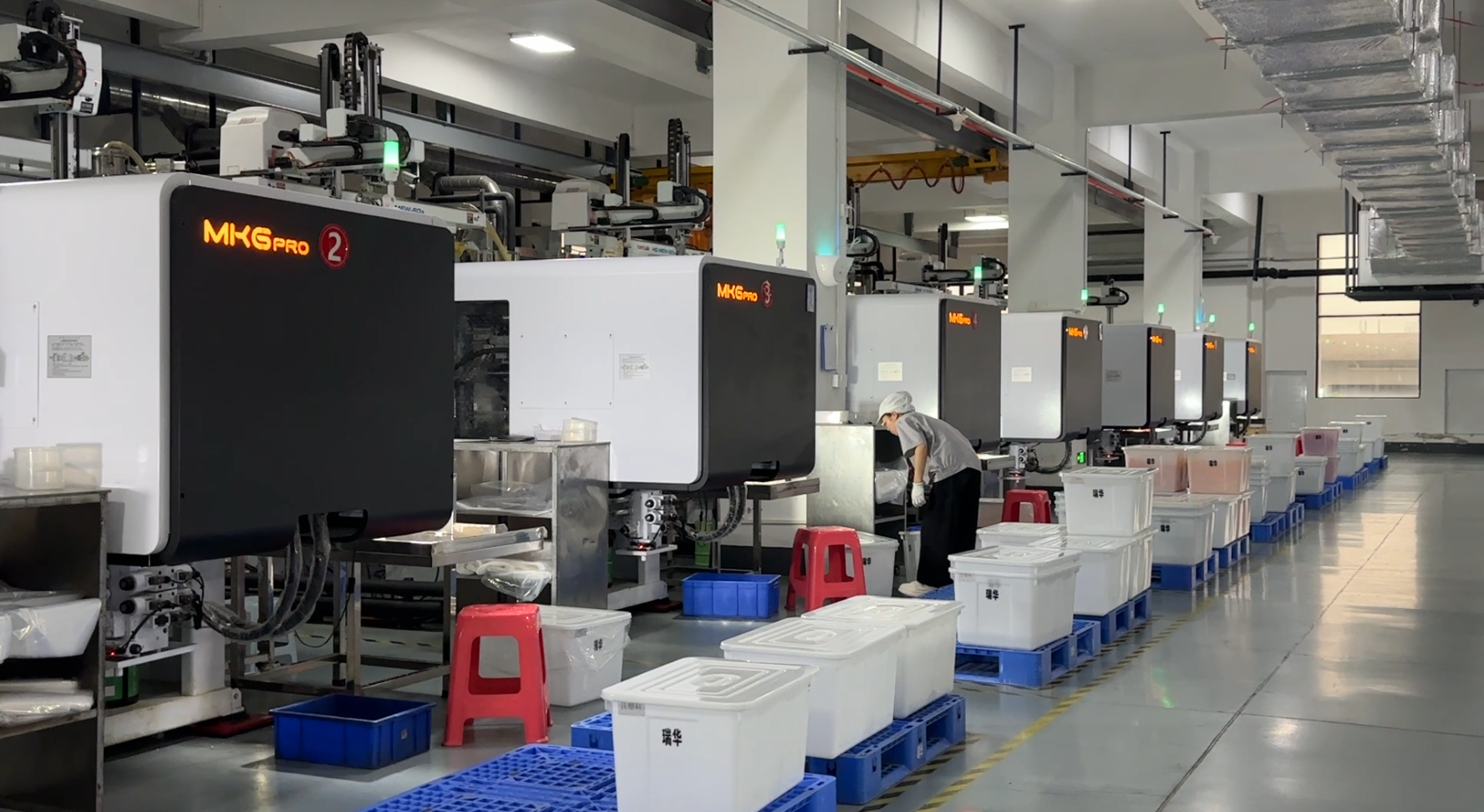
The mold is only the beginning — mass production runs on injection lines with controlled workshop conditions.
MOQ, mixed orders and the commercial terms that matter
Minimum order quantities for custom spout caps do not follow the ladder most buyers expect — where higher volume unlocks lower minimums. The actual structure is:
| Scenario | Minimum order |
| Stock models (off-the-shelf) | Any quantity — standard models are held in stock |
| Custom color | From 100,000 units; negotiable in special cases |
| After a dedicated custom mold | No minimum — supply follows your demand |
Two consequences follow. First, a custom-color order has a higher MOQ than a fully custom molded part — the opposite of the usual intuition. The reason is operational: changing color requires purging the machine and re-qualifying the resin, which a small run does not justify. A dedicated mold project, by contrast, has already bound the supplier and buyer together, so production volumes follow the customer's needs. Second, mixed orders are welcome: different models can be combined in a single order, which makes stock-plus-custom purchasing practical.
Do not let a single "MOQ 100,000" figure scare you off the whole conversation. That number applies to color changes on standard lines. If your project is a custom mold, the minimum-order constraint effectively disappears, and if you are buying stock models, you can start small.
Quality, certifications and food-contact compliance
Custom tooling buys you a part built to your spec — but the quality system around it is what makes that part sellable in regulated markets. Four layers matter:
- Management systems. ISO 9001:2015 for quality management and HACCP for food-safety hazard control are the baseline a serious supplier holds.
- Food-contact certifications. US FDA clearance and EU compliance with Regulation 1935/2004 (certified by TÜV SÜD) cover the closure for direct food, beverage, cosmetic and pharmaceutical contact. Product-level standards such as GB 4806.7 and EU LFGB apply where relevant.
- Dimensional control. For spout caps, the inner diameter — the dimension that determines sealing against the spout — is held to within ±0.1 mm of nominal per our published tolerance.
- Verification on demand. Full machine-vision inspection of every part is available on request for brand factory audits, along with the test documents an auditor will ask for. Note the qualifier: full inspection is an option you request for critical batches, not a silent default on every order.
If you are mapping certifications to specific products and markets, our food-grade spout caps certification guide walks through which certificate covers which claim.
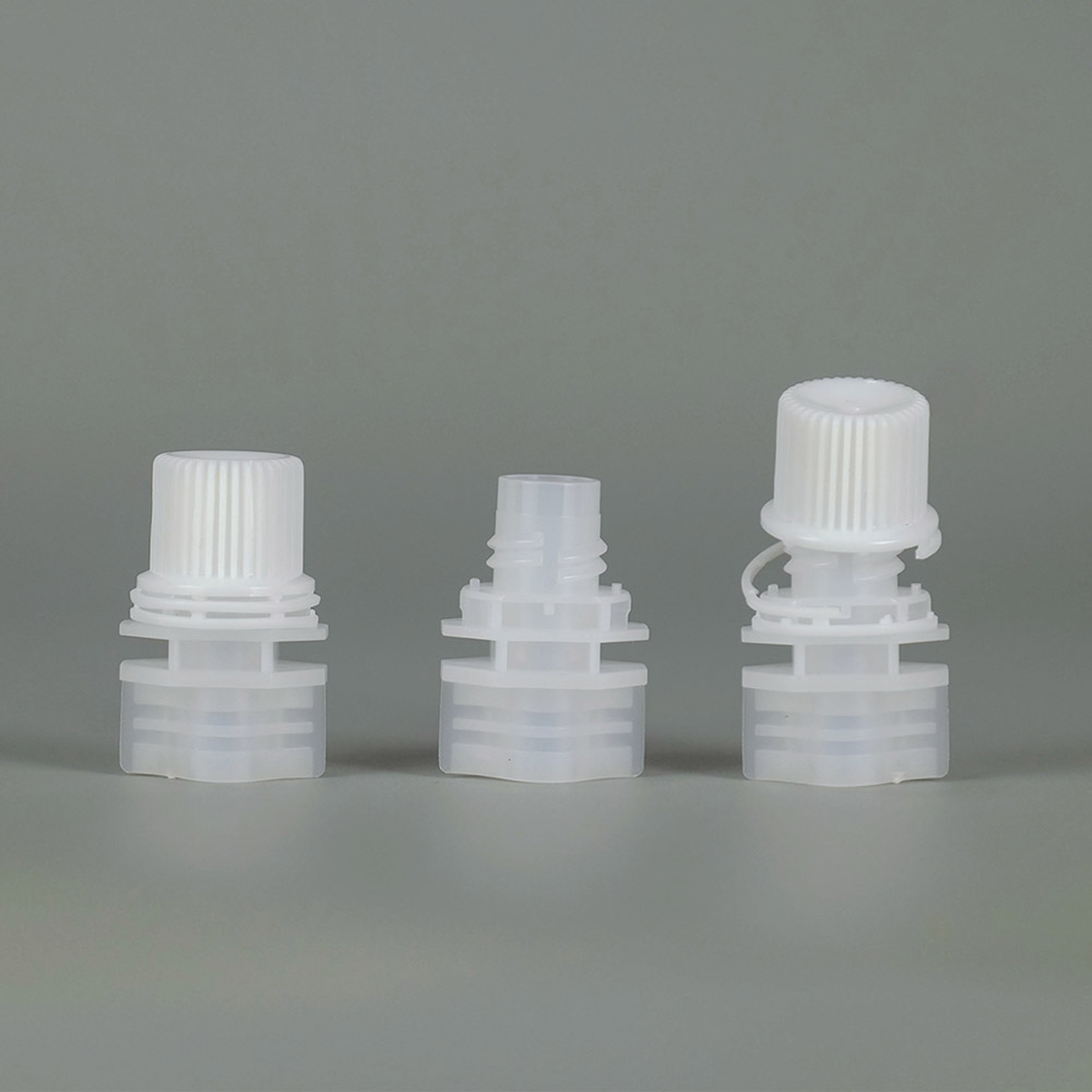
A tethered, non-separated twist cap keeps the closure attached to the spout at full opening — the design EU regulation increasingly requires.
Stock or custom? A five-question check
Run your project through these five questions. Four or five "yes" answers point to stock; one or two point to a custom project.
- Is your target diameter in the existing range? Bores from 1.2 mm to 40 mm cover nearly every pouch format in production. If yours matches a standard bore, the flow side of the problem is already solved.
- Does a stock model's closure style fit your use case? Screw, flip-top, push-pull, anti-choking and tamper-evident styles all exist off the shelf. Only combinations no catalog part offers push you toward custom.
- Do you need branding that stock parts cannot carry? Embossed logos and custom Pantone colors are customization work even when the geometry is standard — this is the middle path: standard mold, custom color and branding, with a moderate MOQ.
- Does a regulation shape the design? Tethered caps for EU-bound products, anti-choking geometry for children's packaging, and food-contact grades for direct content contact are compliance-driven customization.
- Does your volume justify the tooling? A dedicated mold pays off when annual volume is high enough for the tooling cost to amortize into the per-cap price. Below that threshold, the custom tooling hub has the economics spelled out so you can run the math before committing.
What to send, and where each route goes next
The brief is different for each route, and it is what decides the quality of your quote:
- Stock — your pouch film, fill conditions, and the bore and cap style you need. The spout cap RFQ checklist lists every field.
- Color — the same film and fill detail, plus a Pantone reference and logo artwork.
- New tooling — the same, plus a physical pouch sample, your annual volume and ramp, and your target markets.
The full field-by-field list — film structure, fill conditions, bore and tolerance, quantities, market and validation — is in the spout cap specifications guide linked above, and the tooling cost guide explains how your volume becomes a mold quote. When you are ready, request samples or a quote with the route you have chosen and the items above — a manufacturer with in-house mold design, 3D printing and injection molding can take it from drawing to mass production without the handoffs a trader adds.