The short answer: a food contact notification is manufacturer-specific
A supplier sends a specification sheet with an FCN number on it, and the number is real. Whether it covers the cap you are buying is a separate question, and the answer sits in three lines of the regulation: an FCN is effective for the food contact substance manufactured or prepared by the manufacturer or supplier identified in the notification. If a different manufacturer wants to sell the same substance for the same use, 21 CFR 170.100(a) says that manufacturer "must also submit an FCN to FDA."
The FDA states the same rule on its own inventory page, with the citation that gives it force: under section 409(h)(2)(C) of the Federal Food, Drug, and Cosmetic Act, a notification is "only effective for the manufacturer or supplier identified in the notification." Anyone marketing a substance on the strength of it "must be able to demonstrate that the notification is effective for their food contact substance."
So four things have to line up before that number means anything for your purchase order:
- The named manufacturer in the notification is the one that actually made the material in your cap.
- The substance is the same substance, at the same specifications, not a family name that sounds alike.
- The intended use matches: your food type, your process temperature, your use level.
- The notification is still effective on the day you buy.
Get any one wrong and the document is decoration. Get them all right and you can defend the file in an audit. The rest of this article is those four checks in order, plus what to ask for when one fails — and the cases where you never needed an FCN at all.
If you are new to how the US regime sits next to the European and Chinese ones, the Regulations & Recyclability hub is the place to start; this article assumes you are already holding a supplier document.
What an FCN authorizes — a substance and a use, not your cap
The notification is a premarket instrument. A manufacturer or supplier tells the FDA, at least 120 days before marketing, what the substance is and what it will be used for; if the agency raises no objection inside that window, the substance can be marketed (FDA's overview of the review program). There is no certificate, no approval letter with a seal, and no product-level sign-off. The evidence is the notification, the record of it in the inventory, and your ability to trace what you bought back to the company named in it.
That last point is the one buyers miss. The FDA puts it plainly on the page about determining the regulatory status of food contact components: notifications are "proprietary to the manufacturer for which the notification is effective, therefore, the FCS must be obtained from that manufacturer."
A spout cap is not a substance. It is an article assembled from several: the body resin, the colorant or masterbatch, the liner or gasket, sometimes a silicone valve. Each one carries its own authorization basis. One FCN number on the spec sheet therefore cannot answer the whole question, even when it is genuine and current.
What the FCN covers | What your purchase order actually needs |
|---|---|
One food contact substance | Every substance in the cap that can migrate |
The manufacturer or supplier named in it | The company that made each substance, proven by documents |
The intended use and its limitations | Your food type, process temperature and use level |
An effective date and a status | The status on the day the goods ship |
For context on how this maps onto the EU declaration system and China's GB standard, see our comparison of FDA, EU 1935/2004 and GB 4806.7. The US regime is the only one of the three where the permission is attached to a company rather than to a list entry, which is why the checks below are specific to it.
Check 1: find the named manufacturer in your own chain
Open the FCN record and read the notifier and manufacturer lines. Then open your bill of materials and ask a single question: does that company's material reach my cap, or does something else reach it?
The statute is worded to close the obvious loophole, and the FDA's administrative guidance for notifiers reads section 409(h)(2)(C) as a limit on the notification itself: an FCN is "effective for the manufacturer, the FCS, and the conditions of use identified in the notification and not effective for a similar or identical substance produced or prepared by a manufacturer other than a manufacturer identified in the prior notification." The same guidance adds what a buyer has to prove: anyone relying on an FCN must be able to show the substance "has been manufactured or supplied by the manufacturer identified in the FCN and is being used under the conditions that are the subject of the FCN."
There is a real allowance further down the chain, and the FDA's inventory page states it: everyone who buys the substance from the named manufacturer may rely on the notification, "consistent with any limitations in that notification." That sentence is what makes normal trade possible: a molder does not have to file its own notification for a resin it buys from the company that filed one.
Which means the question is never "does an FCN exist for this material" but "which plant made the material in this box."
Supply chain shape | Can the FCN carry you? | What proves it |
|---|---|---|
molder buys the grade directly from the company named in the FCN | Yes, within the notification's limits | Purchase records tying the grade to that supplier, plus a current letter of guaranty |
molder buys through a distributor of the named manufacturer | Usually, if traceability survives the extra hop | Distributor's statement of provenance, batch references, guaranty that names the grade |
molder buys an equivalent grade from a second compounder | No | Nothing does; the second compounder needs its own notification |
molder compounds its own masterbatch or formulation | No, for the part it compounds | Its own notification, or a listed regulation for that substance |
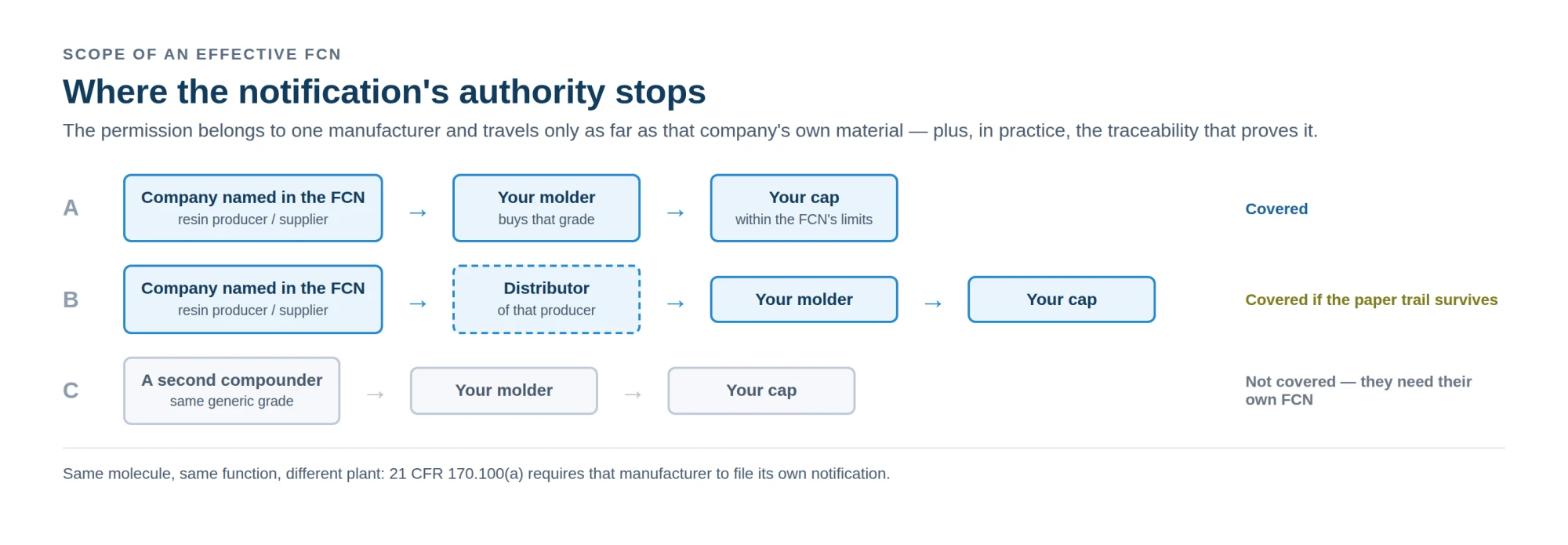
Figure: three supply-chain shapes, and where the notification's authority ends in each one.
The failure mode is mundane. A compliance letter is assembled from the resin supplier's paperwork, the molder's name goes on the letterhead, and the FCN number travels along. Nothing in that document is false. It simply describes a permission that belongs to someone else, for material that may or may not be in the part.
Check 2: the substance, not the family name
Manufacturer identity is only half of the scope. The other half is identity of the substance itself, including its specifications and impurities.
The FDA guidance lists the situations where a new notification should be filed rather than relying on an existing one: a different manufacturer; substantive changes in the specifications; changes in the manufacturing method that alter the identity of the product or its impurities; and conditions or levels of use not covered by the earlier notification. Read that list from a buyer's seat and it becomes a change-control list. A grade swap, a new colorant, a different liner supplier, a moved production line — each one can push your part outside the notification that used to cover it.
The components are easy to forget because they are small. The colorant in a colored cap is its own substance with its own basis. So is the liner, the gasket, and any additive package. This is the same trap that makes a single-substance marketing claim — BPA-free, for instance — an incomplete answer to a compliance question, which we cover in what a BPA-free spout claim actually proves.
Ask for the grade code, not the trade family. "Food-grade polypropylene" is a category. An FCN record names a substance and a specification. If the supplier cannot connect the two, the number is not doing any work. The same reasoning governs test reports, where the question becomes whether the sample tested represents the part you buy — the logic in can one migration test cover a family of spout caps.
Check 3: the intended use — food type, temperature, use level
An FCN is effective for a use, not for a material in general. The FDA defines that use with two vocabularies, published as the Food Types and Conditions of Use tables.
Food type separates aqueous and acidic products from fatty ones, and from dry solids whose surface carries free fat or oil. Conditions of use are a temperature ladder that the FDA letters, from frozen storage up to high-temperature heat sterilization: frozen or refrigerated storage, room-temperature fill, hot fill or pasteurization below 150 °F, hot fill or pasteurization above 150 °F, boiling-water sterilization, and high-temperature heat sterilization above 212 °F. Those letters are what appear in an FCN record, so learn them early.
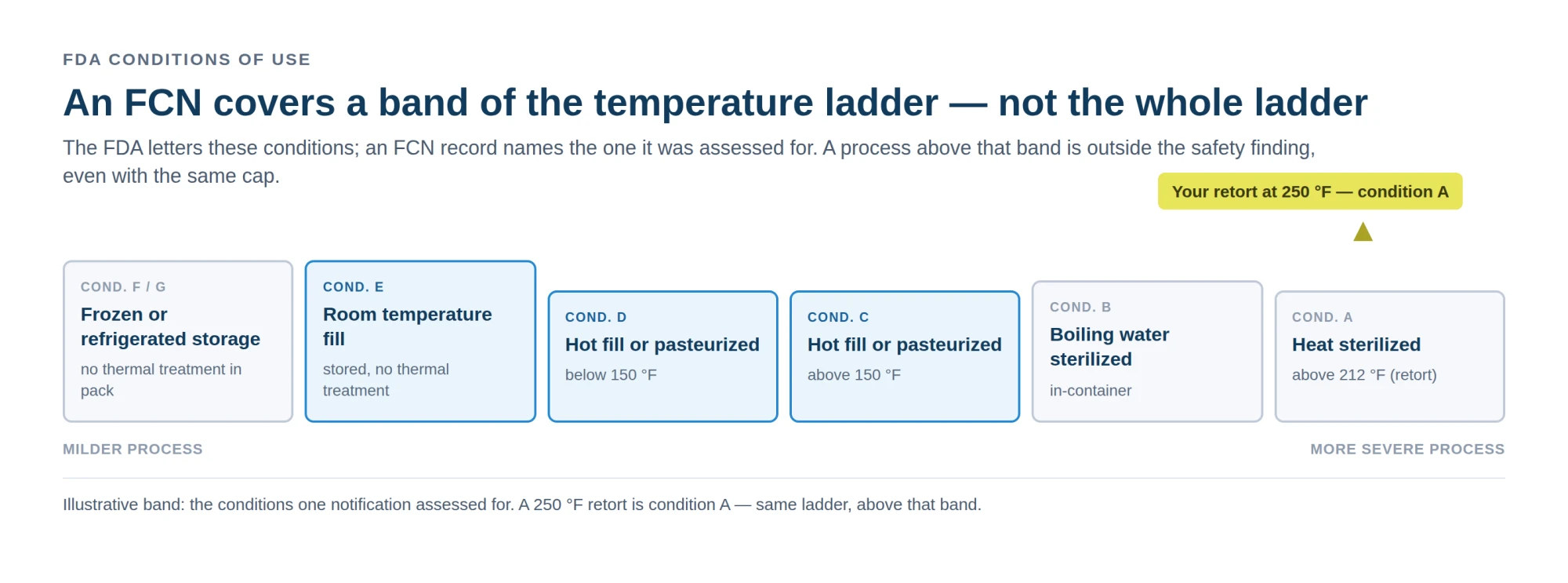
Figure: a 250 °F retort is condition A in the FDA's own lettering — a step on the same ladder, well above the band the notification was assessed for. Inside the ladder, outside the finding.
This is where two products that look identical diverge. A cap resin cleared for room-temperature fill of an acidic beverage is not automatically cleared for the same cap on a retort line running above 212 °F, because the migration behavior that the notification assessed belongs to the milder conditions. The same applies sideways: a notification written for aqueous foods does not speak to a fatty sauce that extracts different substances.
Use level and geometry usually appear in the limitations column rather than the headline. A notification may name a maximum concentration in the finished article, or a thickness, or an area-to-mass ratio. Those are not bureaucratic footnotes; they are the numbers the safety finding rests on, and a wall section outside the range the notification states is a different question — so read whether the figure is a ceiling or a floor.
Field | Where to find it | What has to match |
|---|---|---|
Food type | FCN record, intended use | Your product's category, including fat content |
Thermal process | FCN record, conditions of use | Fill and any downstream sterilization step |
Use level / thickness | FCN record, limitations | The actual concentration and wall section in your cap |
Contact conditions | FCN record, specifications | Storage, duration and any cooking-in-pack step |
The ask that follows is specific. Put your sterilization or pasteurization step — retort, water bath, hot fill — into the inquiry, and ask the supplier to answer against that process rather than against the words "food grade."
Check 4: is the notification still effective?
An FCN can stop being effective, and the regulation that governs it is short. 21 CFR 170.105 sets out four grounds for that determination. Two are the ones a buyer will meet: new data showing the intended use is no longer safe, or evidence that the named manufacturer or supplier has ceased — or intends to cease — producing, supplying or using the substance for that use. (That second ground includes the company asking the FDA to withdraw it.) The other two are administrative and worth knowing, because they point at the remedy in the next section: the same use becomes authorized by a food additive regulation, or becomes the subject of an issued Threshold of Regulation exemption.
So a document dated 2019 can be perfectly authentic and describe a permission that lapsed when the original producer left the grade. This is why the date on the compliance statement matters as much as the number in it, and why "we have an FCN" is not an answer to "is it effective today."
Put plainly: if the substance's use is already covered by a regulation or an exemption, the notification is no longer the document that authorizes it. That is the formal version of the advice below — sometimes the answer is not a better FCN letter but a different kind of citation altogether.
Two habits close the gap. First, read the inventory record rather than the supplier's transcription of it; the record is the current list, and the inventory page states the date its content was last brought up to date. Second, put the obligation in writing: a clause requiring notice when the resin grade, the colorant, the liner or the manufacturing site changes is worth more than a thicker folder of old certificates. The broader version of that discipline is in how to verify a packaging supplier's certificate, which applies the same read-the-record-first method to ISO and scheme certificates.
How to read the FDA inventory record
The inventory is a searchable database, and the record behind each number is where the four checks are actually performed.
- Open the FDA's Inventory of Effective Food Contact Substance Notifications and search the number your supplier quoted.
- Read the food contact substance line first. If the substance named is not the material in your cap, stop; the rest of the record is irrelevant.
- Read the notifier and manufacturer lines and put them against your bill of materials (check 1).
- Read the intended use, limitations on conditions of use and specifications against your product and process (check 3), and confirm the record is still listed (check 4).
- Save the record with the date you checked it, and file it next to the supplier's letter. The next reviewer will need to know which version you saw.
Record field | Question it answers |
|---|---|
Food contact substance | Is this the material I am buying? |
Notifier / manufacturer | Is this the company in my supply chain? |
Intended use | Is this my food type and process? |
Limitations and specifications | Does my use level and wall section stay inside the finding? |
Effective date and status | Is it still effective today? |
If the record does not exist, or the number does not resolve, that is an answer too — and a more useful one than a letter that cannot be checked.
What to ask for when the number does not cover you
Most of the time the gap is fixable, and it is fixed with a different document rather than a different supplier.
Situation | Request this | What good looks like |
|---|---|---|
molder buys the grade from the named manufacturer | Chain-of-custody documents plus a letter of guaranty naming the grade | Guaranty on company letterhead, signed, dated, referencing the FCN number and the grade code |
molder buys an equivalent grade elsewhere | That compounder's own FCN, or the regulation that covers the substance | A notification record in the compounder's name, for your use |
The substance is already listed in 21 CFR | The citation, not an FCN number | For the base olefin polymer of a PP or PE cap, 21 CFR 177.1520 is the usual answer |
The substance rests on another basis | The basis itself: GRAS, prior sanction, or a Threshold of Regulation exemption | A named basis the FDA recognizes, traceable to the substance |
Nothing can be produced | A decision, not a document | Change the material, or change the market claim |
The letter of guaranty deserves a note, because it is often the only document a Chinese molder can issue quickly. Its legal footing is section 303(c) of the Food, Drug, and Cosmetic Act, with suggested wording in 21 CFR 7.12 and 7.13 — the FDA's own page describes it as the basis for the guaranty "supplied by many manufacturers to their clients."
What that section gives you comes in two halves, and only one of them survives the trip. A guaranty establishes where the material came from, which is the traceability the notification rule asks for. The penalty protection is narrower: 21 U.S.C. 333(c)(2) applies to a guaranty "signed by, and containing the name and address of, the person residing in the United States from whom he received in good faith the article." A document signed in Shantou traces the material; it does not, by itself, carry the shield. Importers who need both usually take the guaranty from the US-resident seller or importer they buy from, or the supplier signs it through its own US entity.
Neither half creates a permission, and no guaranty can make an out-of-scope FCN number apply. What it does is put a named company behind a named grade — the traceability the notification rule actually requires.
The third row is worth taking seriously before you ask for paperwork. For a plain polypropylene or polyethylene cap body, the authorization often comes from a listing rather than from a notification, because the base polymers are addressed in 21 CFR. Notifications tend to enter the picture with a novel additive, a specialized colorant or a formulation someone deliberately developed. A buyer who demands "an FCN" for a commodity cap can end up rejecting a perfectly documented part — and a supplier who volunteers an FCN number where a listing would do is telling you something about how carefully the file was assembled.
One phrase to retire from your supplier reviews: "FDA approved." The FDA does not approve food contact materials or issue certificates for them. What exists is a notification that became effective, a listing, or an exemption. A supplier who uses approval language is either translating loosely or does not have the document they are describing.
What to keep in the supplier file
The four checks collapse into one row per component, and that row is the artifact worth maintaining.
Component | Authorization basis | Named manufacturer | Use matched | Checked on |
|---|---|---|---|---|
Cap body resin | FCN number or 21 CFR citation | Company in the notification or listing | Food type, process temperature, use level | Date, with the inventory record attached |
Colorant / masterbatch | Separate basis | Separate named company | Concentration in the finished part | Date |
Liner / gasket | Separate basis | Separate named company | Contact conditions | Date |
Valve or other insert | Separate basis | Separate named company | Contact conditions | Date |
Re-check the row when the supplier changes, when the grade changes, when the manufacturing site changes, and on a fixed annual cycle. Add the inventory record's "content current as of" date to your own note, so a later reviewer can tell which snapshot you relied on.
That is the whole discipline. It is not legal work; it is document control applied to one question — who made this material, and what did the FDA allow them to do with it.
Questions buyers actually ask
My supplier quoted an FCN number that belongs to a resin company. Is that enough?
Only if the resin in your cap was made or supplied by that company and used within the notification's conditions. If your molder buys an equivalent grade elsewhere, the number does not reach your part.
Is an FCN the same as FDA approval or certification?
No. It is a premarket notification that becomes effective if the FDA does not object within 120 days. There is no certificate, and the FDA does not approve individual materials or caps.
Do I need an FCN for a plain PP spout cap?
Often not. Base olefin polymers are addressed in 21 CFR 177.1520, so the question for a commodity cap is usually which listing covers the grade, not which FCN. Notifications matter most for additives, colorants and unusual formulations.
My molder is in China and the named manufacturer is a resin producer. Can the chain still work?
Yes, and this is the normal case. What has to survive is traceability: purchase records that tie the grade to the named producer, a dated guaranty, and no substitution at the compounding step.
How often should I re-check?
At every supplier, grade or site change, and at least once a year. Notifications can stop being effective, and the inventory is the current list.
If you are qualifying spout caps for the US market and want the material question answered before the sample order rather than after, ask us which resin grade sits behind a specific part and which documents travel with it. Our own documentation — the FDA food-grade compliance statement we hold, plus ISO 9001, HACCP and EU 1935/2004 certificates — is published on the certificate page. That is the documentation we can stand behind; if your file needs something beyond it, say so and we will tell you whether it is obtainable.