
A refill pouch leaves the filler in a carton, rides a pallet or a parcel network for a week, and reaches a store shelf or a customer's doorstep. Somewhere in that journey it is shaken for hours and pressed by everything stacked above it. When a retailer or a distributor asks you to prove the pack survives that, the request arrives as two words — transit testing — and the quote that comes back is a test schedule you have no obvious way to argue with.
This article is about commissioning refill pouch transit testing rather than performing it. It assumes the lab owns the equipment and the engineering, and that what is missing is on your side of the desk: a route nobody wrote down, a failure nobody defined, and a report nobody can re-run. Below are the four inputs only you can supply, twelve questions that separate a designed test from a stock package, and a record sheet that turns one passing run into evidence you can use again. It sits in the wider set of spout cap decisions covered under our hub — where "spout cap" always means the closure on a stand-up pouch or doypack, never a gas-can spout.
One boundary up front. This article does not give vibration levels, compression forces, durations, sample sizes or pass limits, and it does not tell you what counts as a failure. Those numbers belong to your distribution route and your specification — inventing them here would produce a page that looks authoritative and is worth nothing in an argument with a lab or a buyer. What it gives you is the shape of the request, which is the part that decides whether the result is usable.
Why refill pouch transit testing is two tests, not one
Vibration and compression arrive in the same quotation, usually under the same heading, and they are not variations on a theme. They load the pack in opposite ways, they break different things, and the sample you send is not the same sample.
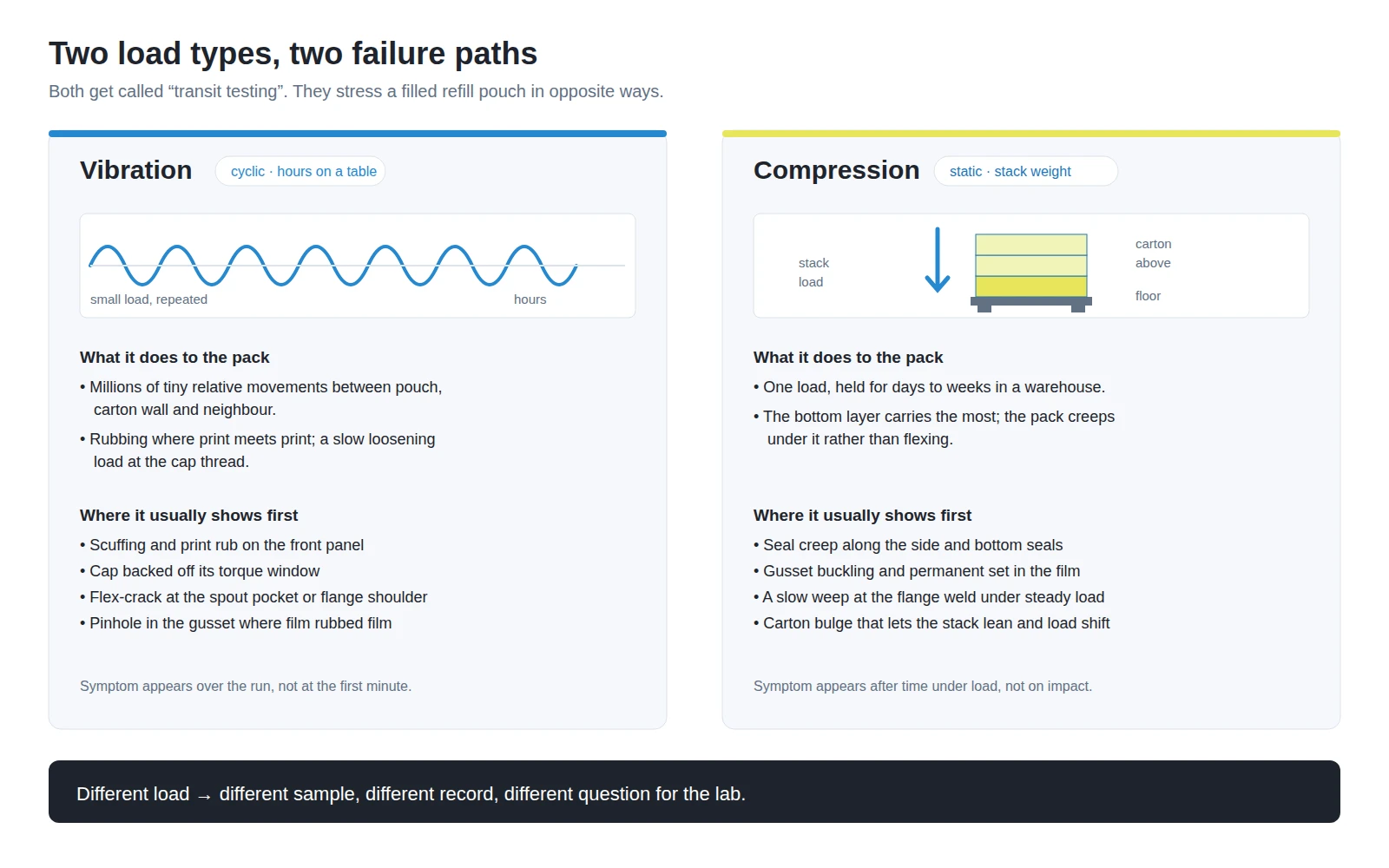
Vibration is a small load repeated an enormous number of times. The pouch does not get hit; it gets worked. Film rubs against film and against the carton wall, print scuffs, a cap can creep off the torque window it was applied to, and the place where a rigid fitment meets a flexible film — the flange shoulder and the spout pocket — flexes until a crack starts. None of that is visible at minute one. It accumulates.
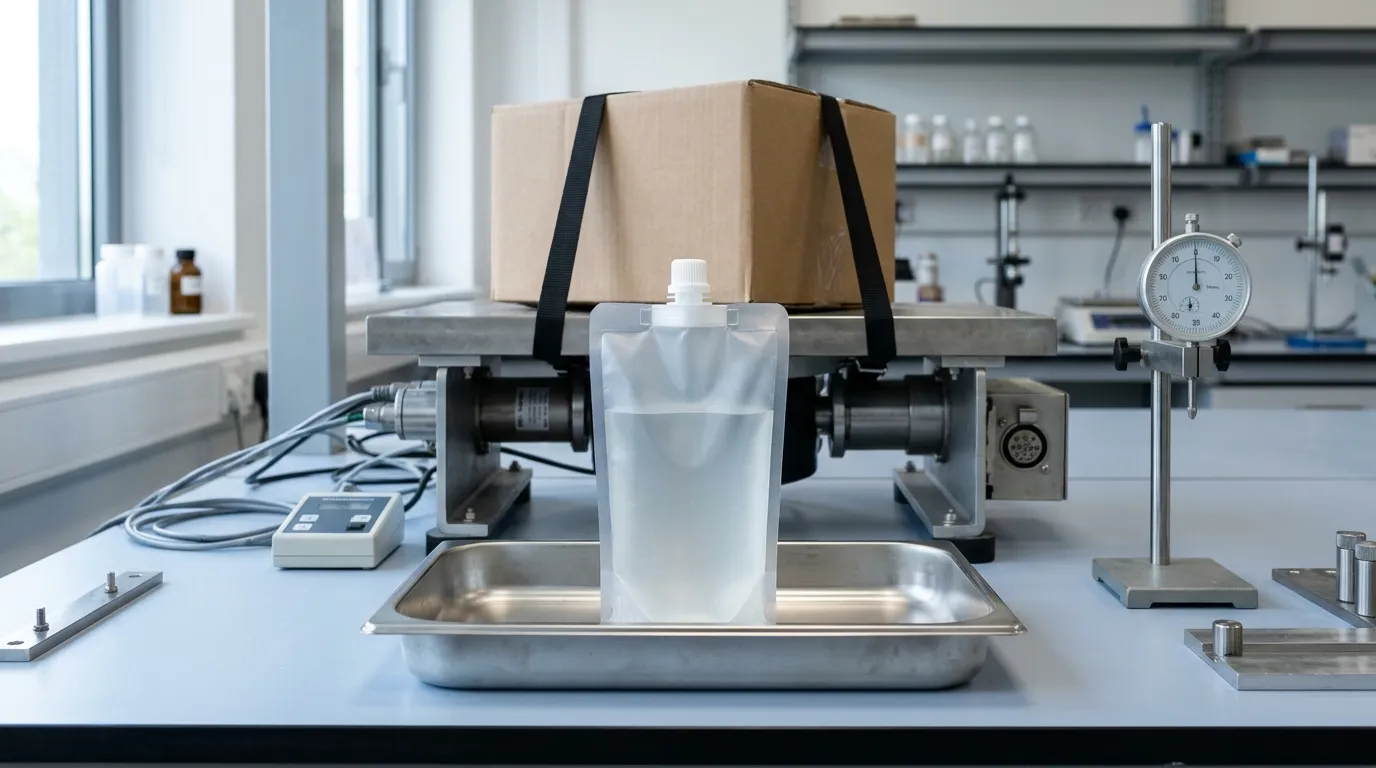
Compression is one load held for a long time. The bottom layer of a pallet carries everything above it for as long as the pallet stands in a warehouse, and the pack answers by creeping: seals thin out, a gusset takes a permanent set, a flange weld that was marginal weeps slowly under a steady push rather than failing at a moment. Different mechanism, different evidence, different fix.
Those differences are not academic, and they are why the two tests should stay separate in your own head even when the quote bundles them:
- The sample differs. A bare cap-and-spout assembly can be vibrated in a fixture, and that tells you something real about the thread and the sealing land under the cap. It cannot tell you anything about seal creep under a stack, because there is no seal and no stack.
- The record differs. A vibration result is a story about time — what appeared, and when. A compression result is a story about load and dwell — what deformed, and whether it came back. A single "passed" line erases both.
Published practice treats them as separate hazards inside one schedule rather than as one test. ASTM D4169 is the standard practice for performance testing of shipping containers and systems. ISO 4180:2019 sets out general rules for compiling a performance test schedule for complete, filled transport packages, and ISTA publishes its own procedure set organised by distribution channel — procedure 3A for parcel delivery, 3B for less-than-truckload freight, 3E for unitized loads. All three are frameworks for assembling a schedule from the hazards a pack actually meets. None of them knows your route.
There is a third hazard in the same family, and it behaves differently again: the drop. A drop is a single high load over milliseconds, and it fails a spout pouch in places vibration and compression do not touch — the gusset corner, the top seal beside the spout pocket. It also has its own record discipline, set out in the drop record format for spouted pouches; if your programme includes it, keep it as its own run rather than folding it into the vibration sheet.
The four inputs a lab cannot invent
A contract lab can choose machines, write a protocol and run it repeatably. What it cannot do is guess the four things that determine whether the protocol means anything.
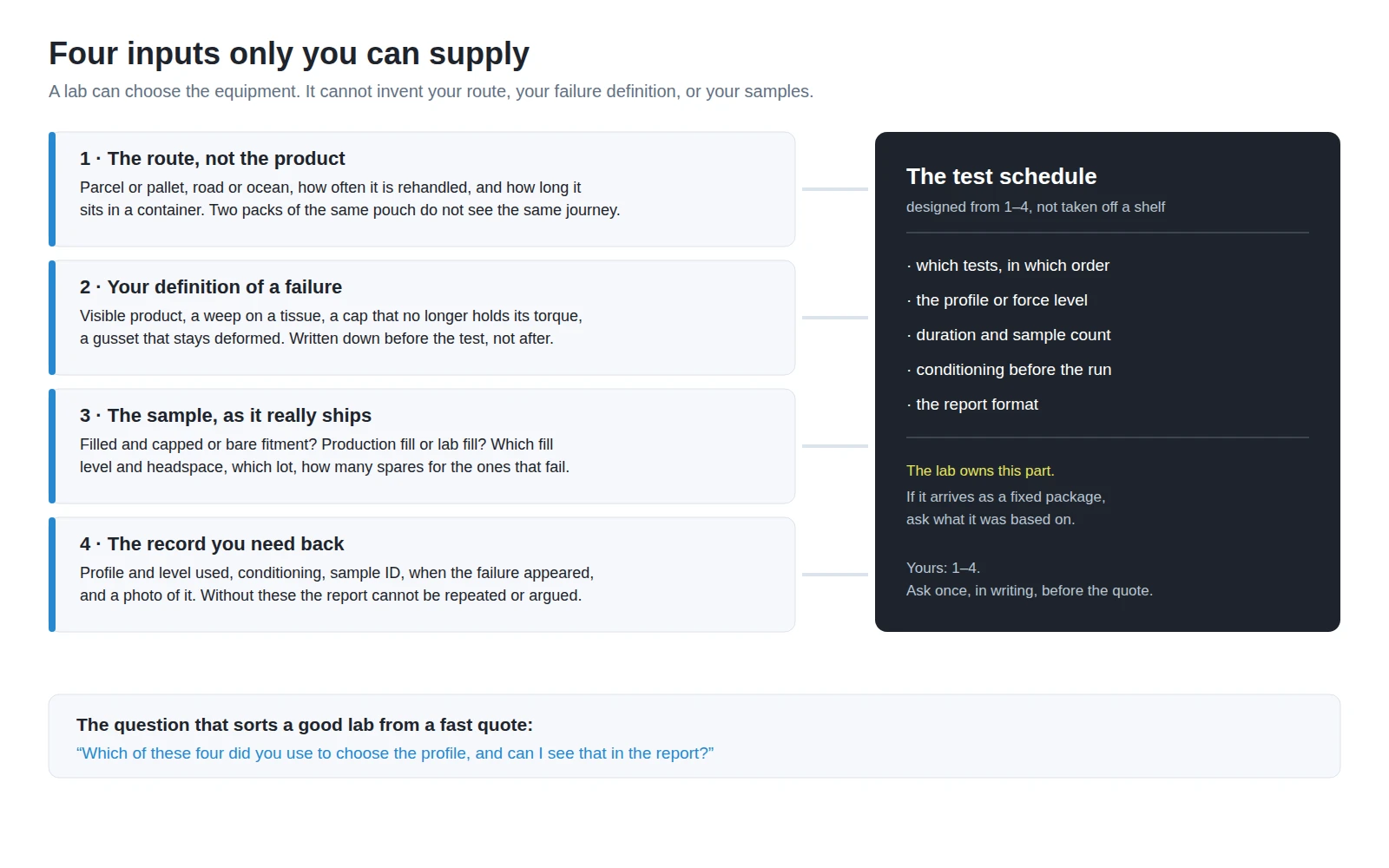
The route, not the product. Parcel and pallet are not two intensities of the same journey; they are different journeys with different handling counts, different dwell times and different neighbours in the box. A pouch on a same-day depot run and a pouch that spends five weeks in an ocean container are not being asked the same question. If you cannot describe the route, the lab will default to a generic schedule and you will not know which part of it applies to you.
Your definition of a failure. Is a damp patch on the outside of a pouch a failure, or only visible product? A cap that still seals but has backed off its applied torque — pass or fail? A gusset that stays creased after the load comes off? Each answer changes what the technician writes down, and the definition has to be agreed before the run, not negotiated over the report. One contract lab's published description of parcel integrity testing says the same thing in one line: before the test begins, acceptance criteria and the location of the unit's faces and edges must be considered — which is the part worth copying.
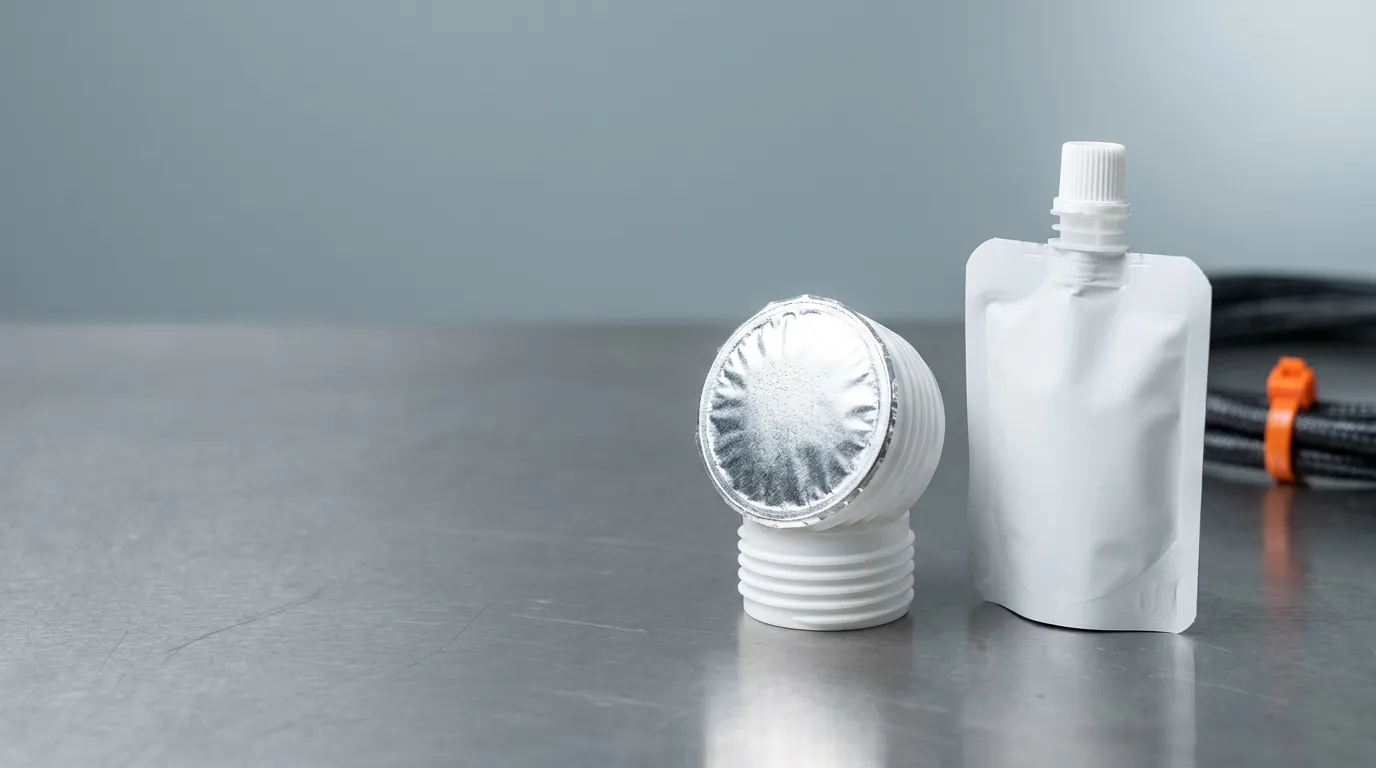
The sample, as it really ships. Filled and capped, or bare fitment? Product fill or a lab substitute? Which fill level and how much headspace? Which lot, so the film and the fitment can be traced? A lab testing a lab-filled pouch in a clean bag is testing a different object from the one your customer opens.
The record you need back. The report is the only durable product of the exercise. If it names the nominal profile from the quotation rather than the one that ran, or omits conditioning, the run cannot be repeated and cannot be defended.
There is a commercial argument for getting these right, and it is not abstract. A packaging-equipment supplier's own account of its in-house lab, published in 2016, puts the engineering work of properly testing a unit at about 40 hours, and describes its central instrument as a recorder that collects route-specific shock and vibration data so the table can replay it later (Packaging Digest on lab testing). The replay is only as good as the recording. If nobody recorded your lane, the profile is somebody else's lane.
Twelve questions to put to a contract lab
Send these with the request for quotation. They are written to be answered in writing, and a lab that answers them without irritation is telling you something useful about how it works.
Scope and schedule
- Which hazards in my route does this schedule represent, and which ones did you leave out? A schedule is always a selection. Knowing what was dropped — handling drops, altitude, humidity, a rail segment — tells you what the result does not cover.
- Will the schedule come from a published practice, or from data recorded on my lane? Either answer can be right. What you are listening for is whether the lab knows which one it is doing, and whether it can name the basis.
- If my pack changes — a new film, a different fill weight, a new cap — which parts have to be re-run? This is the question that turns a one-off test into a qualification plan, and it is cheapest to ask now.
Samples and conditioning
- What exactly do I ship you: bare caps and spouts, filled capped pouches, or shippers of pouches? Ask what each version can prove that the others cannot, then pick the combination that matches the failure you are worried about.
- Do you condition the samples before the run — at what temperature and humidity, and for how long? A film at warehouse temperature and a film at winter temperature are not the same material. Conditioning follows published practice — ISO 2233 is the ISO reference for conditioning complete, filled packages, and ASTM D4332 the US practice — and it has to appear in the report or the number is not comparable with anything.
- How many samples per condition, and what happens to the ones that fail? A failed sample that is photographed, labelled and returned is worth more than any pass. Ask for it before the run, because after the run it is usually in a bin.
Profile and equipment
- For the vibration run: sinusoidal or random, mounted how, and in which axes? ASTM D999 covers vibration testing of shipping containers and ASTM D4728 covers the random method; how the pack is restrained on the table, and whether it runs vertically only or in three axes, changes what the run represents.
- For the compression run: constant force or constant platen, on one carton or on a stack, and held for how long? ASTM D642 covers compressive resistance of containers, components and unit loads. The distinction that matters to you is whether the pack is being crushed or being held — a stack in a warehouse is the second.
- What is the machine's calibration status, and does your accreditation scope cover this test? A force reading without a calibration reference is an opinion with a decimal point; an accreditation that does not list the method is a gap you want to know about before the quote, not after the report.
Report and acceptance
- Will the report state the profile or level actually run, or the nominal one from the quote? Ask to see a sample report page. This is where most of the argument after a failure is won or lost.
- How will a failure be described — location, severity, and time since the run started? "Failed" is not a finding. A weep at the flange late in a vibration run and a split gusset on the first compression cycle lead to different people.
- What does the report explicitly not cover, and who signs the pass/fail line? A lab report is evidence, not a certificate. Whether the verdict is the lab's, yours, or your customer's is a commercial decision worth settling in writing before anybody runs anything.
What a pouch vibration test and a pouch compression test each prove
The four rows below are the ones that come up in a refill pouch programme. They are not interchangeable, and a quote that offers "transit testing" without naming which of them you are buying is a quote you cannot compare with another.
What you are asking | Test that answers it | What it stresses on a spout pouch | What it will not tell you |
|---|---|---|---|
Does the pack survive hours of shaking in its shipper? | Vibration, sinusoidal sweep — ASTM D999 | Film-to-film and film-to-carton abrasion, cap creep, flex at the flange shoulder | Whether it will survive being stacked for a month |
Does the pack survive a real, mixed-frequency road profile? | Vibration, random — ASTM D4728 | The same zones, driven by a broadband profile rather than a fixed frequency | Anything about a route nobody recorded |
Does the bottom carton hold the stack above it? | Compression — ASTM D642 | Seal creep, gusset set, slow weep at the weld under steady load | Impact damage, or what vibration does on the way there |
Does the whole journey hang together? | A schedule built on ASTM D4169, ISO 4180 or an ISTA procedure | Whichever sequence the schedule assembles, in the order it assembles them | Whether the sequence matches your route — that is your input |
Two habits make this table usable. First, ask for the test to be run on the shipper as it actually ships, with the pouches packed the way the line packs them; a pouch tested loose is a pouch tested in a different product. Second, keep one retained set of untested pouches from the same lot, so a failure can be compared against a pack that never left the building.
The compression row is the one that catches people out after a run, because "the seal crept" is a result and not yet a verdict. If the pack still holds but the seal has thinned, the question moves from transit to the seal itself — and seal strength is not the same measurement as seal integrity, so a healthy peel value will not answer it.
The record sheet that makes a result reusable
A lab report is written for the lab's file. Your record is written for the next test, the next supplier meeting and the complaint that arrives eleven months later. They overlap but they are not the same document, and the fields you need are the ones most often missing.
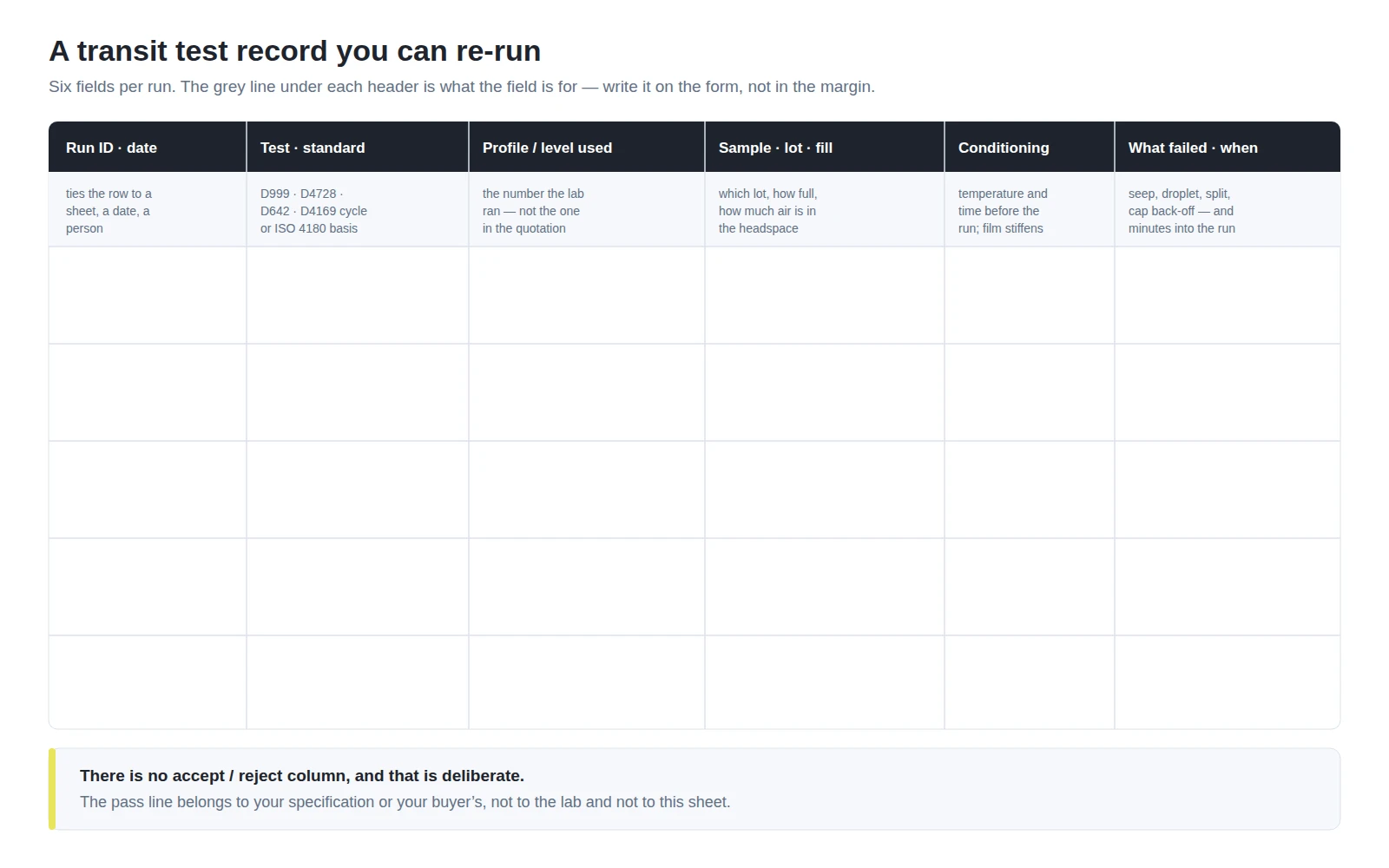
Six fields per run cover it. The drop sheet referenced earlier is the same discipline applied to impact; this one adds the two fields a cyclic or static load needs, because it has to say what the machine did, not just what the pack looks like afterwards. The six: a run ID with date and person; the test and the standard it followed; the profile or level actually used; the sample identity, fill level and lot; the conditioning the samples sat through; and what failed, in what way, and how long into the run. Copy the sheet for every run rather than summarising across runs, because a summary is where the discriminating detail goes.
Two of those fields decide whether the record has any value. Conditioning is the one teams skip when the lab is local and the samples are warm from the van; run twice at different sample temperatures and you have effectively tested two different materials, with the gap filed later as a design change that never happened. Time since the run started is the one that separates an impact-type failure from a fatigue-type one — a leak at the flange in the first minutes is a different fault from the same leak hours in, even when the photograph is identical.
There is deliberately no accept/reject column. The pass line is set by the specification you and your customer agreed, and a test house that will not state one is being honest rather than unhelpful. What you should insist on is that the report states every condition the run used, so the verdict you apply later is applied to a known object.
The same logic runs on the component side: a six-line specification of the cap and spout does for a purchase order what this sheet does for a test run — it makes the thing you are comparing against reproducible.
Reading a failure back to the right part of the pack
A failed run is only useful if it narrows the search. The failure location does most of that work, and it usually points at one of five owners — each with a different next step, and often a different supplier.
What you see | Whose question it is | What to run next |
|---|---|---|
Scuffed print, or a pinhole in the panel | Pack-out: clearance, dividers, how tightly the pouches are loaded | A packing trial with the carton, not another transit run |
Cap loosened, or a wet thread with the cap still on | Cap-to-spout fit and the torque window the capper runs | Torque measurement across a shift, then the cause-by-cause leak diagnosis |
A weep at the flange after vibration | The spout-to-film weld, not the closure | A seal test, then a look at whether the weld window still matches the film |
A seal that creeps or thins under compression | Film structure and seal width | A conversation with the converter, with the load and dwell in hand |
A fitment that separated | What the pack met before it failed | The drop record sheet, run as its own series |
When the seep only appears once the pack has been standing for a day, the answer is a method that locates leaks rather than a longer transit run; the five pouch leak test methods sets out which one answers which question.
What a spout and cap supplier can and cannot sign
When a transit run fails at the thread or the flange, the first question in the room is usually "whose part is this?" A closure maker can answer part of that and cannot answer the rest, and it is worth separating the two before the meeting rather than during it.
When the run fails here | The component evidence we can hand you | What we cannot decide for you |
|---|---|---|
Thread or cap seat after vibration — cap crept, neck scuffed, sealing face marked | Bore and thread dimensions, the torque window that cap-and-spout pair was designed for, cavity marking so the failed part traces to a batch | Whether your capper stayed inside that window, and under what fill temperature |
Flange weld or spout pocket after a stack load — weep, whitening, separation | The weld window set for that model, resin grade, a dimensional report for the specific combination | Whether the laminate, seal width and fill level were in the condition that window assumes |
Any pack-level verdict | Component records, and nothing about the finished pack | Whether the pack passes your distribution test, and who signs that line |
That third row is the honest boundary. A closure supplier who offers to guarantee how your finished pack travels is describing a measurement it cannot make: the cap and spout are the rigid side of a joint whose other side is the film, the seal width and the fill level, and none of those three belong to us.
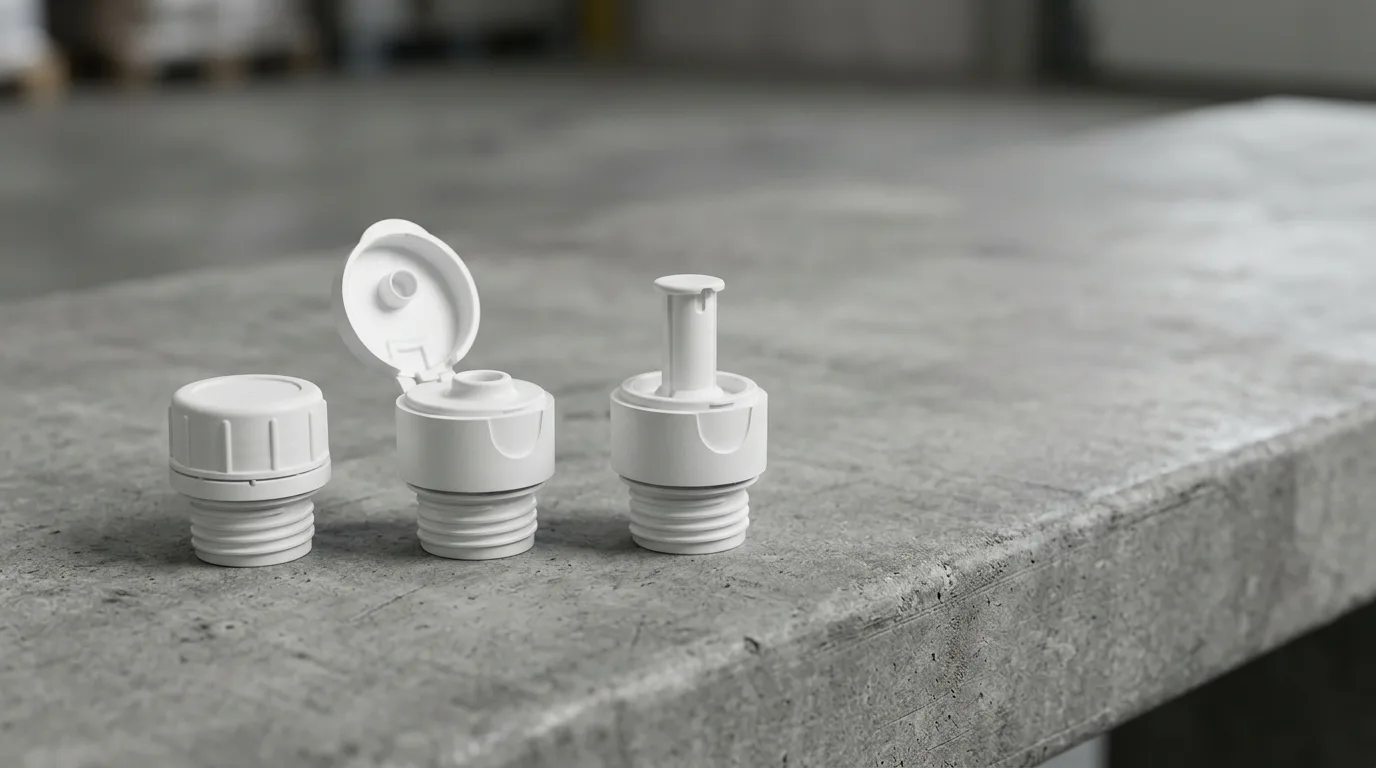
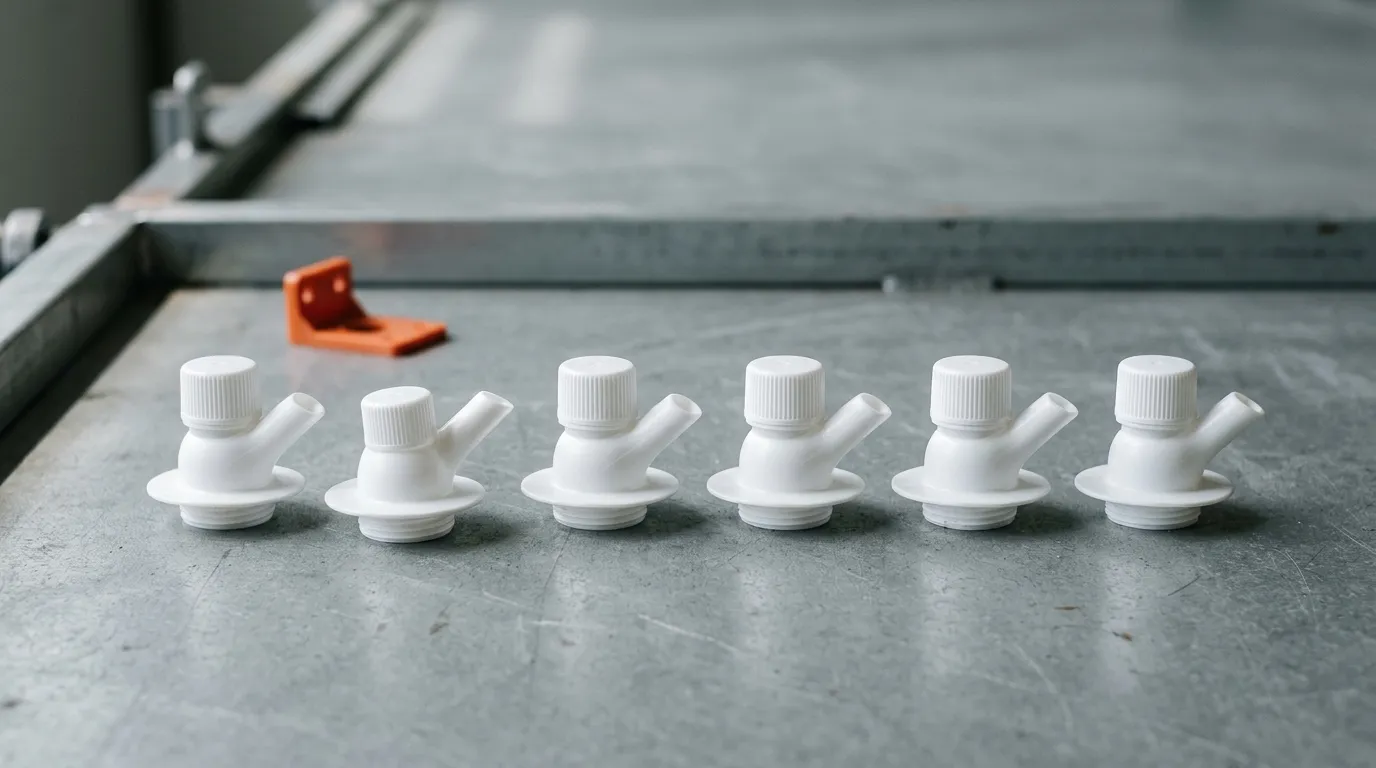
What a supplier can do is shrink the number of unknowns. Ruihua moulds the cap and the spout as a pair — food-grade PP and PE, 1.2 mm to 40 mm bore — so a failure at the thread is one joint to examine rather than a tolerance stack between two companies, and the tolerance the bore is held to is documented rather than implied. Give us the fill weight, the case the pouches leave in, and the failure you are hunting, and the component records can be lined up against whatever the lab actually ran.
What to do before the next quote arrives
Write the four inputs down — route, failure definition, sample description, required record — in a page, and send them with the twelve questions. Most labs will answer most of them, and the two or three they cannot answer are exactly where your test programme was going to be vague.
Then run it once, on the pack as it ships, and keep the sheet. The second time you commission a transit test — a new film, a smaller bore, a different carton — the first sheet is what turns a fresh negotiation into a comparison, and comparison is the only thing that ever tells you whether a change to the closure helped.