
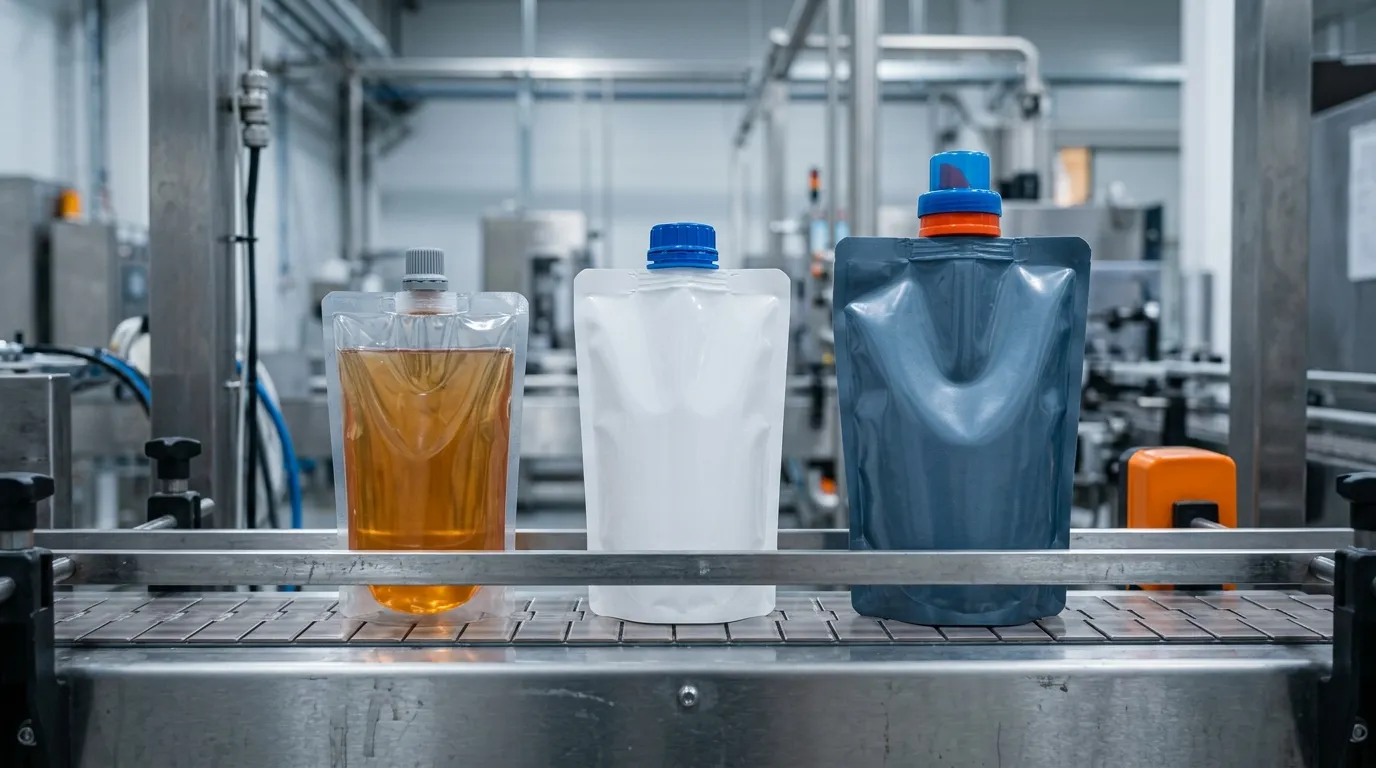
Direct answer. A spout cap for liquid and powder fills is decided by what is inside the pouch: viscosity, particle size, chemical aggressiveness, filling temperature and the intended dispensing method point you to a candidate family of bore sizes, cap styles and resins. A thin juice, a honey refill, a fine powder and a detergent pouch each land in a different family — but that classification only narrows the shortlist. The final model is confirmed together with your pouch film, the spout-to-film sealing window and sample testing on your actual filling line.
Every spout cap for liquid and powder fills looks similar in a catalog photo, and that is exactly why so many pouches fail in the field. The same 8.6 mm screw-cap-and-spout fitment that serves a juice pouch for years can clog on milk powder, crack on laundry detergent, or leak on edible oil — not because the part is defective, but because the closure was matched to a price list instead of to the product inside. This guide is written for brand owners and packaging engineers specifying closures for stand-up pouches and doypacks (the screw-cap-and-spout fitment welded into the pouch film — not the spout cap on a gas can or a bottle). It lays out a content-first framework: identify what your fill does to plastic, then let that decide bore size, cap style, resin and compliance. You will also find the real specification numbers behind each choice, drawn from a manufacturer that builds this one product family at scale. If you are starting from the full selection process, How to Choose a Spout Cap for Your Pouch walks the end-to-end decision; this article zooms into the input that changes everything — the fill.
Quick Decision Table: From Fill to Closure Shortlist
Before the full argument, the fast path: find your fill in the left column, and the middle column tells you what to ask first. The right column is the performance or structure to confirm with your supplier.
| Fill characteristic | First question to ask | Performance / structure to confirm |
| Low-viscosity liquid (water, juice, tea, soy milk) | How fast should it pour, and what dose per use? | 8–10 mm bore; firm, clean seal; leak-free spout-to-film weld |
| High-viscosity liquid (honey, ketchup, oil, syrup) | What is the viscosity at filling and at pouring temperature? | 18–40 mm bore; wide, clean flow channel; large-bore cap structure |
| Fine powder (chicken powder, spices, milk powder) | Does it bridge, dust or cling to the thread? | Anti-clog thread geometry; moisture seal (liner for hygroscopic fills); easy-wipe opening |
| Granules (rice, cereal, pet food) | What is the largest granule that must pass? | 30–33 mm bore wider than the biggest granule; scoop-and-pour-friendly opening |
| Corrosive / chemically aggressive (detergent, reagents) | Which resin grades has the supplier screened against this formula class? | ESCR-screened resin; guided high-seal cap structure; low internal stress |
| Hot-fill / high-temperature fills | What is the fill temperature and the sealing window? | Heat-grade resin; low-temperature-sealing spout (110–130 °C for recyclable PE); seal-temperature test |
To move from the table to a concrete list of candidate models, run the same questions through the Spout Cap Selector tool — it takes your fill inputs and returns fitments worth checking with your supplier.
Not a final compatibility approval. Classifying your fill — liquid, powder, granular, corrosive, hot-fill — narrows the shortlist; it does not approve a closure for your pouch. Actual pouch testing does: your film structure, the spout-to-film sealing window, filling-line conditions and the compliance rules of your target market sit outside the fill classification and remain the final criteria. Use the Fitment Compatibility Guide to structure those pouch-side checks, then validate the shortlisted model on samples before you commit to tooling.
Why a Spout Cap for Liquid and Powder Fills Is Not One-Size-Fits-All
A closure fails in one of four ways, and each failure maps to a fill family:
Leaks. Thin, low-viscosity liquids — water, juice, tea, soy milk — find any gap in the seal. The cap must close firmly, and the spout-to-pouch weld must survive transport pressure without weeping.
Clogs and bridges. Powders and fine granules pack into narrow bores and bridge across the opening. A spout sized for pouring water is the wrong geometry for chicken powder or milk powder.
Chemical attack. Detergent, fabric softener, reagents and other chemically aggressive fills attack stressed plastic. The failure mode is environmental stress cracking (ESCR): the liquid wets micro-cracks and pries the polymer apart, so the same cap that lasts years on juice can fail in months on detergent. The liquid changed, not the part.
Compliance gaps. Food, beverage, cosmetics and pharmaceutical fills sit under food-contact regulations. A cap that is perfectly functional but not made of food-grade, certified resin cannot legally touch the product.
The framework this guide uses has six steps: content → flow behavior → bore size → cap style → resin → compliance → validation. You start with what is going inside the pouch, and every later decision follows from it. The rest of this guide walks each step with real numbers, and the hub article on spout caps by content gives the full landscape of how closure choice connects to the pouch system.
Liquid Fills: Matching Bore Size to Flow and Viscosity
Liquids are the default case for spout pouches, but "liquid" hides a huge range of flow behavior. The single most important spec on the cap is the inner bore diameter — the opening through which the product flows. It is the difference between a controlled pour and a 10-second fight with a honey pouch.
Thin liquids: 8–10 mm standard bores
Water-like products — juice, milk tea, coffee, soy milk, sports drinks — pour easily through a small bore, and a small bore gives consumers the controlled stream they expect. In a production spout-cap range, the standard sizes for this family sit around 8.2–10 mm inner diameter. Examples from the field: an 8.6 mm spout cap for coffee, milk tea and juice pouches under 200 ml, an 8.2 mm cap for soy milk pouches, and a 10 mm cap that handles both soy milk and smaller detergent formats. These sizes are also what most baby-food and on-the-go formats use, because they match the flow a child or a commuter can manage. These sizes cover the everyday formats, and the common-shape range holds them in food-contact PE and retort-capable PP: RD-001 at 8.6 mm, retort-rated to 121 °C, is one of our stock models and easy to sample, and RD-005 at 10 mm suits thinner beverages and powder fills — ask us for the current stock list before you plan a launch around any single model.
High-viscosity and high-flow liquids: 18–40 mm bores
The moment viscosity climbs — honey, ketchup, syrup, pear paste, edible oil, concentrated detergent — a small bore becomes a bottleneck. Pouring honey through a 10 mm opening takes forever and collapses the pouch; pouring a 5 kg oil refill through it is impractical. For these fills, the bore moves to 18–40 mm, and the choice inside that band tracks viscosity and volume:
| Inner bore | Typical fills | What the size buys you |
| 18 mm | Ketchup, chili and tomato sauce, seasoning | Fast pour at moderate viscosity; PHA low-temperature recyclable options exist |
| 22 mm | Laundry detergent, fabric softener, cooking oil, pourable condiments | Large channel for genuinely high flow rates on a full-size pouch |
| 25 mm | Thick fruit puree, syrup, edible oil, cold-drink refills | Wide channel plus dual tamper-evident ring, good low-temperature toughness |
| 30 mm | Honey, pear paste, semi-liquid foods, large refills | Handles semi-solid paste without bridging; anti-leak sealing structure |
| 40 mm | 3–20 kg bulk refill pouches: honey, maltose, peanut oil, bulk ingredients | Fast, smooth pouring of high-viscosity liquid at industrial volume |
Two models anchor the ends of that table: RD-074 is the 18 mm ketchup-and-seasoning cap in a PHA low-temperature recyclable material, and RD-132 is the 40 mm bore built for 3–20 kg bulk refill pouches.
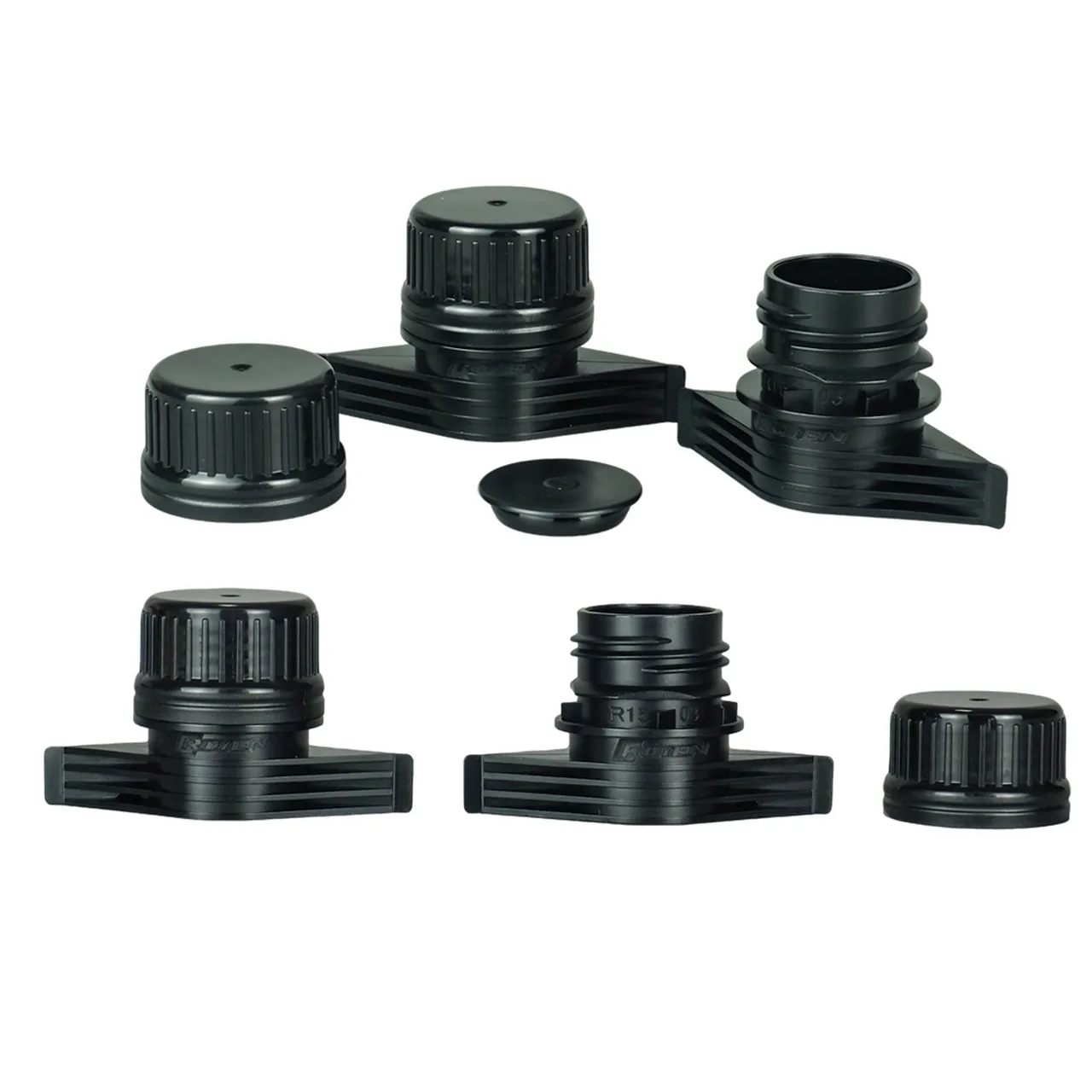
A 22 mm large-bore spout cap: the flow channel is the spec that keeps high-flow liquid fills pouring cleanly.
The bore choice also interacts with how you fill the pouch. Small-batch or manual production can fill through the spout itself — open the cap, inject, recap — which puts a premium on a wide, clean opening and a thread that does not trap product. Medium and large lines usually fill through the top opening before the spout weld, then cap on the line; there the cap only needs to seal, not to receive product, and bore sizing is purely about consumer pouring. State your filling sequence to the supplier before they quote a cap: a through-spout design needs different internal geometry than a seal-only design, and the difference shows up as residue, foaming or slow line speeds.
Two cautions. First, bore is not the only flow spec — spout tube length and internal geometry matter too, which is why matching spout cap diameter to the pouch is its own decision step. Second, large-bore caps weigh more and cost more resin, so do not oversize: a 22 mm cap on a 100 ml juice pouch is a waste of material and a sloppy pour. Match the bore to the viscosity and the dose, not to fashion.
Powder and Granular Fills: Wide Openings and Anti-Clog Design
Powders and granules are where generic spout caps embarrass themselves. The physics is different from liquids: powders bridge across narrow openings, they dust and cling to threads, and they pull moisture into the pouch every time the cap opens.
Fine powders: small doses can stay small, but geometry matters
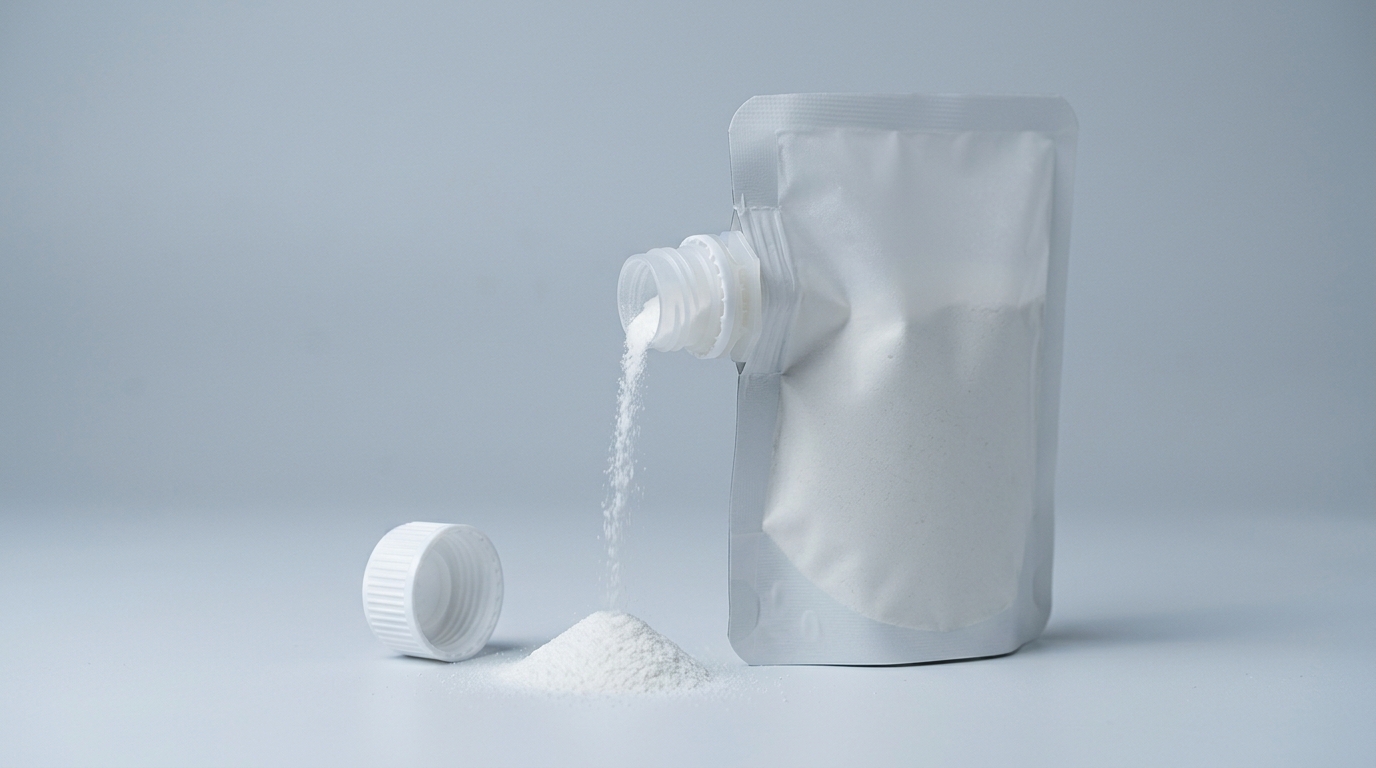
For low-dose powders — chicken powder, spice sachets, protein shots — an 8.6 mm spout cap is proven workable: it is the size used for chicken-powder stand-up pouches, and the same bore class serves sugar and salt pouches with a pilfer-proof cap. The trick is not the bore, it is the thread and the closure: the cap must seat so cleanly that powder cannot lodge in the thread and grind when reopened, and the opening must be easy to wipe. If your powder dose is small and your consumer pours it in one shot, a small-bore screw cap is fine.
Granular and bulky fills: 30–33 mm wide openings
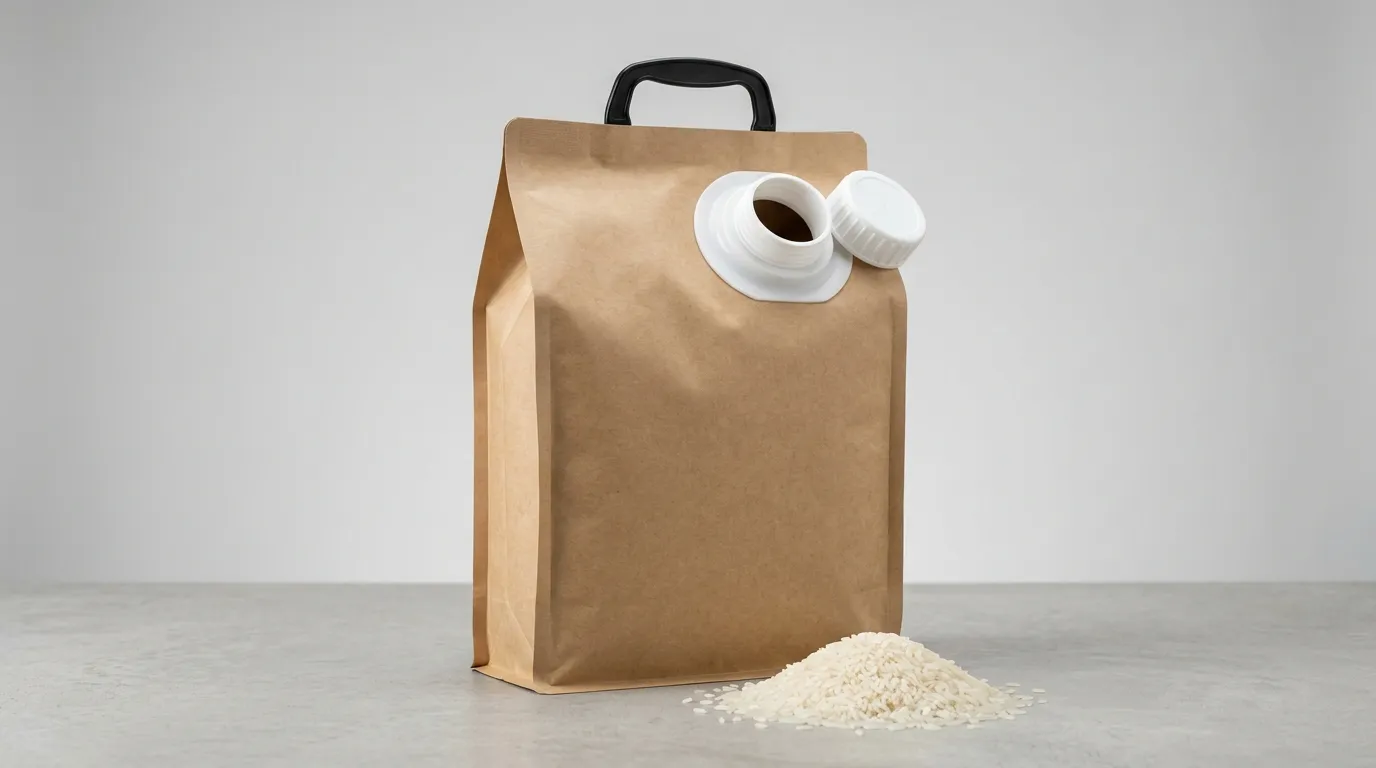
Once the product is granular — rice, cereal, pet food, cat litter — the bore must be wide enough for the largest granule to pass without jamming. In practice that means 30–33 mm: a 30 mm spout cap is specified for large-capacity granular and powdered products such as pet food, cat litter, rice and cereal, and a 33 mm cap covers rice, miscellaneous grains and pet-food bags. A wide opening also makes the pouch usable as a scoop-and-pour vessel, which is what buyers of bulk rice or pet food expect. Both openings sit in the wide-bore part of the range, and if the fill is a fine powder rather than a granule, powder pouch spouts and anti-clog design takes the thread and closure geometry further.
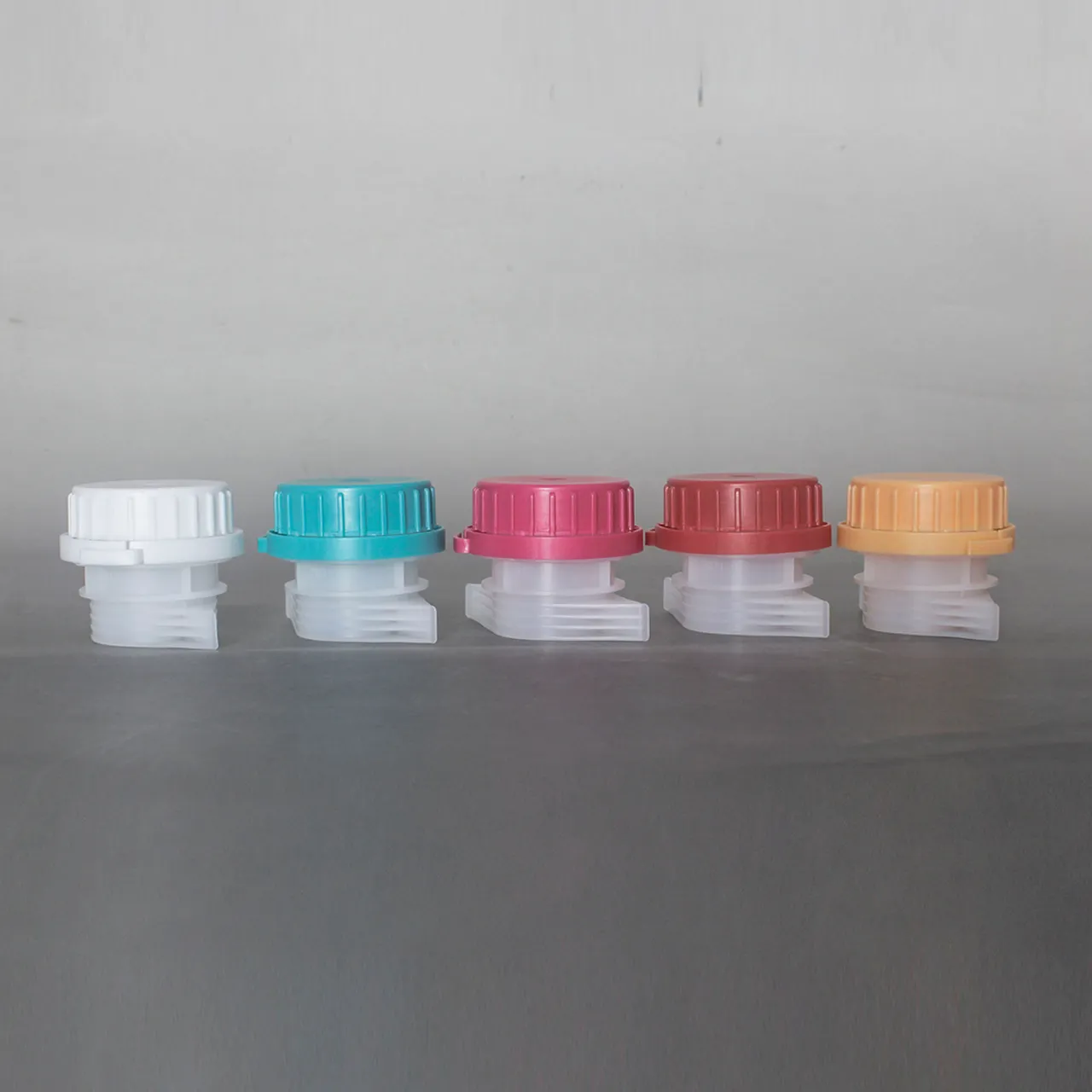
A 33 mm wide-bore spout cap: granular fills need an opening larger than the biggest granule.
Three powder-specific checks before you commit:
- Moisture. Every open-close cycle admits humid air. If the product is hygroscopic, pair the cap with a foil or induction seal liner and specify a tight thread seal.
- Thread hygiene. Ask for a thread design that sheds powder instead of trapping it — a caked thread is a leaking, squeaking thread a month later.
- Static and dust. On a filling line, powder dust around the spout weld area can compromise the heat seal. Plan the filling sequence (fill through the spout, or fill through the top before the spout weld) before you lock the cap geometry.
One more thing powder fills change: reseal quality matters more. A powder pouch is opened, closed and reopened dozens of times over its life — scooping, sprinkling, resealing — so the cap needs a positive, audible closure and a thread that stays clean after every cycle. This is also the fill family where a tamper-evident first-opening ring earns its keep on retail shelves: it proves nobody opened the pouch between the factory and the kitchen. And because powders sit on shelves for months, ask how the closure behaves in hot warehouse conditions — a cap that softens or warps changes its seal torque, and a powder pouch with a loose cap is a pouch with a moisture problem.
Corrosive Fills: Choosing a Resin That Survives the Chemistry
Detergent pouches are the most common corrosive fill, and they punish careless closure selection harder than any other category. Laundry detergent, fabric softener and cleaning concentrates are built from surfactants, alkaline builders, enzymes and solvents. Individually these are hard on plastics; together they are worse, and the dominant failure mode is environmental stress cracking (ESCR) — a surface-active liquid works its way into micro-cracks in a stressed part and pries the polymer chains apart, with no chemical corrosion involved. The mechanism is worth understanding at a practical level: every injection-molded cap carries internal stress frozen in during molding, concentrated around threads and hinges; surfactants wet that stressed surface and physically lower the energy needed for a crack to run. That is why the same geometry can be trouble-free on juice and fail in months on detergent — the part never changed, the liquid did. It is also why the mechanics of ESCR are well documented, and why engineers diagnosing real cap-cracking cases walk through the same diagnosis on eng-tips: cracks that appear days after molding are almost always stress cracking combined with post-molding shrinkage, and the fixes are lower internal stress or a resin with higher elongation at break.
What actually resists the chemistry
| Resin | Where it fits on a pouch fitment | Behavior on corrosive fills |
| PE (LDPE/LLDPE) | Spout base welded into the pouch film | Flexible and forgiving; welds to PE film at low temperature; grade selection decides ESCR resistance |
| HDPE | Screw caps, stiffer closures | Better rigidity and chemical resistance than LDPE; still needs ESCR screening |
| PP | Screw caps, flip-top hinges | Rigid and fatigue-resistant, the classic hinge material; notch-sensitive |
| Specialty acid/alkali-resistant compounds | Caps for reagents, pesticides, aggressive concentrates | Engineered for chemical resistance; the choice when detergents are not the hardest thing you fill |
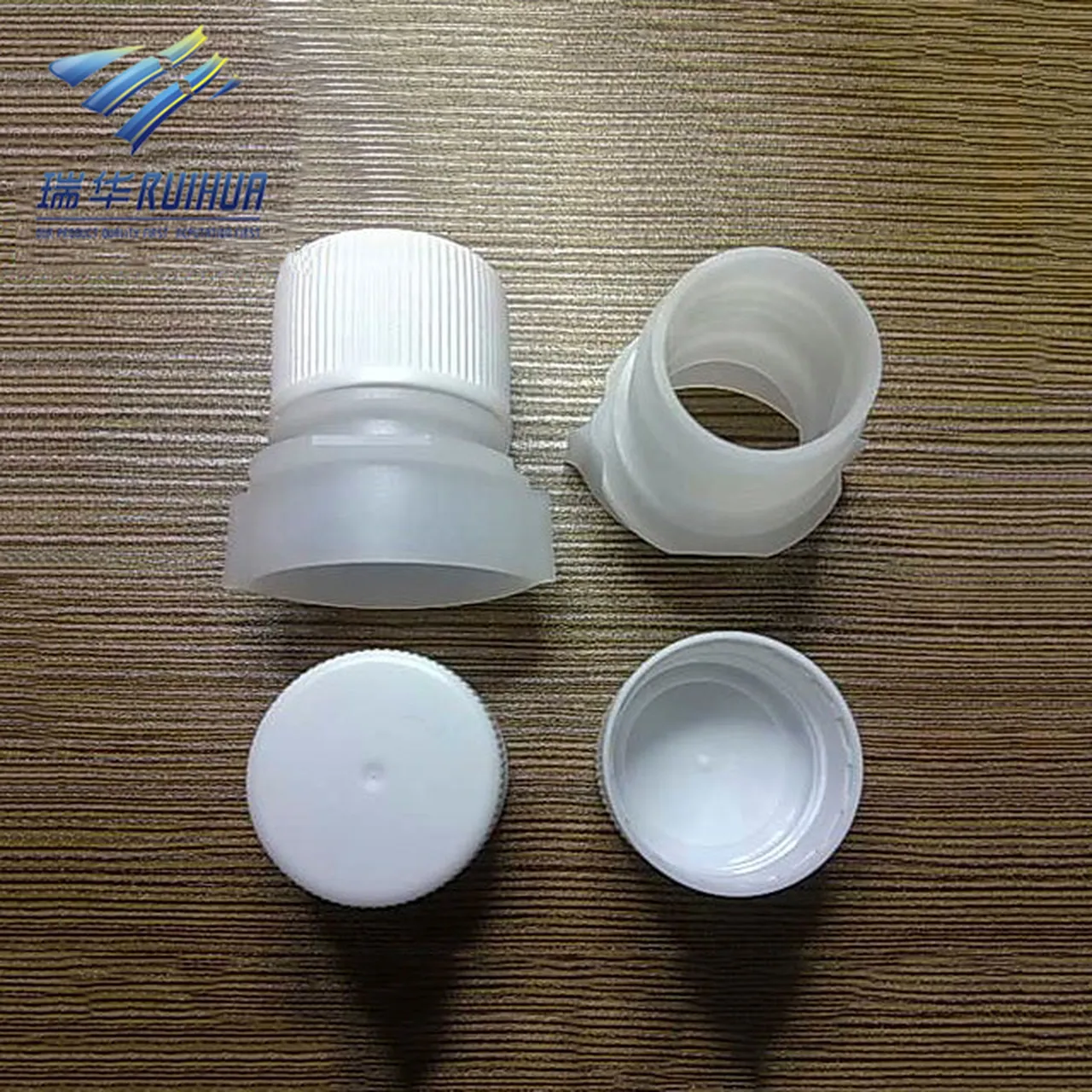
A 22 mm screw spout cap built for chemical fills: for reagents, pesticides and aggressive concentrates, the resin is the spec — not the shape.
The application-specific line for this chemistry is the detergent and high-corrosive spout cap range, built on a thickened thread and sealing structure for long-term contact with alkaline cleaners. For the deepest treatment of detergent-specific cracking — why it happens, how PE, PP, HDPE and PET compare, and how to verify the choice — read the companion guide on why detergent pouch caps crack and how to fix it. Here, three selection rules matter most:
- Spec the resin for the liquid, not the catalog. A "food-grade PP" label does not tell you how the grade behaves under surfactant load. Ask the supplier which resin grades they have screened against your formula class.
- Large-bore, guided high-seal structures reduce the stress load. Leakage on large-capacity detergent pouches is usually a sealing-geometry problem, not a material problem. A large-bore spout with a guided, high-seal cap structure is built to prevent leakage during transport, pouring and storage — that is the design pattern used for laundry-detergent pouches (e.g. 10 mm and 22 mm detergent formats, and a 22 mm reagents/pesticides cap for chemical fills).
- Verify with an ESCR-style test before tooling. Put a stressed sample in contact with your actual formula at elevated temperature and look for cracking. If the supplier cannot run that test, that is a red flag, not a discount.
Food-Contact and Compliance by Fill Category
Whether your closure needs food-contact certification is decided by the fill, and only by the fill. The dividing line is simple: food, beverage, cosmetics and pharmaceutical fills need certified food-contact closures; industrial and non-food chemical fills may not need them, but often want the same quality anyway.
The regulatory frame for the EU market is Regulation (EC) 1935/2004 — the framework regulation on materials and articles intended to come into contact with food — and it is the legal basis that "EU food-grade" claims rest on. In the US, food-contact polymers fall under the FDA's indirect food additives rules, codified in 21 CFR Part 177, which lists the polymer types permitted in food-contact articles. A closure manufacturer serving food brands should be able to show, at minimum: ISO 9001 and HACCP system certifications, FDA-compliant food-grade resin, and EU 1935/2004 food-contact conformity — in Ruihua's case verified by TÜV SÜD. Two further details buyers often miss:
- Virgin, brightener-free resin. Food-grade resin must be virgin material free of brighteners and fluorescers. "Recycled-content food-grade" claims need specific regulatory approval; do not accept them on a handshake.
- Dust-free production. For food and pharmaceutical fills, ask whether the cap is molded and packed in a dust-free workshop with minimal manual contact. It matters for audit, not just for optics.
Do not take certification words at face value — what food-grade certification actually covers is a separate deep dive, and it will save you from accepting a certificate that does not cover your fill. Note also that compliance is not static: EU rules on attached caps (below) are actively reshaping which cap designs are even legal to sell in Europe.
A practical note on verifying certificates: certificates certify systems and materials, not batches. Ask for the certificate number and issuing body, check that the resin grade named on the certificate matches the grade actually molded, and confirm the certificate covers the specific article type (spout, cap, or both as an assembly). A manufacturer that molds spout caps daily should produce these documents from a drawer, not from a sales call a week later — if it takes them three weeks to find the certificate, treat that as a signal about the whole compliance posture. For factory audits, the same documents plus dust-free-workshop records are what your own quality team will want on file before the first shipment.
Cap Styles and When Each One Earns Its Place
Bore size handles flow; the cap style handles the human being. Different fills and different users justify different cap mechanisms, and the same pouch can ship with several options.
| Cap style | Best for | Typical fills | What to verify |
| Screw cap | The default: clean reseal, good thread hygiene | Most liquids, powders, sauces | Thread pitch vs. your filling/capping line |
| Flip-top | One-handed opening, on-the-go | Travel-size shampoo, hand wash, body wash pouches | Hinge fatigue over repeated cycles |
| Mushroom / anti-choking cap | Children's safety | Baby food, fruit puree, juice squeeze pouches | Anti-swallowing geometry; EU market acceptance |
| Tamper-evident / pilfer-proof ring | Retail trust, first-opening evidence | Detergent, sauces, food pouches on shelves | Ring integrity after opening; double-ring options |
| Non-separated (tethered) cap | EU market compliance | Single-use plastic beverage pouches ≤ 3 L (scope per product definition & member-state implementation) | Cap stays attached after repeated opening |
| Foil / induction seal liner | Freshness, leak protection, tamper evidence | Juices, pharmaceuticals, premium foods | Liner compatibility with induction sealing |
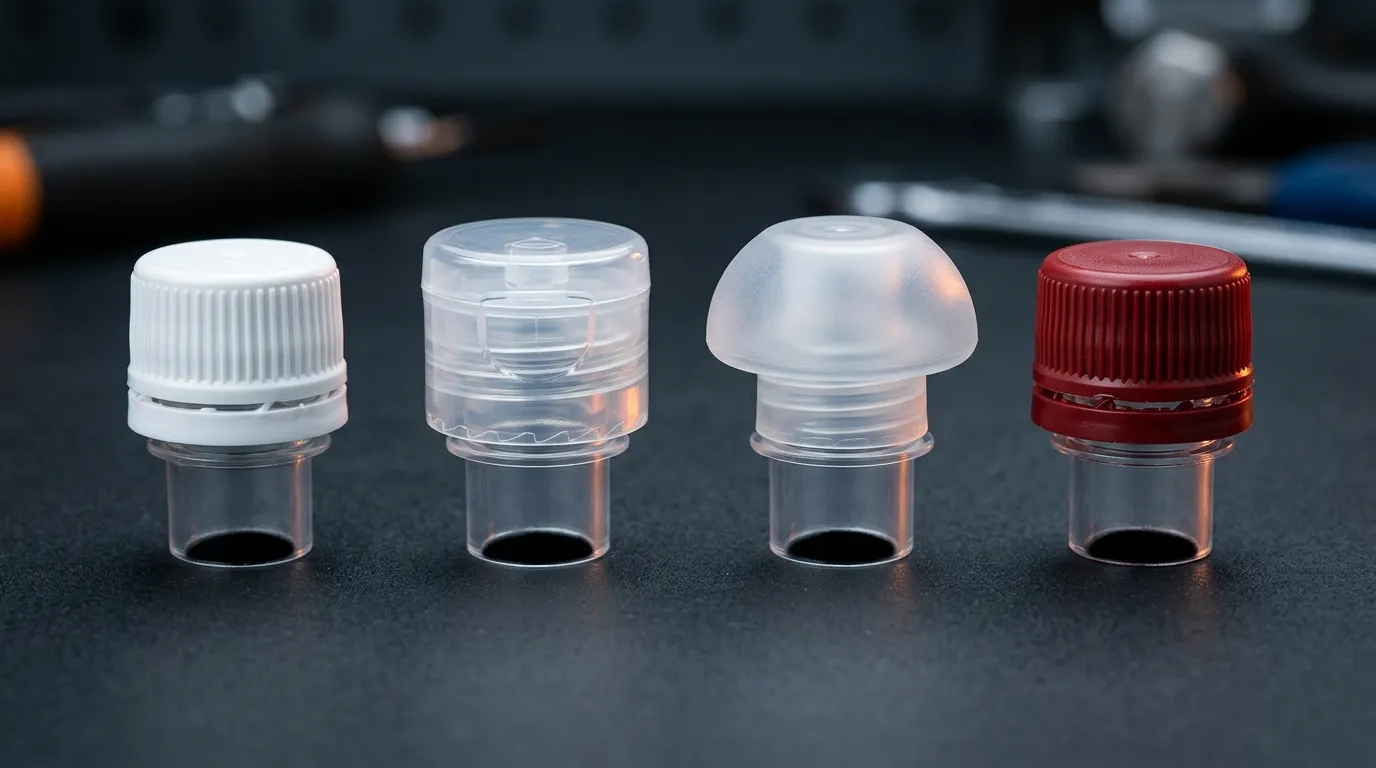
Four cap styles, four jobs: the same spout base can carry a screw cap, a flip-top, an anti-choking mushroom cap or a tamper-evident closure — the fill and the user decide which.
Special-shape caps — flip-top, tethered flip and OEM profiles — sit in their own special-shape range, where the same spout base can carry either a fully detachable lid or an integrated tethered flip lid, depending on the market rules you sell into.
Before you pick a style, think about your capping line, because automation has opinions about cap geometry. Screw caps are the easiest to run: they are radially symmetric, feed cleanly through a hopper and orient themselves. Flip-tops and asymmetric designs need orientation on the capping station — a flip-top that lands hinge-down jams or caps upside down, and orientation hardware is a real line cost. Mushroom and anti-choking caps are symmetric in most designs, which keeps them line-friendly. If you are on a high-speed automatic line, this is a genuine tie-breaker: two styles that perform identically for the consumer are not identical for your capper, so ask the machinery side of the house before the style is locked.
Three styles deserve a closer look because they are load-bearing for specific fills:
Anti-choking mushroom caps. For baby-food and children's juice pouches, the mushroom-shaped cap is a safety feature, not a design flourish: the wide, rounded profile prevents swallowing, and dedicated anti-choking geometries are produced in both PP and PE at the standard 8.6 mm baby-food bore. If your product is aimed at children, this is a non-negotiable, and it is also where EU packaging-safety expectations are highest.
Tamper-evident rings. A pilfer-proof ring that snaps on first opening is the visible proof of integrity that retail food and detergent buyers expect. For high-value or high-risk fills, double tamper-evident tear rings exist — two break points instead of one — which is why the 25 mm large-bore cap for thick purees and syrups carries a dual anti-tamper ring with good low-temperature toughness.
Non-separated (tethered) caps. The EU's Single-Use Plastics Directive (Directive (EU) 2019/904) requires caps and lids on single-use plastic beverage containers up to three litres to remain attached after opening. Note the scope: the tethering obligation targets that specific category — it does not extend to every pouch fill, and whether a particular spouted pouch counts as a covered beverage container depends on its product definition and on how the requirement is implemented in each member state. For pouch formats that are in scope, the compliant answer is a non-separated twist cap whose built-in stop lug limits the cap at the maximum opening position — the cap stays connected to the spout permanently, which also prevents lost caps and eliminates a choking hazard. The pouch-specific reading of the tethered cap rule walks through which pouch categories are affected (and which — such as detergent and shampoo — fall outside the beverage-container definition) and how to design for it. If you pack beverages into Europe, confirm whether your pouch is in scope for your target markets before you commit to a cap design.
A Spout Cap Specification Checklist by Fill Type
The quick-start table above gets you to a candidate family; this is the full checklist to work down with your supplier. The row for your fill tells you the starting spec — confirm every line before you tool.
| Fill family | Bore size | Cap style | Resin | Compliance |
| Thin liquid (juice, tea, water, soy milk) | 8.2–10 mm | Screw; flip-top for on-the-go | Food-grade PP/PE | FDA / EU 1935/2004 if food |
| High-viscosity liquid (honey, ketchup, oil, syrup) | 18–40 mm | Screw; tamper-evident for retail | Food-grade PP/PE; PHA low-temp option | FDA / EU 1935/2004 if food |
| Detergent / corrosive liquid | 10–22 mm | Screw with tamper-evident ring; guided high-seal | ESCR-screened PE/HDPE; specialty acid/alkali-resistant | Food-grade if food-contact; tethered only if product qualifies as a beverage container (usually not) |
| Fine powder (chicken powder, spices, milk powder) | 8.6 mm | Screw with clean thread; optional liner | Food-grade PP/PE | FDA / EU 1935/2004 if food |
| Granular (rice, cereal, pet food) | 30–33 mm | Screw, wide opening | Food-grade PP/PE | FDA / EU 1935/2004 if food |
| Chemical / reagent | 22 mm | Screw, sealed | Acid/alkali-resistant compound | Per product regulation; often food-grade anyway |
If your fill sits between two rows, spec the stricter one: a detergent pouch that also carries a food-grade claim gets the food-grade resin and the ESCR screening. When in doubt, the manufacturer's spout cap specification sheet — spanning inner diameters from 1.2 mm to 40 mm across 117 models — is the reference for what the industry actually builds for each fill family.
Validating the Choice Before You Commit to Tooling
The cheapest failure is the one caught on a sample, and every one of the decisions above is testable before you spend on custom tooling. A minimum validation package for a new spout cap on a new fill:
Seal-temperature test. The spout welds into the pouch film at a specific temperature window, and the cap must survive that process without distortion. For recyclable mono-material PE pouches, the spout must seal at 110–130 °C so it does not burn the film — a low-temperature-sealing spout is a hard requirement, not a nice-to-have, if recyclability is on your brief. The full mechanics of spout sealing temperature are covered in a companion guide.
Leak and drop testing. Fill sample pouches, cap them, and put them through transport simulation — squeeze, drop, inverted storage. This is where a guided high-seal cap structure proves itself on detergent and oil fills.
ESCR screening for corrosive fills. Stressed cap samples in contact with your actual formula, at elevated temperature, for a defined period. No cracking = the resin grade passes for your chemistry.
Dimensional verification. Check the bore against your filling nozzle and the thread against your capping station. For precision fitments, the inner diameter is held to ±0.1 mm of nominal — a number worth putting in your incoming-inspection spec.
Line trial. Run the sample through your actual filling and capping line, including the spout-rail feeding if you use one. A cap that is perfect in the hand can still jam a capping chuck at 50 pouches per minute.
Add to that package two process questions that cost nothing but reveal a lot. Sample lead time: how long from drawing to physical sample? A supplier with in-house mold R&D and 3D mold printing can iterate in days; a trading company that has to email a factory takes weeks, and the delay lands on your launch calendar. Documentation: request the contact-test documents and material certificates up front, and audit the workshop — you want to see dust-free production and AI-assisted inspection, not a promise. These checks are what separate a component supplier from a packaging partner, and they are exactly the things that never show up in a catalog photo.
A manufacturer with in-house mold R&D — Ruihua builds molds, runs a 70,000 m² factory with 130+ sets of production equipment, and holds 38 patents including dual anti-theft and anti-choking mold technology — will run these checks with you before tooling, because a closure that fails on your line is bad for both of you. Ask for sample caps, the test documents for your formula class, and factory-audit access; a supplier that cannot produce those is a supplier to walk away from.
Start with the fill, and the closure follows. Define your content's flow behavior, chemical aggressiveness and compliance class; match bore size, cap style and resin to those three facts; then validate on samples before you tool. That order turns spout-cap selection from a guessing game into an engineering decision — and it is exactly the conversation worth having early with your supplier. If you are specifying closures for stand-up pouches now, browse the full spout cap range or request samples and send your fill details so the engineers can match the closure to the content.