
Direct answer. Three cap families, three different mechanical ideas. A screw cap is a lid you take off the pack: the seal is set by torque on your filling line and remade by hand every time someone closes it. A flip-top is a lid that stays on the pack: the seal is a plug pressed into the spout bore, and the hinge is the part that wears out. A push-pull is not a lid at all — it is a sliding valve with two positions, and its seal is an interference fit between a moving stem and the body it travels in.
Screw vs flip-top pouch caps is the comparison most buyers open with. It is the wrong first cut, and it only becomes the right one once the opening action is fixed. The first question is what the opening has to do — one hand or two, pour or drink, resealed ten times or once — and the second is what your filler can close reliably, shift after shift.
This page sits in the Choosing & Running Spout Caps series, where a spout cap means the closure welded onto a stand-up pouch or doypack. Keep that qualifier on the phrase while you search. The terms are badly served by Google: screw vs flip top pouch cap currently returns water-bottle caps, and push pull pouch cap returns medical ostomy products. Neither result set knows your fitment exists.
The Three Closures at a Glance
These are the three spout cap types that turn up in a pouch RFQ. Everything else — disc tops, sprayers, taps, pour spouts — belongs to a different container or a different conversation.
Screw cap | Flip-top cap | Push-pull cap | |
|---|---|---|---|
How it opens | unscrewed and lifted off the pack | lid lifted on its hinge | stem pulled out of the body |
How it closes | screwed back on by hand | lid pressed down until it seats | stem pushed back in |
What makes the seal | thread plus a land or plug, compressed by torque | plug or spigot entering the bore, plus a land on the rim | interference between the moving stem and its bore |
What wears out | thread and liner; the cap itself gets lost | hinge web, then the plug edge | stem surface, then the bore it slides in |
Working part stays on the pack | no — the cap leaves with the customer | yes — the hinge holds the lid | yes — the stem stays in its body |
One-handed | rarely | yes | yes |
Product left exposed while open | the whole spout mouth | the spout mouth, briefly | a narrow slot or an exposed stem |
Where it usually belongs | sauces, syrups, refills, pharma liquids | hand wash, lotion, condiments, drinks | water, sports drinks, thin juice, squeeze packs |
Read the fifth row twice. It is the one difference on this table that shows up in your purchase order every month. A screw cap is a loose part: it gets dropped on a factory floor, left on a kitchen counter, and lost. A flip-top or push-pull closure cannot lose its lid or stem — the hinge, the band or the fitment has to break first, and only then does the working part come away from the pack. If your product is refilled at home and used over weeks, that single fact decides more about the customer experience than the seal does.
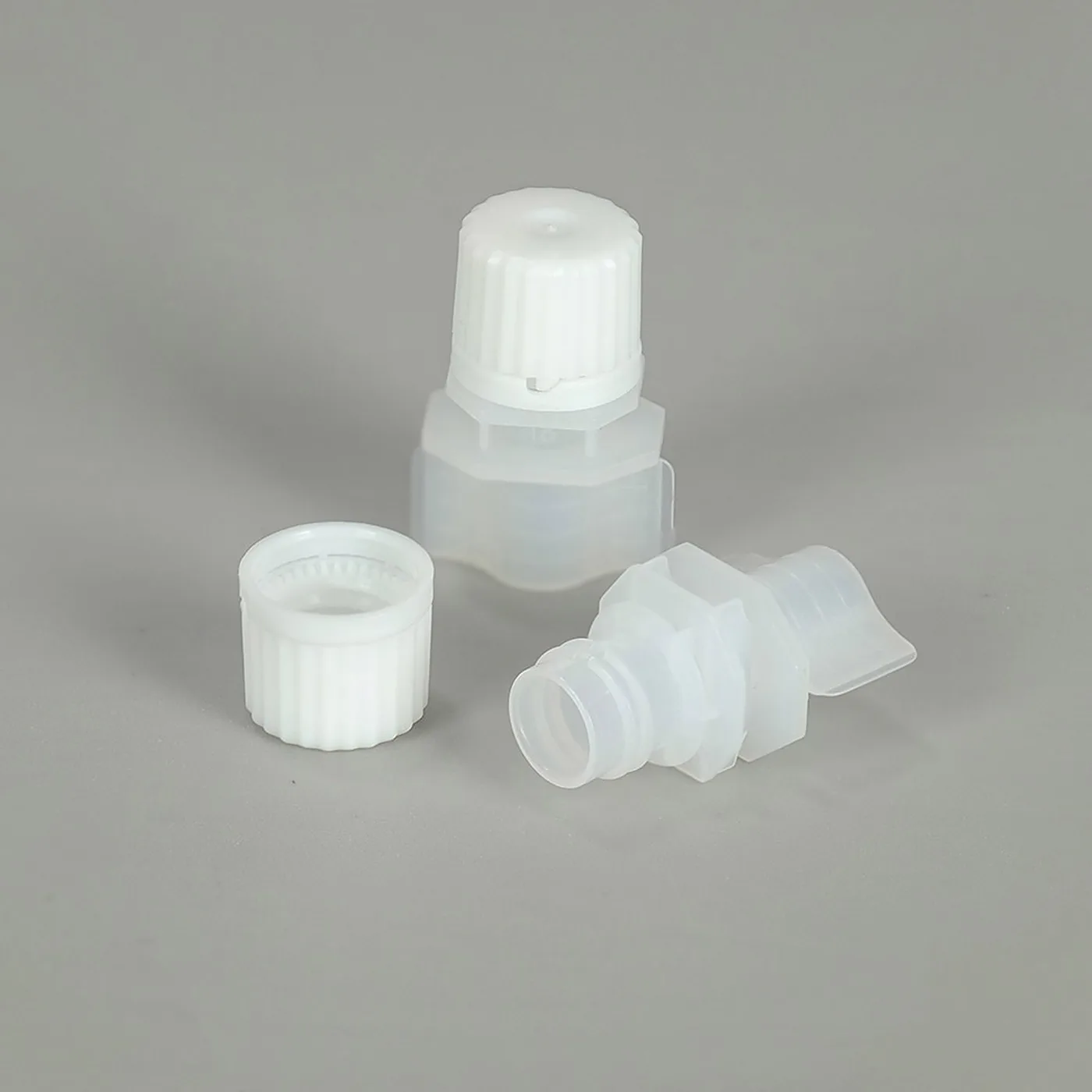
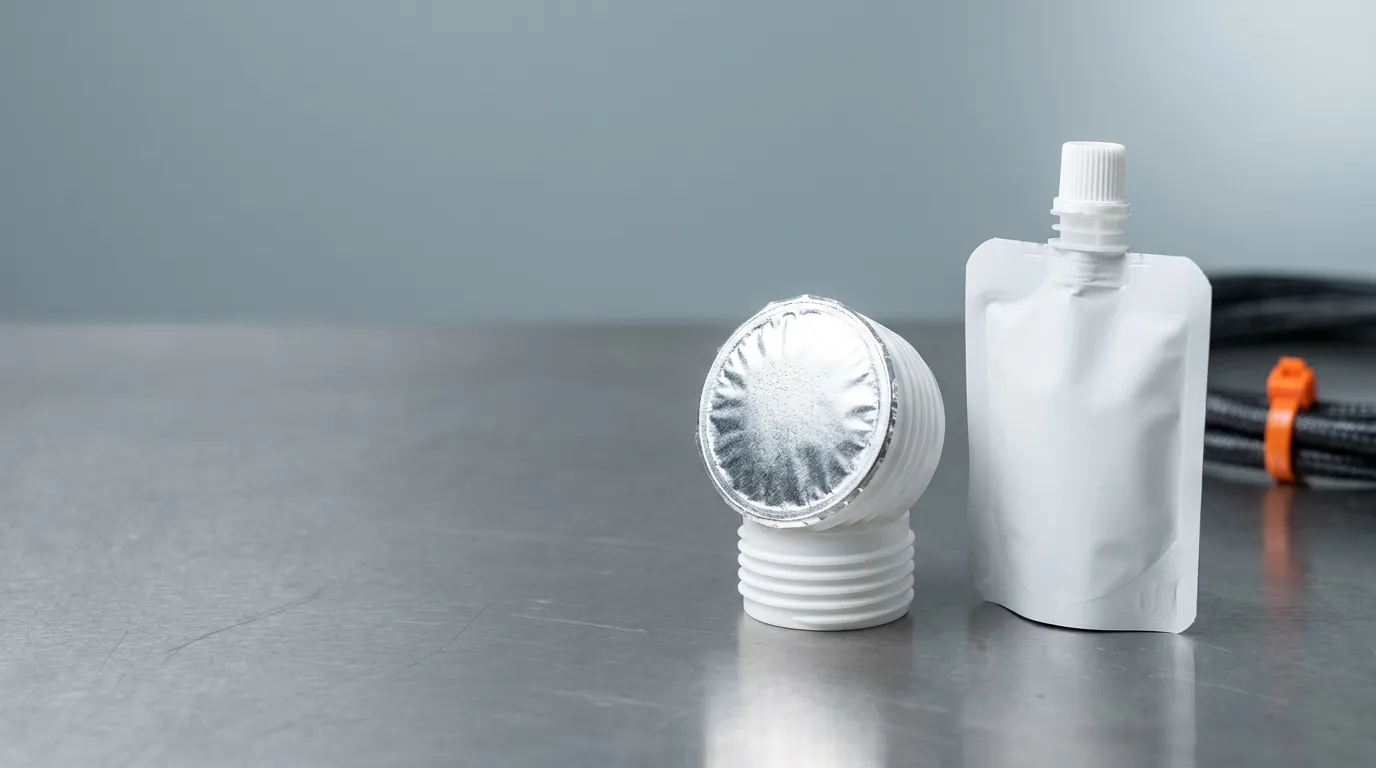
The screw cap in its two states: the threaded joint on the base, and the cap that comes off it. Once separated, nothing holds the two together — which is why this closure is the one buyers replace.
Screw Caps: The Seal Is a Torque, Not a Cap
Most buyers start with a screw cap spout pouch, which makes it the format everything else is measured against. A screw cap does not seal because it is tight. It seals because a defined application torque compresses a land, a plug or a liner against the spout rim by a defined amount. That number is set by your capper, not by the mould, and it is the single most common thing left out of a pouch closure specification.
Too little and the cap backs off during distribution — the pack arrives with a loose closure and a slow leak that only shows at the retailer. Too much and the bore deforms, the skirt stress-whitens, and the consumer needs two hands and a bad word to open it. The buyer's side of the specification is therefore two numbers, not one: application torque at the filler, and the removal torque band the customer should feel. Ask for both in the units your filling line uses, and put them on the spout cap specification sheet that travels with the artwork.
Between the cap and the product there is usually one of two sealing principles. A plug seal relies on the cap's inner skirt pressing against the bore — geometry only, no separate component. A liner adds a disc, often an induction foil welded to the rim, which is then peeled away at first use. Liners buy you a barrier and a visible tamper event; plugs buy you fewer parts and no foil to peel. Neither is better in the abstract, and the choice follows the product: a liquid that needs an oxygen barrier and a long shelf life is a different problem from a detergent refill sold to be used within the season.
The cap body itself is almost always PP or PE, and the two behave differently under torque and under heat — the resin question has its own page. What matters at the buying stage is that the resin carries a food-contact status you can point at: in the US, olefin polymers for food-contact articles are covered by 21 CFR 177.1520; in the EU, plastic food-contact materials fall under Regulation (EU) No 10/2011, which is also the regulation behind the declaration of compliance you should be asking your supplier for. A declaration is a document, not a reassurance.
Two screw-cap failure modes are worth knowing before you approve a sample, because both are caused by handling rather than by the mould. Cross-threading happens when a cap meets a thread at an angle — common on manual refill lines and on any pack a consumer reopens in a hurry. Product in the thread happens when the fill is viscous enough to smear; it dries, jams the cap, and reads to the consumer as a badly made pack.
Flip-Top Caps: You Are Buying a Hinge
A flip-top spout cap is one moulded part with a living hinge: a thin web of polypropylene moulded integrally with the lid, in the open position, so that lid and body are one part out of the tool. That is why the closure cannot be lost, and it is also why the hinge is the component to interrogate. A hinge is a flexing element with a finite life, and the life depends on the resin, the web thickness and how far the lid has to travel.
The seal is separate from the hinge and is easy to confuse with it. When the lid closes, a plug or spigot enters the spout bore while the lid rim lands on the spout top. Both surfaces have to meet at the same time; if the plug bottoms out first, the rim never seals, and the pack weeps from the edge rather than from the bore. That is a tooling-geometry question, and it is why "the lid clicks" is not evidence of anything.
Opening force is the specification that decides whether the closure works for the people who actually use it. A lid stiff enough to survive a shipping carton is often stiff enough to defeat a wet hand. If your product is opened in a shower, at a gym or by someone with weak grip, ask for the opening force as a measured number and test it with the pack wet, not dry.
On a pouch specifically, there is a clearance question that bottle closures never face. The spout neck has to be long enough that the opened lid stands clear of the pouch film and the shoulder weld. A short neck with a wide lid produces a cap that fouls the pack, opens itself inside a carton, and looks to the customer like a design fault. When you approve a sample, open it fully with the pouch standing and filled. Where the spout sits also changes what the lid has to clear — a centre spout and a corner spout are two different clearance problems — so approve the neck length on the pouch you will actually run.
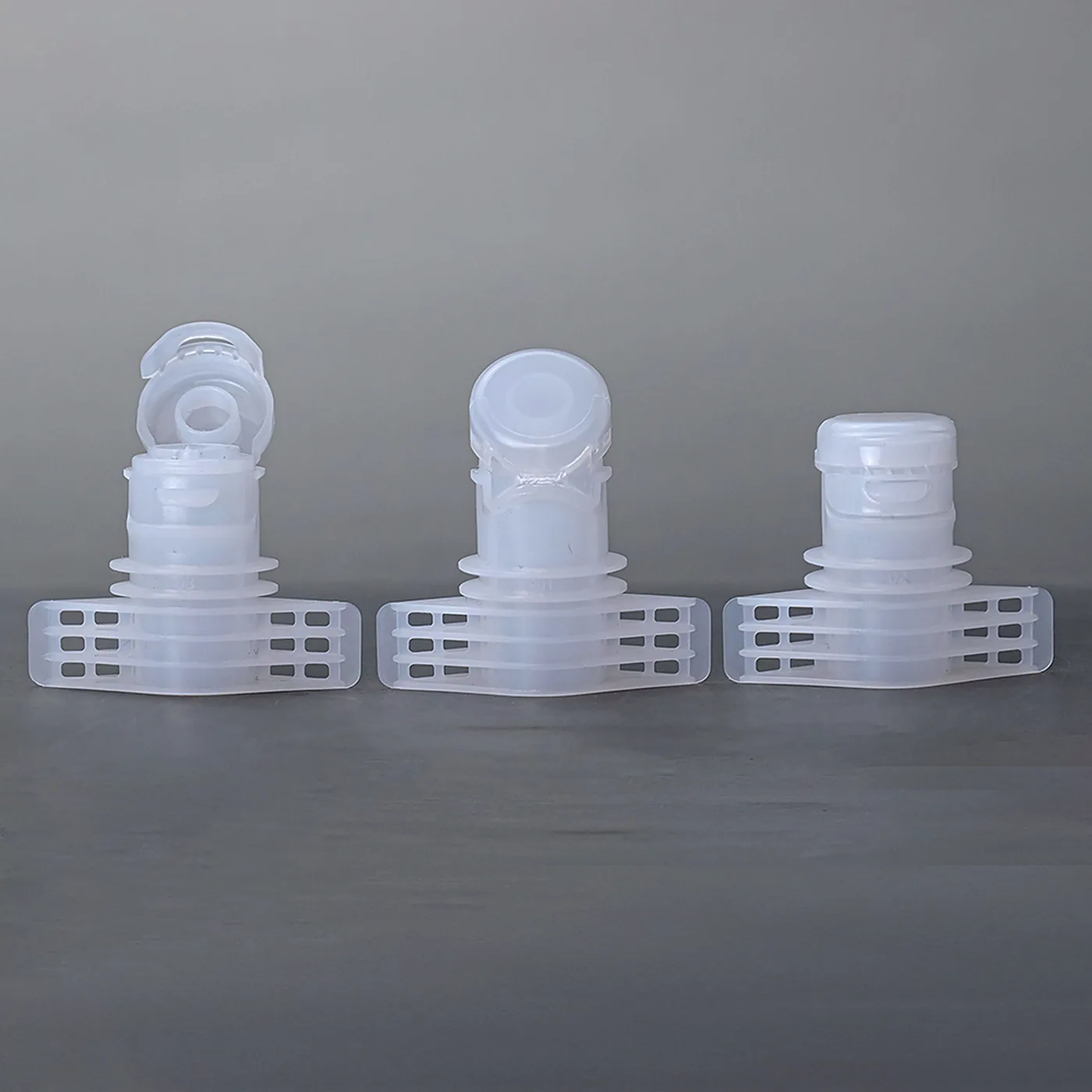
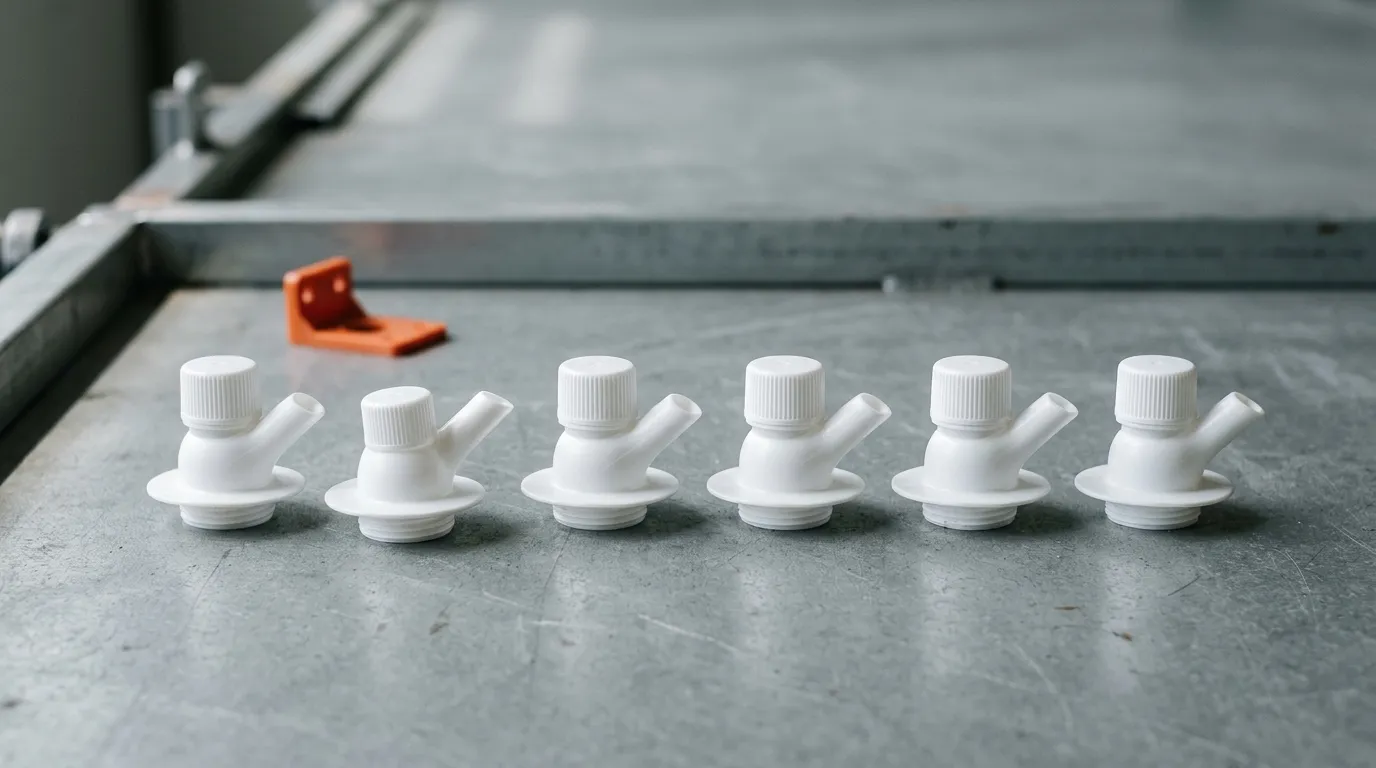
Left to right: the lid open on its hinge, then two closed units in two different lid styles. The hinge web at the back of each cap is the part that flexes; on the open unit you can see the spout bore the lid has to cover.
For beverage packs there is now a regulatory layer on top of the mechanics. The EU single-use plastics directive requires caps and lids on single-use plastic beverage containers of up to three litres to stay attached to the container, applicable from 3 July 2024 — see Directive (EU) 2019/904. That requirement is what pushed tethered flip-top geometry into the mainstream, and if you export a drinking pouch into the EU it belongs in the brief, not in a late design review. Tamper evidence is a separate question and sits on a different part of the cap — the band that breaks on first opening; the band and child-resistance trade-off is covered here.
Push-Pull Caps: A Valve, Not a Lid
The push-pull closure is the least documented of the three, and the one most often specified by name without anyone checking what it does. Most push pull pouch cap comparisons stop at the name and the price; the mechanism is the part that decides whether the pack works. There is no lid — just a stem that slides inside a body between two positions: pulled out, where the drink path is open, and pushed in, where the stem's sealing surface seats in the bore and closes it. Because the seal is an interference fit on a moving part, it depends on the stem staying round and the bore staying clean.
That geometry buys three things. The closure cannot be lost, the flow path is wide enough to drink from or to squeeze a pouch through, and it can be operated one-handed by a child. It costs you three others. Dribble is the first: product sits in the annulus between stem and body, and when the stem closes, that trapped volume has nowhere to go but out. Sugary and syrupy fills make it worse. Hygiene is the second: an exposed stem collects dust between uses, and some designs add a dust cover that then becomes a second part to lose. Cleaning is the third: a valve has internal surfaces that a rinse cannot reach, which matters more for a product with pulp or particulates than for water.
Push-pull caps reward thin liquids and punish thick ones. Water, isotonic drinks, thin juice, a squeeze-pack gel — all fine. A sauce with visible pieces will clog the drink path and hold product in the mechanism. Hot fill is a separate caution: the assembly has more parts and more crevices than a screw cap, and heat distortion acts on each of them differently.
One practical point before you write artwork: the catalogue names vary — pull-cap, sport cap, push-pull — while the action does not. The stem comes out to open and goes back in to close, and that is what belongs in your pack copy and on the artwork, not whichever catalogue label the supplier happened to use. Check the travel on the sample before you commit: how far the stem moves, and whether it clicks into each position rather than drifting.
Screw vs Flip-Top Pouch Cap: What Actually Differs
The comparison narrows quickly once the situation is on the table. Read your product down the left column, take the middle as a starting point, and treat the right column as the list you confirm before you commit tooling.
Your situation | Start with | Confirm before you approve |
|---|---|---|
Sauce, paste or anything with visible pieces | Wide-bore screw cap | Bore clears the largest particle; the thread does not collect product |
Hot fill or retort | Screw cap | Liner type and cap distortion at fill temperature |
Drunk straight from the pack, often by a child | Push-pull or flip-top | Flow rate, opening force, and whether the valve stays clean |
Refilling a bottle, sprayer or dispenser | Wide-bore screw cap | Thread match with the target container; grip while pouring |
Shipped alone in e-commerce | Flip-top or push-pull | Lid or stem stays closed through a drop test |
Retail shelf needing visible tamper evidence | Either, with a band | The band breaks cleanly and visibly on first open |
Child-resistant closure required by the product | Not a cap-type decision | The closure's child-resistance is demonstrated, not assumed |
Mono-material recycling target | Any of the three | Component count and material mix, not just the body resin |
Beverage exported to the EU | Tethered flip-top | Cap stays attached through the pack's life |
Squeezable, high-viscosity fill | Large-bore flip-top | Internal pressure does not push the plug out |
The row that surprises buyers is the last one. A flip-top on a squeezable pack sees internal pressure every time the pouch is compressed, and the plug has to hold against it in the closed position. A plug that seals beautifully on a gravity-fed bottle can lift on a pouch that someone squeezes. That is not a defect in the cap; it is a mismatch between a closure and a fill method.
Two of the rows are regulatory rather than mechanical. Where a product requires a child-resistant closure, what has to be demonstrated is performance against a defined protocol — in the US, the poison prevention packaging standards in 16 CFR 1700.15, tested to the protocol in 16 CFR 1700.20 — and the closure either passes that protocol or it does not, whatever shape it is. Recyclability is attaching to the closure as a component too: Regulation (EU) 2025/40, the packaging and packaging waste regulation, applies from 12 August 2026, and its recyclability grading — packaging may only be placed on the market if it is recyclable within grades A, B or C — applies from 1 January 2030. That is why the component count matters alongside the body resin — and why it is worth asking about at the design stage, not at the redesign.
Cost is where intuition usually fails, and it fails because people compare piece prices. Compare part counts instead: a screw cap is typically cap plus liner plus sometimes a band; a flip-top is a single moulded part; a push-pull is several parts that have to be assembled. Tooling complexity, assembly labour and inspection all follow from that count, and none of it is visible in a quote sheet. Ask for cost at your annual volume with the assembly step included, then let fill type shape the rest of the shortlist.
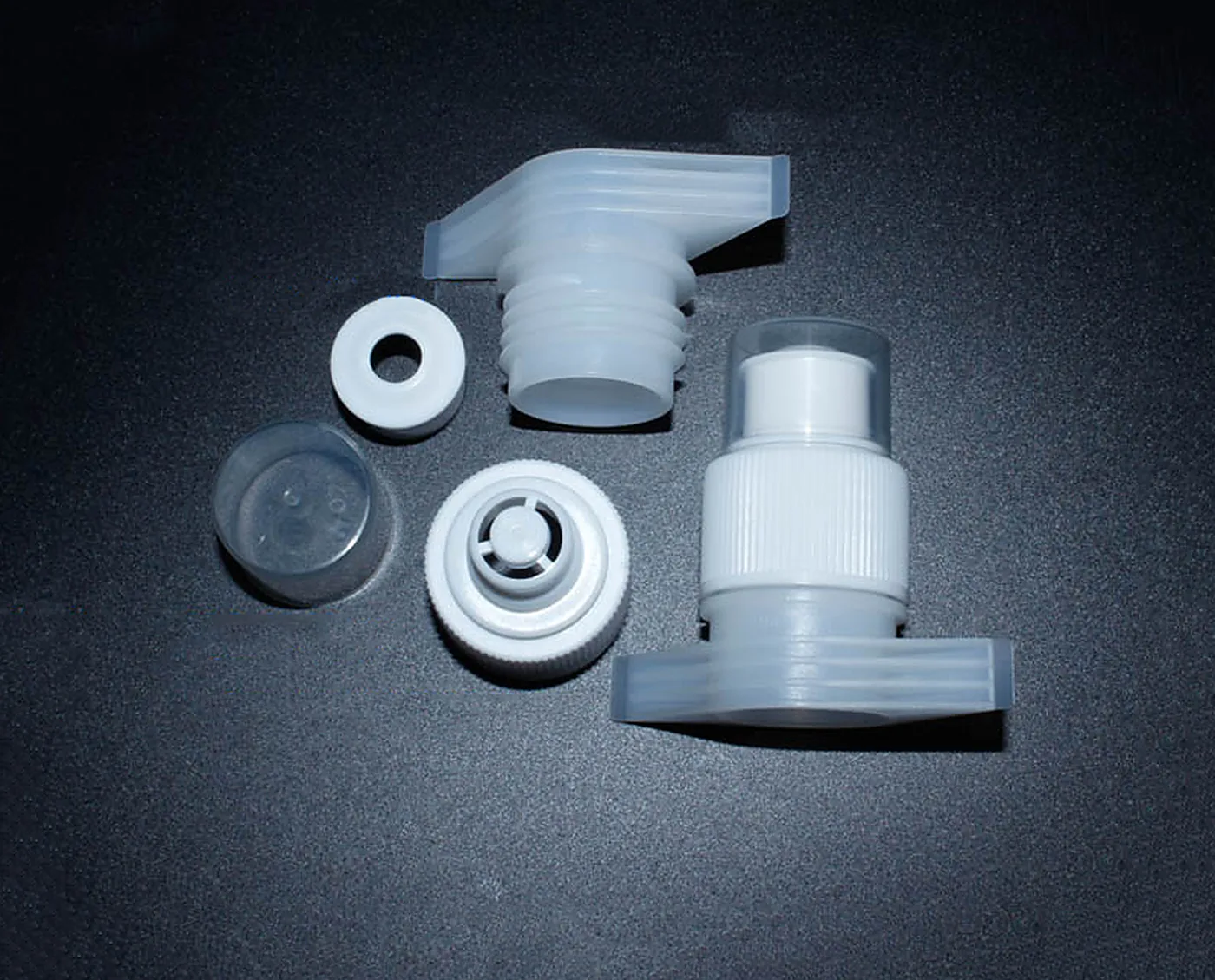
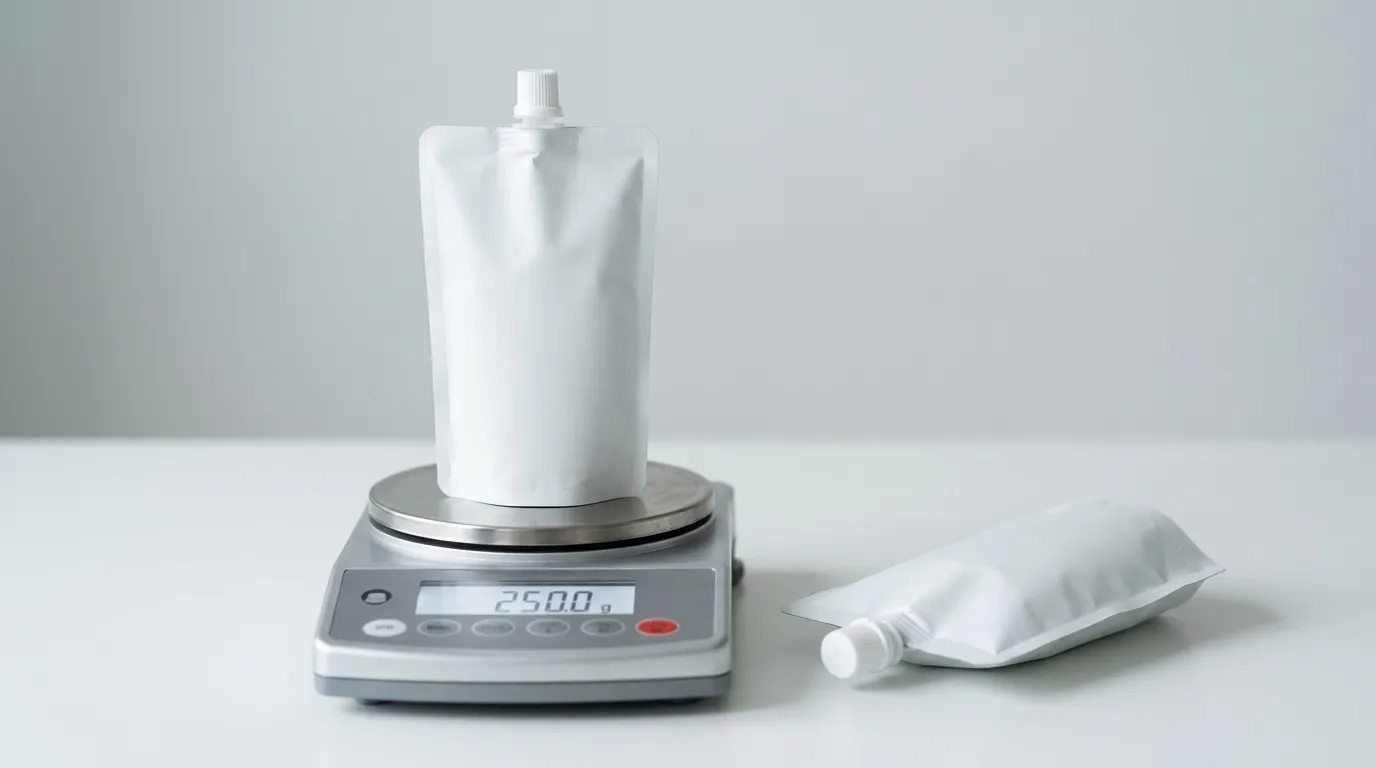
The valve in parts: body, sliding stem, seal and dust cover. More parts than either of the other two families, and every one of them is a surface the product can sit in.
What Goes in the RFQ for Each Type
A closure enquiry that says "spout cap, food grade, good sealing" gets a catalogue page back. These are the lines that get a specification.
Screw cap
- Thread and neck finish, plus the spout bore
- Application torque, and the removal torque band, in your filler's units
- Plug seal or liner — and if a liner, which construction
- Tamper-evident band: present, and how it breaks
- Resin grade, with the food-contact declaration reference
Flip-top cap
- Hinge type, and the hinge test method with its result
- Opening force, measured wet and dry
- Plug engagement depth and the rim land width
- Lid clearance against your spout neck length and pouch film
- Band, and whether the design is tethered
Push-pull cap
- Actuation force in both directions
- Closed-state leak test, and how it was run
- Stem travel, orifice size, and expected flow rate for your fill
- Dust cover, and its retention force
- Cleaning method the closure is designed for
If a supplier answers a torque question with "excellent sealing", you have been given no data. The same applies to a hinge question answered with "durable material", or a valve question answered with "leak-proof". None of those phrases can be checked on a sample.
Failure Modes, and Which Closure Owns Them
Most leaks blamed on a cap are not cap failures. Sorting the symptom from the cause saves a tooling change you did not need.
Symptom | Most likely cause | What actually fixes it |
|---|---|---|
Leak at the spout weld before the pack is ever opened | Seal area, film or weld parameters | Filling and sealing settings, not the closure |
Cap loose on arrival | Application torque too low, or liner creep | Capper torque, then liner specification |
Cap will not come off | Over-torque, or dried product in the thread | Torque band, and a rinse step |
Hinge cracked at first open | Hinge web geometry or resin, sometimes cold-fill brittleness | Tooling and resin, at the design stage |
Lid opens inside the carton | Plug too light, or lid fouling the pouch film | Plug engagement, spout neck length |
Product dribbles after closing | Valve geometry against a viscous fill | Stem and bore design, or a different closure family |
Cap spins without engaging | Cross-threading on a manual line | Line handling, then thread chamfer |
Tamper band intact after opening | Band not engaged at capping | Cap seating, or band design |
The pattern in that table is that the closure owns about half of these and the line owns the other half. A buyer who treats every leak as a cap problem will change suppliers without changing the outcome.
A Five-Minute Approval Routine
Before you sign a sample, run this with the actual product in the actual pouch. It takes minutes and it catches most of what a specification sheet hides.
- Open and close the closure twenty times with the pack filled, and note where your hand slips.
- Open it with wet hands. If it needs two hands wet, it needs two hands in a shower.
- Stand the filled pouch and open the lid fully — check it clears the film and the shoulder weld.
- Invert the closed pack for ten minutes over a paper towel. Any ring on the paper is a seal question.
- Drop the pack from waist height on a hard floor, on a corner and on the face, then open it.
- Break the tamper band deliberately and look at the break — it should be obvious, not a hairline.
- If it is a refill pack, pour the whole contents into the target container and watch the last 10%.
- Leave the closed pack on its side overnight, then check the thread for product.
Keep the samples. The one that fails step 5 or step 8 is the one that will generate the customer complaint six months from now.
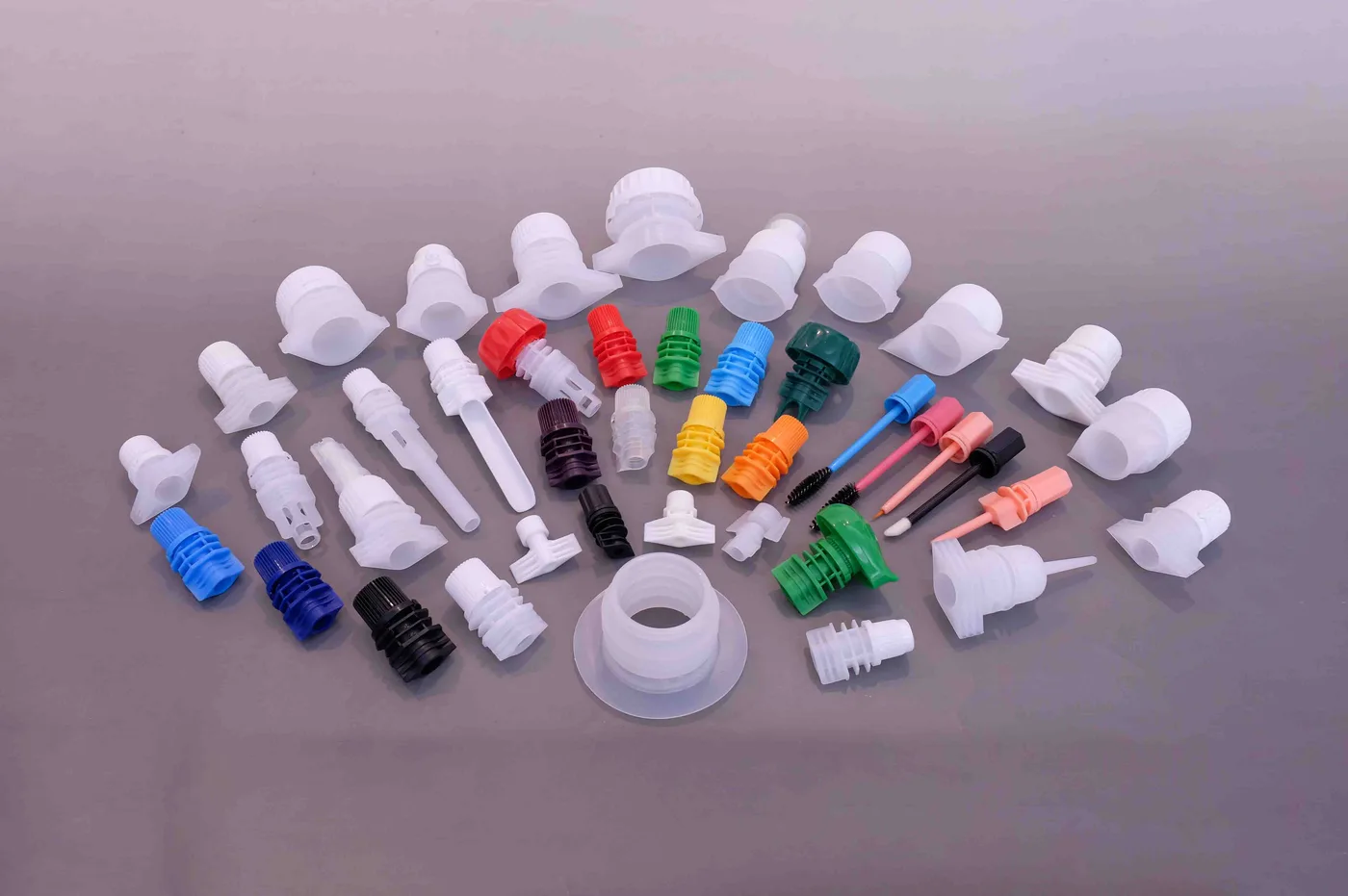
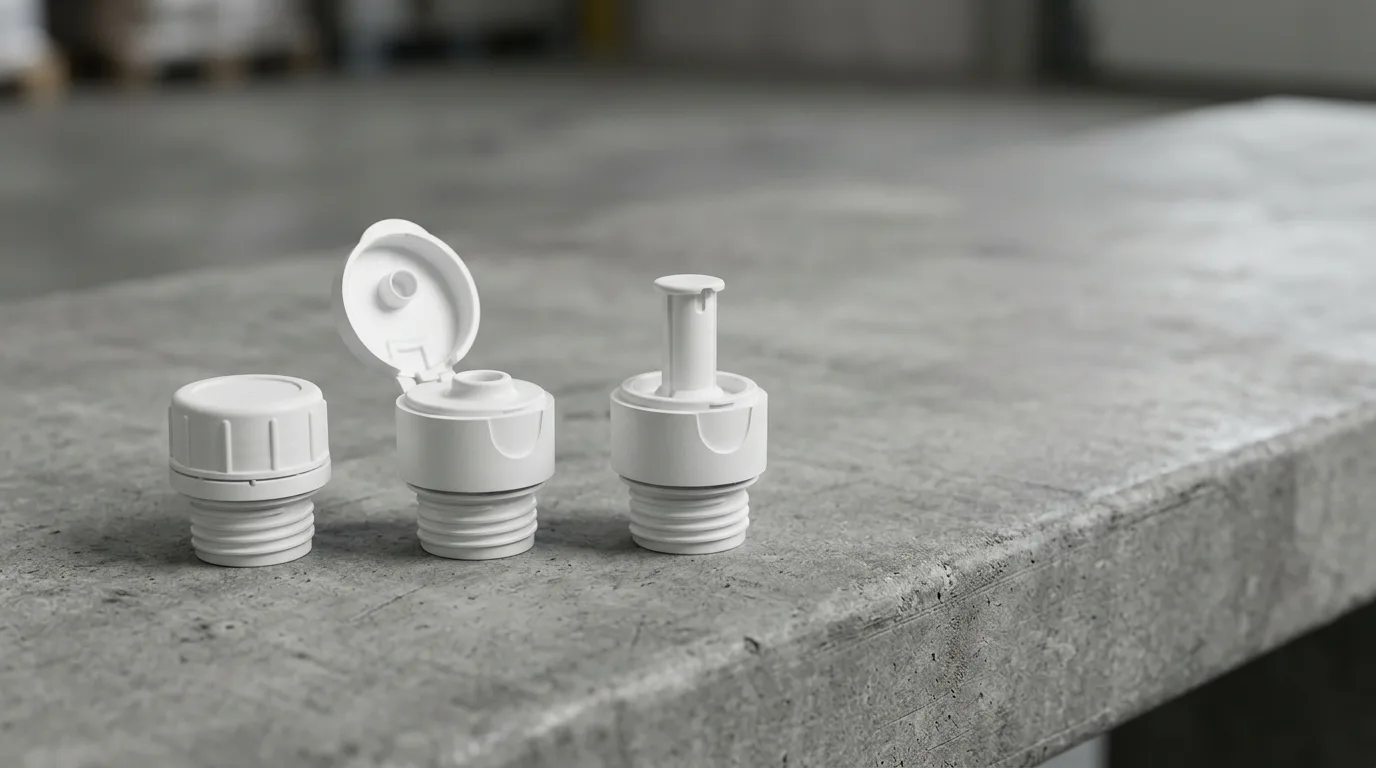
The same three families at different bores and in different colours — the closure decision comes first, the finish afterwards.
The three families are not a hierarchy and there is no default. A detergent refill wants a wide-bore screw cap with a band; a child's water pouch wants a valve; a hand-wash pouch at a hotel wants a flip-top with a pilfer-proof band. Ruihua moulds all three families for stand-up pouches, and its spout-cap range as a whole runs from 1.2 mm to 40 mm, so the choice can follow the product rather than the catalogue. If you are still working out which closure your fill actually needs, start with how to choose a spout cap and come back here with a shortlist; if you already know the family, the spout cap catalogue is the next stop. Either way, write the torque, the force and the test method into the enquiry — those three lines are what separate a quote from a specification.