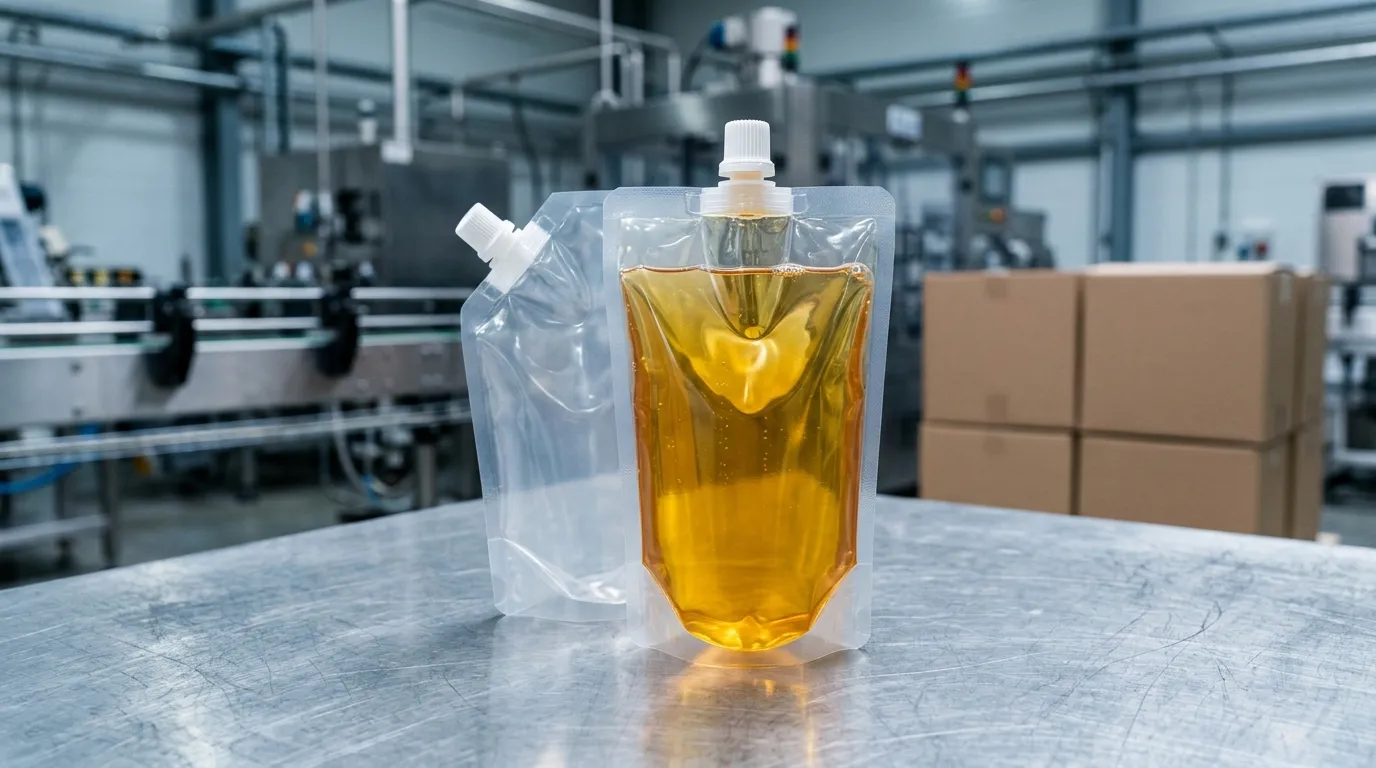

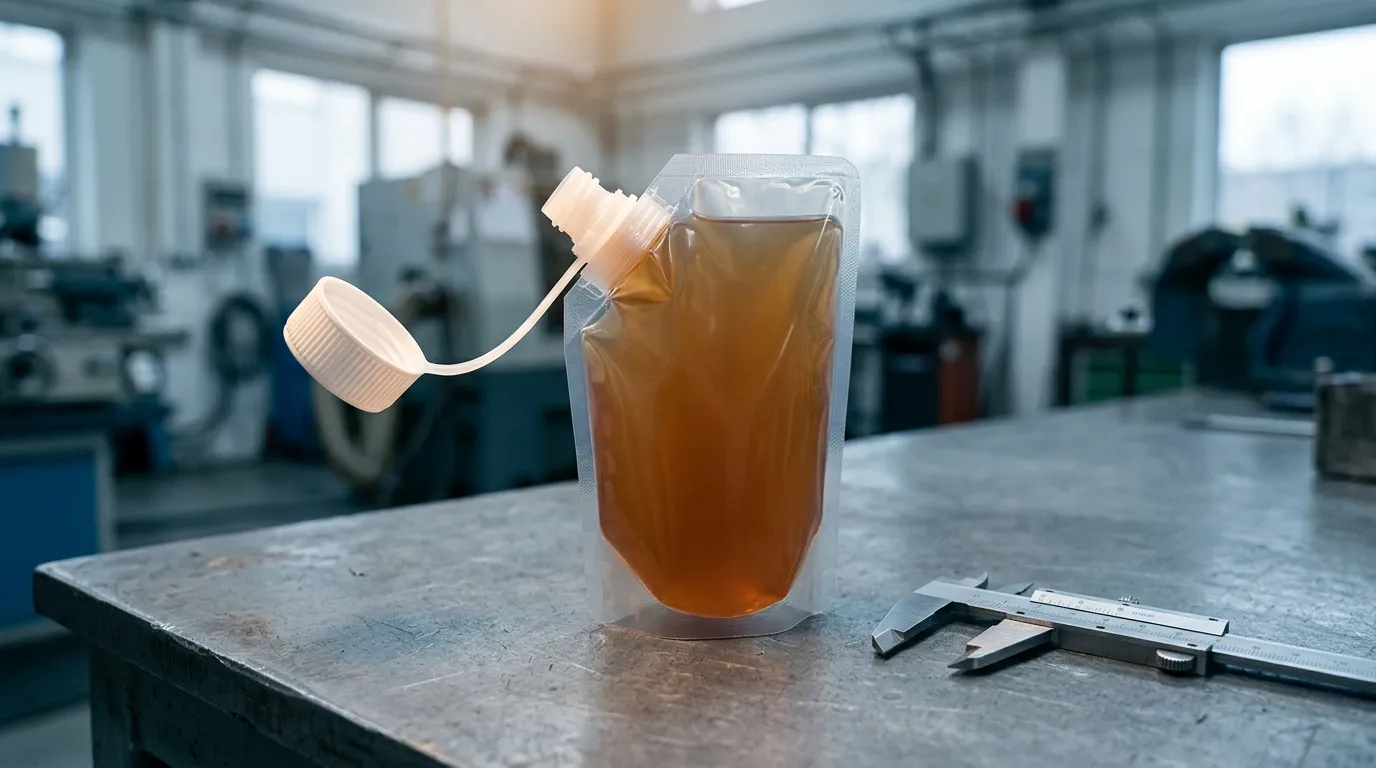
An EU standard tethered cap for pouch packaging is not a particular cap shape, and it is not a badge a supplier either has or does not have. It is a test regime. The EU's obligation is that the cap stays attached to the container through its intended use, and since June 2023 a named European standard — EN 17665:2022+A1:2023 — has held harmonised status and sets out how a manufacturer demonstrates it.
That distinction matters more on a pouch than on a bottle. A bottle has a rigid neck finish the cap screws onto; a spouted pouch does not. The attachment load on a pouch runs through the cap–spout thread interface and then out through the spout-to-film weld. So when you buy a tethered spout cap, you are buying one half of a system whose other half is the spout and the seal you make with your own film.
This article covers the requirement, the standard and what it actually tests, and what to have in writing before you place an EU-bound order.
What "EU standard tethered cap" actually refers to
Three different things get bundled into that phrase, and mixing them up is why the topic feels murkier than it is.
The obligation comes from Article 6(1) of Directive (EU) 2019/904, the Single-Use Plastics Directive. Caps and lids made of plastic on the single-use plastic products listed in Part C of the Annex may be placed on the market only if they remain attached to the container during the product's intended use stage. Part C is the beverage-container category: containers up to three litres, described in the Annex as "receptacles used to contain liquid … such as beverage bottles including their caps and lids and composite beverage packaging". Member states had to apply that requirement from 3 July 2024. The reasoning behind it is the Commission's own: plastic caps and lids are consistently among the most common single-use plastic items found on European beaches, according to the Commission's single-use plastics pages, so a cap that travels with its container through collection and recycling is the point of the rule.
The standard is CEN's response to the standardisation request the Commission issued in October 2020. CEN produced EN 17665:2022+A1:2023, *Packaging — Test methods and requirements to demonstrate that plastic caps and lids remain attached to beverage containers*. Its scope, as published by the Swedish Institute for Standards, is single-use beverage containers with a capacity of up to three litres, and it also addresses "the necessary strength, reliability and safety of beverage container closures, including those for carbonated drinks" — with the explicit limitation that it applies to the strength, reliability and safety impacted by the attachment features, not to the closure system as a whole.
The legal effect is in Article 6(4) of the Directive: products that conform to a harmonised standard whose reference has been published in the Official Journal are presumed to conform to the requirement it covers. The reference to EN 17665 was published by Commission Implementing Decision (EU) 2023/1060 of 30 May 2023, and the entry appears in the Commission's list of harmonised standards for plastic caps and lids. That is what a compliance buyer should be asking for: not a generic tether, but a test report against a named standard. Presumption of conformity is a legal effect of the standard, not of a supplier's own summary of it.
One honest caveat before you build a project plan on it: the standard inherits the Directive's container definition, so EN 17665 by itself settles nothing about whether a spouted beverage pouch counts as a "beverage container". That question belongs to the Directive and to the Commission's guidance under it, not to a test standard. We set that scope question out separately in whether the tethered cap rule reaches spouted pouches at all; the operative point here is that a supplier cannot make that call for you, and neither can a standard.
What EN 17665 actually tests
This is the part most pages about tethered caps skip entirely, and it is the part that determines whether your closure passes. The standard builds the requirement around three properties — strength, reliability and safety of the attachment feature — and gives each one its own method and acceptance criteria.
Strength is measured as resistance to a tensile force. The method outline available in a standards-catalog preview of the EN 17665 entry runs like this: the cap or lid is applied to the neck finish it was designed for, the samples are stabilized for 24 h at (23 ± 2) °C, and testing is carried out at that temperature. The opened cap is then gripped in a tensile testing machine and pulled at 200 mm/min ± 20 mm/min, twice — once along the main axis of the neck finish, once perpendicular to it — with 10 separate samples for each subtest, 20 in total. Whether the cap detaches or stays attached is recorded and judged against the pass value specified in Table 1 of clause 6.1. Be clear about what you are reading, though: that summary is a catalog preview of the document, not the document. It is enough to tell you what the test looks like and what to ask your supplier for; it is not enough to certify a closure against.
Reliability is a separate test family, evaluated under its own test method and against its own acceptance criteria. It addresses the behavior that the Directive's phrase "during the product's intended use stage" implies: the attachment feature has to survive normal handling as the consumer opens the container, pours or drinks, and recloses it for later servings. Deliberately forcing the cap off is explicitly outside "intended use" — the standard acknowledges that a determined consumer can always tear a closure apart.
Safety is handled through a risk assessment of the attachment feature, which the standard permits you to fold into your normal product-safety assessment rather than run as a standalone exercise.
Two practical consequences follow. First, the numbers you will be asked for live in the standard itself, not in any blog post — including this one. If a supplier quotes you a tensile figure or a cycle count without naming the clause it comes from, ask which clause. Second, the test is performed on a neck finish. That is fine for a bottle and needs translation for a pouch.

Why a spout pouch is not a bottle neck finish
On a bottle, the cap's attachment feature holds the cap to a rigid, integrally molded neck. The load path is short: cap, thread, neck, container. The container absorbs it.
On a spouted pouch there is no neck finish. The spout is a separate molded fitment welded to flexible film, and the thread the cap turns on belongs to that fitment. When you pull the open cap, the load travels cap → thread interface → spout body → spout-to-film weld → pouch film. Two of those links are not part of the cap at all, and one of them — the weld — is created by the packer, not by the cap supplier.
Three things follow for an EU-bound project:
- The weld becomes part of the attachment assessment. A spout that never leaves its base is only half the story; the film-to-spout seal has to hold the same working load. Weld quality varies with film structure, seal temperature, dwell time and the filling line's tooling.
- The spout's bowl and shoulder geometry matters. A stop-lug or tether feature has to open to a usable angle without the cap fouling the dispensing path, and on a small pouch the spout itself is only a few millimetres across.
- Sealing temperature ties back to the film. Spouts engineered to weld at 110–130 °C let you run mono-material PE film without cooking it, which is why closure choice and mono-material PE pouch design are one decision rather than two.
The engineering upside is real: a pouch closure is redesigned at the component level, not by rebuilding a bottling line. That is why flexible packaging has been able to adopt tethered closures quickly despite the regulatory picture being less tidy than it is for bottles.
Two ways to make a spout cap non-detachable
There are two families of mechanism in use on spouted pouches, and they behave differently on a filling line.
A stop lug on the thread. A molded lug inside the cap's thread limits how far the cap can travel as it unscrews. The cap keeps turning counterclockwise, stops at its maximum opening position, and cannot be lifted off the spout. There is no extra part, so nothing new to feed or orient on the capping head, and the twist-to-open motion is the one consumers already expect. It also removes the smallest detached item from the equation, which is why this design shows up on baby-food and juice pouches where a loose cap is a choking risk as well as litter.
A strap, lanyard or hinge tether. A flexible link physically joins cap to spout. Flip-top sports closures and water-bag caps use this pattern: the cap swings clear and stays connected. The trade-off is a second component to handle and a hinge line that can fatigue if its thickness is inconsistent — the standard's reliability test is exactly where that shows up.
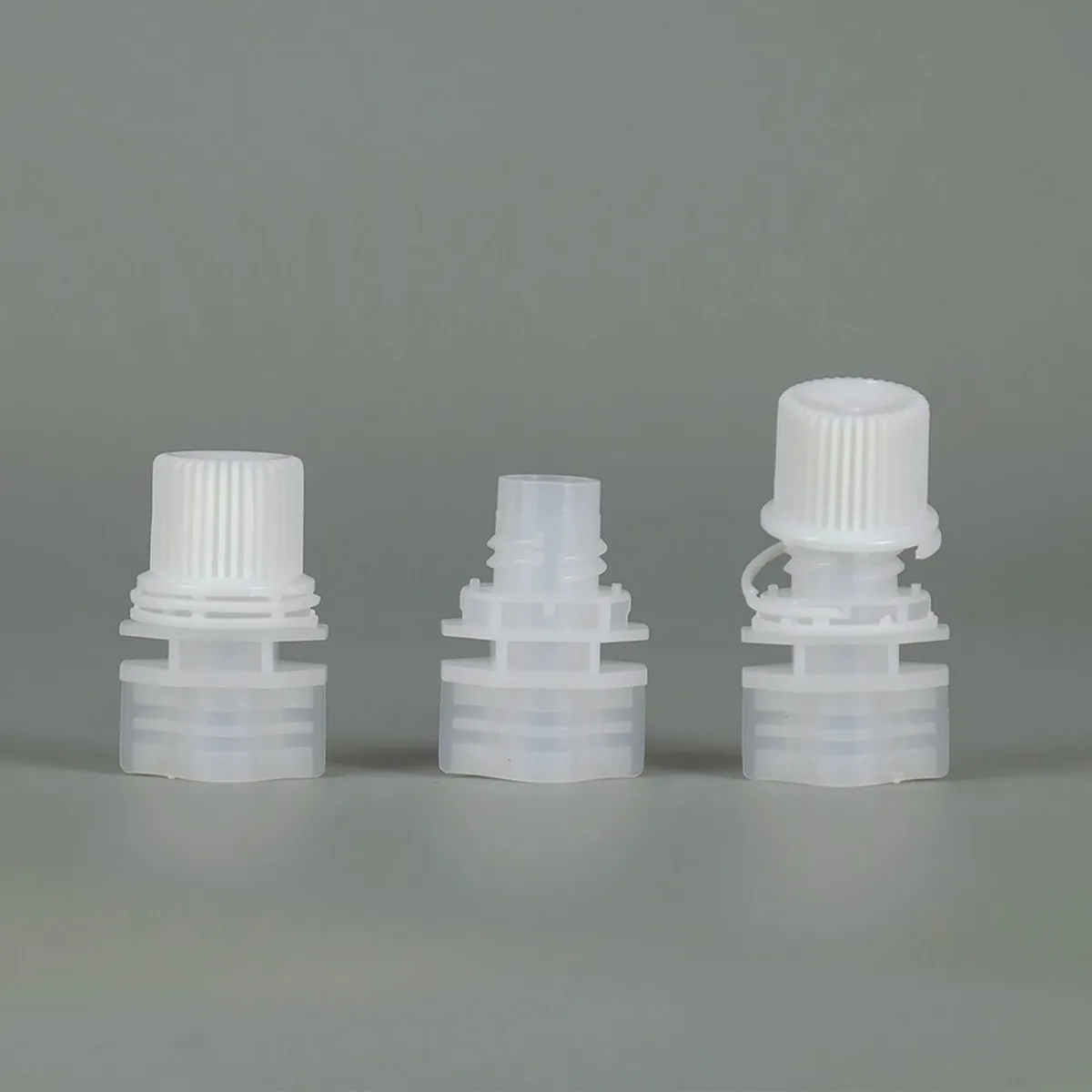
Stop lug on the thread | Strap / lanyard / hinge | |
|---|---|---|
Extra component | None — feature is molded into the cap | Yes: the tether, or a separate ring |
Filling-line effect | No new part to feed, orient or inspect | Additional handling and orientation step |
Opening behavior | Cap stays on the thread, stops at maximum opening | Cap swings clear of the spout |
Fatigue risk | Thread and lug wear | Hinge or tether thinning over cycles |
Typical use | Juice, baby puree, water pouches | Sports pouches, water bags, flip-top caps |
Neither is universally better. A stop-lug cap gives you fewer parts and simpler line behavior; a strap tether keeps the cap further out of the pouring path. What matters for compliance is that the design is non-detachable by construction rather than by friction or tolerance stacking — a cap that usually stays on is not the property the Directive is asking for.
Specifying a tethered cap for your pouch
Put these on the specification sheet, and expect the supplier to bid against them rather than guess:
Item | What to specify | Why it matters here |
|---|---|---|
Nominal bore / spout class | Spout bore and fitment series, e.g. the 8.6 mm class widely used for juice and baby puree pouches | The cap must be tooled for the exact spout series, not "a small spout" |
Attachment mechanism | Stop lug, strap tether or hinge; state that non-detachment is by design | Determines which test route applies and what the supplier must document |
Attachment test evidence | Report against the strength and reliability clauses of EN 17665, on the spout/weld configuration you actually use | Presumption of conformity is the point of the exercise |
Material | Food-grade PP or PE, matching the pouch's recycling route | Keeps a mono-material PE structure mono-material |
Sealing temperature | Weld window against your film — for recyclable PE film, 110–130 °C | A closure that needs a hot weld forces you off mono-material film |
Open angle and pouring | Opening position clear of the dispensing path, reclose torque after repeated use | The "intended use" stage is where failures are judged |
Tamper evidence | Pilfer-proof / tamper ring if your channel needs it | Can interact with the attachment feature layout |
A spout cap specification sheet is worth keeping as a document your own quality team signs off, because the closure is where the pack's compliance story and its leak performance meet. Our guide to building a spout cap specification sheet walks through the fields in more detail.
The paperwork to collect before your EU launch
The tethering requirement does not sit in isolation — the same cap has to satisfy food-contact law, and that is where most audit requests actually land. Collect:
- A declaration of compliance covering Regulation (EC) 1935/2004, the EU framework regulation for materials intended to come into contact with food, and Regulation (EU) 10/2011 for plastic materials specifically.
- Attachment strength and reliability test reports from an accredited lab, referenced to the clauses of EN 17665.
- Material and colorant declarations, including anything the resin supplier adds.
- Batch traceability for brand factory audits — the ability to tie a delivery back to a production run matters more to auditors than a certificate on the wall.
Put the same four in a table before you ask, so nothing gets lost in a reply thread:
Document | What it should show | Who issues it |
|---|---|---|
Declaration of compliance | The specific regulation cited (1935/2004 plus 10/2011), with the migration conditions for your intended use | Cap supplier |
Attachment strength and reliability reports | Test configuration, results and the clauses of EN 17665 the results are referenced to | Accredited test lab |
Material and additive declarations | Resin grade, colorant and any additive the compounder adds, tied to the food-contact status | Cap supplier and resin or compounder |
Batch traceability records | Delivery lot traceable to a production run and a resin batch | Cap supplier |
Expect the declaration to cite the standard for the tethering claim as well as the food-contact regulations, and expect the lab report to be traceable to an accredited facility rather than to the supplier's own template. TÜV Rheinland's notice makes the same point from the certification side: compliance with the harmonised standard confers presumption of conformity, it does not merely signal good intent.
If your supplier's response to "can you send the declaration of compliance and the test reports" is a product brochure, that is your answer about the supplier. The wider certification picture is covered in our guide to food-grade certification for spout caps.
What changed recently, and what to watch for
Two things are worth tracking. In September 2026 the Commission updated its single-use plastics guidelines — Commission Notice C/2026/4813, dated 8 September 2026 — with illustrative examples showing that aluminium caps and sealed aluminium foil lids fall outside the tethering requirement, while a plastic cap on a foil-lidded container is only partly covered. That is a reminder that the regime is still being interpreted rather than merely applied, and that enforcement detail can move long after a rule is in force. In parallel, the Packaging and Packaging Waste Regulation pushes in a second direction: design for recyclability, fewer components, less material. A tethered closure that adds a non-separable second polymer, or that defeats a mono-material structure, can create a small PPWR problem while solving a tethering problem. Our component checklist for spout pouches under PPWR covers that side of the ledger.
That guidance is also the closest thing to an official position on the pouch question, and it is worth reading closely, because the Directive's Annex wording never names pouches at all. Among the illustrative examples the updated guidelines set out are plastic caps used in combination with single-use plastic beverage pouches, and pouches up to three litres whether fully plastic or with a plastic layer — both listed as covered by the tethering requirement. The same guidance cuts the other way for some formats: a plastic multilayer pouch holding fruit puree appears there as a food container rather than a beverage container, so a puree pouch is a different case from a juice pouch. Member-state enforcement detail can still differ, and a written interpretation for your own products is worth having, but the direction of travel is no longer genuinely in doubt. All of this sits inside the broader set of EU rules that now reach pouch closures.
Questions to put to a spout cap supplier
Send these in writing. The answers separate a tool room from a trader.
- Which spout series and bore does the cap fit, and is the cap tooled for that series or adapted to it?
- Is the closure non-detachable by design, and by which mechanism — and what is the opening behavior after repeated use?
- Can you supply attachment test data referenced to the standard's clauses, for the spout and weld configuration we will run?
- What is the recommended sealing temperature window against our film structure, and how was it established?
- Who makes the tooling, and can you support a dedicated mold rather than a catalog item?

Ruihua manufactures plastic spout caps for stand-up pouches and doypacks from 1.2 mm to 40 mm, including the 8.6 mm EUR non-separated twist cap for juice and baby-puree pouches. Its stop lug sits in the thread, so the cap stops at its maximum opening position instead of coming away from the spout — non-detachable by construction, with no extra tether part for your capping head to handle. Spouts are molded in food-grade PP/PE with sealing engineered for recyclable PE film at 110–130 °C, and the company holds ISO 9001, HACCP, FDA and EU 1935/2004 certification. Send your pouch structure, spout series and target market, and our engineers will confirm cap fit, sealing window and the documentation package for your EU launch.
FAQ
Is there an official EU standard for tethered caps? Yes. EN 17665:2022+A1:2023, Packaging — Test methods and requirements to demonstrate that plastic caps and lids remain attached to beverage containers, is the harmonised standard supporting Article 6(1) of Directive (EU) 2019/904. Its reference was published by Commission Implementing Decision (EU) 2023/1060.
What does "non-detachable" mean in practice? The cap stays attached to the container through normal opening, pouring and reclosing. Intentional forced separation is possible and is explicitly excluded from the standard's definition of intended use — the requirement is about handling, not about making the cap physically inseparable. Buyers write this same closure as a tethered spout cap, a non-detachable spout cap, a non-separable spout cap or a non-separated spout cap; the design requirement behind all four names is identical.
Do pouches have a "standard cap size"? Not in the way bottles do, and there is no single EU-wide pouch-spout standard. Pouch closures are ordered against the spout fitment series, and the 8.6 mm class — sold as the 8.6 mm tethered spout cap or the 8.6 mm EUR non-separated twist cap — is the common choice for juice and baby-puree pouches. Confirm the fitment series before specifying a cap, because the bore and thread must match exactly.
Does a tethered cap change how the pouch seals? The cap does not change the weld, but the two are judged together. Attachment load on a pouch passes through the spout-to-film weld, so a closure that satisfies an attachment test on one film structure may behave differently on another. Specify the spout's sealing temperature window against your own film.
Does this apply to detergent or personal-care pouches? The Article 6(1) obligation is written for single-use plastic beverage containers up to three litres. Detergent, shampoo and most condiment pouches sit outside that definition. Tethered and non-detachable designs are still worth adopting there — lost caps are a litter and hygiene problem regardless — but they are a design choice rather than a tethering obligation.
Last updated: 21 September 2026. Technical review: Ruihua Technical Team.
Compliance information in this article is provided for general guidance only and does not constitute legal advice. Regulations, standards and their interpretation change and vary by EU member state. Confirm requirements with qualified legal or compliance counsel before placing products on the market.