
What a migration test report covers, and what it does not
The PDF is four pages, the conclusion line says compliant, and the purchase order in front of you lists eight spout-cap SKUs in three colors and two spout diameters. Both documents are real. The problem is that they are not talking about the same thing, and nobody in the approval chain has written down which one the other is supposed to support.
A food contact migration test report is a record of one experiment. It says what the specimen was, what it was exposed to, what was measured against which limit, and what conclusion the laboratory drew. Every sentence in it is scoped to the specimen described on the first page — one item, one set of conditions, one set of analytes. That is all a laboratory can honestly certify.
Coverage is a different statement, and it is made by you, not by the laboratory. It says: the specimen in this report is at least as demanding as the parts I am buying, so a pass on the specimen is a pass on my order. Three questions decide whether that statement survives:
- Same part — does the sample description identify the component you actually buy?
- Same material — is the tested composition the composition you will receive, including color and any liner?
- Same or harder conditions — were the simulant, time and temperature at least as severe as your filling, storage and use?
All three yes, and the report covers the order. Two of three, and it covers part of it — normal, and manageable, once you know which part. One of three, and you are holding evidence about somebody else's product.
The report is also not the compliance document. In the EU the instrument is the declaration of compliance; the test report is supporting documentation behind it. The distinction matters at audit, and it is spelled out in the regulations and recyclability section of this blog.
Two further limits are worth naming. A report covering overall and specific migration does not cover non-intentionally added substances: NIAS are dealt with by a risk assessment under Article 19 of the same regulation, so a report silent on NIAS is not a clean bill of health. And a migration report is not a seal test — whether the closure holds is a separate question, with a separate method.
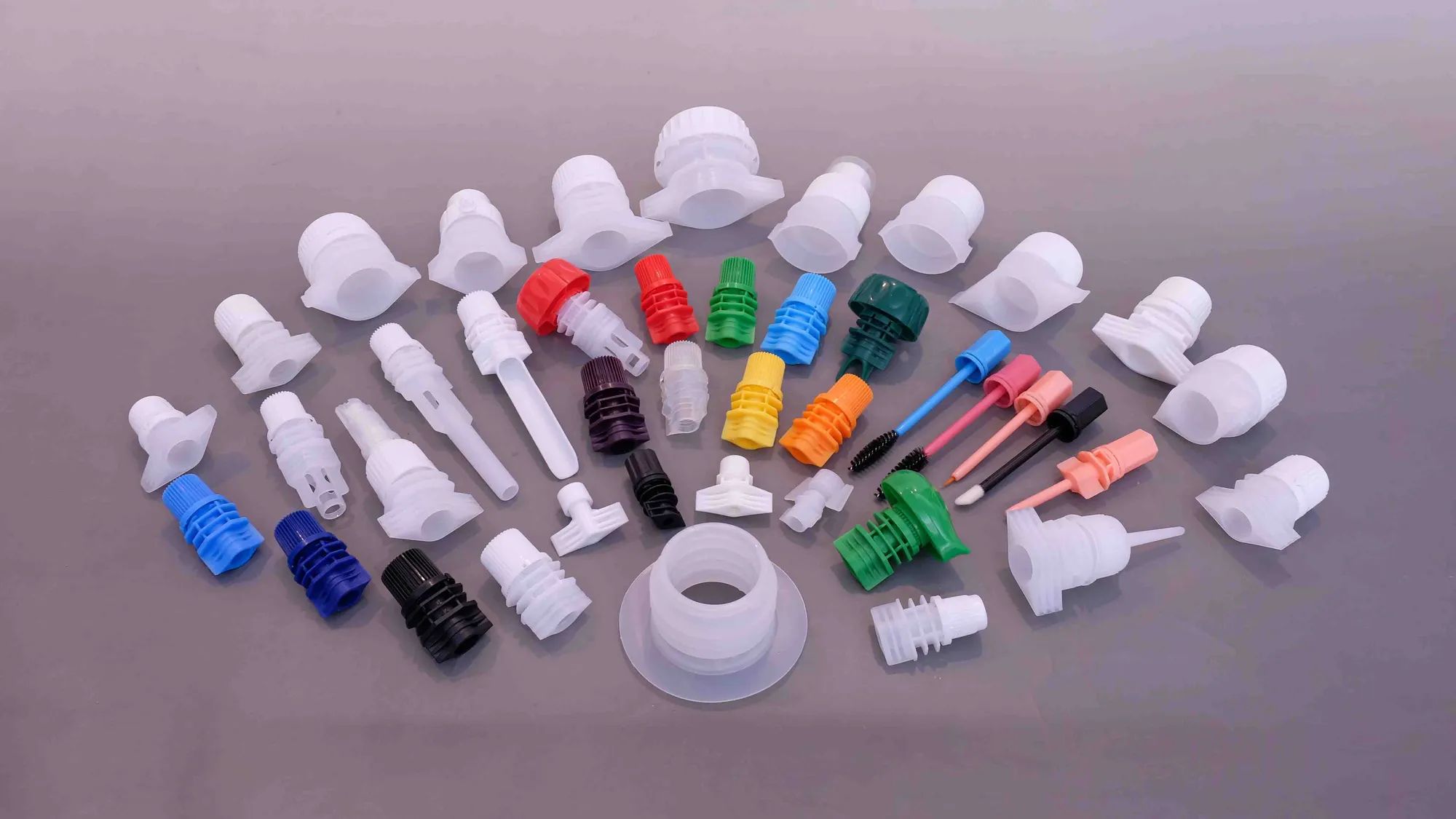
Your spout cap is not one material
A spouted pouch closure arrives as an assembly, and the materials in it do not all come from the same supplier or the same molding. Before comparing any numbers, establish which rows of this table the report actually covers.
Part | Typical material | Usually inside the cap molder's report? | Who else may hold the evidence |
|---|---|---|---|
Spout body (welded to the film) | PE | Yes, if the tested item was the assembled fitment | The converter, for the film side of the weld |
Cap | PP or PE | Yes | — |
Liner / seal disc / gasket | LDPE, EVA, silicone | Often no — bought in as a separate component | The liner supplier, or the brand, if it specified the liner |
Tamper-evident band | Same molding as the cap, joined by bridges | Yes, as part of the cap | — |
Print on the cap | Ink, occasionally a primer | Rarely | The printer |
Induction foil seal | Aluminum foil with a sealing lacquer | No | The seal supplier |
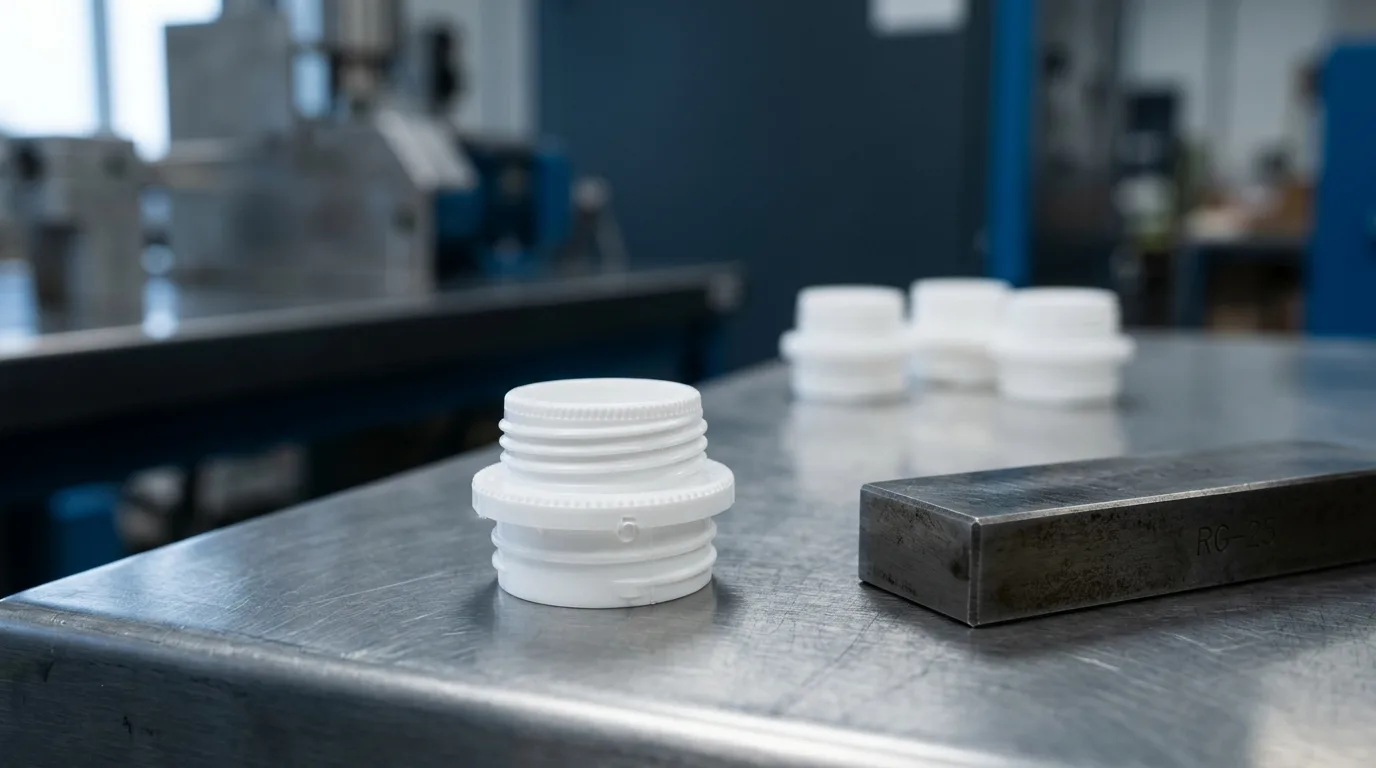
Two consequences follow. A report headed "plastic cap, white, 9.6 mm" is a precise statement about one item and a silent statement about the other five rows, so ask the supplier to mark which parts were in the tested assembly. And the liner is the row most often missing, and the one that sits against the food: a lined closure seals on a separate disc of a different polymer, while a linerless closure seals on a molded fin and has nothing to omit. Mix the two in one SKU list and one report cannot describe both.
Assembly matters for a second reason. Application torque — the force that seats the cap on the spout — is a seal-integrity variable, not a migration variable, so no migration report substitutes for a torque or seal test. But it also means the fitment inside a tested specimen was probably not applied at production torque. A report tells you what migrated from the materials; it does not tell you whether the item tested was assembled the way yours will be.
The four fields that decide whether the tested part stands for your part
Most reports contain enough information to answer the coverage question. What is usually missing is not data but a comparison: nobody has put the report's four scoping fields next to the purchase order.
Field | What to look for in the report | What a gap looks like |
|---|---|---|
Identity | Part number or drawing revision, cavity or mold identification, batch or lot | "Cap, white" and nothing that ties it to a part number |
Composition | Resin grade, color masterbatch, additives, liner material | Color described as a color, not as a formulation |
Worst case | A stated reason why this item is the most demanding in the family | The largest cap assumed to be the worst case, with no reasoning |
Use conditions | Simulant, time, temperature, single or repeated contact, retort or ambient | "10 days at 40 °C" with no reference to your process |
Identity is the cheapest check and the most often skipped: without a drawing revision or a mold, you cannot show that the item tested is the item ordered, and no amount of analytical detail repairs that.
Composition carries more weight for a closure than buyers expect. Color is a masterbatch addition — pigment and carrier at a loading percentage — so a different color is a different composition, not a cosmetic variation. The same holds for an additive package bought as a masterbatch, and for a liner of a different polymer.
Worst case is where family claims live or die. One test can stand for several SKUs only when the tested item sits at the severe end of every axis on which the SKUs differ — and those axes are not the ones buyers guess: pigment loading, wall thickness at the weld flange, spout bore, and the severity of the food. The biggest cap in the range is usually not the worst case. The family-claim test set out in this article applies exactly here.
Use conditions decide whether the result applies at all: a closure for an ambient sauce and one for a retorted baby meal are not covered by the same evidence, and a hotter repeat of the same test does not convert one into the other.

Which basis the numbers are on: mg/kg, mg/dm² or mg/article
This is the section to read with a calculator, because it is where a correct number can still be unusable.
EU plastics rules express the two limits in two different units. Specific migration limits are set in Annex I and expressed in milligrams per kilogram of food (Article 11(1)). The overall migration limit is 10 mg per dm² of food contact surface (Article 12(1)) — and the 60 mg/kg figure in Article 12(2) is not a general alternative: it applies to materials and articles intended to come into contact with food for infants and young children.
Article 17 then says how a result is to be expressed: specific migration values are given in mg/kg applying the real surface-to-volume ratio in actual or foreseen use, with a conventional 6 dm² per kg substituted in three situations — containers and articles holding less than 500 ml or more than 10 L, articles whose form makes the ratio impracticable to estimate, and sheets or films not yet in contact with food. For a 250 ml stand-up pouch the first of those applies, so 6 dm²/kg is the prescribed route there rather than a fallback assumption — unless the pouch is for infants or young children, whom 17(2) expressly excludes and for whom the overall limit is the 60 mg/kg of Article 12(2).
Then come the two paragraphs that decide this page and that buyers almost never read. For caps, gaskets, stoppers and similar sealing articles, Article 17(3) and 17(4) set their own routes:
Route | Limit it applies to | When it applies | What the report has to state |
|---|---|---|---|
mg/kg on the actual contents of the container the closure is made for | specific migration only | intended use known | which container, and the fill it was calculated on |
mg/dm² on the total contact surface of sealing article and sealed container | specific and overall migration | intended use known | that the area is closure plus container, not the closure alone |
mg/article | specific and overall migration | intended use unknown | the article count the value refers to |
There is no mg/kg route for an overall migration result on a sealing article: 17(4) offers only the closure-plus-container area or mg/article.
Three consequences follow for the report in front of you.
- mg/article is a legitimate format, and the prescribed one when the closure molder did not know the intended container — the normal situation for a closure sold to a converter. It is not a defective report, but it cannot be compared with an SML in mg/kg until you know the container and its fill.
- mg/dm² is also legitimate for a sealing article, provided the area is the closure plus the container it seals. A value computed on the cap alone is a different quantity from the limit it is being compared with.
- A closure result in mg/kg on a 6 dm²/kg basis is not automatically wrong either — Article 17(3)(a) requires paragraph 2 to be taken into account. What is wrong is a number with no stated basis.
So the question is not "is this the right unit" but "does the report say which route it used, and is the denominator stated". A closure report that gives a result and no route is undocumented whatever the unit.
What the numbers were measured against matters as much as the basis. The simulant letter tells you which food the result speaks for: A is 10 % ethanol for aqueous foods, B is 3 % acetic acid for acidic foods (pH below 4.5), C is 20 % ethanol for alcoholic foods up to 20 % alcohol and for foods with a relevant amount of lipophilic organic ingredients, D1 is 50 % ethanol for oil-in-water emulsions and stronger alcohol, D2 is vegetable oil for foods with free fat at the surface, and E covers dry foods. Materials intended for all food types are tested with A, B and D2. A report quoting B is not speaking for an oily sauce, however clean the result.
The same ratio logic reaches the declaration of compliance: Annex IV item 8 requires specifications on use, including "the ratio of food contact surface area to volume used to establish the compliance". If that ratio is absent from both the report and the declaration, you have a conclusion without its denominator.
Two smaller traps in the same area. "Not detected" is a statement about the method's capability, not a zero: a report with no limit of detection or quantification leaves you unable to tell a clean result from an insensitive one, and with no stated measurement uncertainty or decision rule you cannot tell whether 9.6 against a limit of 10 is a pass. And for fatty foods the regulation allows a fat reduction factor for certain lipophilic substances, with Annex I column 7 recording per substance whether the correction is allowed — an adjusted result should say so, and an unadjusted one compared against a fatty-food limit should be queried.
The pouch film and the closure are two reports
Here is the failure that survives every other check on this page. The converter sends a migration report for the laminate. The closure molder sends one for the cap. Both are genuine and correctly scoped to their own article; the filled pouch is still uncovered, because it is an assembly of two articles and neither document describes the combination.
What falls between them is small and specific: the film around the spout is heat-affected by the weld, and in the assembled pouch the food contacts the inside of the spout bore and the rim, not the whole cap. If the film report was run on a flat specimen and the cap report on a loose fitment, the geometry that actually exists has been tested by neither.
The fix is administrative, not analytical: put the two documents side by side, one row each, and write down who owns the interface. Usually that is the brand, the only party that knows both suppliers.
The paperwork behind the report
The report is the evidence; the declaration of compliance is what carries it into the supply chain, and the two are governed by different provisions.
Regulation (EC) No 1935/2004 is the framework. Article 16(1) requires a written declaration for materials covered by specific measures, with appropriate documentation available to demonstrate compliance and produced to the competent authorities on demand. Article 17 requires traceability at all stages — systems that identify the businesses from which and to which the material was supplied.
Commission Regulation (EU) No 10/2011 is the specific measure for plastics. Article 15 requires a written declaration at every marketing stage other than retail, issued per Annex IV, and renewed when substantial changes in composition or production bring about a change in migration. Article 16 describes what supporting documentation has to contain: the conditions and results of testing, calculations including modeling, other analysis, and reasoning. Article 18 then routes the verification itself into Annex V.
Three things to check on the declaration, all of them visible on the page:
- Does it identify the article specifically enough to match your part number, or only a product family?
- Does it state the food types, the time and temperature of contact, and the surface-area-to-volume ratio used (Annex IV items 8(i)–(iii))?
- Is it dated, and does the date predate any change in your formulation or color?
A declaration that names no tested item and no ratio is a claim, not evidence. For how the three major regimes relate — EU 1935/2004 and 10/2011, US 21 CFR, China's GB 4806 series — this comparison is the place to start, and if your market is the EU and your customer asks for recyclability documentation per component, the PPWR component checklist covers the parallel set of documents. The Chinese route is not a declaration regime at all: GB 4806.7 is a positive standard with its own migration limits and test conditions, so a GB report answers a different question from an EU declaration even when both describe the same part.
The US route is a different document
Buyers who work mainly in the EU tend to read a US document as a translation of the same thing. It is not, and for a closure the difference is instructive.
21 CFR 177.1520 covers olefin polymers, and its specifications are written against the basic polymer, not the finished part: density, melting point or softening point, maximum extractable fraction in n-hexane, maximum soluble fraction in xylene. The analytical methods are expressly "applicable to the basic polymer in film form not exceeding 4 mils in thickness". A supplier statement citing 177.1520 tells you the resin is a permitted olefin polymer of the right specification. It does not tell you what migrates from a molded spout made of it.
21 CFR 177.1210 is the part written for your component. It covers closures with sealing gaskets, and it does something the resin section does not: it requires the extraction to be run on the closure assembly, defined as including "the sealing gasket or sealing compound, together with any polymeric or resinous coating, film, foil, natural cork, or glass that forms a part of the food-contact surface". The extraction goes on a glass container filled with solvent, with the procedure adapted — for example by placing the closed container on its side — so that the closure's food-contact surface meets the liquid; the tolerances are then calculated on the basis of the water capacity of the container on which the closure is to be used rather than per square decimeter.
That last point is the one to compare against the EU paperwork. An EU result for a closure is likely to be on a surface-area or 6 dm²/kg basis; a US result for the same closure is on a per-container-capacity basis. The two cannot be converted by arithmetic alone, and the condition of use — the food type and the time-temperature letter — has to match your application before either applies. Those condition tables sit in 21 CFR 176.170.
For a linerless cap the picture changes: with no sealing gasket there is no closure-sealing-gasket assembly for 177.1210 to extract, and the resin specification plus the applicable coating or ink regulations carry the US position instead. Ask which of the two your supplier is actually claiming.
Run the field check
Eight checks, one PDF, about fifteen minutes. The first five cover the four fields above, with assembly scope split out as its own row; the last three cover what that table does not. Each has a pass condition you can write down.
# | Check | Passes when | Not covered when |
|---|---|---|---|
1 | Part identity | Sample description names the component and a part or drawing reference | Only "cap" plus a color |
2 | Assembly scope | The parts tested are listed, including liner or gasket if fitted | The report never says whether a liner was present |
3 | Composition | Resin, color masterbatch and liner material are identified | Color only |
4 | Worst-case argument | A stated reason why this item represents the family | No reasoning, or "largest" assumed |
5 | Simulant and conditions | Simulant matches your food type; time and temperature at least as severe as your process | Conditions below your fill or retort step |
6 | Basis and route | The route is named — mg/kg on the container fill (specific migration only), mg/dm² on closure plus container, or mg/article — and the denominator is stated | A number with no route, or an area that is the cap alone |
7 | Method capability and decision rule | LOD/LOQ reported, plus a measurement uncertainty or a stated decision rule | "Not detected" with no capability statement |
8 | Report metadata | Report number, issue date, laboratory and method identification present | Undated, unnumbered, method unnamed |
A "no" on checks 1, 2 or 6 is a hard stop: the report does not describe your article, or its numbers cannot be placed against a limit. Checks 3 to 5 are negotiable — a supplier can usually close them with a covering letter or an existing document for the correct color. Checks 7 and 8 matter when a result sits near a limit, and when you may need to defend the document years later.
If you want a second opinion on whether the laboratory was competent for the method rather than merely accredited in general, the method inside an ISO/IEC 17025 scope is where that check lives. Both matter; they are not the same check.
What to send your supplier
Six requests, short enough to paste into an email:
- The test report covering this part number and this color, with the sample description page included.
- Confirmation of which components were in the tested assembly — cap, spout body, liner or seal disc, band, print.
- The resin grade and the color masterbatch reference for the tested item, and for each SKU in the order.
- The worst-case reasoning for the family, if one report is intended to cover several SKUs.
- Which expression route the report uses — mg/kg on the container fill, mg/dm² on closure plus container, or mg/article — with the denominator stated, plus the food types and time-temperature conditions the result applies to.
- The declaration of compliance for the article, with its date and the ratio recorded in it.
If the answers come back as a certificate rather than a report, that is not evasion — it is a different document answering a different question, and it is worth saying so plainly in the reply.
For our own part at Ruihua: the certificate page lists the certificates and third-party test reports we hold — ISO 9001, HACCP, US FDA, EU 1935/2004, and SGS reports on heavy-metal and total-fluorine content for tested spout-cap samples — with the scope each one actually covers. It does not list a migration test for every model, and it does not claim one exists: ask which, if any, migration test report exists for the part you are buying, and the answer will be the document or nothing. We will not present a certificate as if it were a test.