
Food grade vs sterile packaging: three different claims
A purchase order line reads: food-grade spout caps, sterile, for aseptic filling. Three obligations are packed into ten words, and the supplier will answer with whichever document it happens to have. If that document is a food-contact declaration, the buyer has just accepted a material statement as an answer to a microbial question — and nobody will notice until the quality file is audited.
The difference between food grade and sterile packaging is not a matter of degree, like clean versus cleaner. They are different kinds of claim, made by different parties, proved by different documents:
- Food-contact compliance says the material and the finished article are permitted to touch food, and that what migrates out of them stays within legal limits.
- Clean manufacturing says something about the environment the part was made and packed in — measurable only if someone names a class and shows a particle count.
- Sterility says a validated process achieved a defined probability that no viable microorganism is present. It is a property of a process applied to a package, not a property a molded part carries in a box.
Requirement | Question it answers | Usual proof | What it still does not prove |
|---|---|---|---|
Food-contact compliance | May this part touch food? | Declaration of compliance, migration test report | Anything about microorganisms or the factory environment |
Clean manufacturing | What was in the air around it? | Cleanroom classification + particle-count report | That the part is sterile, or that it stayed clean in transit |
Sterility | Was a validated process applied? | Sterilization validation report, SAL, bioburden data | That it is still sterile after your filler opens the bag |
Keeping those three apart is the whole job. Most sterile packaging requirements arrive collapsed into a single line, which is why the rest of this page takes them one at a time and then turns them into three lines you can put in a specification.
Requirement 1: food-contact compliance answers a material question
In the United States, the base polymer has to be permitted for food contact — polypropylene and polyethylene sit in 21 CFR 177.1520, the olefin polymer section. In the European Union, Regulation (EC) No 1935/2004 sets the framework: materials must be manufactured under good manufacturing practice and must not transfer constituents into food in quantities that endanger health or change the food's composition or taste. For plastics, Regulation (EU) No 10/2011 is the operative measure — it sets the overall migration limit and the individual specific limits that the "SML" column on a test report refers to.
Two consequences follow, and both are routinely missed.
The declaration is a legal document with a defined scope. Article 16 of 1935/2004 requires a written declaration of compliance where specific measures apply, backed by documentation that must be produced to authorities on demand. It is not a courtesy letter. Ask what it covers: a resin grade, a color masterbatch, or the finished spout and cap as assembled. A declaration for the resin does not automatically cover the additive package or the gasket.
Permitted material is not the same as tested part. Migration testing measures what actually transfers from the finished article into a food simulant under defined time and temperature. The finished article is the molded, colored, assembled cap — not the pellet. Which sample was tested matters just as much as the result, and that question has its own method: see how to justify worst-case sampling for migration testing.
If you want the full certification stack — material layer, migration layer, system layer, and what to demand for each market — that is covered in food-grade spout cap certification. This page stays on the narrower question: what a food-contact document does not answer.
A food-contact certificate tells you what the part is made of and what it releases. It says nothing about what is living on it.
Requirement 2: "clean" is an environment claim, and "dust-free" is not a cleanroom class
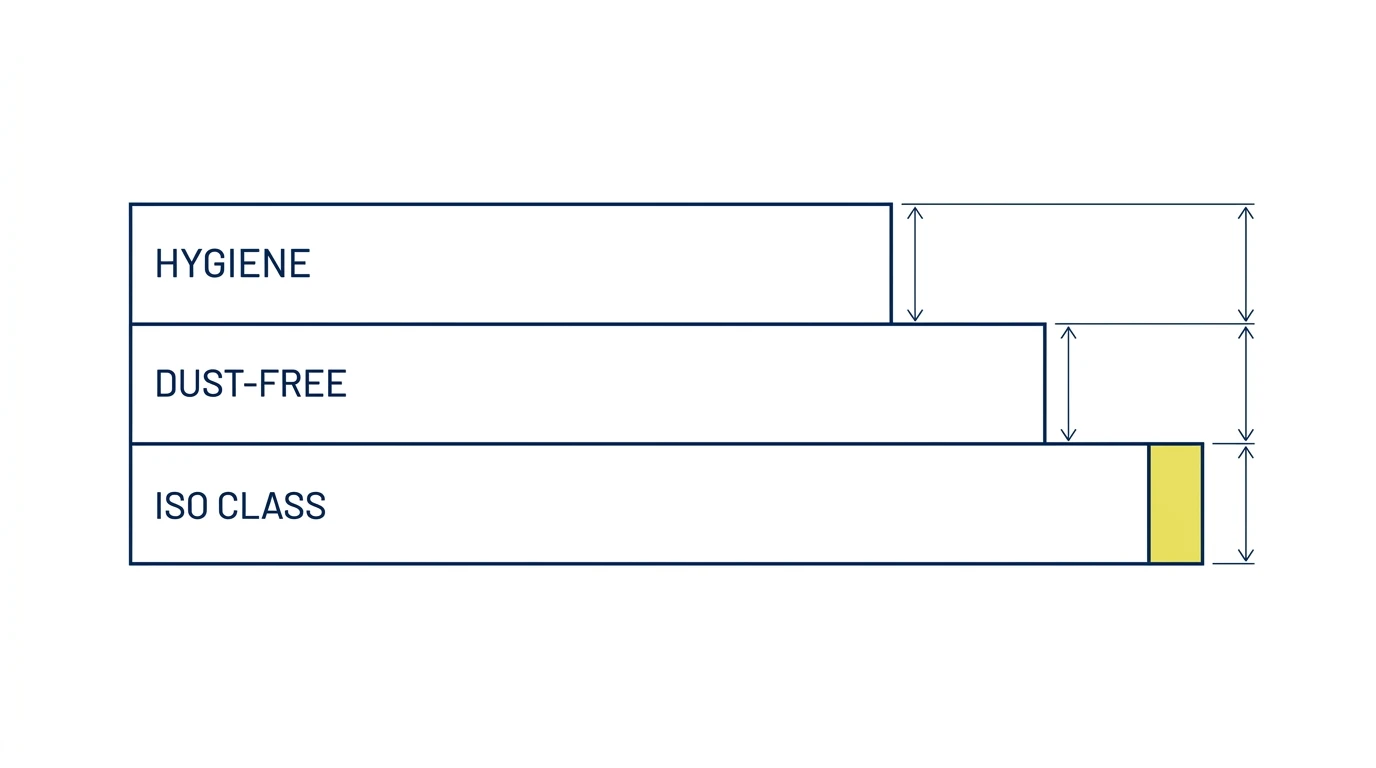
Here the vocabulary collapses fastest, and it collapses hardest in cleanroom packaging, where three different things get called clean:
- A hygiene regime. Cleaning schedules, pest control, personnel rules, hygienic design. This is what food-safety standards such as HACCP, ISO 22000 and BRCGS actually audit, and it is required whether or not there is a cleanroom.
- A dust-free workshop. A real and useful claim about filtered air, controlled access and housekeeping. It is also a marketing phrase: it names no standard, no measurement and no class.
- An ISO 14644-1 classified cleanroom. A defined maximum particle concentration, verified by counting particles at specified locations, at rest and in operation.
Only the third is checkable against a number. And the number is where buyers get hurt, because published tables disagree.
EU GMP Annex 1, Table 1, sets Grade D at 3,520,000 particles per cubic meter at ≥0.5 µm, at rest — the concentration ISO 14644-1 assigns to ISO 8. Grade C's at-rest limit is 352,000, the ISO 7 figure. Those are the numbers to hold in your head: a factor of ten apart, and both large enough that a "we are basically clean" claim can hide anywhere between them.
Tables on cleanroom-supplier sites put a ≥0.1 µm column under a ≥0.5 µm heading, which overstates the class by a factor of nearly thirty. Before comparing a supplier's number with the standard, check which particle size it belongs to. A number that does not match at the stated size is not a conservative estimate; it is a different measurement.
Ten minutes of checking settles which tier you are actually being offered:
- Ask for the classification certificate — which ISO class, which room, which date.
- Ask for the most recent particle-count report, and whether it was taken at rest, in operation, or both. Annex 1 requires both at classification; a report taken only at rest describes an empty room. For Grade D — the class most food closures would sit in — the standard leaves in-operation limits "not predetermined", so what you compare against is the room's own established limits rather than a table.
- Ask what the air handling actually is: HEPA-filtered supply air validated at the terminal filter, positive pressure against the adjacent zones, and the air-change rate the class depends on.
- Ask who performed the count and against which standard, and when the room is due for reclassification.
- Ask what the gowning and material-transfer routine is. A classified room with an uncontrolled goods entrance is a room with an uncontrolled goods entrance.
None of this makes a cleanroom mandatory. Regulation (EC) No 2023/2006 requires good manufacturing practice for food-contact materials, which is a quality-assurance obligation, not an air-class one. Many food closures are correctly made in a controlled hygiene zone rather than a classified room. The error is not choosing the lower tier; it is believing you bought the higher one because the word "dust-free" appeared in a brochure.
Requirement 3: "sterile" needs a number, a method and a validated process
Sterility is not a test result you can read off a certificate. It is a probability statement about a validated process: the sterility assurance level, or SAL, is the expected probability that a single unit is non-sterile after the process. FDA's sterility guidance for devices labeled sterile asks sponsors to state a SAL of 10⁻⁶ — one in a million — and 10⁻³ for devices that contact only intact skin. You cannot promise zero, and a supplier who says "zero microorganisms" has told you they do not work in this vocabulary.
Reaching a SAL means controlling four things in sequence:
- Bioburden — how many viable organisms are on the part before sterilization. Measured to ISO 11737-1, and it is the molder's contribution.
- Material compatibility — whether the closure survives the sterilant. Steam at 121 °C, ethylene oxide, gamma or electron-beam doses, hydrogen peroxide: each attacks different polymers differently, and a cap that yellows, crazes or loses seal force has solved nothing.
- A validated process — the ISO 11135 (ethylene oxide) and ISO 11137 (radiation) families define how a cycle is developed, validated and routinely controlled.
- A sterile barrier — ISO 11607 covers packaging for terminally sterilized medical devices, and FDA's guidance points to it for a reason: a sterile part in a bag that is not a sterile barrier stops being sterile at the first touch of unsterile air.
On the food side the same logic appears under a different name. FDA's aseptic processing and packaging inspection guide is explicit that commercial sterility must be established not only for the product but for the filling equipment and the packaging material, and that packaging sterilization is validated with resistant spores. In an aseptic line, the closure is sterilized by the filler — saturated steam, superheated steam or hydrogen peroxide — and the molder's job is to deliver a part whose bioburden and material behavior make that step work.
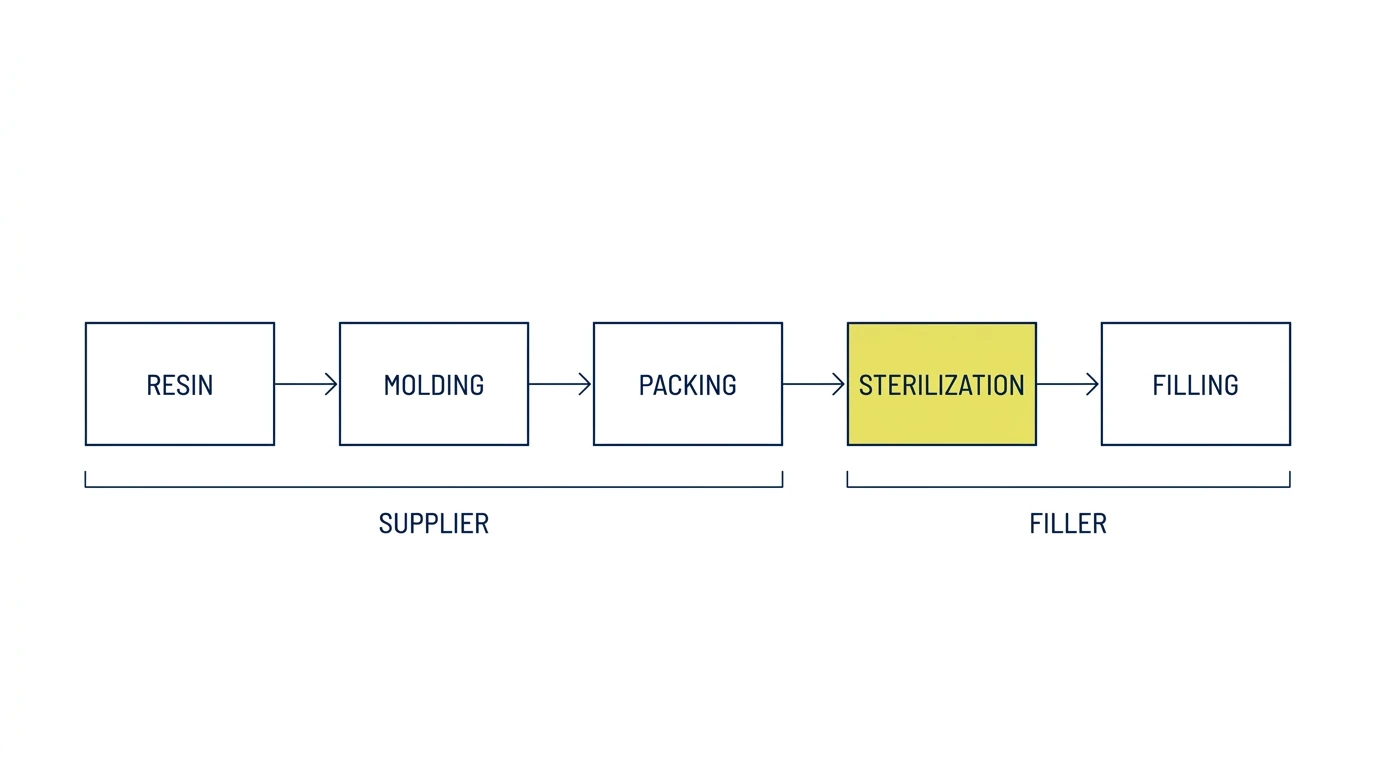
That division of labour is the practical answer to most "are your caps sterile?" emails. A molder can control bioburden, material and packing. It cannot certify a sterile state that depends on a sterilization cycle and a barrier it does not own — unless it also runs a validated sterilization process, which is a different factory with a different quality system.
The document-to-claim map
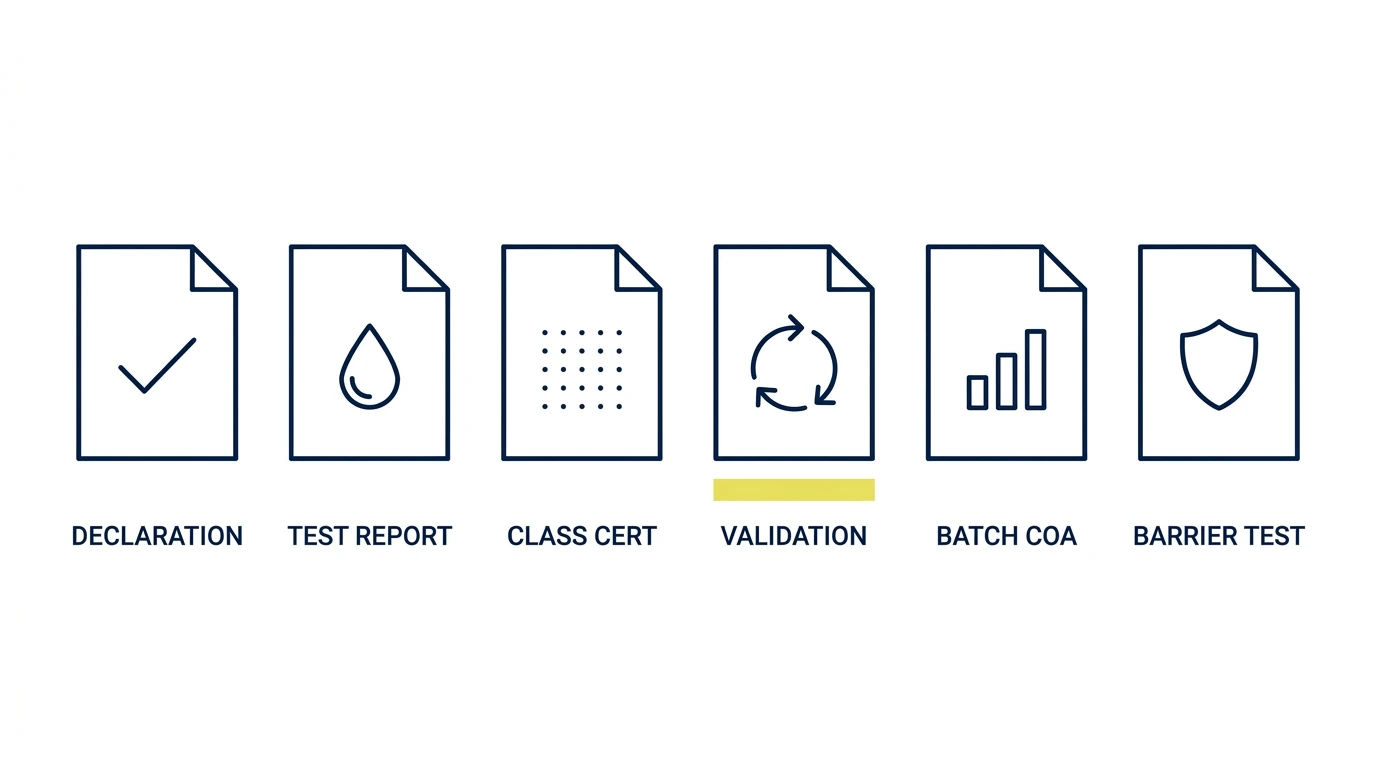
Put the six documents side by side and the confusion usually resolves. Each one answers a narrower question than buyers assume.
Document | What it proves | What it does not prove | Who can sign it |
|---|---|---|---|
Declaration of compliance (1935/2004 and 10/2011) | The article is within the food-contact rules applicable to it | Migration performance at your fill conditions; microbial state | Material supplier or converter |
Migration test report | The tested article released substances within limits under the tested conditions | That an untested color or size behaves the same | Accredited laboratory |
Cleanroom classification certificate | A room met a stated ISO class on the stated date | That the room still does; that the part stayed clean | Cleanroom certifier |
Sterilization validation report | A defined cycle achieved a stated SAL on a defined load | Anything about a different load, package or site | Contract sterilizer / process owner |
CoA with bioburden result | The batch's microbial load was within the stated limit | That the batch is sterile | Manufacturer |
Sterile barrier test data (ISO 11607) | The package holds its integrity and sterility claim through ageing and distribution | That a different package does | Packaging validation lab |
Two habits make the map work. First, ask who signed — a declaration issued by a resin supplier and re-issued by a converter are different documents with the same title. Second, check the scope line before the conclusion; verifying a packaging supplier's certificate is mostly an exercise in reading the scope, the standard edition and the expiry date rather than the logo.
How to write all three as three line items
The one-sentence version is what most buyers send:
"Spout caps, food grade, sterile, suitable for aseptic filling. Please confirm."
It cannot be answered well. A supplier will confirm the parts it can and stay quiet about the rest, and the confirmation will read as agreement to everything. The three-line version takes ten minutes longer and produces a document you can audit:
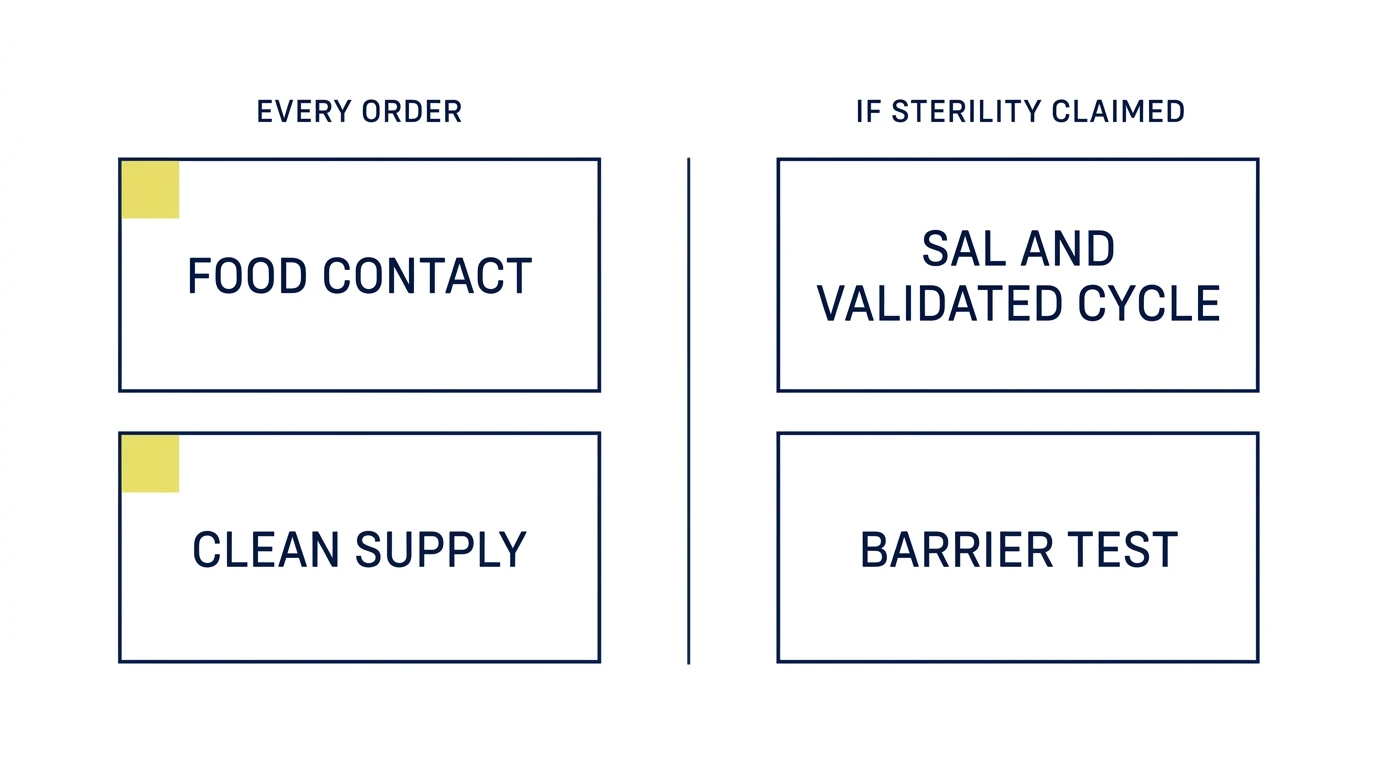
- Food contact. Declaration of compliance to Regulation (EC) 1935/2004 and Regulation (EU) 10/2011, made under GMP per (EC) 2023/2006, covering the finished spout and cap, including color masterbatch; overall and specific migration test report on the specified size at worst-case time and temperature for our product.
- Clean supply. Manufacturing environment declared as a named ISO 14644-1 class, with the current classification certificate and particle-count report taken at rest and in operation; packing performed in the same controlled zone; material transfer procedure stated.
- Sterility. Either (a) supplied non-sterile with a stated bioburden limit per unit and a CoA per batch, sterilization performed at our filler; or (b) supplied sterile by a validated process — method named, SAL 10⁻⁶, barrier per ISO 11607 — with the validation report and the sterilization site named.
Answer (a) is the normal answer for food closures, and it is not a downgrade. It is a clear allocation of responsibility: the molder owns bioburden and material, the filler owns the cycle. Answer (b) exists, but it changes who you are buying from — the SAL convention inside it is the medical-device one FDA applies to devices labeled sterile, and a food product claiming commercial sterility is instead governed by its own scheduled process, filed and validated separately.
The five questions worth attaching to any of this: Which article exactly was tested? At what time and temperature? Which standard edition was the certificate issued against? Who performed the test, and is their scope accredited for that method? What happens to the claim if we change color or size?
If the rest of your specification is still open — bore, seal geometry, cap type, pouch film — work through the spout cap specification checklist first; the three compliance lines above slot into it rather than replacing it.
What a spout-cap supplier can document — and what it should refuse to
A molder that answers all three questions confidently is usually answering only the first.
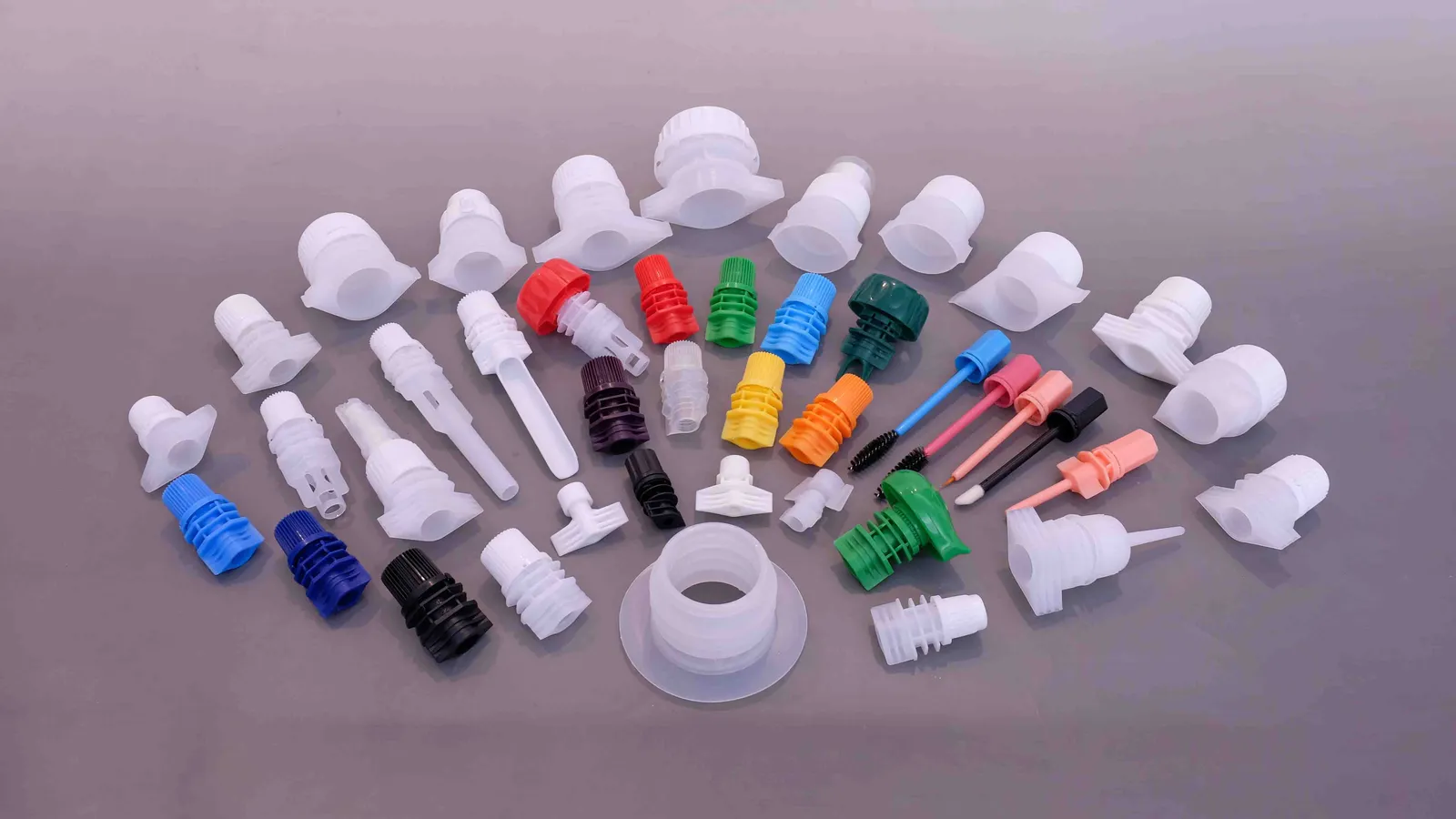
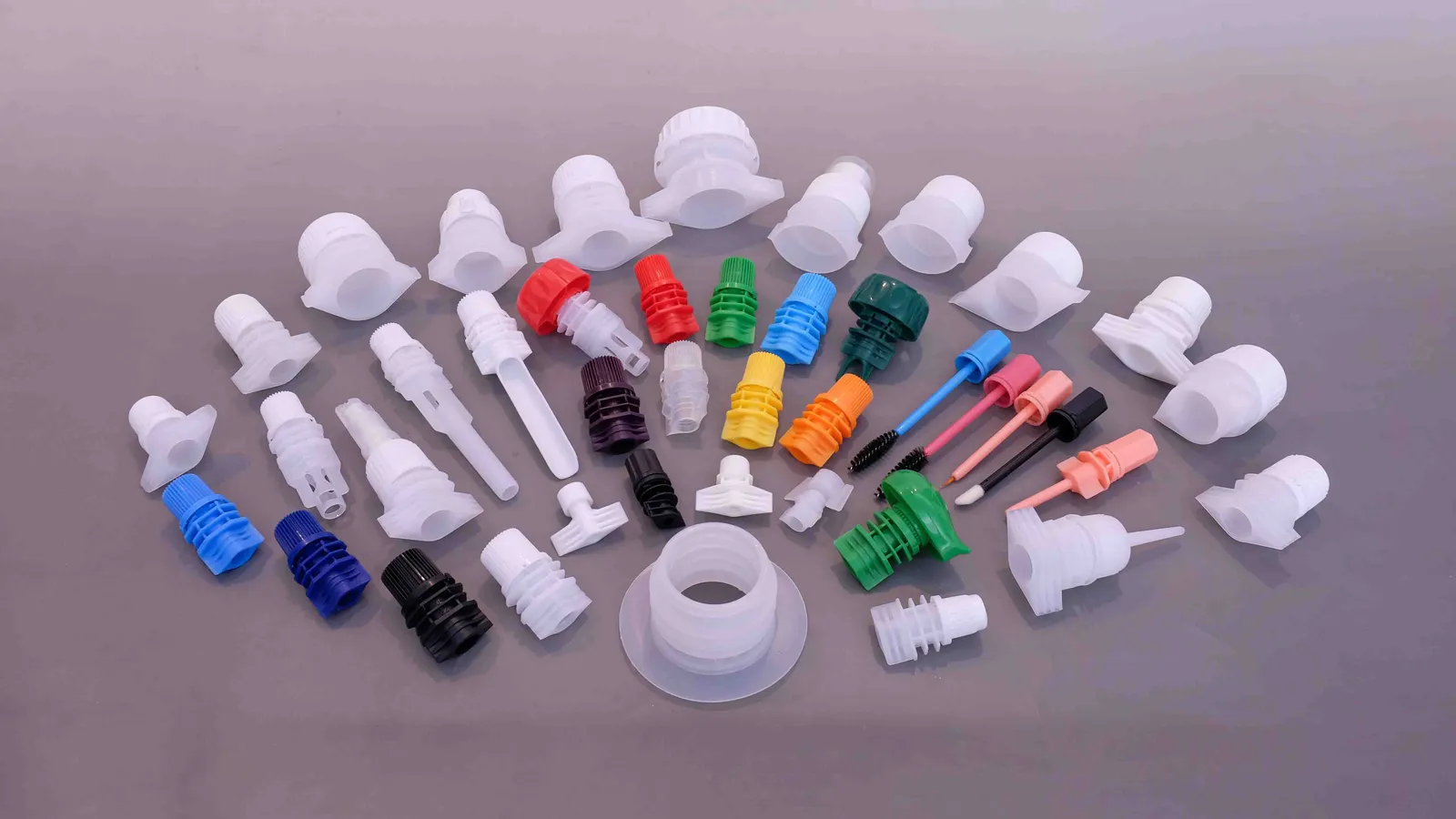
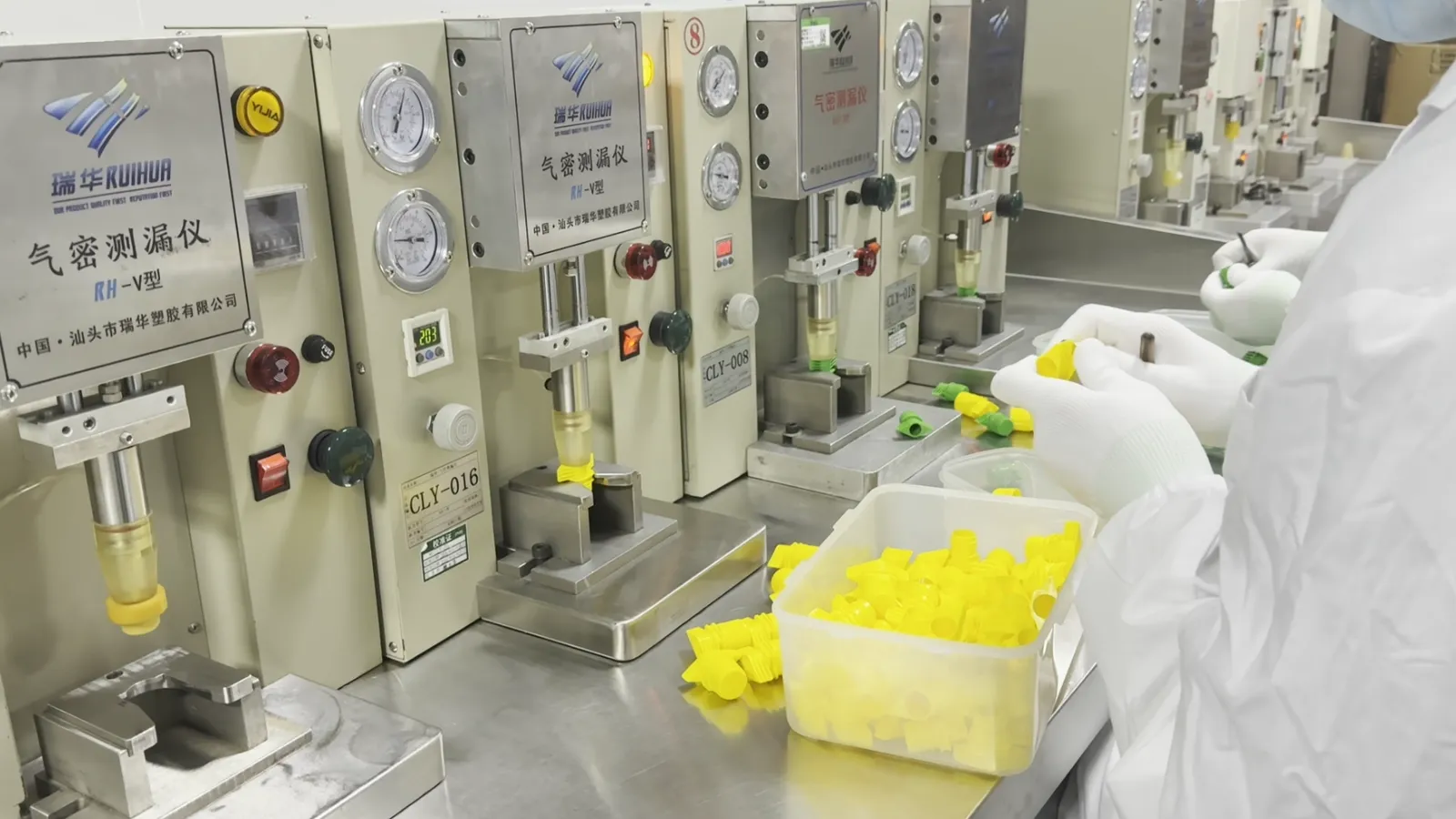
What Ruihua holds and can hand over: ISO 9001:2015 and HACCP system certification, US FDA food-grade material compliance, and EU 1935/2004 (TÜV SÜD) — plus product-level references to China's GB 4806.7 and Germany's LFGB. Spout caps are molded from food-grade PP and PE in a double-door dust-free injection workshop with a central feeding system, and machine-vision inspection is available on request rather than applied to every order by default. Third-party reports, where they exist, are scoped to what was tested: our SGS PPWR heavy-metal and total-fluorine reports were run on a named RD sample, and they say so — sample results, not a family-wide claim.
Vendor vocabulary is the cleanest test of this, so it is worth walking through rather than glossing over. A data sheet that reads "Class-300,000 Cleanroom" is not quoting an ISO 14644-1 class — the ISO series runs from 1 to 9, and 300,000 is a particle count in the older per-cubic-foot grading. Converted, it is roughly 10.6 million particles per cubic meter at 0.5 µm and above: about three times looser than ISO 8, not tighter. So the accurate description of a workshop marketed that way is a controlled, double-door dust-free area, which is a real and useful thing, and the word "cleanroom" is doing more work than the number behind it. If your specification is written in ISO classes, ask any supplier using this vocabulary for the particle-count data and the class it was measured against, and put the answer in writing.
What we do not publish: a sterilization validation report and SAL under our own name. Where a specification needs those, say so early — the documents belong to whoever owns the sterilization step, usually the converter or the contract sterilizer, and any closure supplier that offers them without naming the site and the validated cycle is selling you a word.
That asymmetry is the reason this page exists. If a supplier's quality pack contains a food-contact declaration, a cleanroom certificate and a sterilization validation report, ask which legal entity signed each one. If it contains only the first, you have not been lied to — you have been sold requirement one when you asked for three. The cluster hub for the rest of this conversation, from MOQ rules to supplier audits, is Sourcing & Supply.
When you need none of this
Not every spouted pouch needs a cleanroom, and very few need a sterile closure. An ambient-stable acidic or low-water-activity food — an acidic juice drink, a vinegar-based sauce, a syrup — is preserved by pH, water activity, heat or barrier, not by sterility. For those, food-contact compliance plus hygienic manufacturing plus a sealed, integral pack is the right specification, and adding "sterile" to the RFQ buys nothing except a longer lead time and a supplier who has to guess what you meant. A detergent or a cosmetic fill is further out still: it needs chemical resistance and its own regulatory stack, not food-contact compliance.
The testing that actually protects you there is pack integrity: seal strength, leak, drop and transit performance. If that is your case, start with leak and integrity test methods for non-sterile spouted pouches instead of this page's sterility section.
The three-line checklist
Before the next RFQ goes out, three questions decide whether you are buying what you think:
- Which requirement am I actually writing — material, environment, or validated process?
- Which document discharges it, and who signs that document?
- What does that document leave unproven, and who owns that part?
A specification that answers all three is short, auditable and boring in the best way: when the quality file is opened two years later, every claim in it points at a piece of paper that says exactly what it says.
If you are writing that spec now and want to see the documents we can actually hand over, the spout cap sample and quote request is the shortest route.