
Direct answer. A powder pouch spout is specified in four steps that have to agree with each other: the powder's particle size and bulk density set the minimum bore, the bore and the mouth geometry decide whether the powder arches and stops, the cap seal and the spout resin decide whether the contents are still free-flowing weeks after opening, and your filling and capping line decides what the spout can physically be. Chosen as one closure system, these four settle in a single sample round. Chosen as four separate line items, they surface as a customer complaint about a pack that "doesn't pour".
This guide is for brand owners, packaging engineers and buyers specifying the closure component of a stand-up pouch or doypack — the doypack spout and its screw cap, welded into the pouch film. It is not about the pour spout cap on a gas can or an oil bottle, and it is not about the finished pouch itself. The map of which closure suits which fill lives on the spout caps by content hub page; this article takes the powdered corner of that map, where the liquid-pouch rules stop working.
Why Powder Behaves Nothing Like Liquid in a Spout
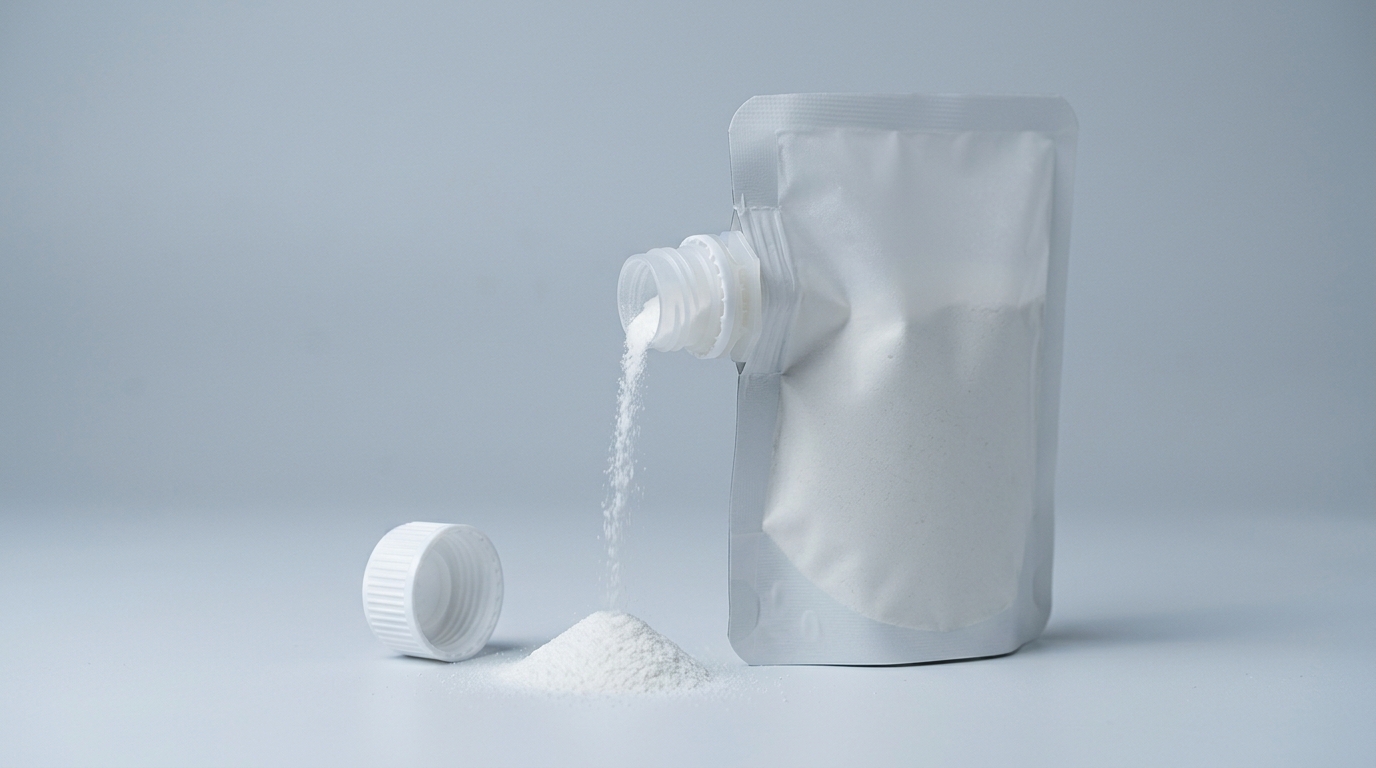
Watch a 500 g pouch of chicken powder or instant coffee being poured through an 8.6 mm spout — a bore the catalogue also carries for juice, sauce and cosmetic packs — and the difference is immediate. The powder does not flow; it pulses. A plug of powder arches across the opening, the pouch glugs, a burst of powder dumps out, and then it stalls until the bag is shaken hard enough to break the arch. That arch is what a user calls a clogged spout: the pack is not empty, it simply will not pour.
Powder punishes a spout in four ways that liquids never do:
- Bridging and arching. Coarse or cohesive powder forms a stable arch over the opening and simply stops. The narrower the flow channel, the easier the arch is to form — and every internal step or shoulder in the closure gives it a place to lock.
- Dust in the threads. Fines settle into the cap's thread helix, where they get crushed and compacted every time the cap is turned. The cap starts to feel gritty, then stiff, and eventually stops closing cleanly.
- Slow, erratic dispensing. A liquid pours at a predictable rate; a powder that has to be coaxed out turns every use into a decision about how hard to tilt the bag. Users squeeze the pouch, and that is how seams and welds get stressed.
- Perceived defect. To the end customer a spout that will not pour reads as a bad pack, not as a mismatched component — and the complaint comes back to the brand either way.
The one article on this query that addresses powder directly stops at the advice that "a wider spout might be a better option" (bnpak on spouts for powders). That advice is not wrong; it just leaves out the part a packaging engineer needs — how wide, at which point in the flow path, and why. That is what the rest of this article covers.
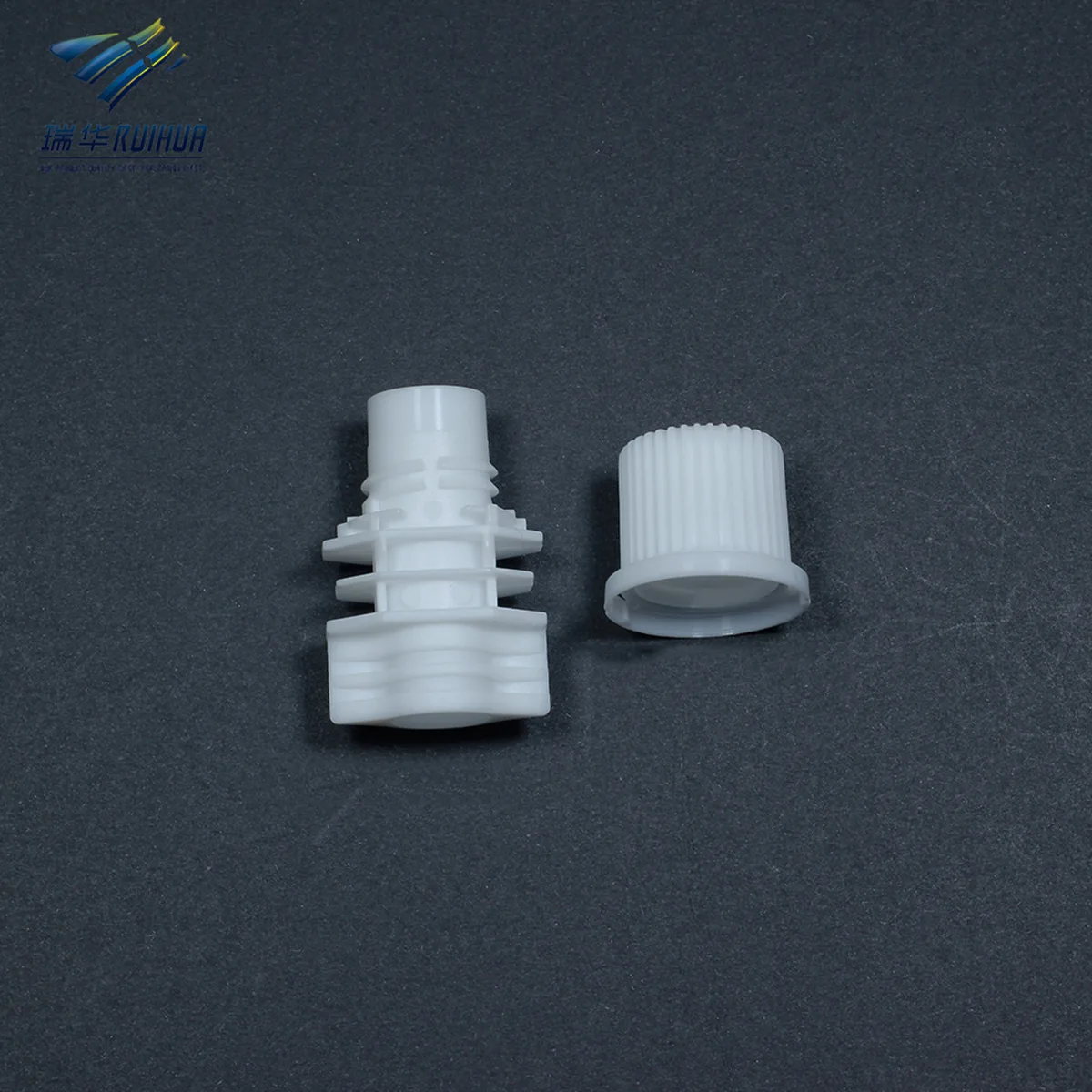
A 10 mm fitment of the type specified for food powder and liquid food pouches — the lower end of the retail powder band, where dosing feel matters more than pour rate.
Powder Pouch Spout Sizes: How to Pick the Bore
Bore size is a flow decision before it is a dimensional one. Two properties of your fill drive it: the largest particle that has to pass, and how freely the bulk powder moves when it is pressed down by a full bag. Retail powders that are free-flowing and fine — cocoa, milk powder, ground spice — and cohesive ones that cake under pressure — protein blends with fat and humectant content, onion or garlic powder — can land on different bores at the same pouch size. The two ends of that spread are a 10 g single-serve stick and a protein powder pouch of a kilo, which is why the bore shortlist is split by fill weight and pack format rather than by diameter alone.
The table below is how the useful band divides for real powdered fills. Bores from 1.2 mm to 40 mm exist across the whole product family; the spout cap diameter guide covers that full range, and this table covers the part a powder packer will shortlist.
Powder fill | Bore band | What to confirm before you commit |
|---|---|---|
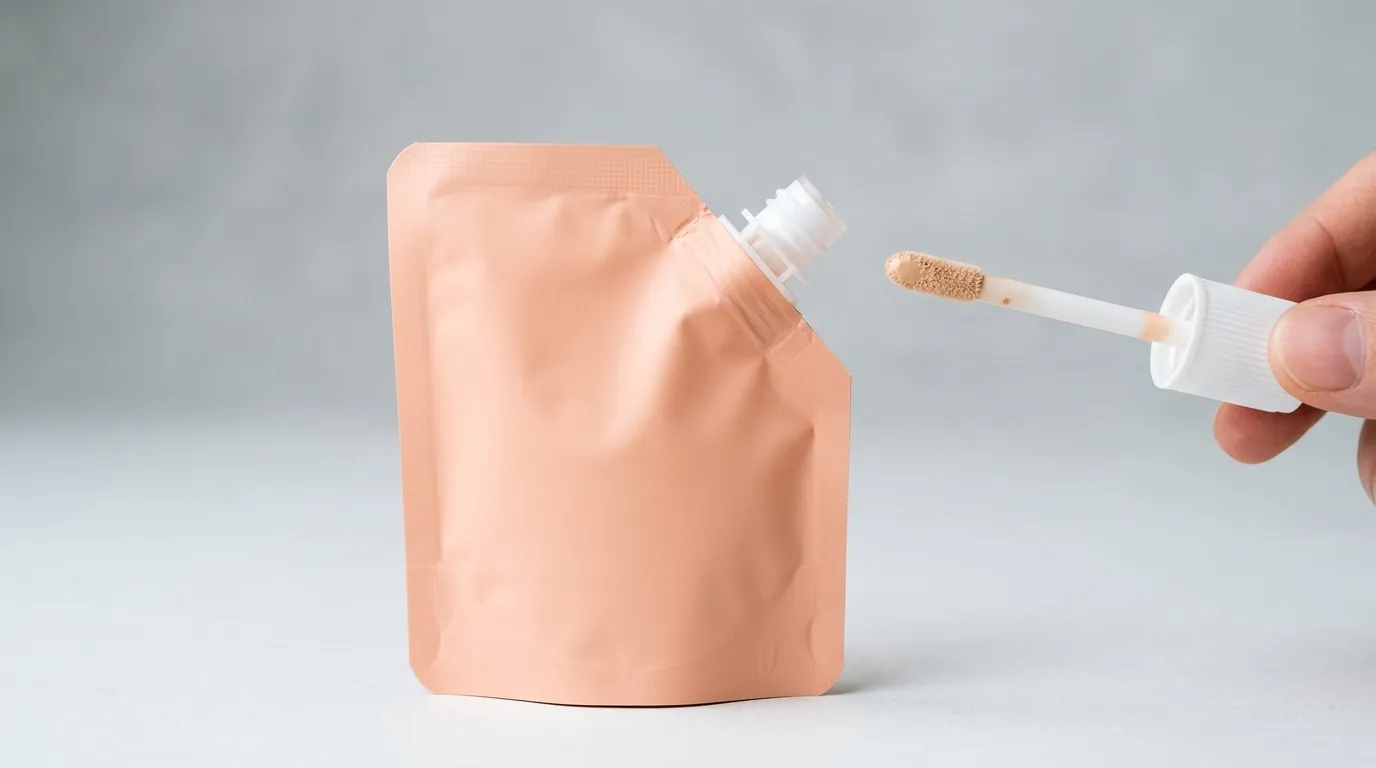
Single-serve sticks and sachets, 3–10 g | 8.6–10 mm | Whether the pour feels like dosing or like shaking; dust behaviour in the thread |
Retail powder pouch, 100–500 g — seasoning, coffee mix, milk powder, chicken powder | 10–15 mm | Pour rate with a full bag and again as it empties; cap closing cleanly over fines |
Protein, meal-replacement and nutrition blends, 500 g–1 kg | 15–22 mm | Clumping tendency of the blend after opening; whether the user pours or spoons |
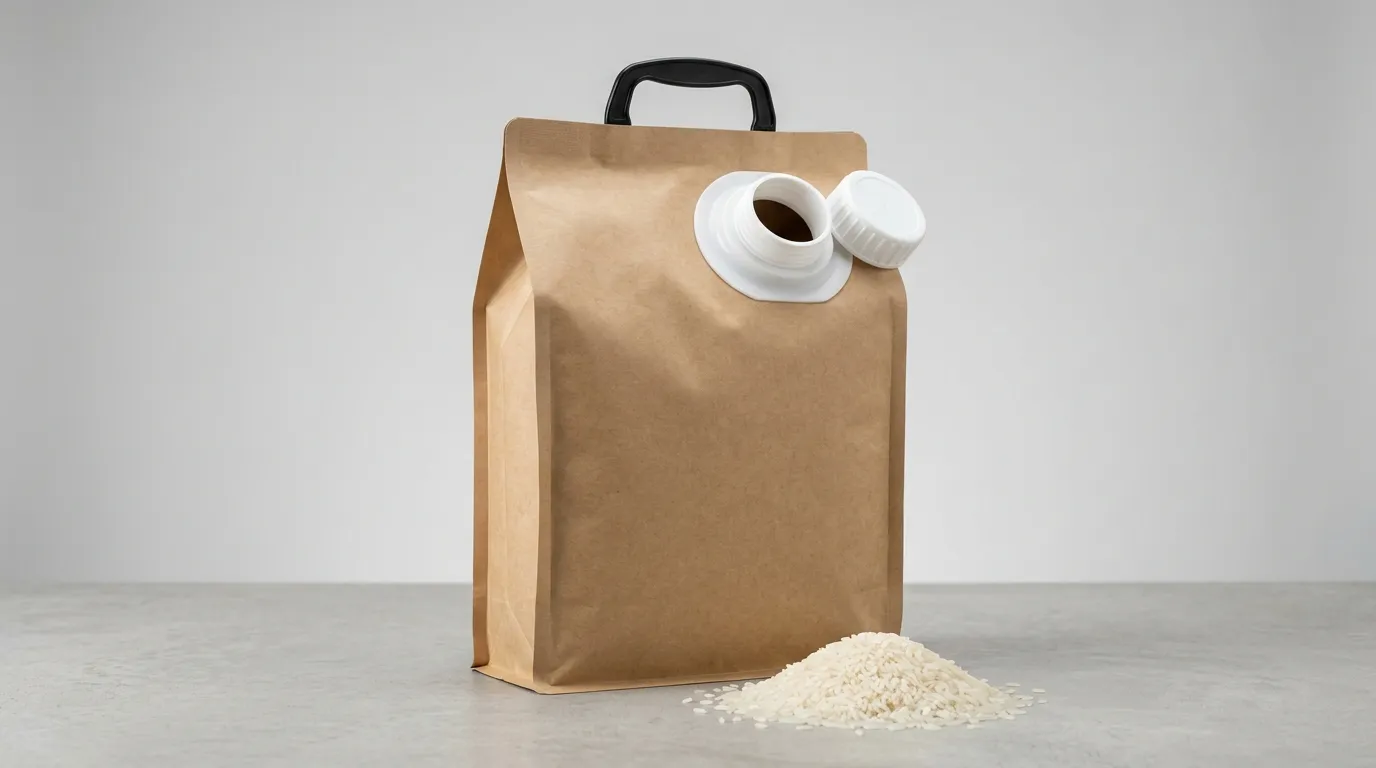
Bulk blends, dry pet food, cat litter, 2–15 kg | 26–33 mm | Pour speed with a full bag pressing down; dust load; whether a carry handle is in scope |
Refill and industrial fills, 3–20 kg | 33–40 mm | Weld quality on the film; capping torque on the line |
The bands above are a working synthesis rather than a standard formula: they come from the bore sizes our own catalogue carries for powdered applications, cross-checked against how the powder behaves once a filled pouch is tilted. Treat them as a shortlist filter — confirm the final bore on a full bag of your own product, at the pouch weight you will sell.
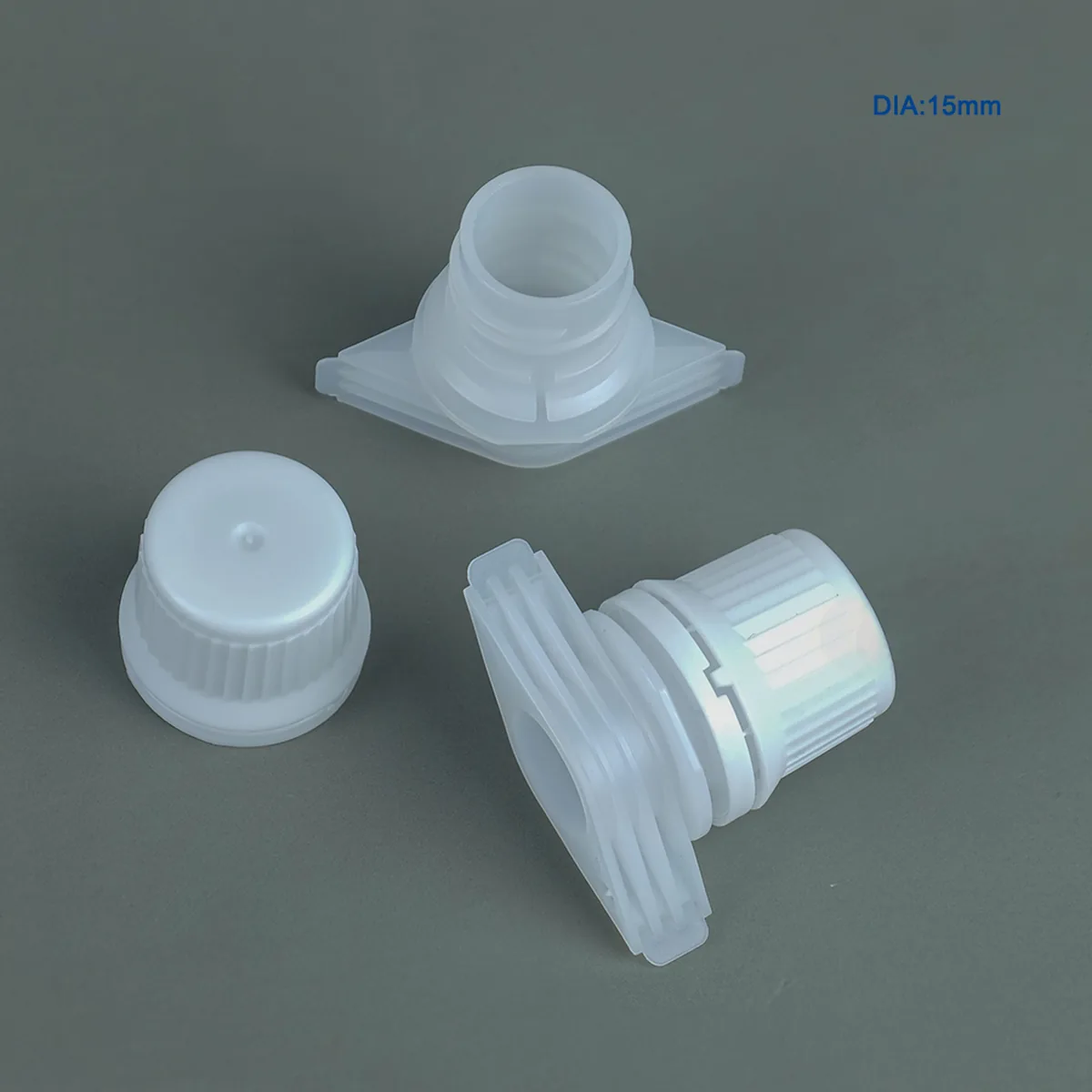
A 15 mm screw-cap-and-spout fitment — the workhorse bore for retail milk powder, flour and sugar pouches.
Two spec points worth carrying into the sample round:
The bore floor is set by the largest particle, not the average one. A powder whose typical particle is 200 µm but which carries agglomerates or inclusions ten times that size will bridge on the agglomerates. Measure the top of the distribution, then leave margin for the fines that will compact around it.
Where the powder is genuinely cohesive, no fixed multiple of the particle size settles the question. In bulk-solids engineering the outlet is sized from the material's measured flow properties, and a stable cohesive arch is a recognised no-flow condition that must be designed out rather than shaken out (Jenike & Johanson on hopper bridging). A pouch spout is a much smaller flow channel than a hopper, but the mechanism is the same, and the practical translation is simple: test with a full bag of your actual powder, at the pouch weight you will sell, before you fix the bore. A spout that pours generously on a half-filled sample can stall when 500 g of powder is pressing down through it.
In Ruihua's own catalogue the powder end of the range looks like this: a 15 mm model (RD-143, spout body roughly 44 × 31 × 23 mm, cap roughly 25 mm across) is specified for sauce bags and for milk powder, glucose, granulated sugar and flour pouches; an 8.6 mm model (RD-098, spout body roughly 21 × 34 mm) is specified for chicken powder doypacks. Both are food-grade PP/PE. Larger fills move to a 26 mm model specified for large-capacity granular and powdered products such as cat litter, dog food and feed, or a 30 mm model for pet food, cat litter, rice and cereal.
Funnel Bore vs Straight Bore: Where Powder Bridges
On a spout, bridging is rarely about the powder being too big for the hole. It is about geometry. Powder arches where the flow channel changes — where it narrows, where it steps, where a shoulder interrupts it. A short, straight, wide channel with no internal ledges gives an arch nowhere to lock. A channel that funnels down to a small mouth, or that meets a sharp internal step at the cap seat, hands the powder the exact geometry it needs.
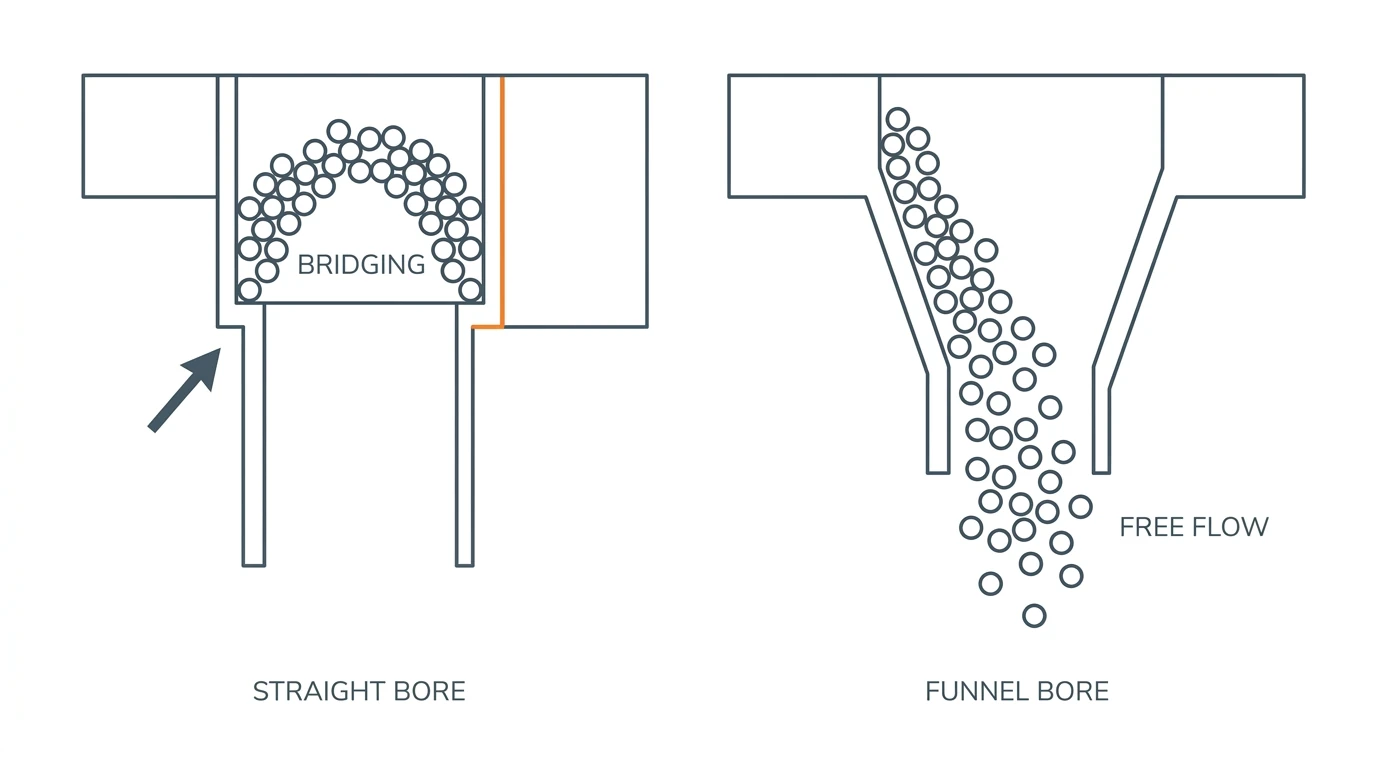
Where a powder spout bridges: a straight channel with a shoulder lets an arch lock, while a short tapered channel keeps the powder moving.
Three design decisions do most of the work:
- Move the narrowest point. A funnel spout cap — a taper-mouthed bore — puts the narrowest section at the exit, past the point where the pouch's own headspace has already stripped the flow into a column. A straight cylindrical bore of the same nominal diameter puts the full bore depth in the path.
- Eliminate internal shoulders. Every step inside the closure — a seat, a ledge, a lip where the cap meets the body — is a candidate arch line. Where the cap is meant to be reversible or to carry a dosing feature, the shoulder is often unavoidable, which is a reason to size the bore one band up rather than down.
- Keep the cap interior open and drainable. A cap that traps powder every time it is closed looks unclean and invites moisture in through the fines layer. A wide, open interior returns powder on the next pour.
Thread geometry matters for a different reason. Dust accumulates in the thread helix; a coarse, open thread is easier to wipe and less prone to compacting fines than a fine-pitch thread on a dusty fill. On very fine hygroscopic powders, the thread is where a pack starts to feel cheap, long before the pour itself becomes a problem.
An honest caveat belongs here: how much a given powder bridges is a property of that powder — its cohesion, moisture content and fines fraction — and no datasheet settles it. Industrial practice is to characterise flow behaviour rather than assume it, and the outlet geometry work behind that practice is summarised in this overview of hopper outlet geometry and arching. The cheap version of the same rigour for a pouch program is a full-bag pour test with product straight off your filler.
Venting: Why a Powder Spout Glugs (and What Fixes It)
The glug has a mechanical cause. As powder leaves the pouch, air has to come back in to replace the volume it occupied. If the spout itself is the only path, the two flows fight each other: powder blocks the air, pressure drops inside, the flow stalls, air rushes back through the powder, and the cycle repeats as a pulse. In a rigid bottle this is the sound you hear when a full bottle is upended.
A flexible pouch is a partial fix, because the film collapses as the contents leave and takes up some of the volume change. It is not a complete fix: the top seal, the gusset and the standing base all resist collapse. The consequences for spec work are modest but real:
- A larger bore shortens the pulse cycle. With more bore area, powder and returning air interfere less, which is part of why the 15–22 mm band feels smoother on a full retail pouch than a 10 mm bore does.
- Do not spec a spout that chokes the film's collapse. A fitment whose flange and body sit tight against a stiff top seal leaves less of the pouch free to move; on a fully filled pouch this shows up as a harder, more intermittent pour.
- A degassing valve is not the answer to this problem. A one-way valve is a separate component used to let gas out of a sealed pack — the classic case being carbon dioxide from roasted coffee — and it is not designed to let air into a pouch while powder is being poured. A desiccant sachet is a third thing again: it manages moisture inside the headspace, not airflow.
Moisture, Caking and Reclose: What the Cap Must Hold
Before the first opening, the pouch film does the protecting. After it, the spout pouch cap is the only controllable moisture door on the pack, and for a hygroscopic powder that is the difference between a product that pours for the life of the pack and one that lumps in the last third.
The mechanism of powder caking is familiar to anyone who has left a jar of onion powder open: many food powders sorb moisture from the air, and as moisture content rises the particles become sticky and start to stick to each other. The first symptom is lumping; the end state is a caked mass that clogs the spout and has to be dug out. Three levers exist, and they are often confused with each other:
Lever | Whose job | What it changes | What it cannot do |
|---|---|---|---|
Formulation | The formulator | Anti-caking agents and moisture-scavenging ingredients change how the powder responds to the moisture it meets | Rescue a pack whose cap no longer closes |
Pack | The pouch and film specifier | Desiccant sachets and an oxygen-and-moisture barrier film slow the moisture that reaches the powder | Stop the repeated opening and closing that follows first use |
Closure | Whoever specifies the spout and cap | A cap that seats fully and holds torque, on a thread that does not hold fines between the sealing surfaces | Make a hygroscopic powder stop being hygroscopic |
Two powder-specific details follow from that. First, dust on the sealing land of a powder pouch spout cap prevents full engagement, so the cap will feel closed long before it is; any cap for a dusty fill is worth testing with powder deliberately left on the mouth. Second, for a staple that sits in a pantry for months, a tamper-evident or pilfer-proof band gives the buyer first-opening evidence, and it is specified with the same ring geometry that has to survive the filler. Child-resistant and anti-choking cap types are a separate family, specified where the contents are hazardous to a child — baby puree and juice squeeze pouches, for instance — rather than for a retail food powder.
Material and Seal Compatibility: PP, PE and the Weld Window
A spout can have the right bore and the right mouth and still fail, because a fitment is only as good as the weld that holds it in the film. That weld joins two materials chosen by two different people: the spout's resin, chosen by the closure supplier, and the film's inner sealant layer, chosen by the converter. They have to match. The standard pairing is a PE spout with a PE-sealant film, and a PP spout with a film whose sealant is PP.
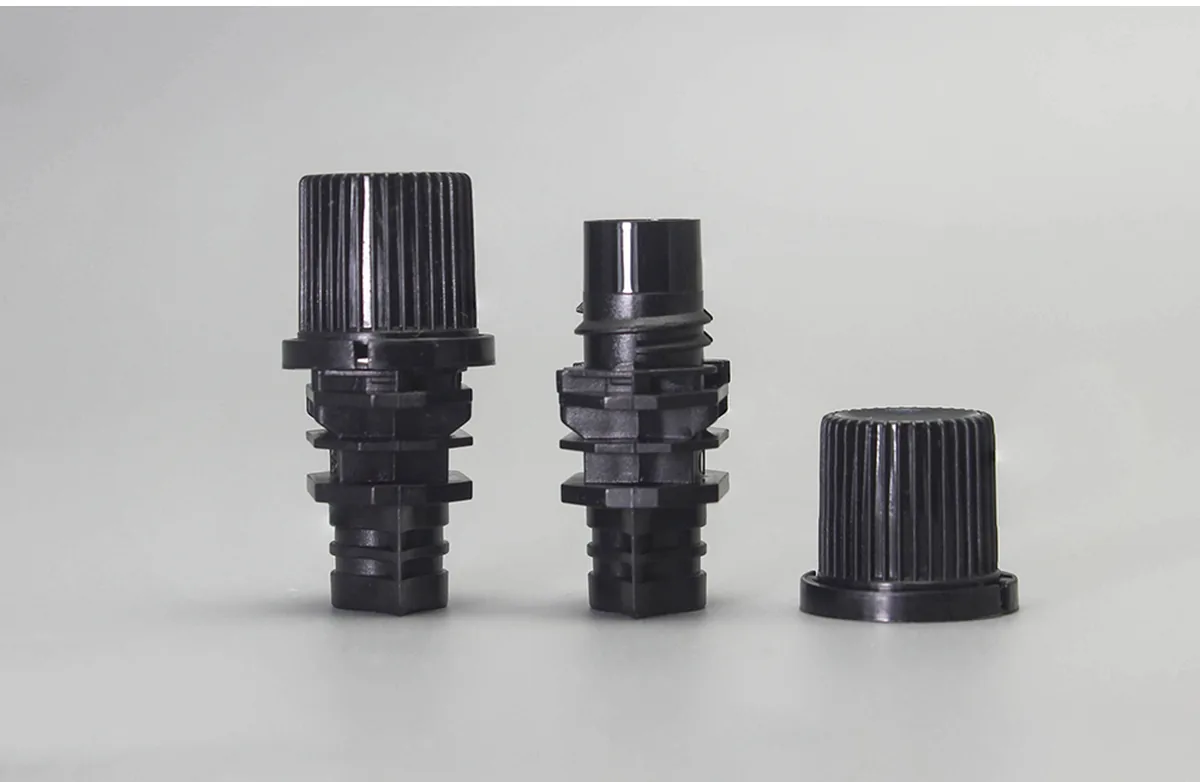
An 8.6 mm screw-cap fitment of the type specified for chicken powder and seasoning doypacks — small bore, food-grade resin, sealed into the pouch film.
Three compatibility points carry extra weight on powder:
- Sealing temperature. The line welds the spout into the film at a temperature the film survives without shrinking or burning through. Pouches built for recyclable mono-material PE structures seal at lower temperatures than conventional laminates, which is why spouts engineered to weld in the 110–130 °C window exist; they keep the whole structure mono-material-compatible. Why that window matters for recyclability is covered in the article on the mono-material PE pouch spout, and the mechanics in the spout cap sealing temperature guide.
- Product trapped at the flange. Powder that sits between the flange and the film at the moment of sealing is a guaranteed leak path. The sealing station has to be clean of loose product — on a dusty fill that is a line-discipline problem, and samples will expose it well before a production run does.
- The food-contact file. These parts touch food, so the paperwork is part of the specification. In the United States, the rules for the olefin polymers used in spouts and caps sit in 21 CFR 177.1520. In the European Union the framework regulation is Regulation (EC) No 1935/2004. Plastics are then covered by the specific measure Regulation (EU) No 10/2011. Ask the supplier for the document, not the word — a declaration or test report you can file, on resin that is stated to be virgin and food-grade. Which documents to demand of any supplier is itemised in the guide on food-grade spout cap certification.
Specifying for Your Filling Line
Most of the failure modes in this article are decided at the sample stage, and the sample stage only works if the supplier knows what the spout has to survive — including the spout pouch filling machine that will dose, seal and cap it. Send a fill profile rather than a product name:
- The powder. Largest particle size and a sense of the distribution, bulk density if you have it, and how dusty the fill is.
- The dose. Fill weight and the target pour behaviour — a controlled shake, a steady stream, or as fast as the bag allows.
- The pouch. Flat dimensions, filled weight, film structure and sealant layer, and whether a spout rail or guiding rail is part of the format.
- The filling method, and whether the powder can pass the spout at all. On a premade-pouch line the spout and cap are welded on before the pouch is filled, the powder is dosed in through the still-open top edge, and the top seal is made afterwards (a premade-pouch filling line); on a fill-through-spout line the spout is the only opening, so the powder has to travel down the bore. Confirm which route your pouch will run — on the second one the bore is both the filling channel and your customer's pouring channel, and the tighter of the two requirements sets the size.
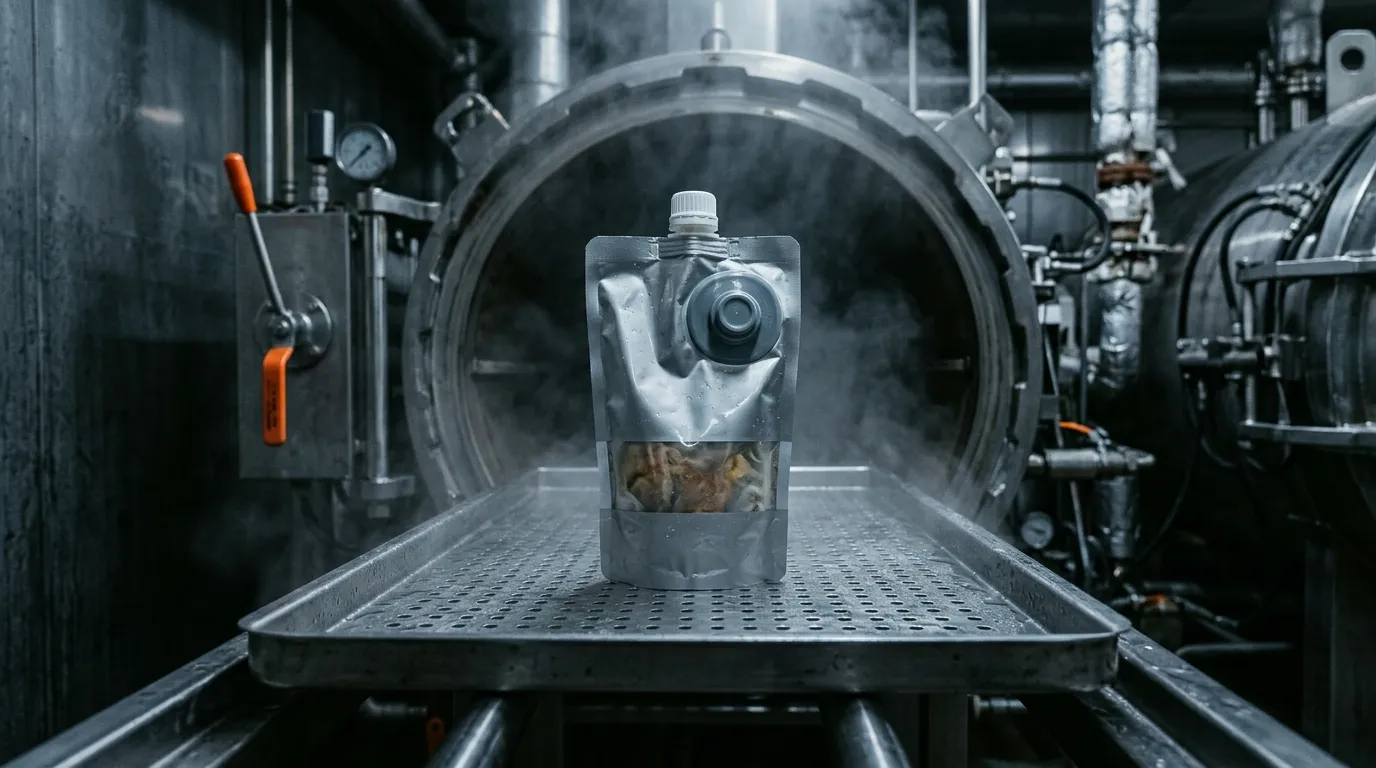
- The line itself. Seal temperature and dwell, capping torque limits, and the orientation the pouch runs in. Automated capping equipment has to suit the closing geometry — the same question the spout sealing and capping machines on our product side are built around.
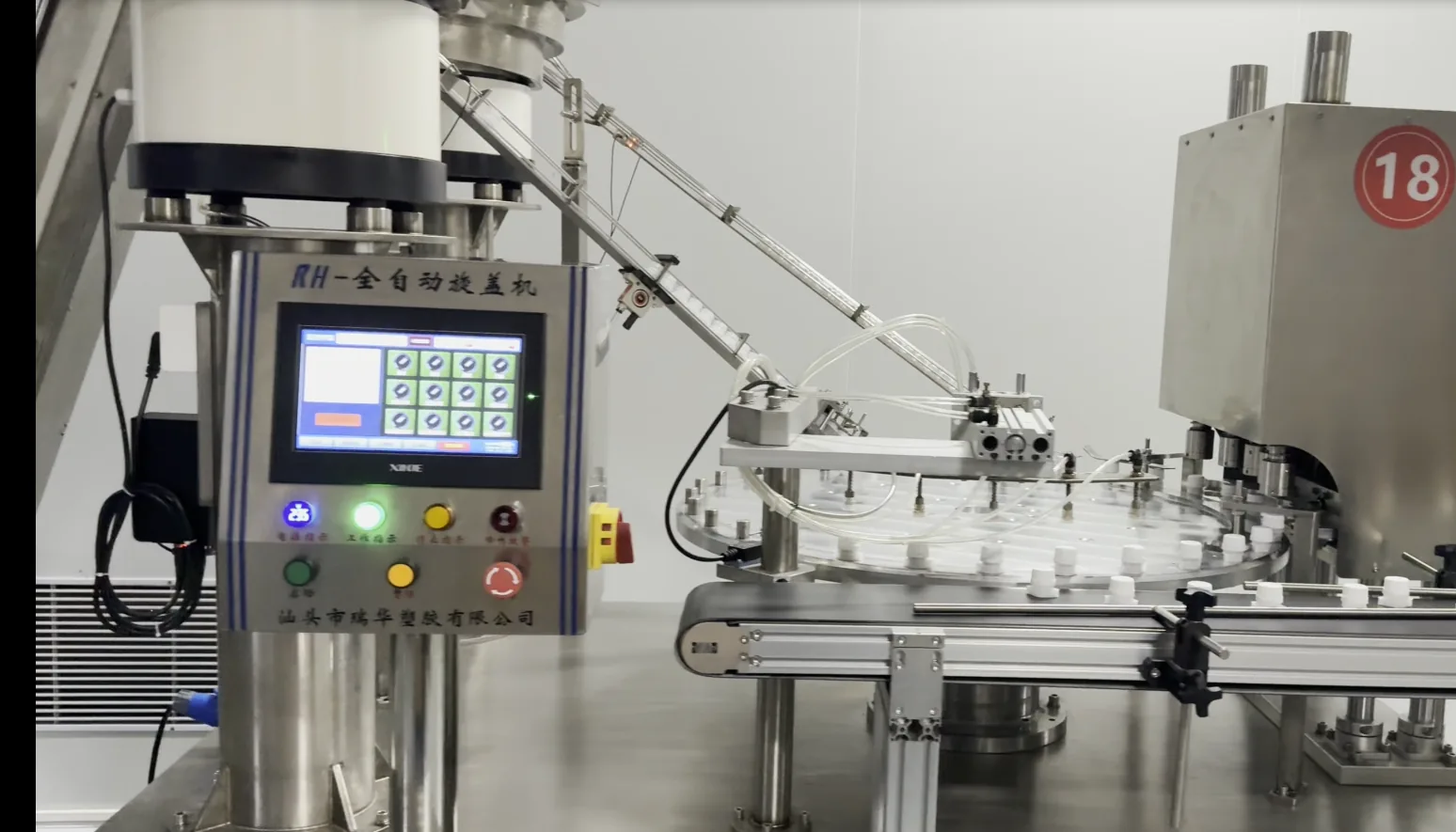
The spout has to survive the line: seal temperature, orientation and capping torque all feed back into the closure specification.
Then validate in this order, and stop at the first failure:
- Weld samples into your actual film at your actual seal temperature, then peel-test the joint.
- Pour-test a full bag of your actual powder, tilted the way a user tilts it.
- Close the cap over a powder-loaded mouth and check that it still seats and holds.
- Run a short pilot to confirm the spout does not interfere with filling, sealing, capping or case packing.
Once a candidate bore and cap type are in hand, the spout cap selector shows which stock geometry matches them.
A Powder Spout Specification Checklist
Work down this list and you will have specified the closure, not guessed at it:
- Largest particle in the fill, plus the fineness of the dust fraction.
- Bulk density and a free-flowing or cohesive judgement, confirmed by a full-bag pour test.
- Bore band from the table in this article, rounded up if the cap needs an internal shoulder.
- Mouth geometry: straight or tapered, and no internal step where an arch can form.
- Cap seat and thread that will still close over a layer of fines.
- Resin that matches your film's sealant, at a seal temperature your film survives.
- Food-contact documentation for the exact resin, for your market.
- Filled weight, pouch format and capping torque checked against the closure on your own line.
Ruihua samples against this list too: the catalogue carries spout geometry at 8.6, 10, 15, 22, 26 and 30 mm, so tell us which band your fill falls in and we will say which of them is worth a full-bag pour test.
A spout that pours badly is usually a component that was chosen from a price list rather than specified against the fill. If you are at the point of shortlisting bores for a powder pouch, send us your fill profile and pouch format and we will come back with sample fitments to weld into your own film — which is the state, according to everything above, in which the specification finally becomes answerable.