
Packaging compatibility testing and stability testing are usually quoted as one line item and run as one study. They answer different questions. Compatibility asks whether the product and the pack interact; stability asks whether the product stays within specification while it sits in that pack over time. A compatibility study is organized around contact — which materials touch the product, for how long, at what temperature, and what moves across that boundary. A stability study is organized around the calendar — which timepoints, under which storage conditions, and how the results trend.
The distinction matters because each test has a blind spot the other fills. A pack can pass stability with the product still in specification while quietly absorbing its aroma, and it can pass compatibility while stress-cracking in month nine. This page covers what each study is designed to prove, how to build one test matrix that serves both, where the pass criteria belong, and the five misreads that turn a passing report into a failed launch. It sits in the Choosing & Running Spout Caps series, where "spout cap" always means the closure on a stand-up pouch or doypack.
The Difference in One Sentence
Compatibility is a contact question; stability is a duration question.
Put a new sauce in a spouted pouch and compatibility testing asks: does the film's seal layer soften, does the cap thread swell, does anything migrate into the food, does the flavor come back wrong after two weeks in contact. Stability testing asks a different question: at month 3, 6, 12 and 24, is the product still inside its own specification — pH, color, viscosity, microbial state, seal strength — and if it drifts, does it drift predictably.
You need both answers because they fail independently. Neither one is the more important test, and a supplier who offers "stability" as a substitute for "compatibility" is answering a question you did not ask.
What a Compatibility Study Is Actually Asking
A compatibility study is a set of interaction questions, and a useful protocol names each one instead of running a single vague "compatibility test".
Four interactions cover most of what goes wrong in a spouted pouch:
- Migration, pack to product. Additives, slip agents, antioxidants, inks and adhesives move from the film, the spout or the gasket into the fill. In food contact this is the regulated axis: Regulation (EC) No 1935/2004 requires that materials not transfer constituents in quantities that endanger health, change the composition of the food unacceptably, or deteriorate its organoleptic properties. The plastics-specific measure, Regulation (EU) No 10/2011, turns that into overall and specific migration limits you can actually test against. In the US the equivalent route runs through food-contact notifications and 21 CFR Parts 170–199.
- Sorption, product to pack. The reverse direction, and the one nobody tests for unless prompted. Aroma compounds, essential oils, preservatives and actives absorb into the seal layer or diffuse through the cap. The product stays in specification on paper while the sensory panel says "flat" or "cardboard". Citrus, mint, coffee and highly spiced fills are the classic sufferers.
- Mechanical interaction. Plasticizers and surfactants in the fill soften or swell the polymer; residual stress in an injection-molded spout plus an aggressive fill produces environmental stress cracking at the flange or thread root. Detergent and high-surfactant refills are where this shows up first.
- Interface degradation. The flange weld, the cap liner, the foil or induction seal. Delamination, loss of seal strength after contact, a liner that swells and no longer reseats.
A defensible compatibility protocol fixes the four variables that move the answer: the fill medium (the real product, never water or a placebo), the contact ratio (fill volume against wetted surface — a 100 ml lab pouch is not a 1 L production pack), the temperature (elevated to accelerate, typically 40 °C, sometimes 50 °C for short screening), and the contact time (two to four weeks for screening, twelve weeks for a firmer read). Then it measures both sides: the product for assay, pH, appearance, odor and taste, and the pack for weight loss, dimensions, color, seal strength and torque.
Where the product is a drug or a biologic, the same logic carries formal names — extractables from the container, leachables in the product — and the FDA container closure guidance sets out the expectation. USP <1663> and <1664> describe the assessment of each. You do not need that vocabulary for a shampoo refill pouch, but you do need the discipline behind it.
What a Stability Study Is Actually Asking
Stability testing holds the pack constant and varies time. Its output is not a pass or fail on the material — it is a trend line with a shelf-life claim attached, and the claim is only as good as the timepoints under it.
The reference design is ICH Q1A(R2): long-term storage at 25 °C/60% relative humidity (or 30 °C/65% RH in hot, humid zones), an intermediate condition at 30 °C/65% RH where relevant, and accelerated storage at 40 °C/75% RH for six months. Testing at t=0, then at defined points across the study. Real-time data at the long-term condition is what supports the shelf life you print. Accelerated data supports the claim and exposes failure modes early; it does not replace real-time data.
That last sentence is the one buyers most often get wrong at the quoting stage, so it is worth being blunt: accelerated aging is a model, and models have assumptions. ASTM F1980 writes the commonest version into a method — the Q10 rule, where the acceleration factor is Q10 raised to the difference in temperature divided by ten. The standard is written for sterile barrier systems and medical devices, but the arithmetic is the one labs apply to food and home-care pouches too. At the default Q10 of 2.0, storage at 55 °C ages a sample about eight times faster than at 25 °C, so roughly six and a half weeks at 55 °C approximates a year at 25 °C. That arithmetic is only valid when the dominant failure mode is a single chemical reaction that speeds up with heat.
Three things break the assumption in a spouted pouch. Physical creep — the cap thread relaxing, the flange cold-flowing — runs on load and time, and its temperature dependence is not the single-reaction form that Q10 describes. Migration equilibrium depends on how long the two materials have been in contact, and heating can drive it to a different endpoint than the one you would reach slowly. Multilayer films can fail at an interface through differential expansion that no Q10 factor predicts. So accelerated data is a screening tool and an early-warning system. If your shelf life claim rests on it alone, you have a claim, not evidence. Budget the real-time work the same way: cost scales with timepoints and replicates, so a 24-month claim is normally paid in stages as the study reads out, not bought once up front.
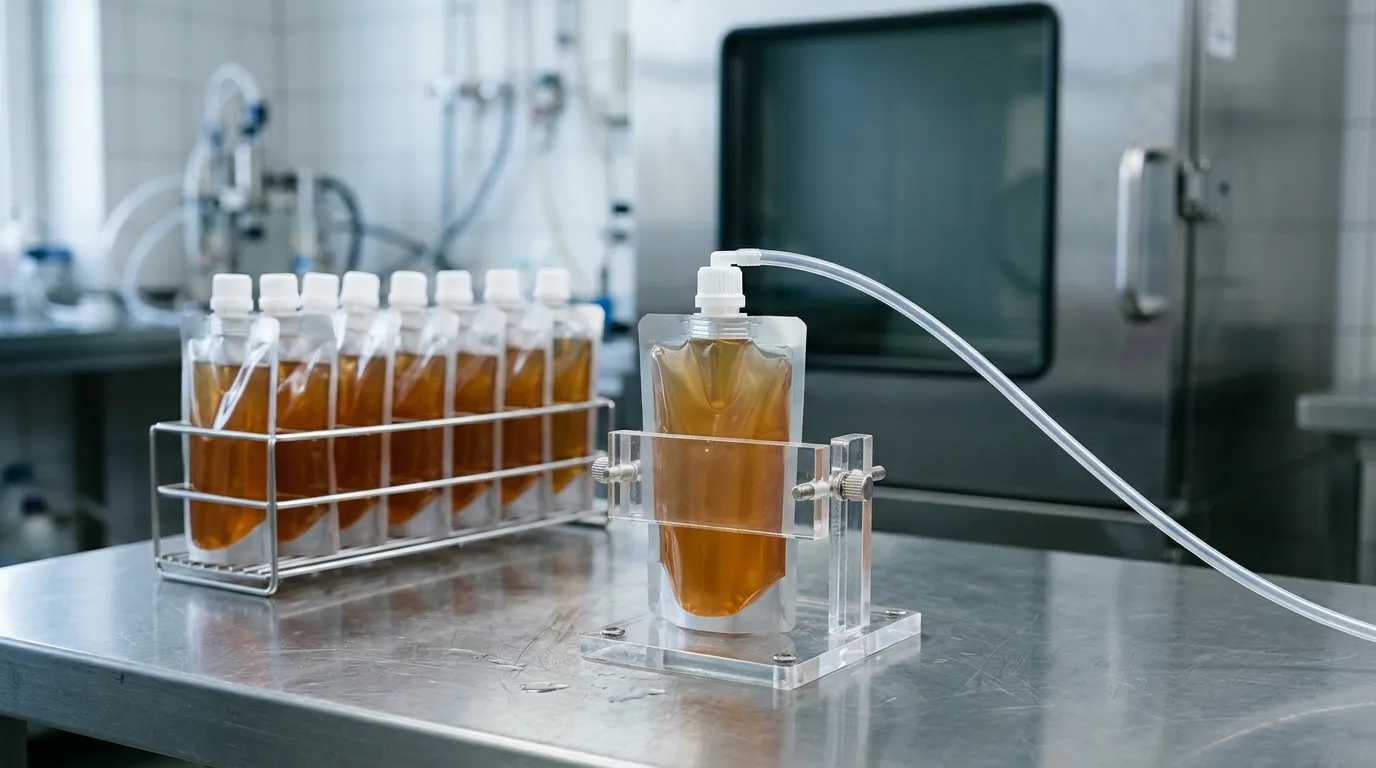
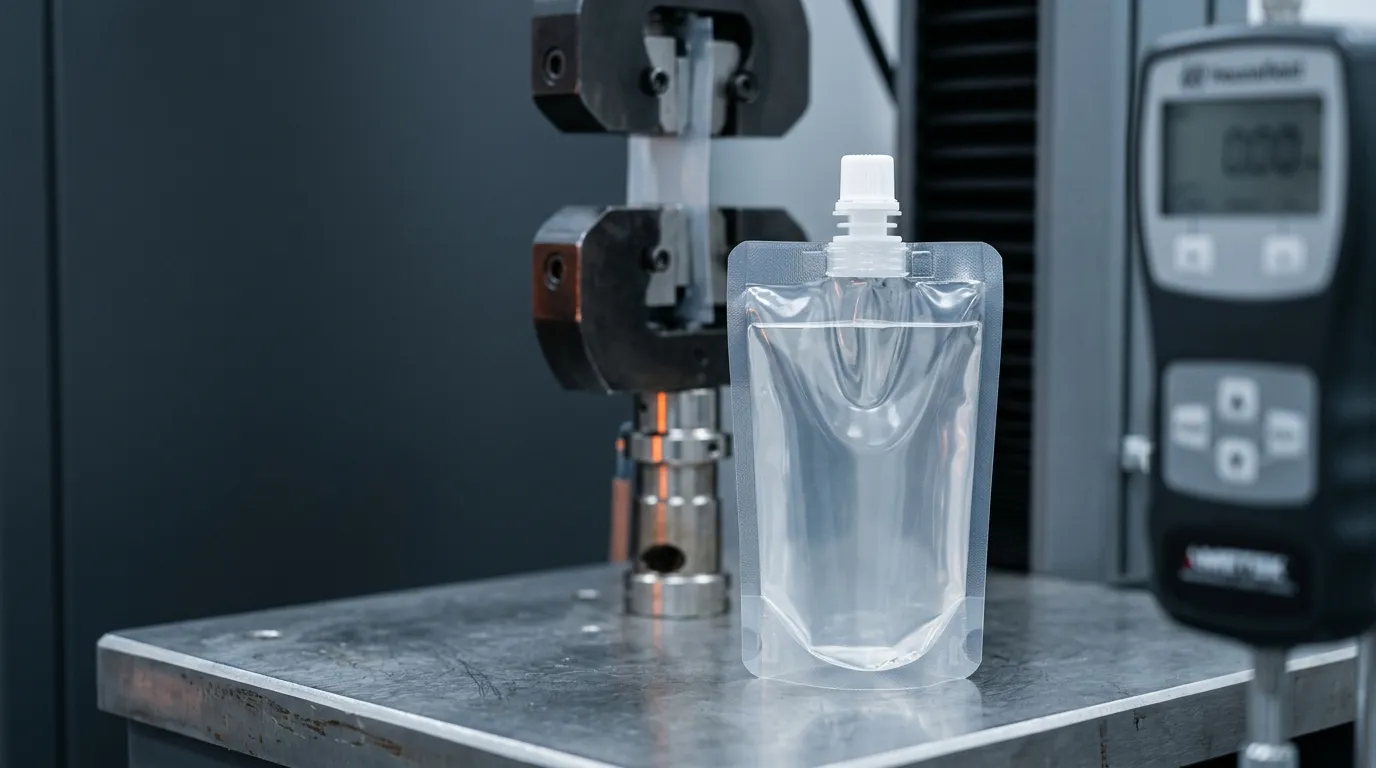
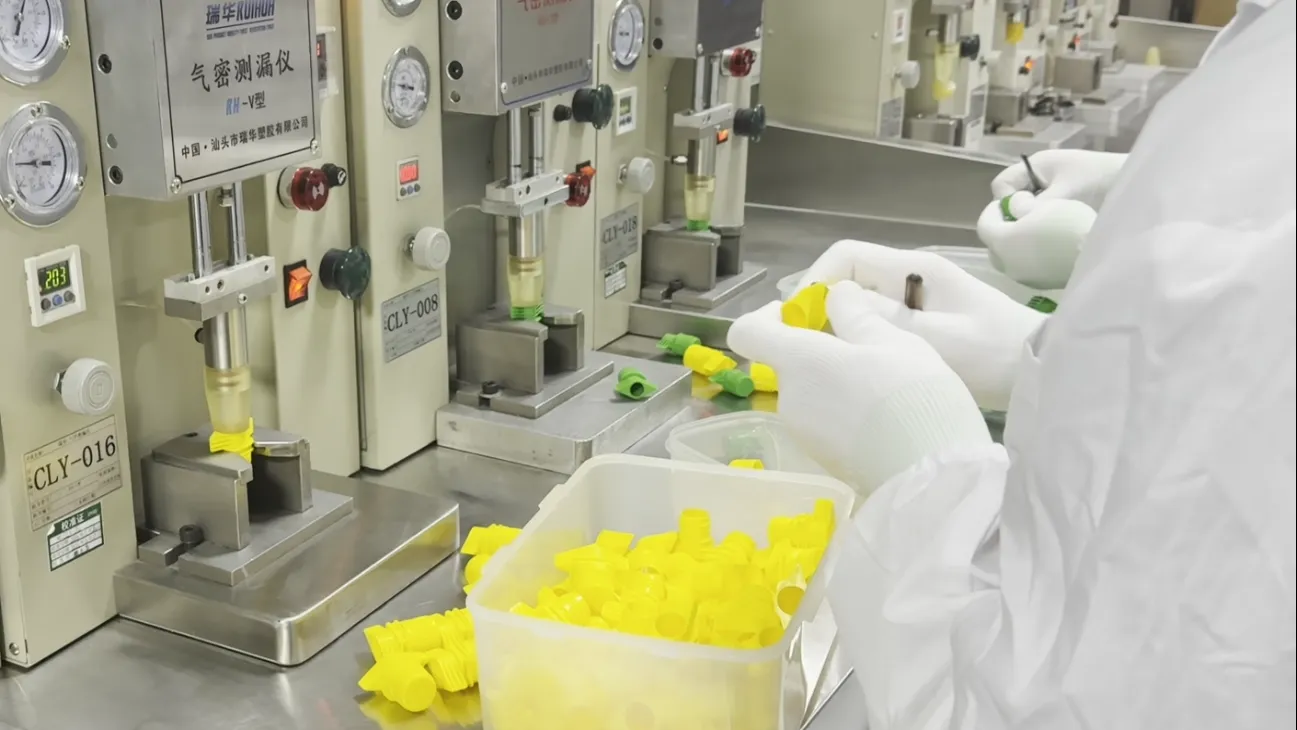
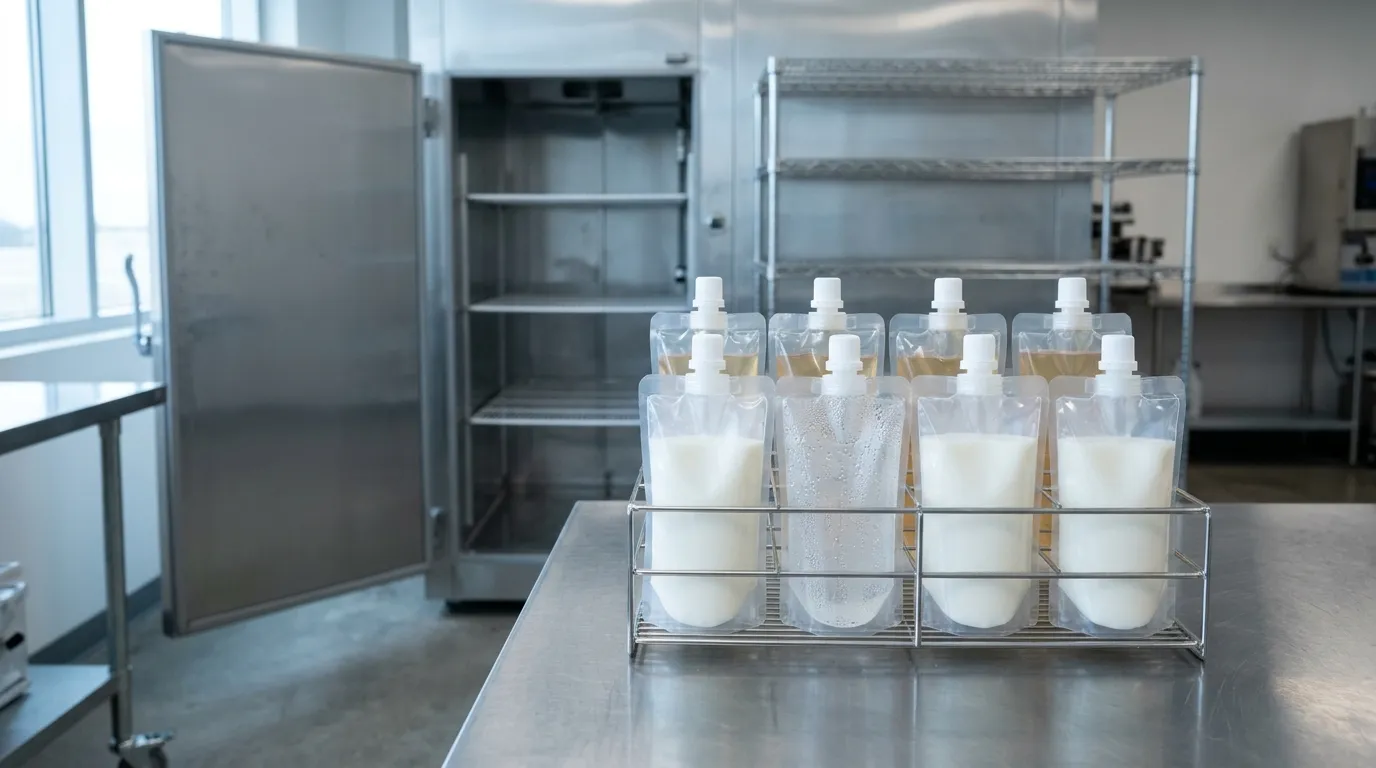
The two studies share a bench but not a question: one pack on a fixture answering "does this interact", a whole rack in a chamber answering "how does this hold".
Side by Side: The Decision Table
Compatibility testing | Stability testing | |
|---|---|---|
The question | does the product and pack combination interact badly | does the product stay in spec over the declared life |
Organized around | contact: medium, ratio, temperature, time | duration: timepoints under fixed storage conditions |
Specimen | the assembled pack, filled with the real product | the assembled pack, filled, in replicate |
Typical duration | 2–4 weeks screening, up to 12 weeks confirmatory | 6 months accelerated; 12–24 months real-time |
Conditions | elevated temperature to accelerate contact | fixed ICH-style storage conditions, incl. humidity |
Outputs | migration, sorption, swelling, delamination, seal and torque change | trend per attribute, and a shelf-life claim |
A pass means | no unacceptable interaction at the tested contact | the product stayed within specification to the last timepoint |
Blind spot | time. It cannot tell you about month twelve | interaction. A product in spec can still be tainted |
Print that table into your test request. The two right-hand columns are what most quotation arguments are actually about.
Why Teams Collapse the Two
In practice, compatibility testing usually runs inside a stability protocol: you put filled pouches on stability, and at each timepoint you measure interaction attributes alongside the product attributes. That is efficient and it is correct — one set of samples, one storage footprint, two answers.
The collapse becomes a problem when it is used to skip work. Two patterns recur:
A lab quotes "stability, three months" and the buyer reads it as compatibility. It is not. Three months at ambient tells you the product did not spoil; it does not tell you the cap absorbed the fragrance or that the seal layer started to delaminate.
A lab quotes "compatibility, four weeks at 40 °C" and the buyer reads it as shelf life. Also not. Four weeks of contact at elevated temperature is a screening result, and the extrapolation to 24 months is an assumption you have not tested.
The fix is structural rather than analytical: write the protocol so the compatibility attributes are measured at every stability timepoint, and label the result by the question it answers. If you already have a seal specification, the interaction check rides on the same specimens — seal strength vs seal integrity covers how to tell a bond that weakened from a bond that never formed.
Building the Test Matrix for a Spouted Pouch
A spouted pouch has four places where the product meets a different material, and each one deserves its own line in the matrix: the film seal layer, the spout body and bore, the cap and its liner, and the flange weld where spout meets film. A compatibility result that covers only the film is half a result, because the fitment is usually a different polymer grade from the film and is the part the consumer puts their mouth on.
Build the matrix as variants down the side, timepoints across the top.
Variant to test | Why it earns a row | t=0 | 2–4 weeks | Each declared-life point |
|---|---|---|---|---|
Film structure as specified | baseline; the seal layer is the largest wetted area | seal strength, appearance, weight loss | the same three, plus a sensory triangle against the control | the same three, trended against t=0 |
Spout resin grade as specified | different grade from the film, often the cracking site | dimensions, stress-crack inspection at the flange and thread root | stress-crack inspection under low-angle light | stress-crack inspection, plus torque |
Cap and liner combination | liner swelling and torque loss live here | removal torque, liner compression | torque retention, liner appearance | torque retention, reseat check |
Lowest and highest seal parameters in the window | the weak end of the window is where delamination starts | seal strength at both ends | delamination and tunneling at the weld | seal retention at both ends |
Fill level extremes (min and max headspace) | headspace ratio drives oxygen and aroma results | fill weight and headspace ratio as filled | sensory triangle, weight loss | sensory triangle, weight loss |
Production-intent sample, not just lab molding | a lab-molded spout is not a production spout | the full attribute set | the full attribute set | the full attribute set |
Three columns across the top are the minimum: t=0, one early point (2–4 weeks), and the shelf-life timepoints you intend to claim. Run three replicates per cell as a floor — with two you cannot tell a trend from noise, and single samples are how a "pass" gets recorded on an outlier.
Two practical constraints shape the matrix. Sample count grows multiplicatively, so cut variants deliberately and write down why each was cut. And hold a retained control set at t=0 under refrigeration: when a result at month six looks odd, the control is how you separate "the pack changed" from "the test method drifted".
The fill itself belongs in the protocol, because it changes the answer. A 90% fill in a lab pouch presents a very different product-to-headspace ratio than a 70% fill in the retail pack. If the production pack will be filled on a line that leaves a specified headspace, match it.
Pass Criteria: Write Them Before You Test
The most common defect in a test request is a protocol with no acceptance criteria. The lab then reports numbers, and the decision gets made by whoever reads the PDF first.
Write the criteria per attribute, before the samples ship:
- Product attributes. Assay or active content within a stated percentage of t=0; pH within a stated band; appearance and color against a retained reference; viscosity within a band; microbial state per your own specification. Sensory is a legitimate, testable attribute — a triangle test against a refrigerated control catches sorption that no instrument will.
- Pack attributes. Seal strength retention as a percentage of t=0 rather than an absolute number, measured the same way each time (ASTM F88 is the common method for flexible barrier seals); cap removal torque within a band around the application torque; no visible stress cracking at the flange or thread root under low-angle light; no delamination or tunneling at the weld; weight loss per unit time within a limit you set from your own shelf-life target.
- Migration attributes. Where a regulated limit applies, test against the limit. Where none applies, set an internal threshold and say so.
Two rules make criteria usable. Express pack results as retention against t=0, not as a bare number, because a 14 N/15 mm seal means different things on a 12 N starting point and a 30 N one. And decide in advance what a single failing replicate means — retest, investigate, or fail the cell. Deciding after you have seen the data is how a launch gets made on an average that hides one bad pouch.
Five Misreads That Sink a Launch
- Reading a compatibility pass as a shelf-life claim. Four weeks of contact is not twenty-four months of storage. Different question, different duration, different evidence.
- Reading a stability pass as proof the pack is inert. A product can sit inside its specification while the pack quietly takes the aroma. If nobody ran a sensory comparison, nobody looked.
- Testing the cap alone. Threads, torque and liner compression only behave as a system. A cap tested off the pouch tells you about the cap, not the closure.
- Testing with water or a placebo. Surfactants, alcohol, essential oils, high-acid and high-salt fills are the aggressive ones. A water-filled pouch is the easiest possible pass and the least useful one.
- One timepoint, no control. A single end-point cannot distinguish a material that never interacted from one that interacted and then stabilized. Trend plus control is the minimum.
What Neither Test Covers
Both studies sit on a bench. Your pack does not. Four failure routes live outside them, and each needs its own evidence:
- Distribution. Vibration, drop, compression and altitude. A pouch that passes both studies can still arrive with a channel at the flange. The methods in non-sterile pouch leak test methods are what you run after the transit simulation, not instead of it.
- The filling line. Spout feeding, orientation, cap torque at speed and the sealing window. Interaction that never appears in a lab pouch appears on line three of a filling run — see spout misalignment on the filling line and the sealing temperature window.
- Consumer use. Reopen cycles, dose control, storage after opening, the pack left in a hot car. In-use stability is a third study, not a footnote to either of these — for refill formats the reopen behavior is covered in refill pouch spouts for bottles.
- Scale. A compatibility result earned on a lab-molded spout does not automatically transfer to a production tool with a different gate location and cooling profile. Ask for the resin grade and the tool identity behind the sample, and retest the production-intent part.
The Test Request: Nine Lines to Send a Supplier
The document that gets you a comparable answer is short. Nine lines:
- Product name, and the full formulation or the aggressive constituents if the formulation is confidential.
- Pack construction: film structure, spout resin, cap and liner, and the intended seal parameters.
- Fill volume and headspace ratio for the production pack.
- The questions you need answered, split into compatibility and stability.
- Storage conditions and duration, or the shelf life you are trying to support.
- Timepoints, including t=0 and a retained control.
- Replicate count per cell.
- Acceptance criteria per attribute, with the retention basis for pack results.
- Who signs the report, and what has to be in it — raw data, not just a verdict.
Once the criteria exist, the rest of the specification follows the same discipline as the spout cap specification sheet, and the sample stage can be planned against the sample validation planner so that compatibility, stability and distribution evidence arrive in the order a launch needs them.
If you are at the stage of sourcing spout caps and fitments for a stand-up pouch and need production-intent samples to put through a protocol like this one, Ruihua supplies food-grade spout caps and fitments across a wide diameter range, and sample requests start at quote and samples.