
Direct answer. A spouted stand-up pouch that loses mass on the stability shelf is losing it one of two ways, and the two are not convertible into each other. Mass can cross an intact wall by permeation, or it can escape through a defect by flow. Permeation is a property of the pack as designed — the laminate, the fitment, the closure, and the conditions the pack is stored in — and it acts on every pack in a production run at much the same rate. A leak is a defect, and it acts on the few packs that carry it. Most arguments about "the film is not good enough" or "the seal is not good enough" are really arguments about which of those two contributions is larger. This page is about telling them apart before you spend money on either answer.
It is written for someone holding a number and no cause: a fill weight that drifted down over a storage study, a carton that came back light, a customer asking why the pack does not hold what the specification says. It does not repeat the leak test method catalogue and it does not repeat the fault-by-fault repair path — those exist elsewhere on this site and are linked where they belong. What it does is give you a reading order that costs almost nothing to run, and a list of variables you have to lock before any two results can be compared. Throughout, "spout cap" means the screw or flip closure of a pouch fitment for stand-up pouches and doypacks, never a gas-can spout cap. If the closure itself is still being chosen, the guides under Choosing & Running Spout Caps are the place to fix the bore, the resin grade and the sealing window ahead of any of this.

Two Ways a Spouted Pouch Loses Mass
The physical difference is simple and it drives everything else on this page.
Permeation is diffusion through a material that has no hole in it. A permeant — water vapor, oxygen, a flavor compound, dissolved carbon dioxide — dissolves into the polymer on the high-concentration side, migrates through the wall, and desorbs on the low-concentration side. The rate is set by the concentration gradient across the wall and by the material's own solubility and diffusivity, which is the shape of Fick's relationship that permeation instruments are built around: diffusion through a barrier is a function of the gradient across it and its thickness (Industrial Physics). Nothing is broken. The pack is doing exactly what its materials allow, at a rate the design chose.
A leak is flow through a path. Where the wall stops being continuous, whatever is inside leaves as bulk flow: a wrinkle folded into the top seam, a pinhole opened by a corner crease in transit, a spout flange that bonded cold along one edge, a cap that went on cross-threaded once and never seated again. What drives it is a pressure difference, or simply the weight of the liquid standing above the opening — not a concentration gradient. That is also why a leak has no transmission rate to quote: leak testing reports a leak rate in mbar·L/s against a calibrated orifice, and a figure in those units is neither a large nor a small permeation number. It is a different measurement of a different event.
The industry does not always keep the two apart. Some instrument makers describe the subject as one thing — "everything leaks, even if it is just the movement of gas molecules through a container's walls", with the critical issue being the rate (Versaperm). That framing is defensible for a metal-to-glass seal where the whole question is a leak rate. It is misleading for a pouch, because it invites a single acceptance number for two failure modes that have different owners, different fixes, and different tests. The same confusion runs the other way when a film transmission figure is read as though it described the finished pack; that is its own subject, covered in film barrier versus whole pouch.
What a Weight-Loss Number Actually Removes
Before asking "permeation or leak", ask what left. "Weight loss" is not one phenomenon, and the species that leaves decides which measurement is even relevant.
- Water. In a water-based product — juice, sauce, a detergent gel, an emulsion — the loss is mostly moisture leaving through the wall, and the relevant property is the water vapor transmission rate (WVTR). Test methods for that property are written for flat film, measured with a modulated infrared sensor or with an electrolytic sensor, each with its own calibration logic (ASTM F1249, ASTM F3299).
- Volatiles and aroma compounds. An alcohol-based or flavor-forward product can hold its water and still lose the part of the formulation the consumer notices first. This loss is real mass, it is a permeation phenomenon, and no water vapor figure describes it.
- Dissolved or headspace gas. A nitrogen-flushed or carbonated pack loses its gas inventory through the wall and through the closure. The equivalent quantity with oxygen as the permeant is the oxygen transmission rate (OTR), and the mass change may be small while the quality change is large — which is why gas loss is usually tracked by headspace composition rather than by the balance.
- Nothing — the pack gains. A dry product in a humid store takes up moisture and gets heavier. Direction alone does not rule a leak out, because a defect is a two-way path: in a liquid-filled pack it reads as mass going out, in a dry pack stored humid it reads as mass coming in. What separates ingress through a path from ingress through the wall is rate — a gain larger than the wall could transmit at that gradient points at a path, not at a material.
There is a fifth term that is not the product at all: water on the outside of the pack. A pouch pulled from a humid chamber can carry condensation, and a pouch handled with wet gloves carries more. Weigh after conditioning to a stable temperature and with a dry surface, or the first data point of every study is measuring the room.
The Signature That Separates Them: the Distribution, Not the Average
Here is the observation that does most of the work, and it is the one that a single summary number destroys. It is a gravimetric argument — the balance is the instrument and the shape of the data is the finding — and it is available to anyone with a balance and a notebook.
Permeation is a property of the construction. Every pack from the same laminate, the same fitment and the same closure, stored the same way, permeates at much the same rate — the spread across a batch is the ordinary spread of gauge, weld and process control, not orders of magnitude. So if you weigh thirty or more packs individually and plot the losses, a permeation-dominated batch looks like one tight cluster: every pack has moved roughly the same distance.
A leak is a defect. It sits in the tail of the process, not in its center: a few packs have a channel, a cold weld, a cocked cap. Those packs lose far more than the cluster does, and often lose it faster. The plot becomes skewed or two-humped — a main body plus a small group that is nowhere near it.
That difference is a decision, not a curiosity, provided you read it as a filter rather than as a verdict. If the cluster is tight and the four cheap observations that follow point the same way, then more inspection will not move the number; the answer is in the design and in the storage conditions. A uniform defect produces exactly the same tight cluster, though, which is why the shape of the distribution on its own cannot close the question. If there is a tail, the tail members are your suspects, and they are the packs to open, to leak test, to cross-section.
Two cautions, because this test is powerful and easy to oversell:
A slow weep in every pack also looks like one cluster. If the same defect is present in most of the run — a systematic capping setting, a weld window that was never qualified on this film — the losses will be tight and it will still be a leak. The distribution tells you whether the cause is uniform; it does not, on its own, tell you whether the uniform cause is diffusion or flow. That is what the next section is for.
Thirty packs is a minimum, not a target. The tail is where the information is, and a tail of two packs in a sample of five is invisible. Weigh enough packs that a handful of outliers would actually show up, and record an identifier on each one — weight without identity cannot be correlated with anything later.
A weight loss is an observation. Permeation and leakage are explanations for it, and only one of them is a defect you can inspect out of the process.
Four Cheap Observations Before You Pay for a Lab Test
None of these costs a test request. Each one, on its own, is only suggestive; two that agree are close to a diagnosis.
Observation | If it points to permeation | If it points to a leak |
|---|---|---|
Residue where the pack sat — carton, shelf, shipper | Nothing. The mass left as vapor and left no trace | Staining, a sticky ring, crusted product, a wicking mark, an odor in the shipper. A leak that moves grams leaves a witness |
Orientation — weigh the same packs upright, then on their side or inverted | Little or no change. The gradient does not care which way up the pack is | A clear increase once product covers the defect. Liquid has to reach the path for the path to pass it |
Squeeze or applied pressure | Little change — the driving force is the gradient, not the total pressure; compression moves the wall far less than it moves a leak | Rate rises visibly. A leak is pressure-driven, which is why it shows up in transit and in stacked cartons |
Storage temperature — two identical sets, two temperatures | A strong response. Permeation changes steeply with temperature, which is why instrument makers insist that even a small temperature difference shifts the result | A weak response. A hole passes what pressure and viscosity let through, and a few degrees changes that far less |
The orientation test is the one people skip, and it is the cheapest way to catch a real leak that a bubble test missed: a pack that passes upright and loses mass on its side is not permeating differently, it is leaking. The temperature row needs one addition, because relative humidity belongs with it. Moisture does not only change how fast a wall transmits; on a structure built over a moisture-sensitive layer it changes what the wall effectively is, so a result taken dry and the same pouch living in a humid warehouse are not two measurements of one material. The mechanism is worked through in film barrier versus whole pouch; what this page takes from it is narrower — the humidity of the storage cell has to be recorded, not merely described.

Then Correlate the Same Packs With a Leak Test
The common failure here is organizational rather than technical: QC weighs the packs, a laboratory runs the leak test, and nobody joins the two data sets. The packs that were weighed are not the packs that were tested, so the study produces two answers and no attribution.
Fix it with an identifier. Number every pack at fill, weigh those numbers on a schedule, and send exactly those numbers — plus a few from the middle of the cluster as controls — to the leak test. Two test properties matter for this purpose:
Non-destructive tests let the pack go back on the shelf. Vacuum decay detection, the method of ASTM F2338, covers nonporous packages, rigid and flexible alike, and does not consume the sample; a pack that passes can continue in the weight study. That is what makes a genuine cross-correlation possible on one batch instead of on two, and it is the only reason the method appears here at all — which method to adopt is a separate decision.
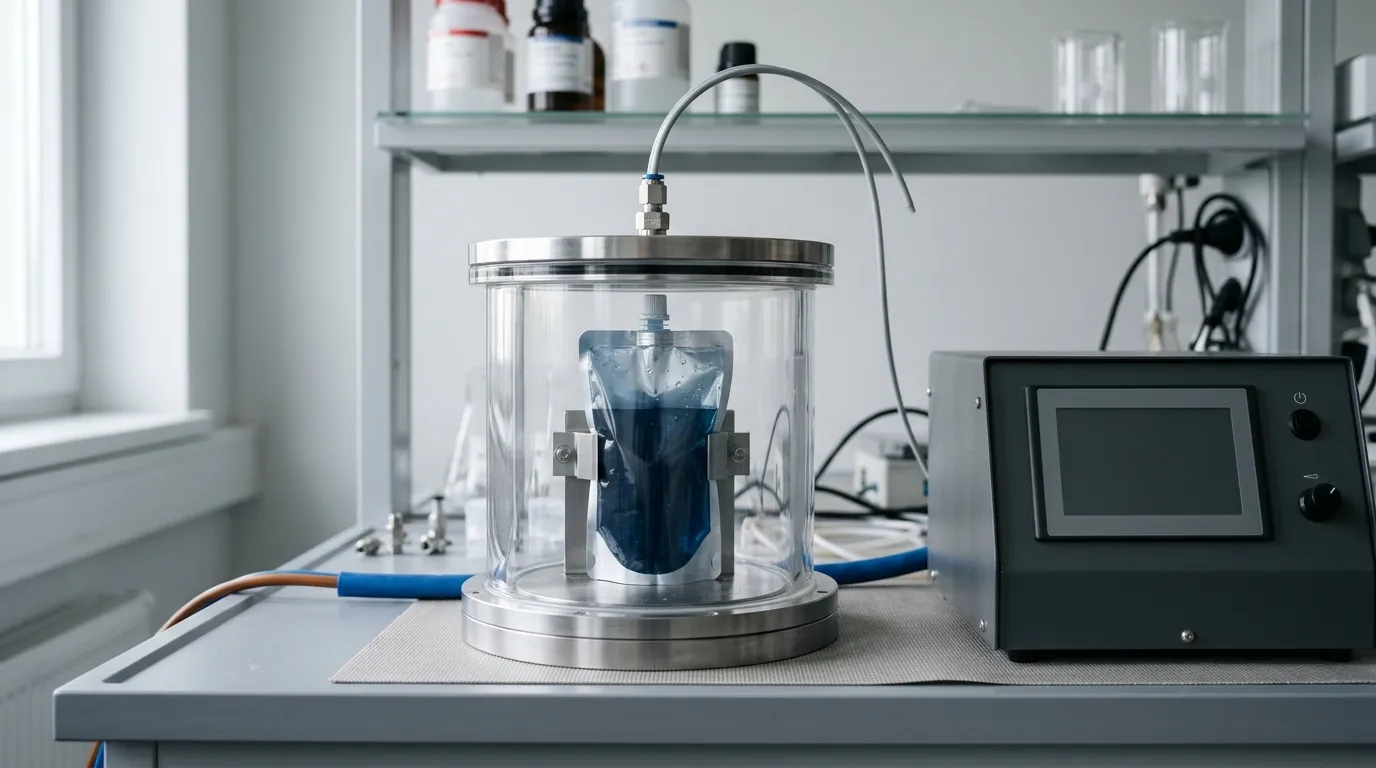
Bubble emission gives you a location and a limit. The water-bath vacuum test of ASTM D3078 is the one to reach for when the site is what you need. Two limits travel with that recommendation, and both are stricter than most users expect. D3078 is a gross-leak method — its scope covers gross leaks in flexible packaging containing a headspace gas, and it states that small leaks may not be detected — so it does not see a hairline, and it needs gas behind the closure to work with at all: a pouch filled to the shoulder, with liquid sitting against the spout and almost no headspace left behind it, can show nothing while a path is present. On a pack like that, silence from the bath says something about the method, not about the pack. How far it reaches is worth knowing too: a leak-test laboratory's published parameter-setting procedure calls 50 µm the visual limit for bubble detection and puts the detection limit near 30 µm (Control Sensei). Read that as a boundary on the conclusion, not a detail. "No bubbles" means no leak above the detection limit of the test you ran — never "no leak". The full comparison of methods, sampling and acceptance criteria belongs to pouch leak test methods by production stage.
A calibrated defect is the control that makes the whole exercise defensible: deliberately punctured packs of known size, tested alongside your samples, prove that the method you are using would have found a defect of that size in this product, with this headspace, in this orientation. Without that control, a clean result is a statement about your test, not about your packs. This family of tests is what pharmaceutical packaging calls container closure integrity testing, CCIT, and the logic is the same at either end of the industry: the method defines the claim.
If the leak test finds a path, the attribution question is answered and the repair question starts — the five fault classes, their confirmation tests and their fixes are in why a pouch spout leaks after filling. This page stops at the fork.
What Each Answer Costs You
The question that arrives labeled permeation vs leakage packaging is a request to separate two numbers; once they are separate, each one has an owner. The two diagnoses lead to different rooms, different budgets and different people.
If permeation dominates, no inspection change will move the number. The levers are design and storage: the barrier structure and its gauge, the area of wall the product actually sees, the closure and the sealing land, the temperature and humidity the pack lives in. That is a conversation with the converter who laminates the film and the molder who supplies the fitment, held with data rather than with a complaint, and it usually ends in a specification change rather than a corrective action.
If leakage dominates, it is a process conversation: a sealing window that was not qualified on this film, a capping torque outside the closure's window, handling that flexes the weld, contamination in the seal zone. That is fixable on a line, and its natural home is the repair path linked above.
In our experience the two usually coexist. A pack can be permeating as designed and additionally losing mass through a marginal weld, and the total is what the balance reports. The point of separating them is not to pick a winner; it is to know the size of each contribution, because a corrective action aimed at the smaller term will be declared ineffective and abandoned. The weld and the film are also not independent of each other: the sealing window a spout is specified for has to match the sealant layer it is welded to, which is why spout cap sealing temperature is a fitment question and not only a machine setting.
The Variables to Lock Before You Compare Two Runs
Two weight-loss studies are comparable only if these are fixed and recorded. Most disputes about "the new film is worse" are disputes about a variable in this table that moved between the runs.
Variable | What has to be recorded | Why it changes the answer |
|---|---|---|
Fill weight and headspace | Nominal fill, actual fill, headspace volume at seal | Headspace is the gas inventory and the buffer that absorbs pressure; a different fill is a different experiment |
Product | Water activity or moisture, alcohol or volatile content, pH, presence of surfactants | The species that permeates, and how aggressive it is on the closure, both come from the formulation |
Storage conditions | Temperature and relative humidity, with the tolerance actually achieved | Permeation is steeply temperature-dependent and humidity-dependent; a two-degree drift is a real difference |
Orientation | Upright, on side, inverted — stated per sample | A leak that only shows when product covers the defect will be missed or invented by orientation changes |
Film structure | Layer order, barrier layer, sealant layer, gauge | The wall is the main permeation term and the sealant layer sets the weld window |
Closure | Cap type, liner or valve, resin, and whether it is reclosed during the study | The seat, thread and liner are part of the wall; a push-pull valve is a designed opening in it |
Capping torque | The window and the measured value on sampled packs | An under-torqued cap fakes a worse wall |
Time points | Interval and total duration, plus the schedule actually kept | A single end-point cannot distinguish a steady rate from a step change |
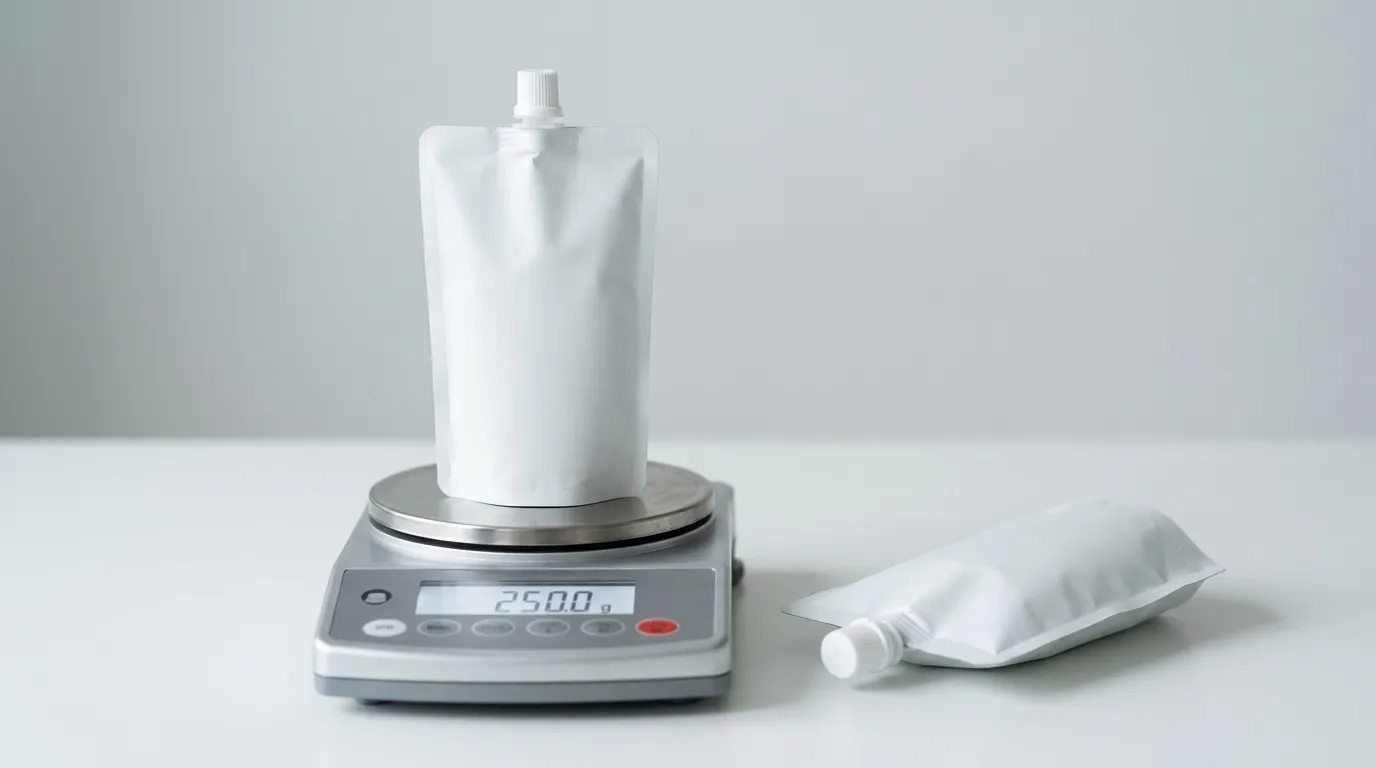
Balance and conditioning | Resolution, and the conditioning routine before each weighing | Resolution has to be small against the loss you are trying to see over the interval; condensation is not product |
Sample size and identity | Count per cell, and an identifier on every pack | Without identity the weight data cannot be joined to the leak data, and the tail cannot be found |
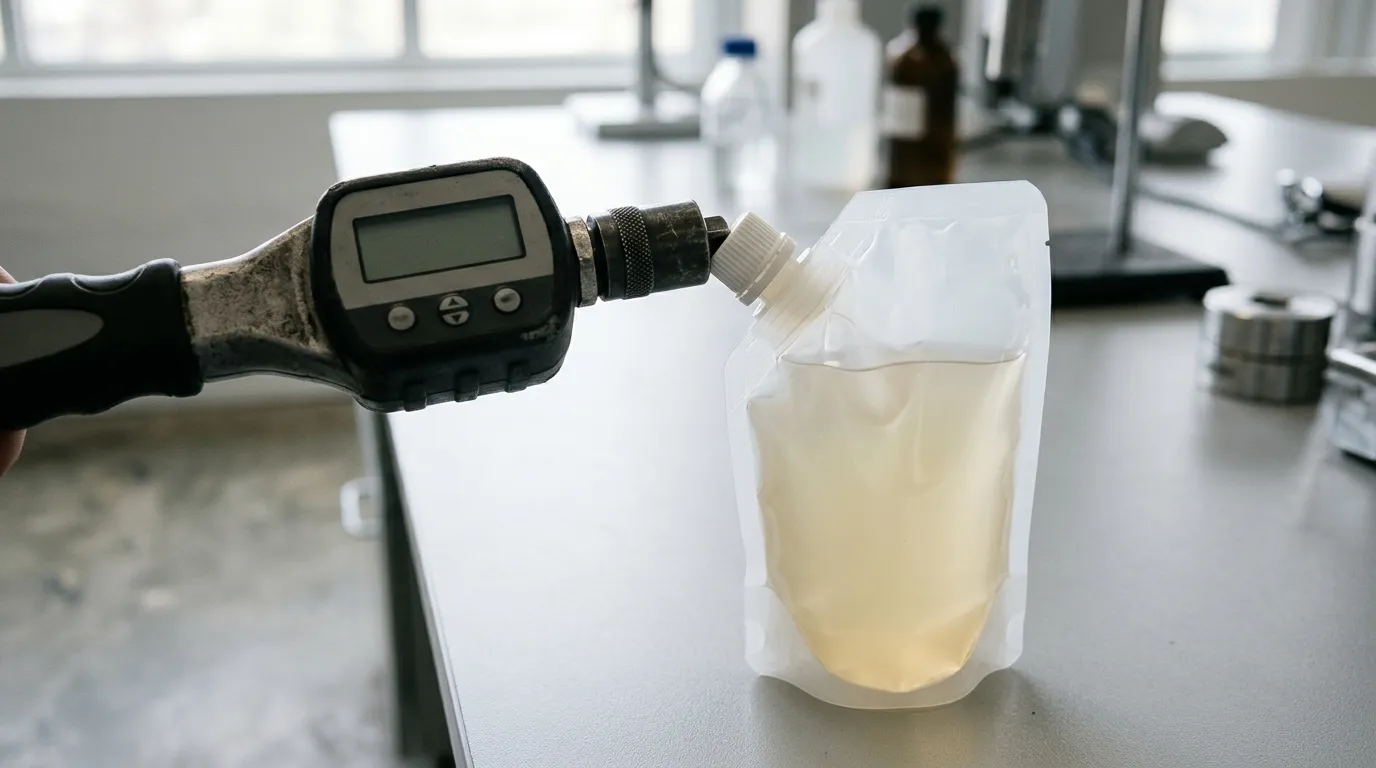
The torque row is the one most often left blank and the one that most easily fakes a deterioration in the wall: an under-torqued cap leaks slowly, its loss is spread across every pack in the cell, and the study concludes that the new laminate is worse when nothing about the laminate changed.
Do Not Write One Weight-Loss Limit Into the Specification
A specification that says "weight loss not more than X" over a stated period has folded two different acceptance criteria into one number, and it will be argued about forever because neither party can prove which term it is measuring.
Write two lines instead:
- A transmission line — a whole-pack figure measured on intact packs, at stated temperature, humidity and driving gradient, with the method and the laboratory named. Package-level methods exist for this purpose: ASTM F1307 puts the finished pack itself in the test cell and reports its oxygen transmission as a quantity per pack per day, with dry-product packs the case the method was built around. The water vapor equivalent is what a moisture-sensitive product needs, and it is a laboratory's whole-pack report, not a film figure. This is the line that describes the design.
- An integrity line — a pass/fail criterion that names the method, the detection limit and the sampling plan, and states the acceptance as a defect rate, not as a promise of zero. A test can only certify the absence of leaks above its own floor; a specification that says "no leaks" is asking a test to certify something it was never able to see.
Both lines belong in the same document as the bore, the flange dimensions and the sealing window, because they are answered by different parties and read together. A template for that document, and the fields that make it usable, is in the spout cap specification sheet guide.
What This Page Does Not Tell You
It does not give you a barrier value, a shelf life or an expected loss rate for your pack, and it will not, because none of those is a property of a category — each is a measurement of one construction under one set of conditions, and quoting a number from a different structure is how wrong specifications get written. Run the attribution on your own pouches; the numbers you get are the only ones that describe them. The spout caps and fitments range is where the closure side of that construction is specified.
One boundary on our own side of the table: which of those two lines Ruihua can sign. The integrity line is ours to speak to, on the closure side: the closure is a molded part, and its seat, thread and flange are checked on our own samples by a batch-sampled air-tightness and torque routine, which is also why torque and closure seat are the first two things we ask about when a filled pack comes back light. The transmission line is not ours to sign at all: that figure is produced on a finished pouch, by whoever ran the test on it, and it moves with the film the pouch was built from — film lamination is not a process we run. What we hand over is the closure half of the design: the bore and its tolerance, the thread, the flange geometry, the resin grade, and the temperature window in which that fitment welds cleanly to the sealant layer you are using. Tell us the pouch format and the film you are sealing to, and the samples and quote request comes back with the fitment dimensions and the sealing window, so the attribution work starts from a known closure rather than an assumed one.