
Tamper-evident and child-resistant closures answer two questions that a spouted pouch has to answer inside the same moulded part. One shows whether the pack has already been opened; the other decides whether a small child can get in. Framing the choice as tamper-evident vs child-resistant closure and then treating one as the stronger version of the other is what produces the expensive mistakes — they are not grades, and neither claim is proved by the cap on its own, because the tests behind both are run on the packed, closed package. This guide is written for buyers and converters working on stand-up pouches and doypacks, and it works from the clause and panel numbers in the US rules, the ISO standard and the EU framework rather than from paraphrases. It is written by a manufacturer that moulds both closure functions, and every clause and panel number below was checked against the primary text in September 2026. That vantage point is stated plainly at the end of this section. If you are new to this closure family, the Choosing & Running Spout Caps hub puts the whole set of decisions in order.
Tamper-evident vs child-resistant closures: two failure modes, not two grades
Start with the definitions, because the two features are defined by different organisations, for different reasons, and neither definition mentions the other.
Child-resistant is about access. ISO 8317:2015 defines a child-resistant package as "a package consisting of a container and appropriate closure which is difficult for young children under the age of 52 months to open (or gain access to the contents), but which is not difficult for adults to use properly." Two things in that sentence do most of the work. The unit is the package — container plus closure — and the target is a delay, not a lock. A child who eventually gets in has not broken the design; the design was never asked to stop that.
Tamper-evident is about history. The definition buyers quote most often comes from the US Food and Drug Administration's drug labelling rules, where a tamper-evident package is "one having one or more indicators or barriers to entry which, if breached or missing, can reasonably be expected to provide visible evidence to consumers that tampering has occurred." The same paragraph adds a detail that gets dropped in most supplier conversations: the packaging is required to be distinctive by design or to carry an identifying characteristic, and "distinctive by design" means it cannot be duplicated with commonly available materials or through commonly available processes. The feature also has to remain intact when handled in a reasonable manner during manufacture, distribution and retail display. That last clause is where pouch specifications usually fail first — a breakaway ring that survives the filling line can still crack in a shrink-wrapped tray. A tamper-evident closure earns the name only while the indicator stays irreversibly changed and the pack still says so.
Neither term is "child-proof." That word appears in marketing and in no regulation, and the industry stopped using it because it promises something no package can deliver. "Child-resistant" is the compliant term, and it sets expectations you can actually defend.
The vocabulary has one more fork worth closing, because it turns up in the same search: tamper-resistant is not a synonym for tamper-evident. A tamper-resistant feature makes opening difficult — a child-resistant closure is the standard example — while a tamper-evident feature makes opening visible, whether or not it was difficult. And "tamper-proof" is not a regulatory term at all: no package is beyond tampering, which is why the rules use "tamper-evident" and test for evidence rather than for impossibility.
One disclosure before the details, because it is the honest way to frame this page: this is written by a manufacturer of spout caps and closures, one that moulds both child-resistant geometry and tamper-evident rings, so treat the decision framework below as the useful part and read our product references with that in mind.
What US law actually requires — and where it splits
The United States has two separate instruments here, and they attach to different things. Confusing them is the most common sourcing error we see.
The Poison Prevention Packaging Act of 1970 applies to substances — a list of household chemicals and drugs that must be sold in "special packaging." It is enforced by the Consumer Product Safety Commission, the federal agency that maintains the special-packaging rules and the child and adult panel protocols described below, and is therefore the body whose current list decides whether your substance is in scope at all. The performance bar sits in 16 CFR 1700.15, and it is expressed as two numbers, both of which your supplier's test report has to show:
- Child-resistant effectiveness of not less than 85% without a demonstration and not less than 80% after a demonstration of the proper way to open the pack.
- Ease of adult opening: a senior-adult use effectiveness of not less than 90% on the 100-person panel aged 50–70.
The same section holds two requirements that matter more for pouches than for bottles. Paragraph (a) says the packaging must keep functioning to those specifications while in contact with the substance, and for the number of openings and closings customary for its size and contents — a closure that passes when new and loosens after the tenth use has not met the standard. Paragraph (c) is blunter: special packaging must not be reused. Refill formats are outside the framework, not a grey area inside it.
How those numbers are produced is in 16 CFR 1700.20. The children's panel runs in groups of 50 — up to a maximum of 200 children, aged 42 to 51 months, with 30% of each group at 42–44 months, 40% at 45–48 months and 30% at 49–51 months — in two stages — 5 minutes without a demonstration, then a further 5 minutes after the tester has demonstrated how to open the package — and the acceptance table in that section applies its criteria to the first 5 minutes and to the full 10-minute test. The senior-adult panel is 100 adults aged 50–70, and the younger-adult panel is 100 adults aged 18–45. If you want the source rather than the summary, the Commission's Poison Prevention Packaging Act pages set out who enforces what.
The tamper-evidence duty sits somewhere else entirely. In US federal law the definition, and the requirement, come from the drug-packaging rules at 21 CFR 211.132, which requires a tamper-evident package for over-the-counter drug products that are accessible to the public while held for sale (dermatological products, dentifrices, insulin and lozenges are carved out), plus a labelling statement identifying the tamper-evident feature used. Note the shape of that: it regulates the pack and its label, and it was written for pharmacy shelves.
Child-resistant | Tamper-evident | |
|---|---|---|
US instrument | PPPA + 16 CFR 1700.15 / 1700.20 | 21 CFR 211.132 (OTC drugs) |
Attaches to | listed substances | the package and its labelling |
Proved by | panel test on the package | an indicator that cannot be restored |
Number to show | 85% / 80% child-resistant effectiveness; 90% adult | the feature is present, distinctive and intact |
So a liquid detergent pouch and an OTC drug bottle are both "safety packaging" and are governed by two different rules with two different kinds of proof. Neither rule was drafted with a welded pouch in mind — which brings us to the question that decides your test budget.
What the EU requires — a different shape entirely
The EU question we get asked most often is "what is the European PPPA?" The honest answer is that the framework has a different shape, and buyers who go looking for a single statute lose time.
EU law does not put child resistance into one general packaging duty enforced by one agency. It arrives along two tracks instead. Track one is hazard-based product law, and it has a name buyers rarely expect to meet in this conversation: Regulation (EC) No 1272/2008 — CLP, the classification, labelling and packaging regulation. Its duties attach to substances and mixtures that present a risk rather than to packaging as a category: Article 35(2) requires packaging of a hazardous mixture supplied to the general public to be fitted with a child-resistant fastening where the mixture meets the criteria in Annex II §3.1.1 — acute toxicity categories 1 to 3, STOT single or repeated exposure category 1, skin corrosion category 1, an aspiration hazard, or methanol or dichloromethane at or above the listed concentration — and with a tactile warning of danger where it meets §3.2.1. That second duty is the EU half of the on-pack labelling question, and it sits on the pack rather than on the substance file. Annex II then points the technical proof at named standards: child-resistant fastenings on reclosable packages must comply with EN ISO 8317, on non-reclosable packages with CEN standard EN 862, and tactile warning devices with EN ISO 11683. Track two is type approval against those standards: conformity is what a supplier is asked to demonstrate, and market surveillance authorities can request the evidence. The standard is what makes the claim checkable, which is why the two tracks meet in the same test report.
The household-chemistry row in this page's own decision table has a further instrument aimed straight at it. Commission Regulation (EU) No 1297/2014 added Annex II §3.3 to CLP: where a liquid consumer laundry detergent is contained in a soluble packaging for single use, the outer packaging must be opaque or obscure, must carry the statement P102 "Keep out of reach of children", must be an easily reclosable, self-standing container, and must be fitted with a closure that "impedes the ability of young children to open the packaging by requiring coordinated action of both hands" and keeps working over repeated opening and closing, with an aversive agent added to the soluble packaging itself.
Read that requirement literally and it sharpens the whole point of this page: the EU child-resistance duty in that case attaches to the outer packaging and its closure, not to the pouch spout. A spout cap welded into a pouch cannot deliver "coordinated action of both hands", so where a soluble dose sits inside a tub or a bag-in-box, the child-resistant mechanism is designed into that container and the pouch closure stays a tamper-evidence and food-contact question. Two duties, two components — the same conclusion the US side reaches from a different direction.
Meanwhile the EU packaging and food-contact law that genuinely does apply to a spouted pouch regulates something else. Regulation (EC) No 1935/2004 governs the material: food-contact articles must not transfer constituents in quantities that could endanger health, change the composition of the food or degrade its organoleptic properties. Regulation (EU) 2025/40, the packaging and packaging waste regulation, governs design and end-of-life — recyclability, substance limits, documentation — and reaches the spout and cap because an integrated closure is a packaging component. Neither instrument answers "who can open it." Both will be in your technical file for reasons that have nothing to do with child resistance.
The practical consequence for a buyer is a change of question. "Is this EU approved?" has no answer, because there is no EU approval to hold. Child-resistant packaging standards are what turn a claim into something an authority can check, and they are where a buyer should aim the question: which standard was the package tested against, on whose package, and where is the test report? If your supplier answers with a certificate for the resin rather than a report for the package, you have evidence for a chemical, not for your packaging. The wider map of these duties across markets — including how the Chinese GB 4806 series fits alongside the EU and US regimes — is in the comparison of the FDA, EU 1935/2004 and GB 4806 frameworks, and the pouch closure regulatory guide shows how the closure layer sits inside it.
One limit we will state plainly rather than paper over: we are not a notified body, we cannot issue an approval, and the framework's shape can change. What a manufacturer can do is build to a known geometry, test what it can, and tell you exactly which claims are backed by which document.
The test is on the package, not on the closure
This is the section that changes sourcing decisions, and it is the one that no comparison article we could find states outright.
ISO 8317:2015 is a type-approval standard. Its catalogue entry at ISO 8317:2015 sets out its scope; the published text of ISO 8317:2015 is more specific than the summaries: only new packages shall be submitted for testing, and "the container and closure system tested shall be representative of those in normal use and shall include any wad or liner, if this is an integral part of the closure system." The pass criteria are attached to that assembly — at least 85% of a 200-child panel (42–51 months) unable to open the package in the first 5 minutes without a demonstration, at least 80% unable after a demonstration, and 90% of a panel of adults aged 50–70 able to open and properly reclose it.
Read that as a specification writer and three consequences follow.
First, the pouch is part of the specimen. The tested object is the package as supplied: film, welded spout base, liner if there is one, and the cap. A closure that carries a child-resistant approval on a rigid bottle has no transferable claim on a pouch, because the container changed and the attachment changed. The weld is a variable the bottle never had.
Second, your line settings are part of the evidence. The US protocol is explicit — in both adult test protocols — that reclosable packages assembled by the testing agency must be properly secured at least 72 hours before testing so that materials such as the closure liner can "take a set", that torque-dependent closures must be secured at the same on-torque as applied on the packaging line, and that application torques must be recorded in the test report. A cap torqued differently on your capper than on the tester's bench is a different specimen.
Third, your SKU family design sets the test bill. The standard allows a "series of similar packaging" to be evaluated rather than every variant. For closures that differ only in diameter, if the largest diameter is no more than 1.5 times the smallest, the largest and smallest sizes are tested; if it is greater than 1.5 times, the largest, smallest and one intermediate size are tested. Containers that differ only in capacity are tested at their largest and smallest. That is a design lever, not a footnote: rationalising a spout-cap family so its diameters stay inside a 1.5× band is cheaper to approve than a family that straddles a wider range.
For the package a pouch program actually submits, the practical question is whether the closure is in scope at all — which is why we ask, when a converter sends us a drawing, which package the approval was granted on. A specification sheet that records the tested assembly, the liner, the torque and the film is what makes that answerable, and the spout cap specification sheet walkthrough covers the fields that belong on it.
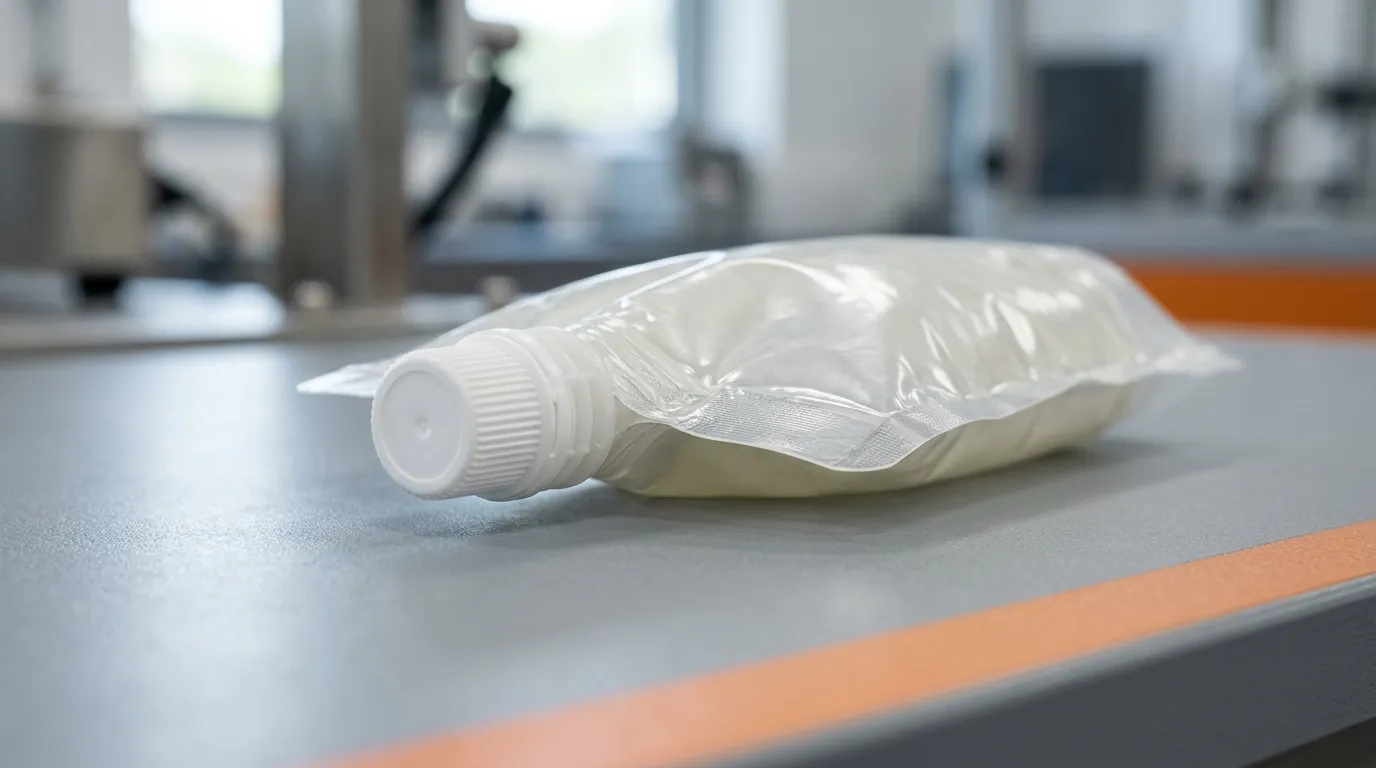
A closure is approved as part of a package, not on its own: the standard's specimen is the container and closure system as supplied, including any liner.
What each feature looks like on a spouted pouch
The generic checklists you find in most articles — shrink bands, overwraps, push-and-turn caps, squeeze-and-turn caps — were written for bottles and jars. Two of those mechanisms have no equivalent on a pouch, and saying why is more useful than repeating the list. The other two change places. A shrink band on a bottle is a sleeve around the neck and shoulder, under the cap; on a pouch the same idea becomes an oversleeve wrapped around the whole pack, which is settled at the film and labelling stage rather than on the closure. An overwrap moves one level out again: it wraps the pack instead of sealing its opening, so it is evidence about the shipment rather than about the spout.
Push-and-turn and squeeze-and-turn caps work by resisting hand torque on a fixed neck. On a stand-up pouch there is no rigid neck to brace against and the body is not a torque anchor; the pack flexes. Child resistance on a pouch therefore comes from geometry rather than from a locking motion, and the governing property is the size and shape of the head. A mushroom-head cap is sized so that a small child cannot take it into the mouth and swallow it: the wide, rounded head defeats the hand-to-mouth test that a small, smooth closure passes. Our own anti-choking caps use that head geometry — the 8.6 mm baby-puree model carries it with a split-petal anti-swallow cover — and the family runs from 8.6 mm up to 22 mm, so check the diameter that matches your pack on the anti-choking spout cap pages. The tension to manage is the one ISO 8317 already named: the same head that resists a child must still clear the 90% adult-use bar, and a head large enough to be safe is also a head a small-handed adult has to grip and twist. Head diameter is therefore a compromise you should agree in the drawing stage, not discover in the panel test.
Tamper evidence on a pouch lives in the cap skirt and at the weld. This is the tamper-evident spout cap most buyers are actually being sold, and what they are being sold is a ring rather than a mechanism. The common construction is a breakaway ring moulded into the cap: it detaches or splits irreversibly on first opening, so the split itself is the indicator. A dual ring construction on a tamper-evident cap gives two independent indicators, which also tells you whether the spout assembly was disturbed before the pouch reached the shelf. Our 25 mm double tamper-evident PE cap is built that way — two tear rings on a low-temperature-toughness PE — and the available models are listed on the dual anti-theft spout cap pages. The design constraint people miss is spatial: the skirt circumference that carries the ring is the same region that has to mate cleanly with the spout and sit clear of the weld flange, where the spout base is welded into the film. A ring that overhangs the flange either fouls the sealing jaw or reads as broken when the pouch comes out of the sealer. An induction foil liner inside the cap can add a second indicator that no breakaway ring can give, because it proves the pack was never opened even if the ring was removed and the cap re-seated.
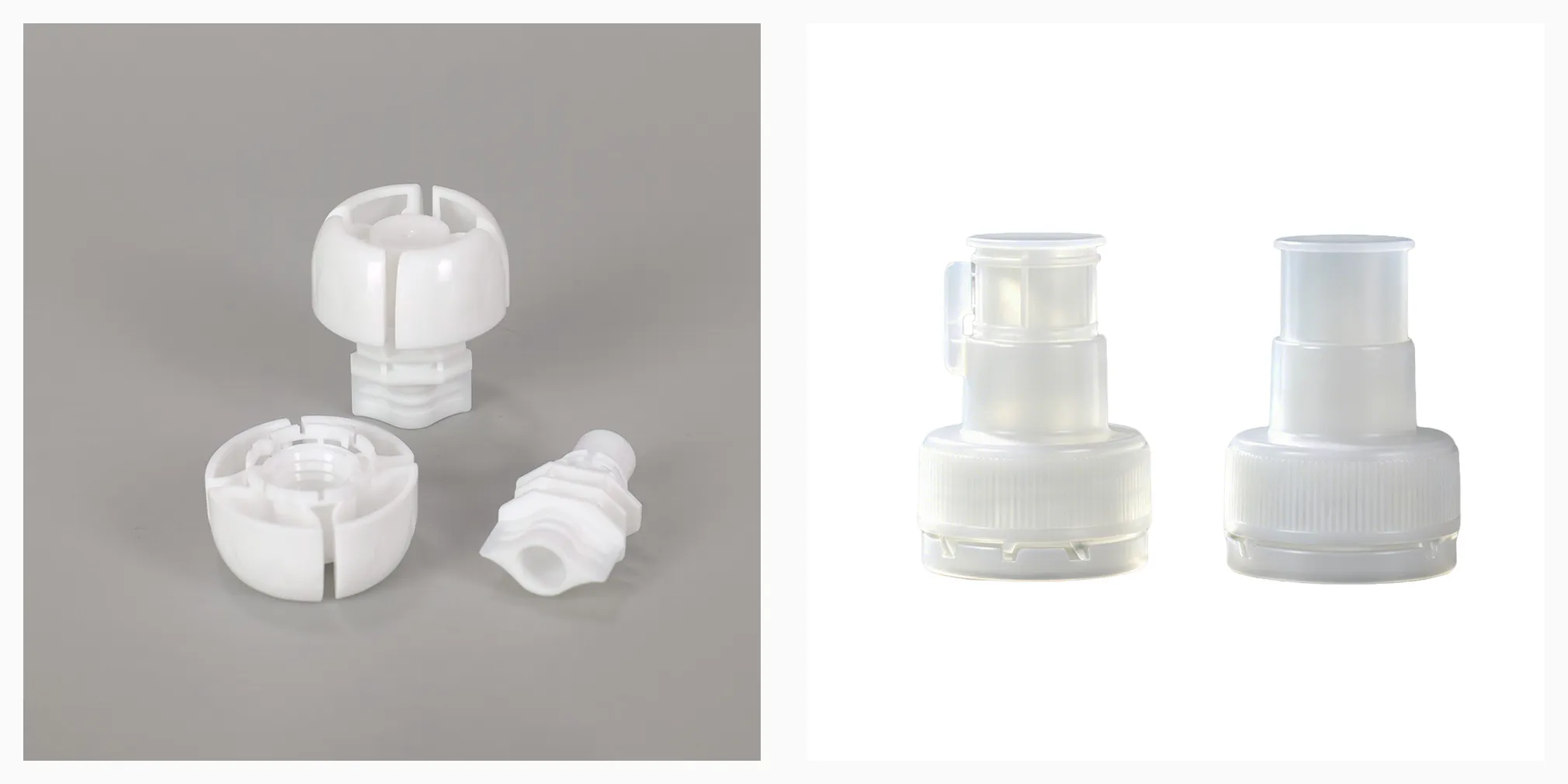
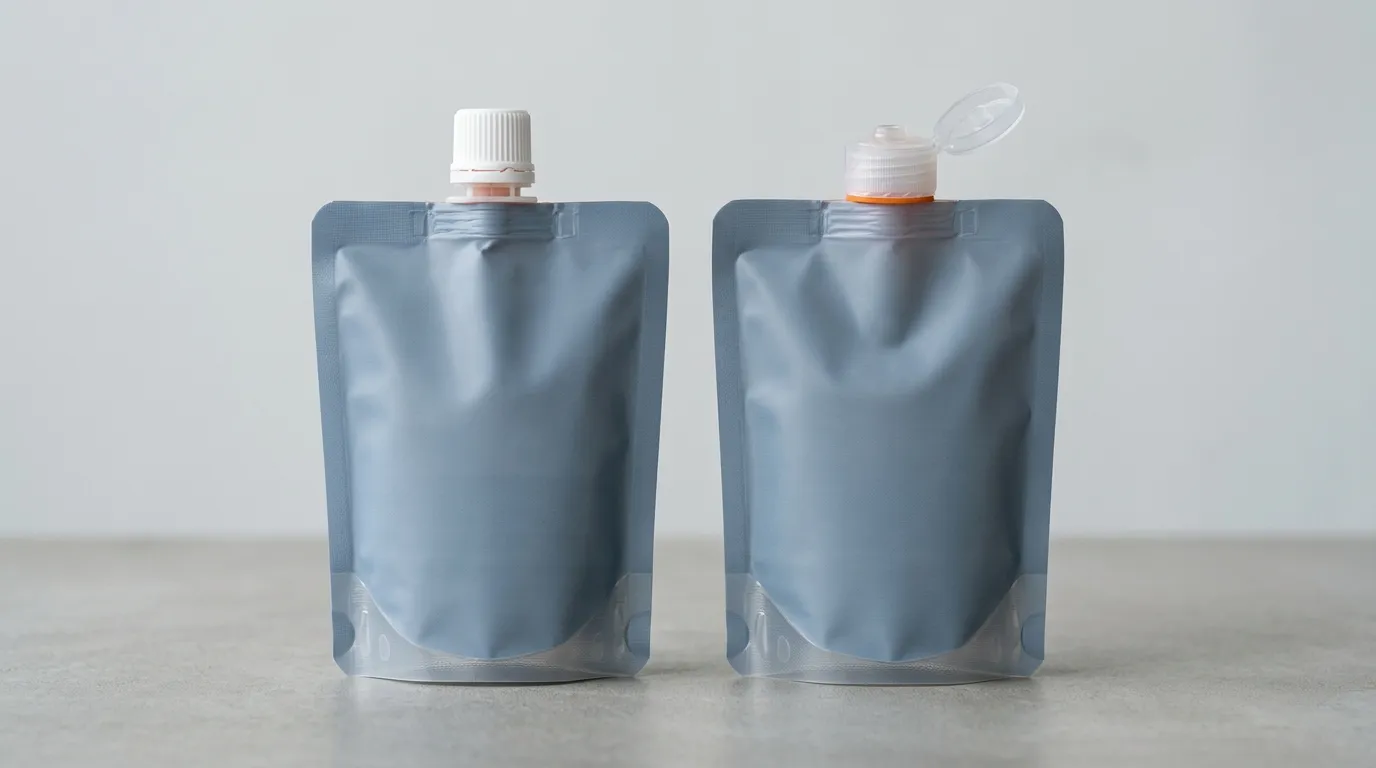
The two duties in two moulded parts, shown side by side: a mushroom-head geometry sized so it cannot be swallowed whole, and a cap skirt carrying a breakaway tamper ring.
Put side by side, the features are not substitutes:
Dimension | Tamper-evident | Child-resistant |
|---|---|---|
Question answered | has this pack been opened? | can a child get in? |
Trigger | first opening breaks an indicator | geometry resists a small child |
On a spouted pouch | breakaway ring in the cap skirt; induction liner | mushroom-head swallow-size geometry |
Evidence required | the indicator is present, distinctive, intact | package-level panel test to 85% / 80% and 90% adult |
Failure it prevents | a pack that was opened and returned to the shelf | an ingestion or choking event |
Cannot do | deter anyone from opening it | prove anything about prior access |
Both features can live in one moulded part, and the two mechanisms do not interfere — but they compete for the same plastic. The ring needs skirt height and toughness; the child-resistant head needs diameter and mass. Allocating both inside a 30 mm footprint is a tooling conversation, which is why the two features belong in the same drawing and the same sample round rather than in two separate purchase orders. Some of the models in this range carry both at once — an anti-choking head and dual anti-theft rings on the same cap — and that combination, not either feature on its own, is what has to be agreed at the drawing stage: the head takes diameter and mass, the ring takes skirt height and toughness, and a part that has to satisfy both is a different set of compromises from a part that carries one.
How to choose — by product, not by preference
There is no rule that says "safer" means "both." The decision follows from who handles the pack, what is inside it, and what the market expects, and the answer is genuinely sometimes "neither feature."
Pack and content | Tamper evidence | Child resistance | Why |
|---|---|---|---|
Infant and toddler puree or squeeze pouches | usually yes | yes — geometry-based | handled and mouthed by the end user; head size is the safety logic |
Liquid laundry detergent and household chemistry | yes | yes, where the market requires it | substance-based duties plus the strongest reputational risk |
Cosmetics and skincare sachets | yes | rarely | product integrity and retail trust, not ingestion risk |
Condiments and sauces | yes | no | openability matters more; no listed-substance duty |
Nutraceutical and supplement pouches | yes | usually yes | substance-based duties follow the formulation, not the format |
Bulk food and grain, large-diameter spouts | usually no | no | closed-then-labelled handling; the closure is a dispenser |
Non-reclosable single-dose formats | yes | separate standard applies | different format class with its own approval route |
Read down that table twice. When tamper evidence alone is right: cosmetic and skincare sachets, condiments, anything where the credible harm is contamination or substitution rather than ingestion. When child resistance alone is right: essentially nowhere in a consumer pouch — a child-resistant closure that carries no indicator still cannot tell you the pack was opened, and if you need that, you need both. When you need both: infant food, household chemistry and supplements, which is exactly where the two mechanisms compete for skirt height — and where a single child-resistant pouch closure has to satisfy both duties at once. When neither is required: bulk formats where the pack is closed on a filling line and labelled afterwards, and where the closure is really a dispenser. Specifying a child-resistant head there costs money, restricts adult opening, and buys nothing. In those categories the tamper-evident food packaging case is commercial reassurance rather than a legal duty, and it is still worth having.
The other input is the content itself, because the closure also has to survive it — a cap that cracks under a corrosive fill turns a compliance conversation into a quality one. The guide to choosing spout caps by fill type covers that material side, and the general how to choose a spout cap walkthrough covers diameter, sealing and storage before either safety feature is specified.
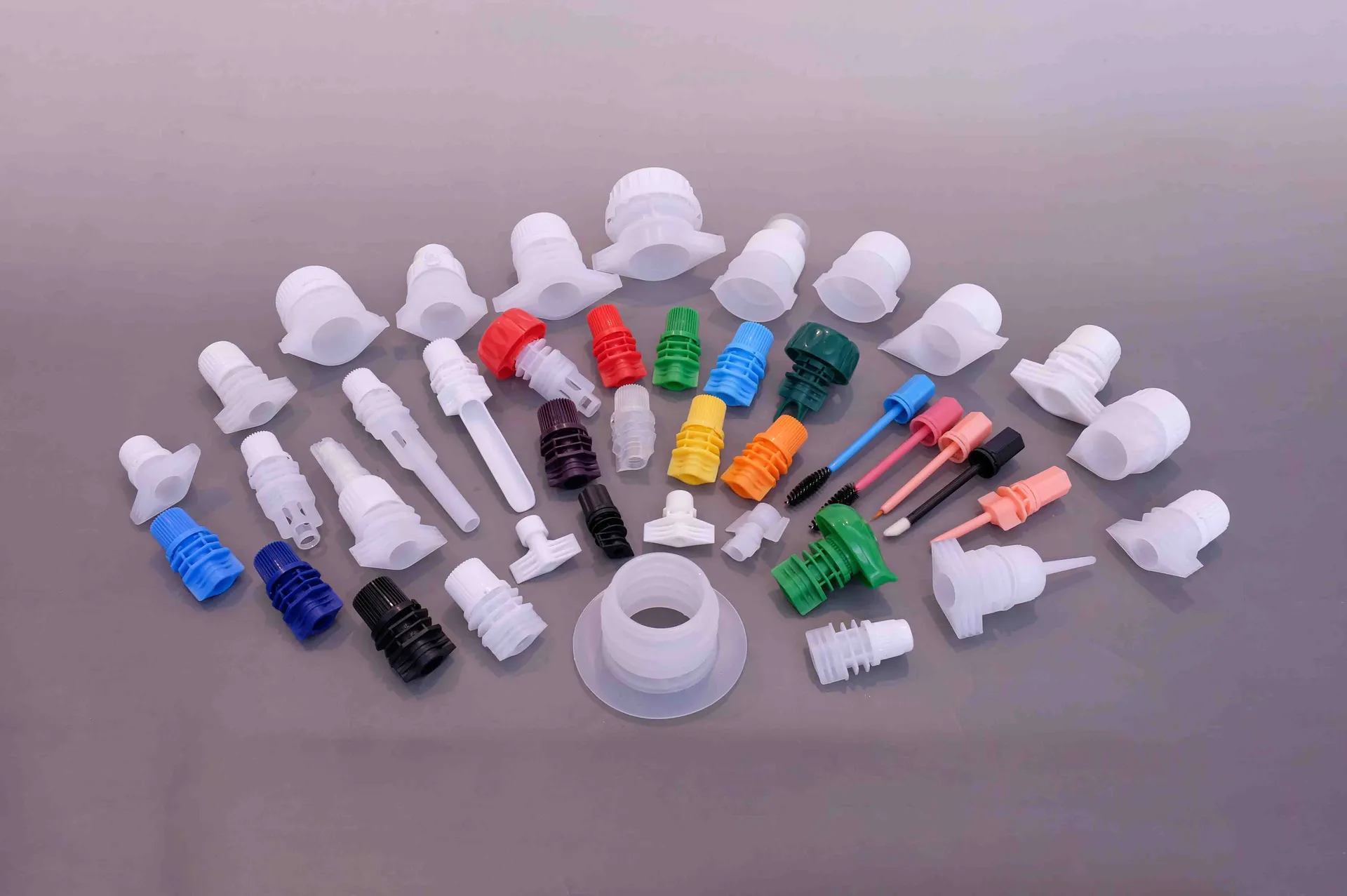
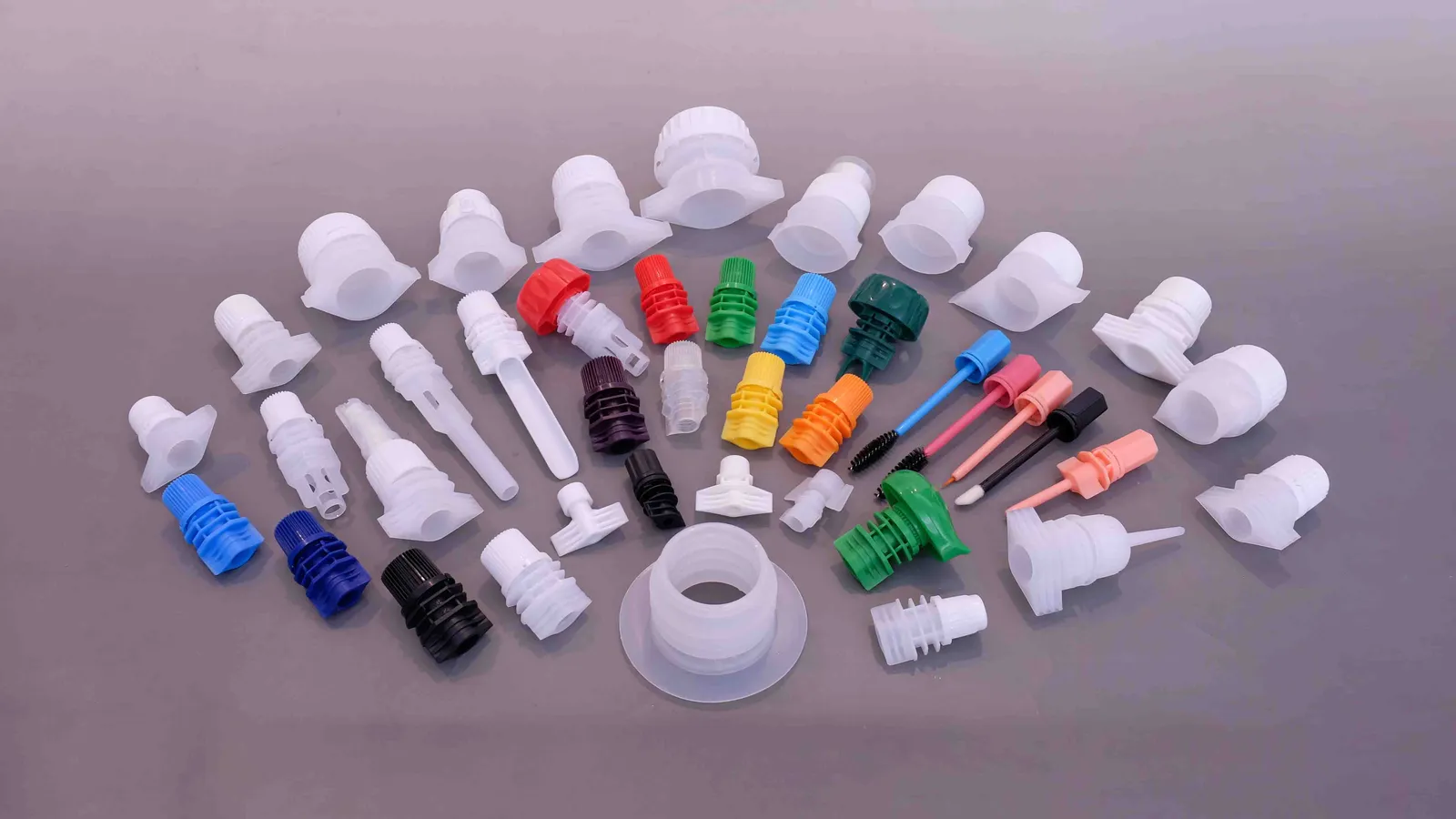
The closure range a decision is made from: differences in head shape, skirt height and spout bore are the physical levers behind both safety features.
Turn the claim into a file: what to put in the spec
A supplier's brochure is not evidence. The buyer's job is to make the claim checkable, and that takes seven lines in the specification and four documents in the folder.
In the specification:
- The tested assembly, named as it was submitted — film, spout model, liner and cap — not just the cap model number.
- Application torque and who sets it, since it is recorded in the test report and must match the packaging line.
- The standard and edition the child-resistant claim rests on, and whether the format is reclosable.
- Breakaway ring pull force, plus the tear behaviour you will accept after filling and after the pouch's temperature exposure.
- Ring-to-flange clearance at the weld, in millimetres, so the sealing jaw has room.
- Head diameter and mass for any child-resistant closure, agreed in the drawing stage.
- The number of open-and-close cycles the closure must hold, matching the customary use for that pack size.
In the folder:
- the panel test report for the package, with the panel composition and the on-torque used;
- the drawing revision the approval was granted on, so a later tooling change is visible;
- the series rationale if one approval covers several diameters;
- the food-contact or material documents for the resin, kept separate from the safety test.
One number is deliberately absent from both lists: a price. This manufacturer does not publish per-unit pricing, because the figure moves with the specification — the drawing (head diameter, skirt height, ring geometry), the resin, and the test bill a family that straddles the 1.5× band attracts all change it. So ask for a quote at the tested specification rather than a price for a cap model, and ask what moves it when the specification changes; a price quoted off a catalogue page, with no tested assembly named, is a number you cannot compare with anything.
Two boundaries worth stating, because we would rather you hear them from us. A child-resistant approval covers the package and the revision that was tested — change the resin, the liner, the film or the torque and the evidence no longer describes what you are shipping. And a manufacturer can only take you as far as the test; the declaration of conformity is the brand owner's, made on their own responsibility. What a closure supplier owes you in that arrangement is a truthful record of which geometry, which test and which revision, which is also why the mould family matters — the same 1.5× series logic that decides the test bill decides which SKUs can share one approval.

A closure family shares an approval only when it shares the essential characteristics: rationalised diameters inside a 1.5× band are cheaper to approve than a family that spreads wider.
Bottom line
Treat tamper-evident and child-resistant as two duties, not two grades. Ask which failure each one prevents — prior access or child access — and then accept the harder half of the answer: the proof belongs to the package, the film and the torque on your line, not to the cap in the catalogue. Buyers who write those seven specification lines and collect those four documents stop arguing about marketing adjectives and start comparing test reports, and the specification is the only place where the two features stop competing for the same millimetres. If you are at the drawing stage on a pouch programme, the spout cap range is the place to match a diameter and a closure construction to the feature you decided on.