
Direct answer. A cosmetic brush cap pouch is a stand-up pouch or doypack fitted with a spout whose screw cap carries the applicator — a brush head on a rod that dips into the product when closed. Because the applicator lives inside the cap, a sample pack no longer needs a separate brush, wand or cotton-tipped tool shipped alongside it. One component disappears from the bill of materials, one step disappears from assembly, and the pack keeps the small-volume, resealable, low-waste profile that sample and travel formats are supposed to have.
This article is written for brand owners, product developers and packaging buyers in cosmetics and personal care who are evaluating cosmetic sample pouches for lip gloss, mascara, eyeliner, liquid lipstick or similar formats. It explains what the integrated brush cap actually removes, where the format earns its place, and how to verify before you commit — the same way a spout caps by content framework would position any closure decision. Throughout, "brush cap pouch" means the spout-and-cap fitment welded into a flexible stand-up pouch or doypack — not a gas-can spout cap, and not a pouch that merely stores makeup brushes.
What a Cosmetic Brush Cap Pouch Is
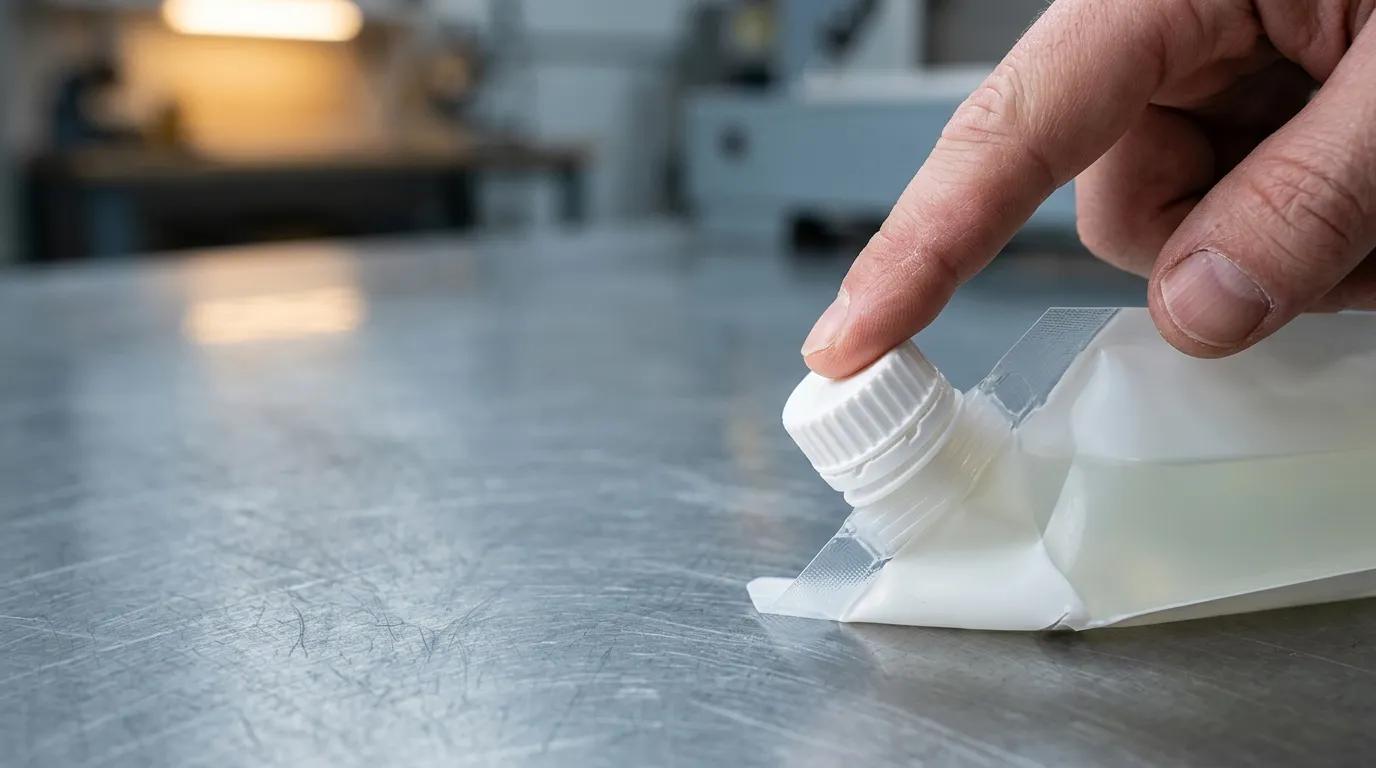
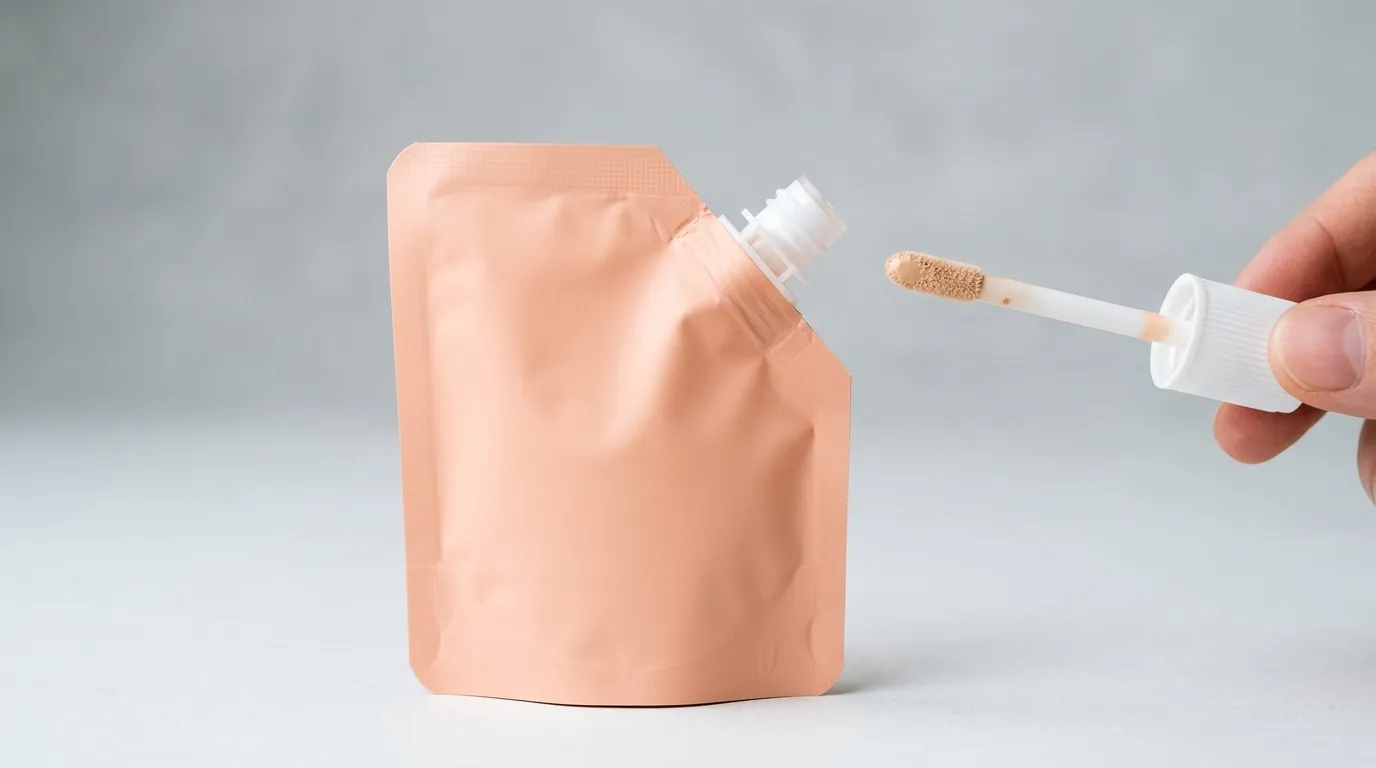
Take a standard spout fitment — the plastic neck welded into the top of a stand-up pouch — and replace its plain screw cap with a cap that has a brush rod moulded into the underside. Close the cap and the brush sits in the product, wetted for the next use. Unscrew it and the brush comes out ready to apply. That is the entire mechanism behind a cosmetic brush cap pouch: no separate tool, no dip-and-dunk step, no applicator to fish out of a box.
The product family built around this idea in Ruihua's range is the cosmetic brush spout series — models such as RD-084 (lip gloss), RD-085 (eyelash/mascara brush), RD-088 (eyeliner, low-temperature-welding variant) and RD-101 (liquid lipstick), all sharing the same brush-in-cap architecture at a 7 mm bore. They are documented in the cosmetic brush spout product range, where the design intent is stated plainly: an applicator brush moulded into the closure, so a sample or travel pouch needs no separate applicator component.
What makes the format work is the pairing of two ideas:
- The applicator is part of the closure, not part of the kit. The brush is attached to the cap you already need for resealing. Nothing extra is manufactured, packed or shipped.
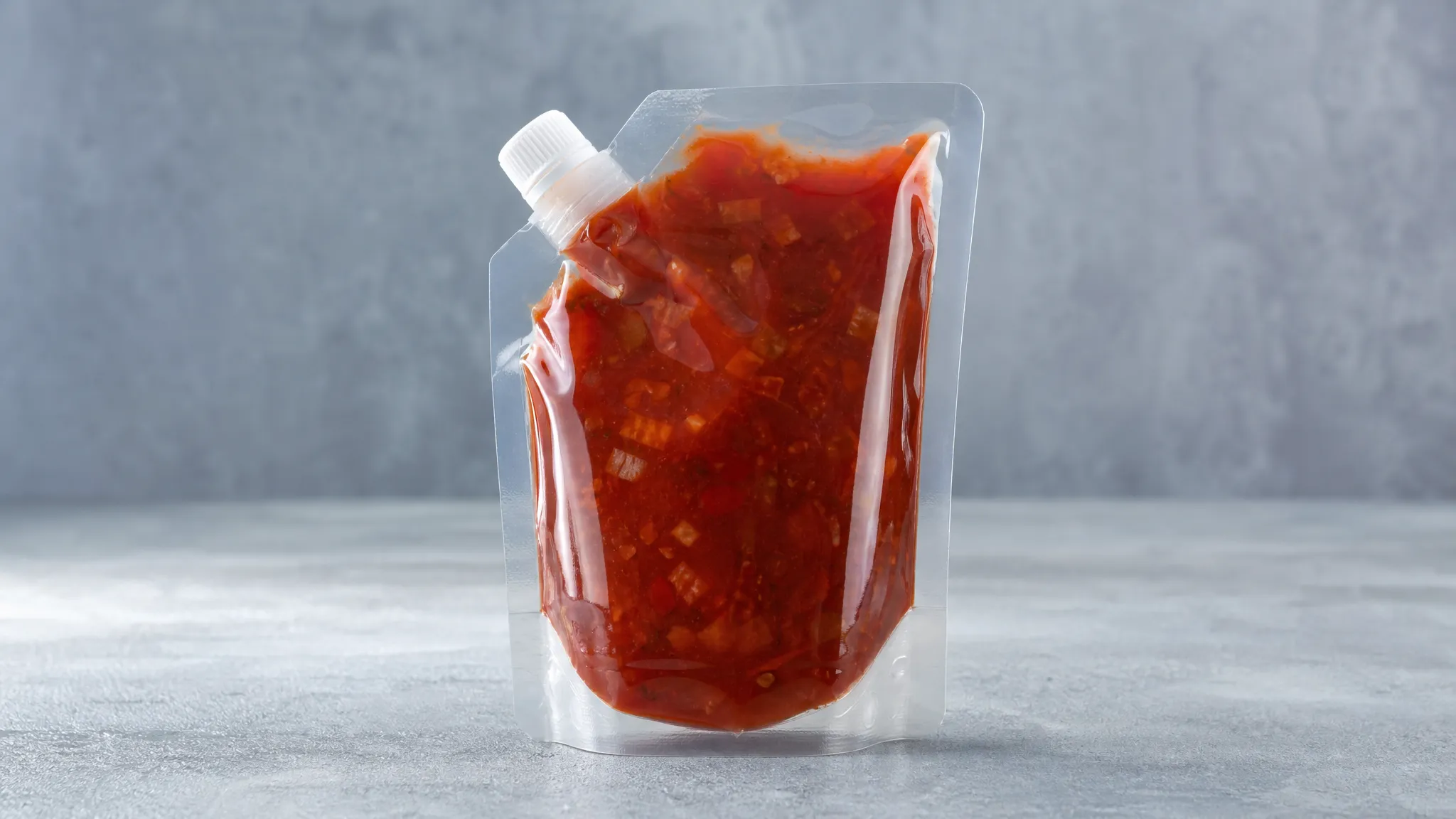
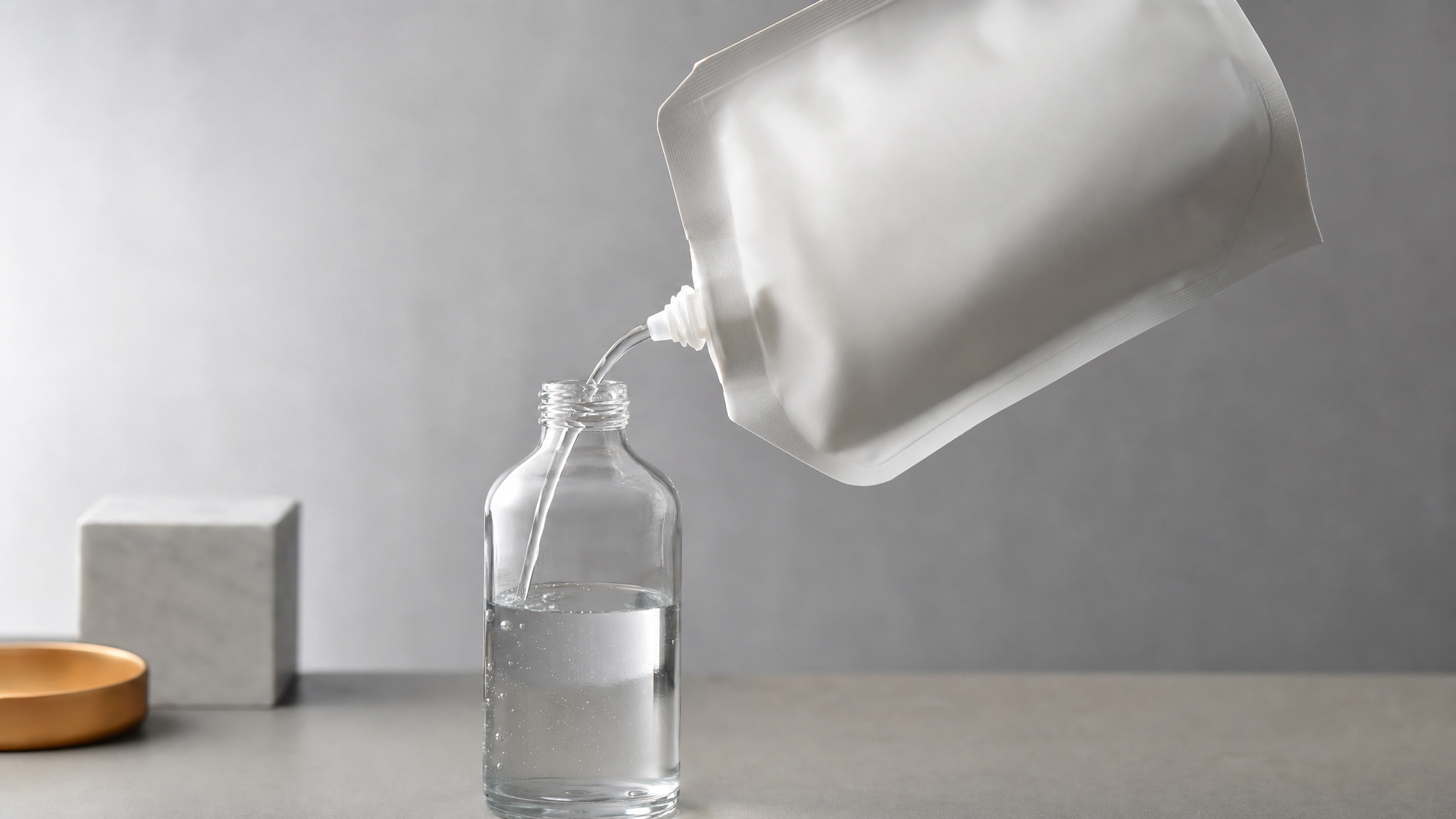
- The pouch is the reservoir. Squeeze a small, flexible pouch and the product loads onto the brush; release and the pack reseals. Small volumes stay fresh because each squeeze exposes only what the brush takes, and the closure blocks air between uses.
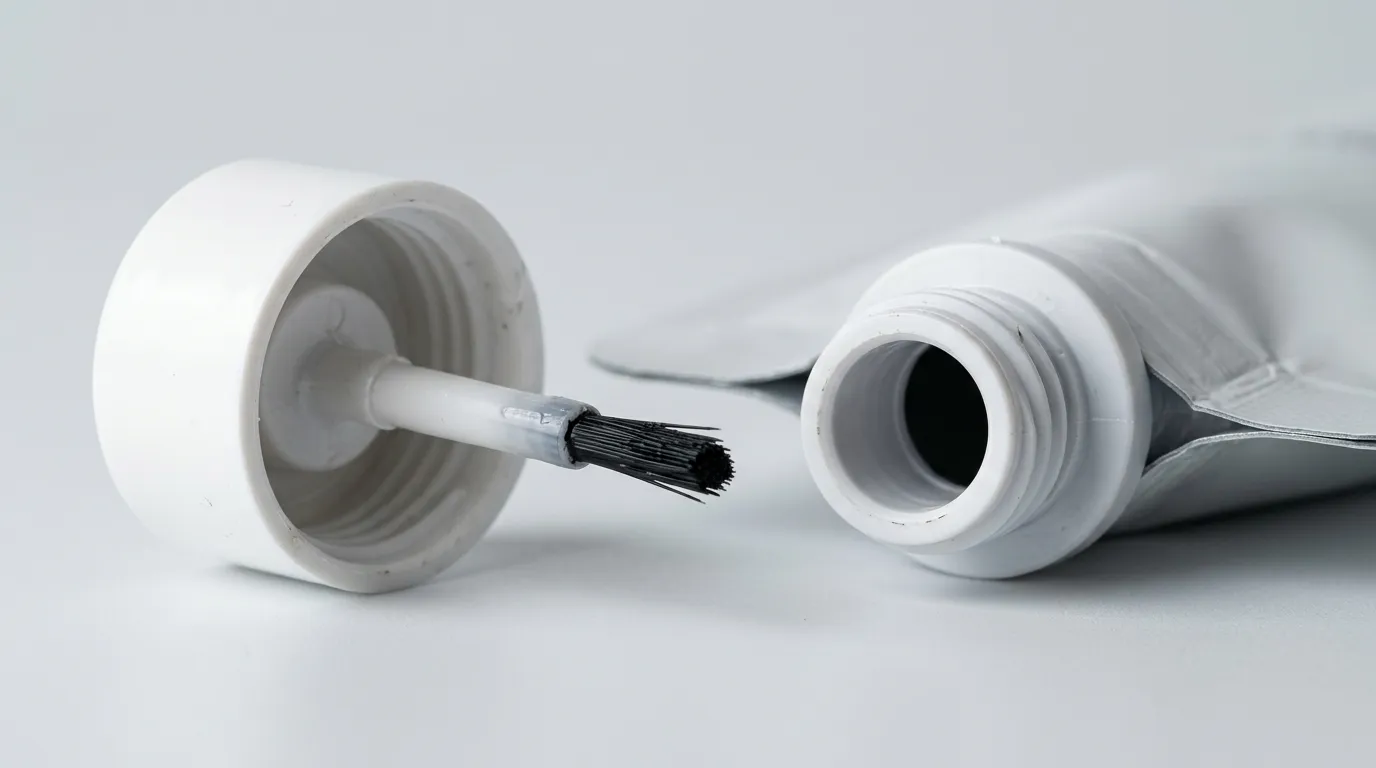
The integrated brush cap: the applicator rod is moulded into the cap you already need for resealing — one component, not two.
The Component It Removes: What Changes in the Bill of Materials
The clearest way to see the value is to write out the component list for a conventional sample format and for an integrated brush cap pouch.
Conventional small sample kit | Integrated brush cap pouch |
|---|---|
Bottle, jar or rigid tube | Stand-up pouch / doypack |
Screw cap or lid | Cap with integrated brush (same part) |
Separate applicator: brush, wand, doe-foot or cotton swab | (not needed) |
Applicator packaging: blister, sleeve or insert holding the tool | (not needed) |
Sometimes an outer carton to hold all of the above | Optional; pouch is self-contained |
The middle two rows are the ones that disappear. For a trial-size product — a lip gloss sample, a mascara tester, a single-use eyeliner dose — the applicator has historically been the awkward part: it must be sourced separately, kept hygienically sealed until use, assembled into or alongside the primary pack, and thrown away after one application. Every one of those steps costs money at the volumes where margins are thinnest.
Removing that component changes the economics in four concrete places:
- Sourcing: one fewer purchased component, one fewer supplier qualification, one fewer SKU to forecast and store.
- Filling and assembly: the pack is filled and sealed as a single unit; there is no separate applicator to insert, blister or attach on the line.
- Hygiene and compliance: the applicator never touches a secondary package, a gloved hand or a warehouse shelf before the consumer — it is sealed inside the cap, in contact only with the product and the closure.
- Waste: a lighter, single-material pack with no tool insert is easier to recycle and lighter to ship, which matters when you are mailing samples or selling travel formats.
None of this claims the brush-in-cap design is right for every product. Thick creams that cannot wet a brush, powder formats that need a sifter, and products whose applicator is part of the brand ritual may all need their conventional packs. The point is narrower and easier to verify: for fluid, brush-applied products in small formats, the integrated brush cap removes a component that was only there because bottles could not carry their own applicator.
Where an Integrated Brush Cap Pouch Earns Its Place: Samples, Travel, Single Doses
The format earns its keep wherever the product is small, portable and expected to be applied on the go. In practice that means three overlapping use cases.
Brand samples and trial sizes. Sampling is the most common reason a cosmetics brand touches pouch packaging at all. A sample run wants the lowest possible cost per unit, a pack that demonstrates the real product experience, and no loose applicator that doubles the packaging budget of a free item. A brush cap pouch delivers the experience — open, apply, reseal — with one part fewer. Because the pack is flexible and lightweight, brands can also send more units for the same shipping weight, which is not a trivial detail when samples travel in international mailers.
Travel and on-the-go formats. Liquid lipstick, lip gloss, eyeliner and lash serum in rigid bottles are bulky relative to the dose they hold, and air enters the bottle every time it opens. A small pouch collapses as it empties, so the product is not gulping air, and the closure keeps the brush sealed between uses. For airport-friendly, pocket-sized formats this is a genuine functional argument, not a cost argument.
Single-dose and hygiene-sensitive applications. Mascara and eyeliner have the shortest shelf-life complaints of any category: users are advised to replace them every few months because each use re-introduces air and bacteria to the full reservoir. A single-serve or short-life pouch doses out a small amount at a time, so the bulk of the product is never exposed. It is the same logic that drives single-use packaging across beauty — smaller exposure per use, fresher product for longer.
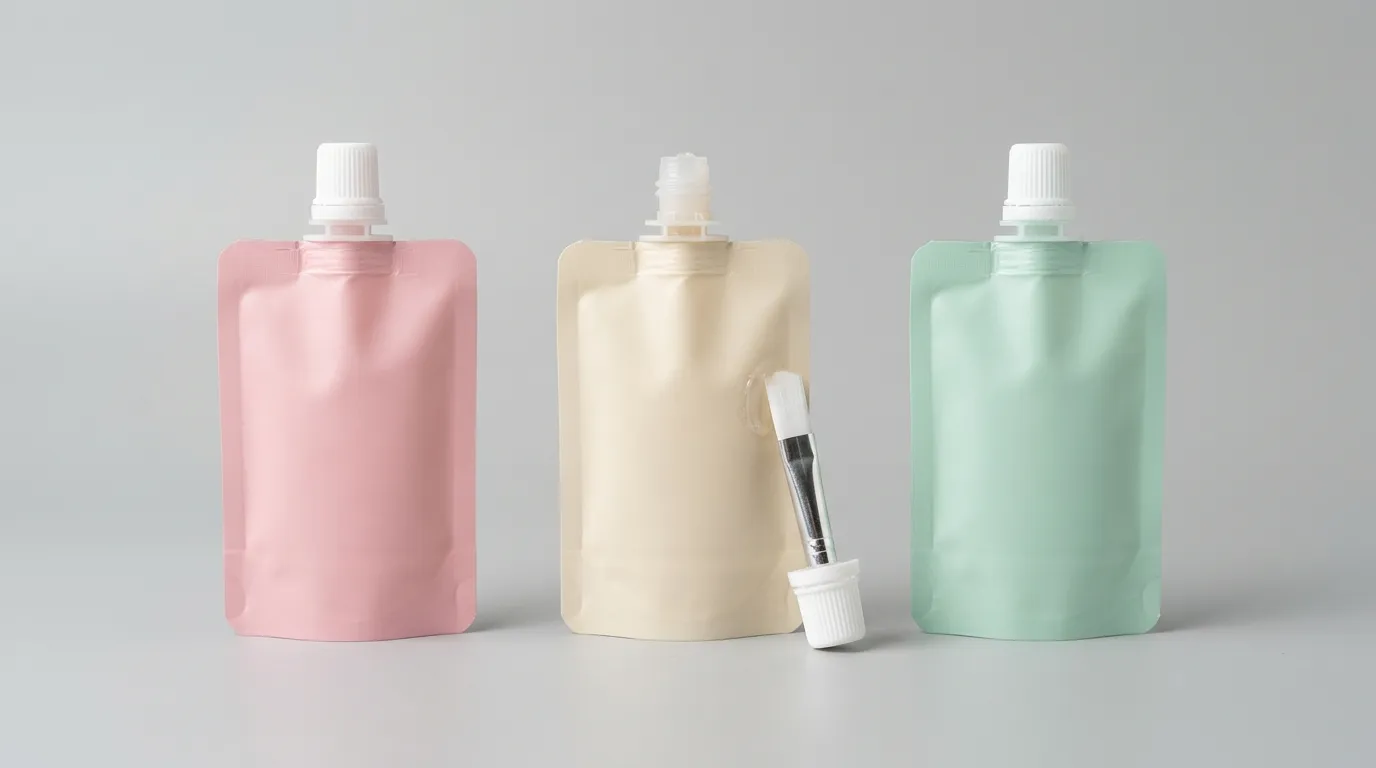
Sample and travel formats are where the brush-in-cap pouch earns its place: self-contained, lightweight and resealable.
A secondary benefit is brand-side flexibility. Small pouches print well, take custom colors and short runs, and let a brand test a new shade or a new market without commissioning a rigid-bottle mold. That makes the format a natural first step before a full launch — which is why the lightest, most portable version of the argument (sample first, validate, then scale) belongs in the same evaluation as the closure itself.
How to Evaluate a Brush Cap Pouch for Your Sample Program
The integrated cap solves the applicator problem, but it does not excuse you from the standard spout-pouch checks. Work through these five steps before you commit to a supplier and a mold.
Step 1 — Match the bore to the product and the dose
The bore is the inner diameter of the spout, and it sets how fast product flows back and forth between pouch and brush. The cosmetic brush spout type is currently produced at a 7 mm bore, and other bores can be tooled to order. For a lip gloss or mascara sample, 7 mm is a proven starting point because the dose per use is small and the brush rod needs to pass through the neck cleanly. The full reasoning behind bore choice — why thin liquids take small bores, why viscosity changes everything — is in the guide to spout cap diameter selection, and the end-to-end decision order is covered in How to Choose a Spout Cap for Your Pouch. Run your own formula through both before locking a size.
Step 2 — Confirm the brush geometry against the product
Not all brush-applied cosmetics behave alike. A mascara brush needs a certain bristle stiffness to separate lashes; a lip gloss applicator is usually a softer, shorter brush or doe-foot; an eyeliner brush wants a fine, firm tip. The cap-and-rod assemblies in the cosmetic brush spout series are built for these fluid, brush-applied products — the lip gloss and mascara models use a cap-and-pipe assembly around 14 × 66.5 mm, which determines whether the brush reaches the product in your chosen pouch depth. Ask the supplier for the dimensional drawing and check the brush reach against your filled pouch, not against a catalog photo.
Step 3 — Check the sealing window against your pouch film
This is the step that catches most first-time pouch buyers. The spout must weld to your film at a temperature the film can survive, and the two sides of that bargain are the film structure and the spout's sealing behavior. Standard spouts weld in a conventional range, but if your pouch is a mono-material PE or heat-sensitive structure, you want a low-temperature-welding variant: the eyeliner model in the brush series (RD-088) is rated for welding at 125–130 °C, which keeps the seal intact without scorching sensitive film.
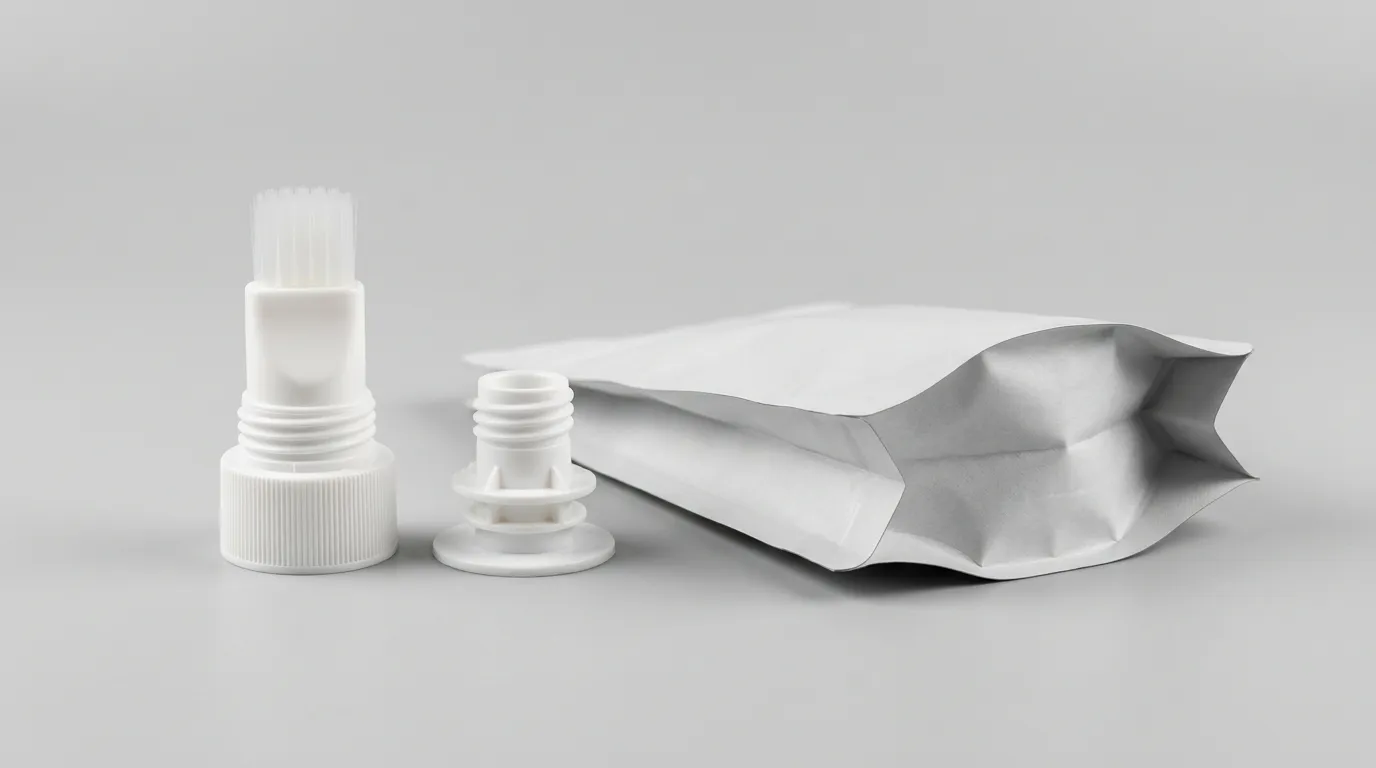
Low-temperature sealing is the fitment check that decides whether a brush cap pouch survives the weld onto heat-sensitive film.
The mechanics of why the sealing window matters — and how to test it — are in the spout cap sealing temperature guide. If you are new to the whole sealing question, start there before you pay for samples.
Step 4 — Verify the cap seals, reseals and survives the journey
A sample pack will be opened, closed, dropped in a handbag, and opened again. The closure needs a positive seal when torqued down, a clean reseal after use, and no leakage through the spout-to-film weld under transport pressure. On the cap side, the screw thread and the brush rod share one moulded part, so there is no separate gasket to lose; on the pouch side, the weld quality is the variable — which is exactly why filled-sample testing matters more than any spec sheet.
Step 5 — Run filled samples through your real conditions
No table in this article can approve a closure for your product. Fill sample pouches with your actual formula, seal them on the line or with the supplier's equipment, and test: leak under pressure and inversion, brush wetting and dose per squeeze, reseal after repeated openings, and stability over your expected sample shelf life. The supplier should be willing to run this loop with you — sample, test, adjust — before you commit to tooling or volume.
Materials and Compliance for Cosmetic Contact
Because the brush sits in the product and the cap touches the lips or eye area, material safety is the question buyers ask second, right after "will it leak." The honest regulatory picture has two layers.
Cosmetics regulation is not food regulation. In the United States, cosmetics are not subject to FDA pre-market approval; the agency regulates them under the Federal Food, Drug, and Cosmetic Act, and a product (including its packaging) must not be adulterated or misbranded. In the European Union, cosmetic products fall under Regulation (EC) No 1223/2009, whose safety assessment covers the finished product in its packaging. Neither regime "certifies" a closure the way food-contact rules do.
That is why food-contact certification is the benchmark brands ask for. When a closure touches lips, eye area or skin, many cosmetics brands specify food-contact-grade materials anyway, because food-contact rules are the strictest widely available standard for plastics that touch the body. Ruihua's spout caps and caps-with-brush are moulded from food-grade PP and PE and carry ISO 9001, HACCP, US FDA and EU 1935/2004 (TÜV SÜD) certifications — the same documentation stack used for food pouches, which is precisely what makes it a credible benchmark for cosmetic contact. What the food-grade spout cap certification article explains for food applies here with one difference: for cosmetics you are choosing a stricter-than-required benchmark, so the documents you request are the same but the legal stakes are lower. Ask the supplier to name the resin grade, the certification body and the standard numbers in writing, and keep those documents with your product safety file.
From Sample Pouch to Shelf: The Path from Prototype to Production
If the evaluation above comes back clean, the path to production is short because the architecture is simple: one moulded fitment, one film pouch, one filling step.
- Request samples of the brush cap series and run Step 5 testing with your formula. The four standard models in the cosmetic brush spout type — RD-084 (lip gloss), RD-085 (eyelash/mascara brush), RD-088 (eyeliner, low-temperature weld) and RD-101 (liquid lipstick) — share the brush-in-cap architecture at the standard 7 mm bore, which keeps first sampling cheap and comparable:
Model | Typical format | Bore | Cap assembly |
|---|---|---|---|
RD-084 | Lip gloss | 7 mm | Cap with pipe ≈ 14 × 66.5 mm |
RD-085 | Eyelash / mascara brush | 7 mm | Cap with pipe ≈ 14 × 66.5 mm |
RD-088 | Eyeliner (welds at 125–130 °C) | 7 mm | Cap with pipe ≈ 14 × 66.5 mm |
RD-101 | Liquid lipstick | 7 mm | Cap with pipe ≈ φ13.9 × 66.3 mm |
Sample requests go through the quote and sample page with your film structure and fill details.
- Lock the specification sheet: bore, cap-and-rod dimensions, sealing temperature, resin grade, color. If you are standardizing your own internal spec, the spout cap specification sheet article walks through exactly which fields to fill.
- Confirm customization needs early. Custom colors are routine; a custom brush type, a different bore, or a brand-specific cap shape means a dedicated mold, which changes lead time and minimum quantities. Decide in the sample round, not after tooling starts.
- Validate the first production run with the same leak, reseal and wetting tests you ran on samples — batch one is the only place where a surprise is cheap.
The supplier side of this loop matters as much as the closure itself. A spout-cap specialist with in-house mold capability (Ruihua has run its own mold shop since 1999 and holds 38 patents) can iterate the rod length, the bore or the sealing profile in weeks rather than quarters — which is the real difference between a sample program that ships this season and one that ships next year.
FAQ: Cosmetic Brush Cap Pouches
What products suit a cosmetic brush cap pouch? Fluid, brush-applied cosmetics — lip gloss, liquid lipstick, mascara, eyeliner, lash or brow serum — in sample, travel or single-serve sizes. Thick creams, powders and products with a defined applicator ritual generally need conventional packaging.
Is the brush a separate piece inside the cap? No — that is the point of the format. The brush rod is moulded as part of the cap assembly, so there is no loose applicator to source, assemble or lose. The cap, spout and brush work as one component.
Does food-grade certification matter for cosmetics? Food-contact certification (FDA, EU 1935/2004) is not legally required for cosmetics packaging, but brands commonly specify food-grade materials as the strictest benchmark for closures that touch lips and eyes. It gives you a defensible material-safety position without inventing a cosmetics-specific "certification" that does not exist.
Can I get custom colors and custom brush types? Custom colors are standard. Custom brush geometry, bores beyond the standard 7 mm and bespoke cap shapes are possible via dedicated tooling — plan for longer lead times and higher minimums, and settle them during the sample round.
Are brush cap pouches refillable or single use? Both exist. The format is most common for small, resealable sample and travel packs; because the pouch collapses as it empties and the cap reseals, repeated use over a short life is normal. Single-serve sizes are a variant of the same architecture.