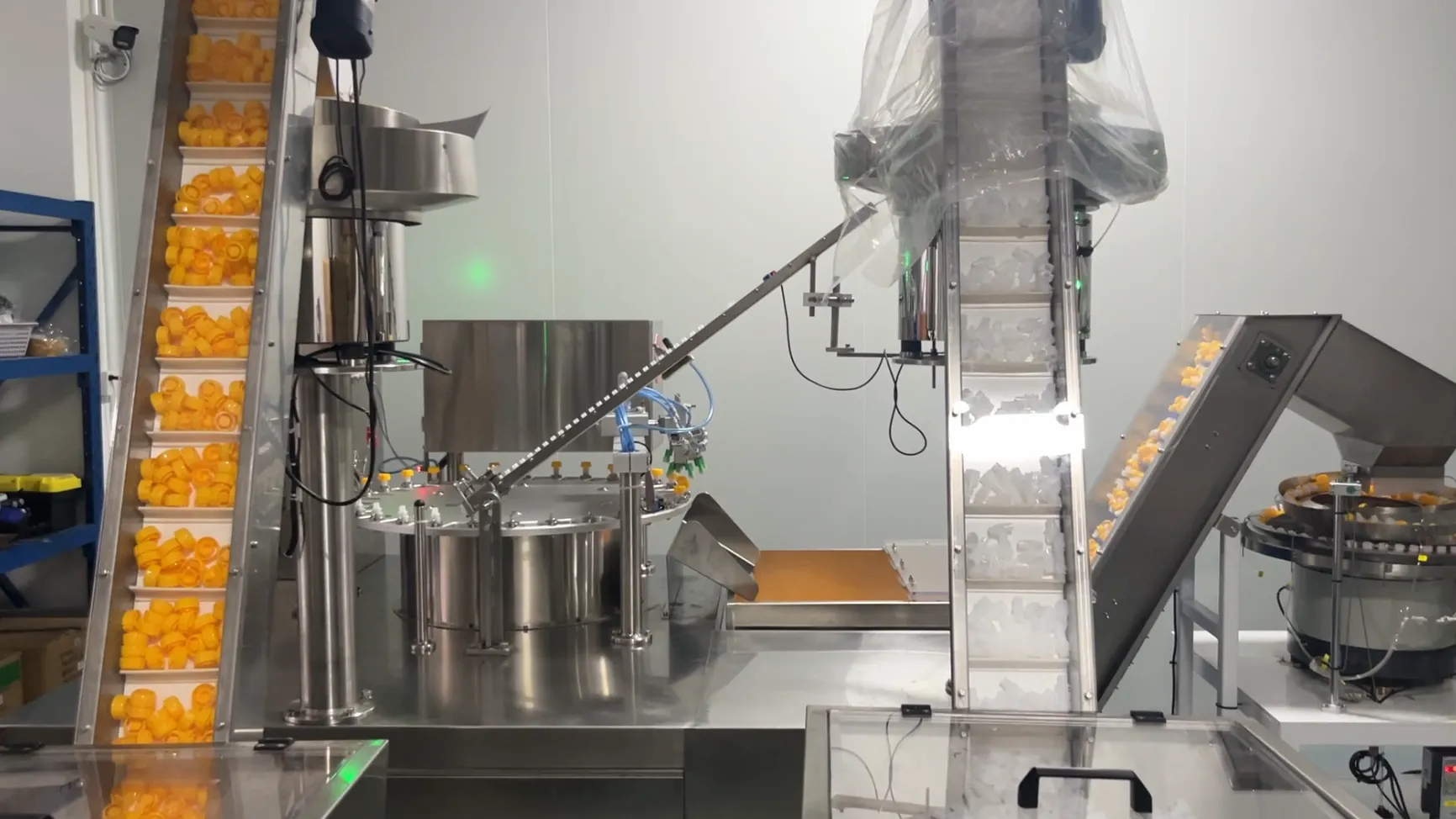

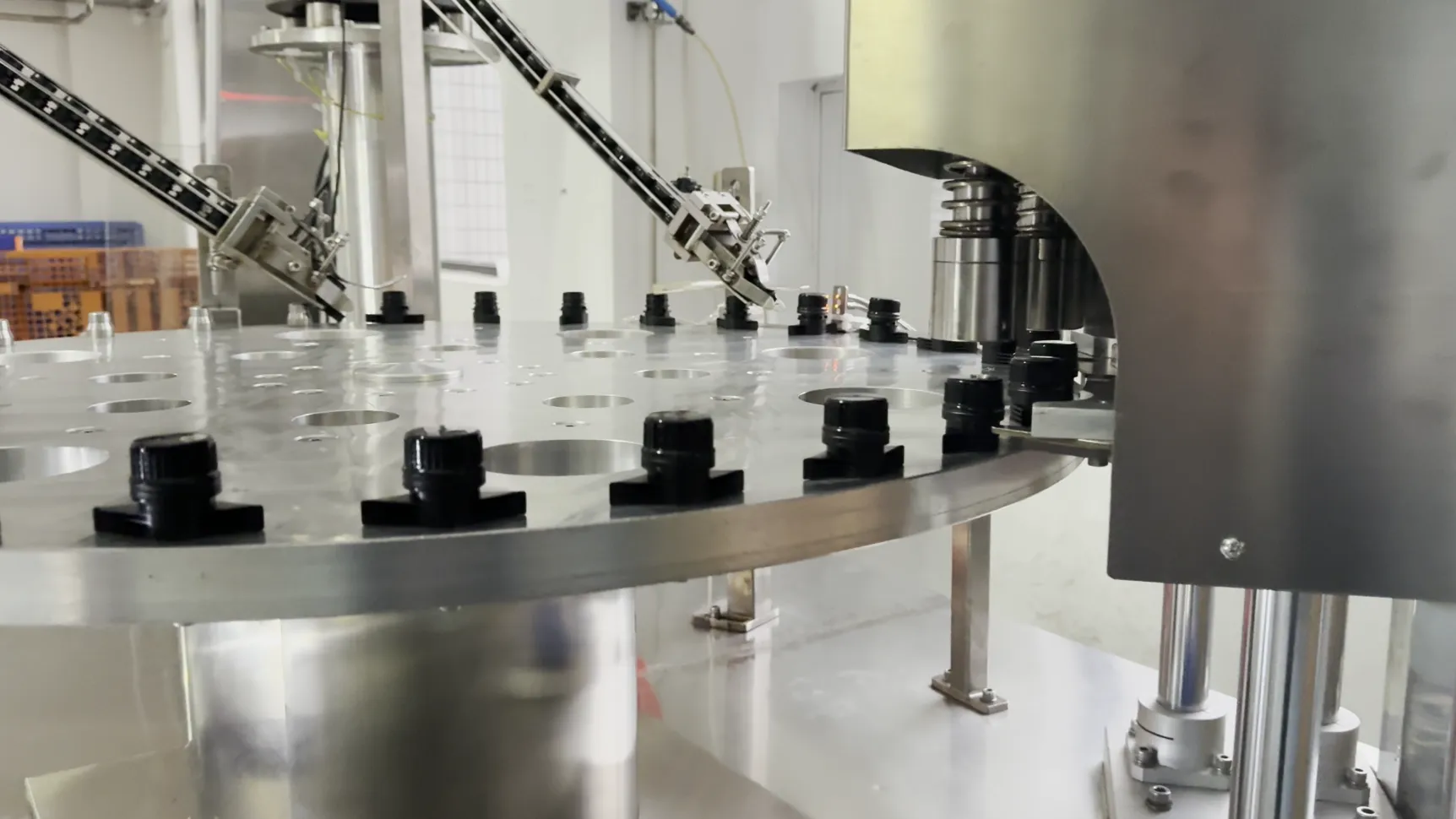
A spout rail is the quietest part of a spouted-pouch line. It holds each stand-up pouch by its spout neck and carries it through loading, opening, filling and capping. When it is right, nobody thinks about it. When it is wrong, the trouble surfaces two stations away: pouches that jam at the loader, a filling nozzle that misses the opening, caps that sit crooked, a line that only runs clean at half speed.
Spout rail compatibility is not a catalogue match. A rail is not a stock part you pick by diameter and length, the way you might pick a cap. It has to fit three things at once — the spout neck that rides in it, the pouch that hangs from it, and the machine it is bolted to — and a rail that misses any one of them is scrap, however good the other two are. This article is the checklist to bring to the first enquiry: what to confirm, in what order, and what to write down before you place the order.
Two clarifications before we start, because the words collide. On this site a spout cap always means the closure of a stand-up pouch or doypack fitment — never a gas-can replacement cap, and never the drip-rail spout that channels rainwater off an RV. A spout rail belongs to the same family as the cap: it is a component of a pouch filling line, and it only makes sense next to the pouch it carries. If you are still choosing the closure itself, the Choosing & Running Spout Caps hub is where the rest of this cluster lives.
What a spout rail actually does on the line
A spout rail — also called a guiding rail or a loading trail — is a plastic or stainless-steel profile with a slot that captures the neck of a spouted pouch. Pouches are loaded onto it by hand or by an automatic loader, the neck slides along the track, and the rail presents each pouch in a fixed position to the filling and capping stations. On a premade-pouch line the rail, not the operator, keeps the spout square to the nozzle.
That single job — hold and index the pouch by its spout — is why the rail is chosen late. By the time the pouch and the machine are fixed, everyone assumes the geometry is settled, and the bridge between them is the part most often ordered wrong.
The three fits that decide spout rail compatibility
Every spout rail enquiry is three fits dressed up as one part. Work them in order, because the first two set dimensions the third must accommodate.
Fit | What it decides | Who usually owns it | What you must confirm |
|---|---|---|---|
1. Spout neck → rail channel | Whether the pouch can ride the rail at all: the gap and profile that capture the neck | The rail supplier, from your spout drawing | Neck outer diameter, the feature the rail actually carries, neck length, any orientation feature, and the tolerance over a production run |
2. Pouch → loading trail | How the pouch hangs and is indexed: pitch along the rail and orientation at each station | Packaging engineer / pouch supplier | Pouch format and flat dimensions, gusset, top-seam position, spout centreline, spout position (centre or corner), spout pitch |
3. Rail → machine | Whether the rail is even the right shape for the loader: length, lanes, track and mounting | Line engineer, with the machine builder | Machine make and model, loading method (manual U-slot pre-load or automatic loader), number of lanes, existing rail length, mounting interface |
If a supplier quotes you a rail from a diameter alone, that is fit 1 of 3 — the other two are still open, and they cause the jams.
A quick test before you order. Can you name the spout neck outer diameter, the pouch pitch and the machine model without looking them up? If any one of the three needs a call to somebody else, that is the row that will delay the order.
Fit 1 — the spout neck to the rail channel
This is the fit that carries the whole design, and the one most often specified from the wrong number.
A rail holds a pouch by its spout neck, so the dimension that matters is the outer diameter of the neck where the rail grips it — not the bore. An "8.6 mm spout" tells you the inner opening the product flows through; it says almost nothing about the outside of the neck, the collar or rib the channel rides on, or how tall that feature is. Two fitments with the same bore can present completely different necks to the same channel.
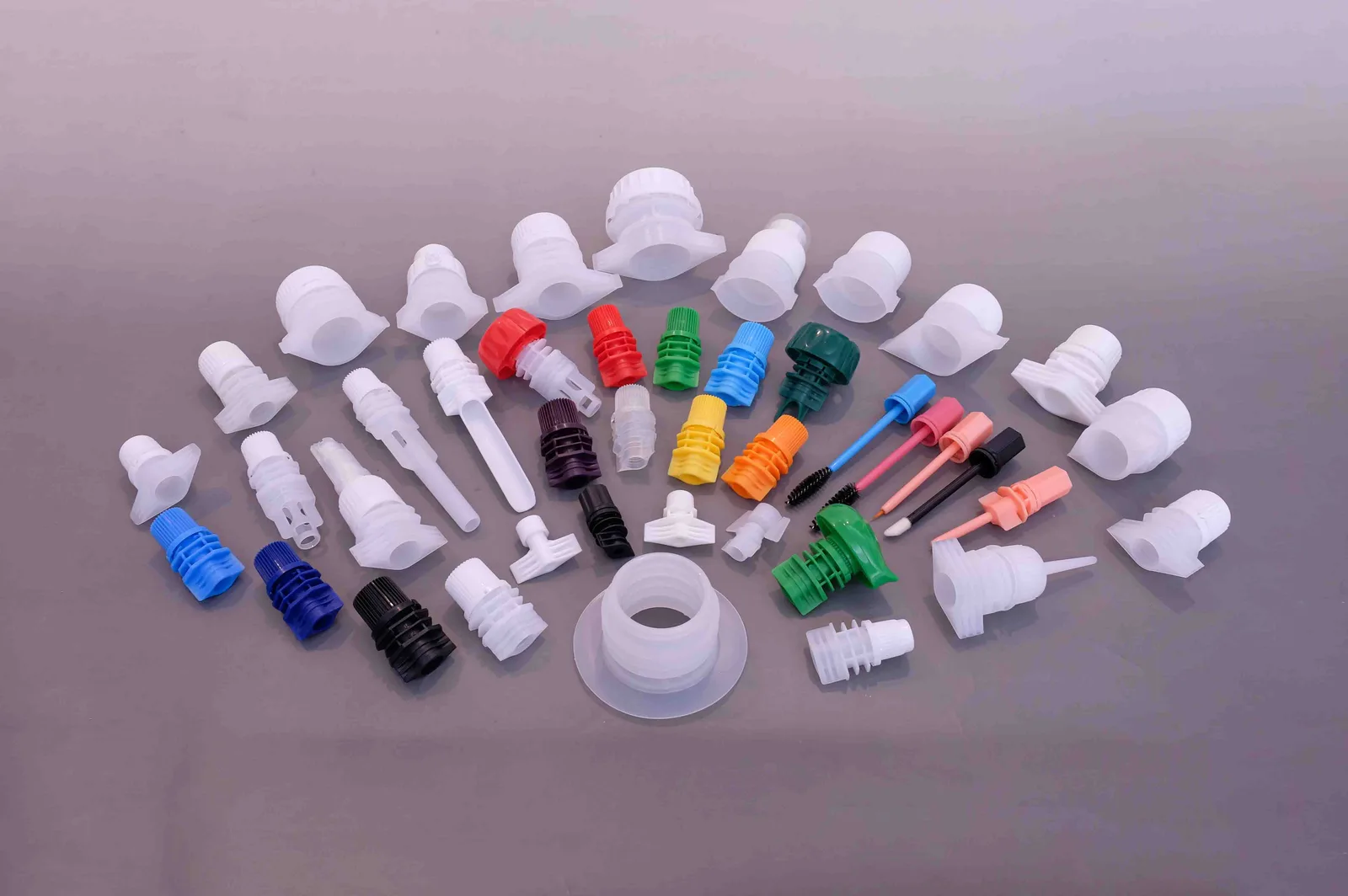
The consequence of getting it wrong is mechanical, and both directions bite. If the channel gap is smaller than the neck it has to pass, pouches jam, the loader alarms and the line stops. If the gap is wider than the neck, the pouch wobbles as it travels, the filling needle no longer lines up with the opening, and you get splashing and rejects instead of a clean fill. That trade-off is not theoretical — it is exactly how automated filling lines describe rail compatibility: an outer diameter that is too large jams the line, and one that is too small makes the pouch wobble out of alignment (Stanley Package, on rail and gripper compatibility).
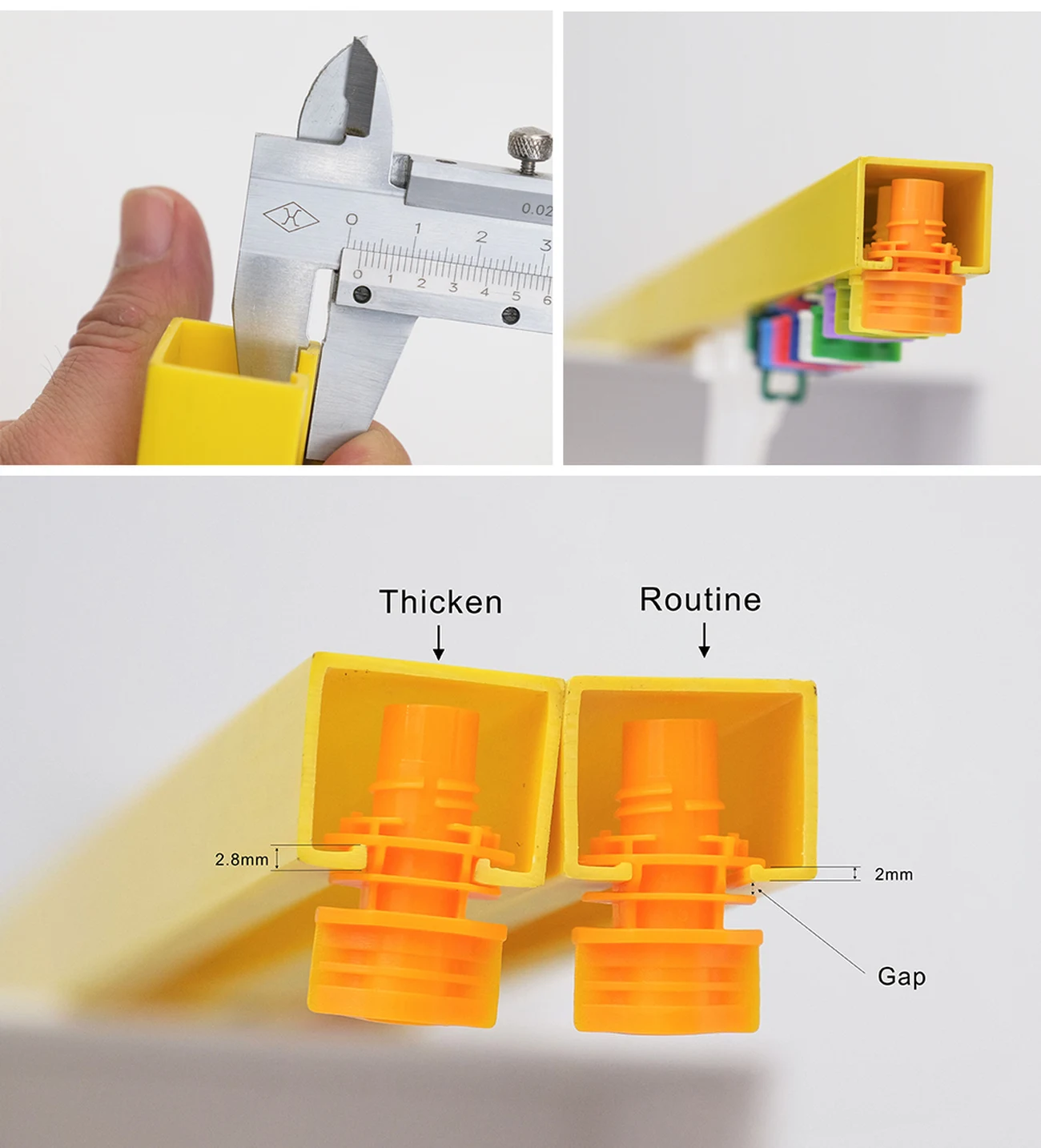
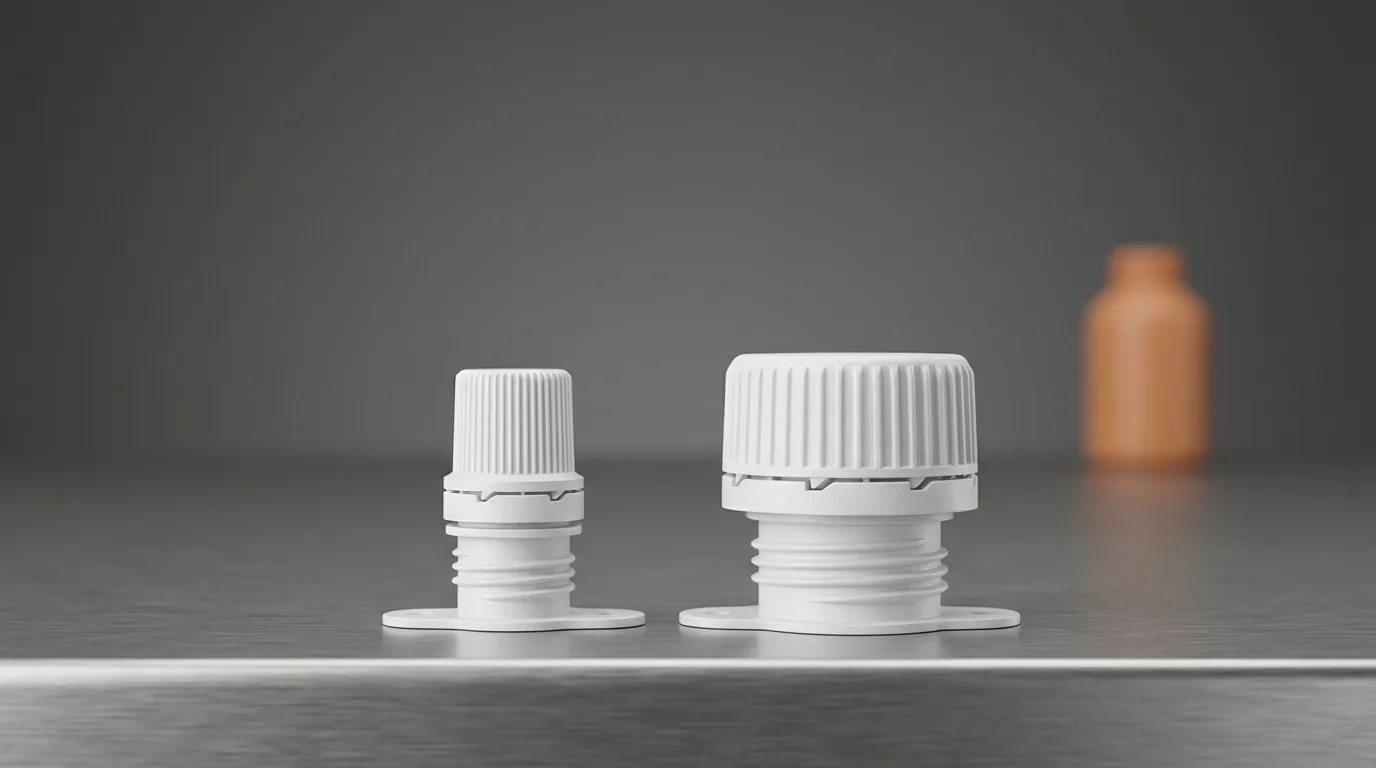
The photo above shows the same profile in two wall thicknesses; the difference between them is the gap the neck sits in — measured in fractions of a millimetre, not in the length of the extrusion. That is the point to carry into an enquiry: a rail is specified by its channel geometry, and length is the last thing anyone should quote.
Four things belong on the spout drawing before you ask for a rail:
- Neck outer diameter at the section the rail grips, with its tolerance — not the nominal bore.
- The feature the rail carries on: a collar, a rib under the cap, or the body of the neck itself. Say which, because a rail cut for one is not cut for another.
- Neck length and the position of that feature relative to the flange, so the pouch hangs at the height the machine expects.
- Any orientation feature — a lug, a seam, a flat — if the line keys on it to clock the pouch. Then it is a controlled dimension, not decoration.
Two more numbers belong on the drawing even if the rail supplier does not ask: the inner diameter, which constrains the filling nozzle, and the repeatability of all of the above from part to part. A well-run fitment family holds its bore to a stated tolerance; the neck geometry is a separate stack-up, and it is the one the rail lives on. Pinning the whole interface down is the exercise behind a spout cap specification sheet — the rail simply reads the row for the neck.
Fit 2 — the pouch and the loading trail
The rail does not carry a bare spout; it carries a pouch hanging off one. That changes the question from "what diameter" to "what spacing and which way round".
Pitch is the centre-to-centre distance between adjacent spouts as they sit on the rail. It is set by the pouch, not the rail: a wider pouch pushes the spouts further apart, and a given rail length holds fewer of them. Order a rail by length without stating the pitch and you get a track sized for somebody's pouch, not yours.
The pouch drawing is where this gets fixed, and it has to be a drawing, not an artwork proof. Before a rail is quoted, the pouch specification should identify overall width and height, gusset dimensions, seal widths, the spout centreline location, the fitment orientation, and the tolerances on each — because a small shift in spout position is exactly what decides whether a pouch clears a guide rail or catches on it (Spout Pouch OEM, filling-machine compatibility guide).
Two pouch choices move the rail more than any other:
- Spout position. A top-spout pouch is presented from the top edge; a corner-spout pouch has to be located and held off-centre, and the rail cut so the pouch hangs square to the station rather than swinging on the neck.
- Gusset and film stiffness. A stiff laminate and a deep gusset change how the pouch sits when its neck is captured, which feeds back into how much clearance the track needs.
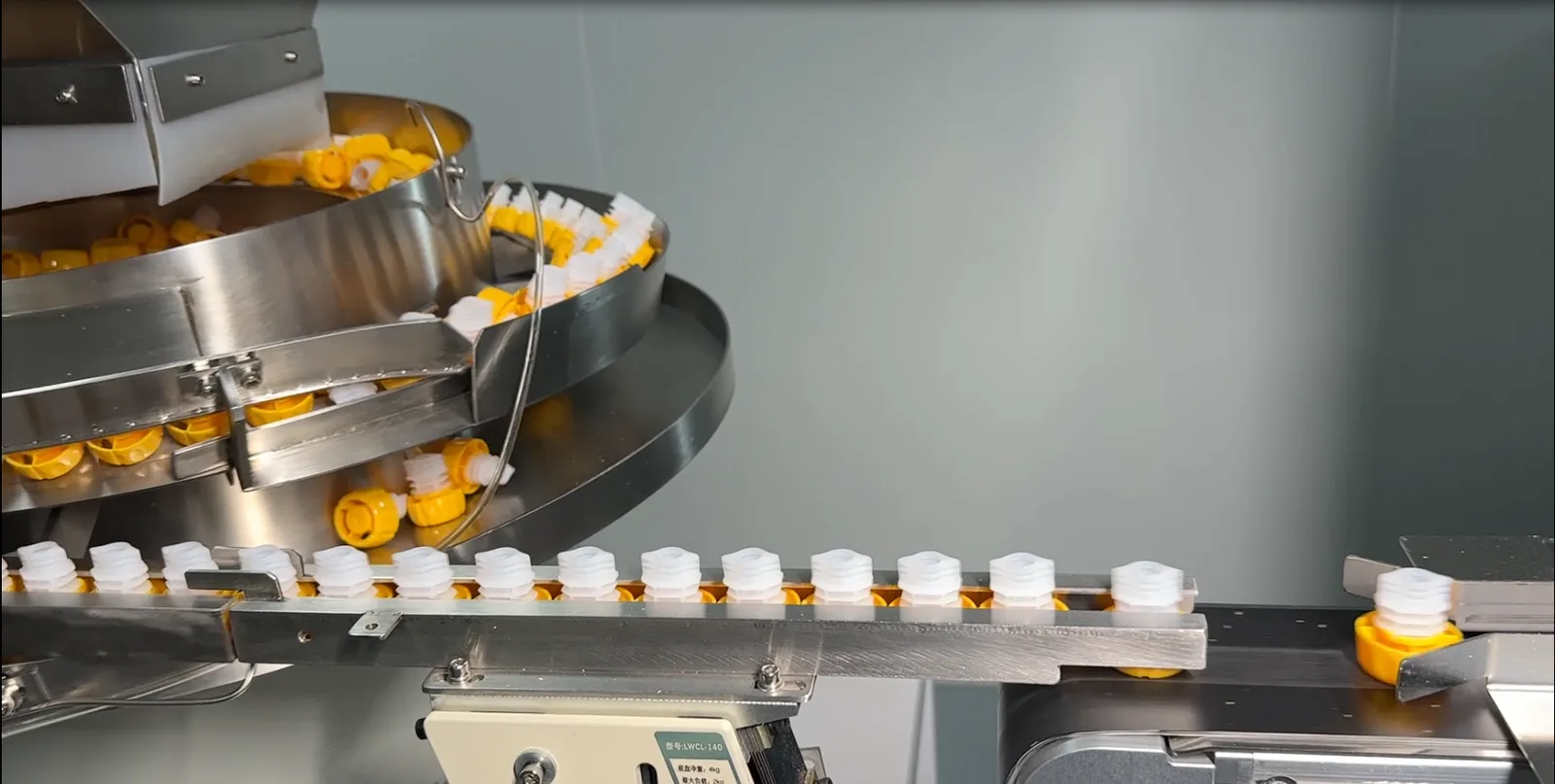
On a premade-pouch line the empty pouches are commonly pre-loaded into the track by a U-slot, with the neck sliding into the channel before the pouch reaches the first station — done by hand, by the pouch maker before shipping, or by an automatic loader (Fenbo Packaging, pre-loading the loading trail). Tell the rail supplier which of the three you intend, because a U-slot cut for hand-loading and one cut for an automatic loader are not the same profile.
If your plant runs more than one pouch format on the same line, the pitch question becomes a changeover question, and the rail is only one of the parts that moves — worked through in our article on changing a spouted-pouch line over between sizes.
Fit 3 — the rail to your machine
A rail is not a universal part that clamps onto any line. It is shaped for one loading method on one machine family, so the third fit is a list of facts about your equipment — have them down before anyone quotes.
Start with make and model. Machine builders differ in how a premade-pouch filler handles the pouch — through its top web, side edges, gusset, fitment neck or a locating feature — and each method implies a different rail and carrier arrangement. A spouted-pouch filler presents and fills pouches at indexed stations; an in-line machine lays the same envelope out differently, and the two do not share a rail profile just because both are "spout pouch machines".
Then record the handling detail — it decides the slot:
- Loading method — manual pre-load, pouch-maker pre-load, or automatic loader (the same three from fit 2, now from the machine side).
- Number of lanes and the rail length the machine currently takes. A two-lane line needs two matched rails, and a replacement has to match the existing length even if a "better" length exists.
- The track and mounting interface — how the rail is held, clamped or bolted, and whether it is the machine's own loading trail or a separate feed track feeding into it.
- The pouch path after loading — opening, filling, capping, discharge — so the rail is cut to survive every station, not just the loader.
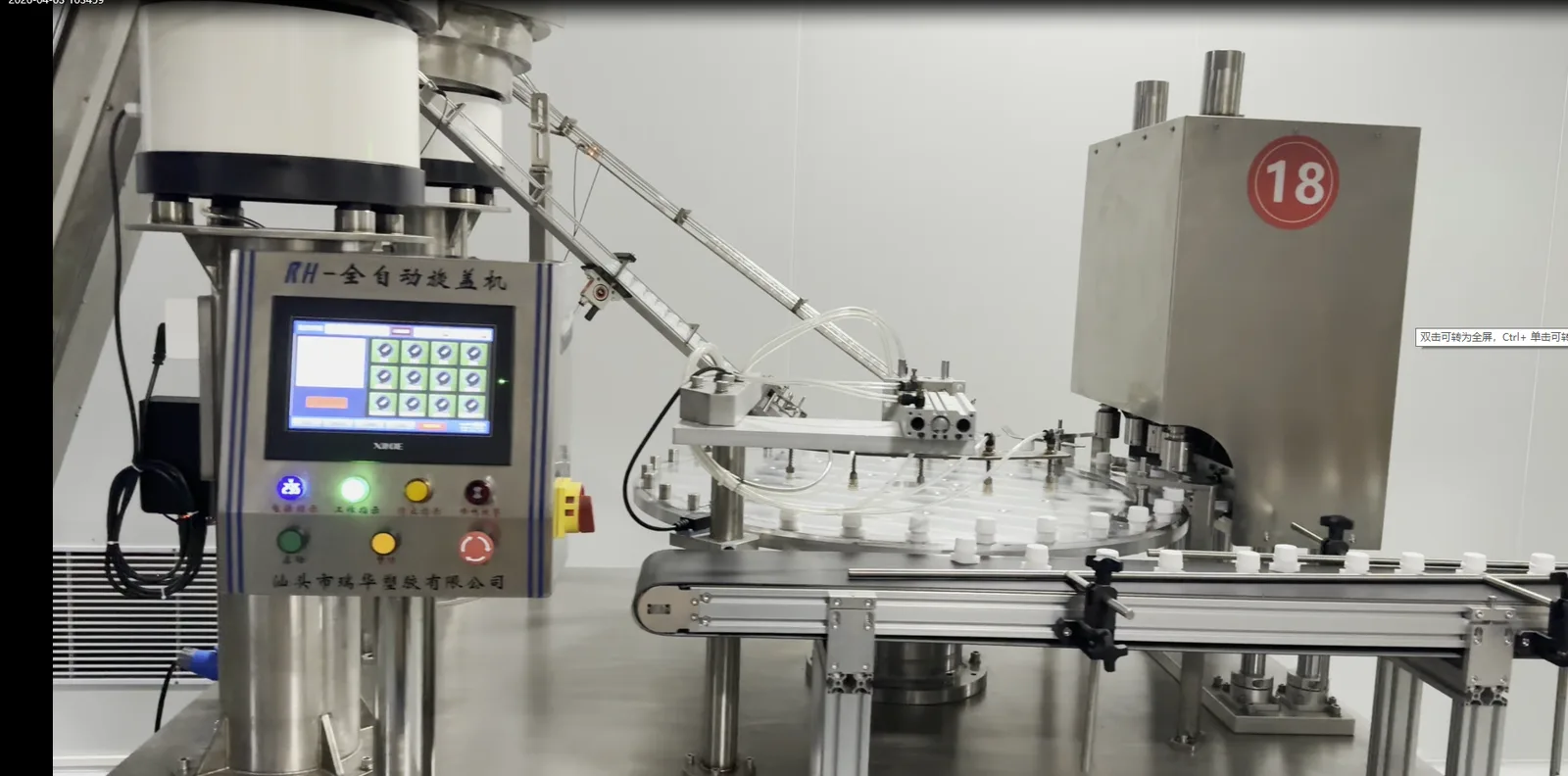
Get one of these wrong and the failure is not always obvious: a rail slightly off radially still lets pouches through, and the symptom shows up later as cross-threaded caps or a seal that closes narrow — the same drift our line-alignment article traces back to the presentation link. If you are also re-checking whether a new spout runs on the machine at all, the five-interface match is covered in whether a spout runs on your existing sealing machine.
Material, finish and wear
Spout rails are moulded in a rigid plastic — PVC and PC among them — or made in stainless steel for heavier or washdown duties. What matters first is the material's food-contact story.
- Is it food-contact rated for your product and process? A rail rides outside the pack, but it sits above open pouches, so if your line washes down or runs hot, confirm the material is rated for it rather than assuming. Our rails are food-grade PP/PE, with ISO 9001, HACCP, FDA and EU 1935/2004 (TÜV SÜD) documentation.
- Is it dimensionally stable over a long run? A rail's whole job is to hold a gap; a profile that creeps or swells changes that gap. "Durable, dimensionally stable" is a claim worth asking a supplier to support, not just assert.
- How does it wear? Every cycle passes the same neck over the same channel, and a worn channel is a wider channel — the wobble failure from fit 1, arriving slowly instead of at the loader. Replacement rails belong in your wear-parts list, not your one-time purchases.
That documentation should travel with the component, as it does for the spout cap itself. If your product is regulated, our overview of food-grade spout caps sets out the certificates to ask for.
The pre-order confirmation checklist
This is the sheet to fill in before you send an enquiry. Every row is something a rail supplier cannot guess for you — and something that, left blank, comes back as a question or a rail that does not fit.
# | Confirm | Write down | Why it blocks the order |
|---|---|---|---|
1 | Spout neck (outer) | Neck OD at the gripped section, tolerance, the feature the rail rides on, neck length | Sets the channel gap — the difference between jam and wobble |
2 | Spout opening | Inner diameter and usable filling opening | Must clear the filling nozzle and cap application |
3 | Orientation feature | Any lug, seam or flat the line keys on, and its angular position | Becomes a controlled dimension if the line clocks the pouch |
4 | Pouch format | Stand-up / doypack, flat width and height, gusset depth, film structure | Fixes how the pouch hangs and how much clearance the track needs |
5 | Spout position | Centre or corner, and its location on the pouch face | Corner spouts need a rail cut to hold the pouch square, off-centre |
6 | Pitch | Centre-to-centre spout spacing along the rail | Sets how many pouches a rail holds and the track's spacing |
7 | Top seam & seal width | Position and width on the pouch drawing | Determines where the pouch presents to the loader |
8 | Machine | Make, model, loading method, number of lanes, existing rail length | The rail is shaped for one handling method, not any machine |
9 | Track & mounting | How the rail is clamped, bolted or held; separate feeder or on-machine trail | A fitted replacement has to match the existing interface |
10 | Duty | Product, washdown, temperature, target output | Filters material and finish choices |
11 | Volume & spares | Order quantity, plus replacement rails as wear parts | Prevents a worn channel from becoming an unplanned stop |
12 | Documentation | Material / food-contact declarations you need with the shipment | Regulated products need the paperwork to travel with the part |
Send that sheet with your pouch and spout drawings, and a supplier can answer against real geometry instead of guessing. The blank rows are the whole value: an enquiry with fits 1–3 filled in is quoted in one round, and one missing the pitch or the machine model is a week of email.
Frequently asked questions
Can I just order a rail by spout diameter and length? No — that covers fit 1 of 3. Diameter and length say nothing about the pouch pitch the rail indexes to or the loading method it must accept, and those are the usual causes of a rail that arrives and does not run. Bring the neck OD as well as the bore, the pouch pitch, and the machine model.
Is a spout rail the same as a cap feeder? Different parts of the same line. A cap feeder (often a vibratory bowl) orients and delivers closures to the capping station; a spout rail holds and indexes the pouches. The two are confused because both are "feed" systems, but a change to one does not fix the other.
Do I need a new rail when I change pouch size? Often yes, and almost always when the spout pitch changes, because the track spacing is set by the pouch. A rail can be re-used if the new pouch keeps the same pitch and neck geometry — but that has to be checked against both drawings, not assumed from the spout diameter.
Will a rail from one machine fit another? Not as a rule. A rail is cut for a specific handling method and mounting, so a rail that runs clean on one make of premade-pouch filler is not a drop-in for a different make. This is why fit 3 exists — the machine facts are part of the rail's specification, not an afterthought.
What makes a pouch wobble on the rail? A channel wider than the neck it holds — usually a rail cut loose or worn. Both end the same way: the pouch arrives off-centre, the nozzle misses, and rejects climb. Measure the channel and the neck before you blame the filling station.
Ordering a rail that fits the first time
A spout rail is a three-fit component sold as if it were a one-number part, and that gap is where most of the waste lives. Confirm the neck before the bore, the pouch before the length, and the machine before the price; fill in the three fits and the checklist becomes a one-page enquiry that any supplier can quote.
If you are working a rail or fitment question now, send us the drawing you have and the three fits you can already name. At Ruihua we make spout rails as well as spout caps, tailored to your spout diameter, pouch pitch and machine, so we will tell you which of the three is still open — and what to measure — before you commit to a mould or a shipment. Request samples or a quote and we will answer against your pouch format.